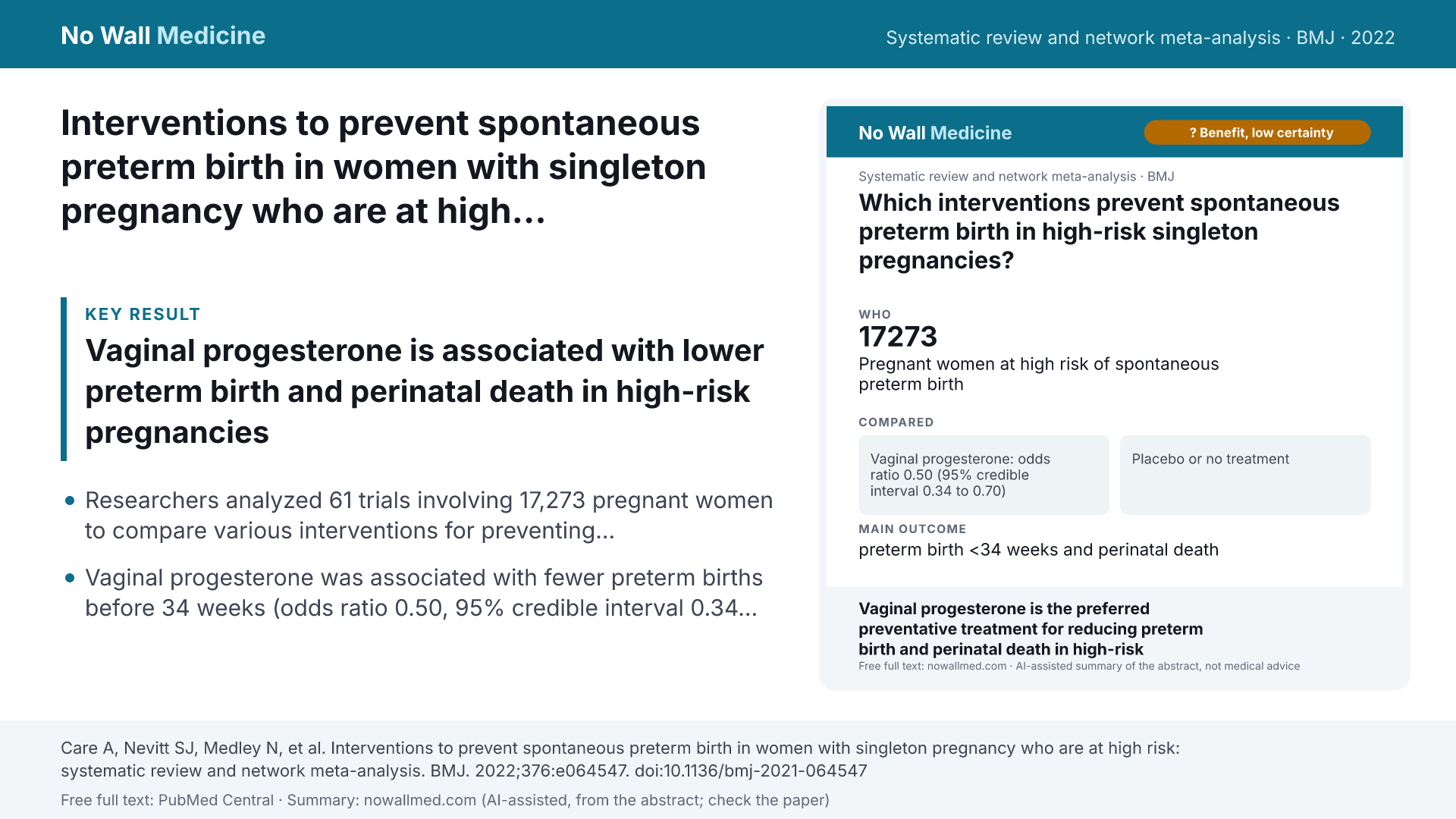
Vaginal progesterone is associated with lower preterm birth and perinatal death in high-risk pregnancies
Interventions to prevent spontaneous preterm birth in women with singleton pregnancy who are at high risk: systematic review and network meta-analysis
Obstetrics & GynecologyAdult and pediatric
Systematic review and network meta-analysisBenefit found
Which interventions prevent spontaneous preterm birth in high-risk singleton pregnancies?
Who
17273
Pregnant women at high risk of spontaneous preterm birth
Compared
Vaginal progesterone: odds ratio 0.50 (95% credible interval 0.34 to 0.70)
Placebo or no treatment
Main outcome
preterm birth <34 weeks and perinatal death
Result: odds ratio 0.50 (95% credible interval 0.34 to 0.70)
Bottom line: Vaginal progesterone is the preferred preventative treatment for reducing preterm birth and perinatal death in high-risk women.
BMJ · 2022-02-15Download image
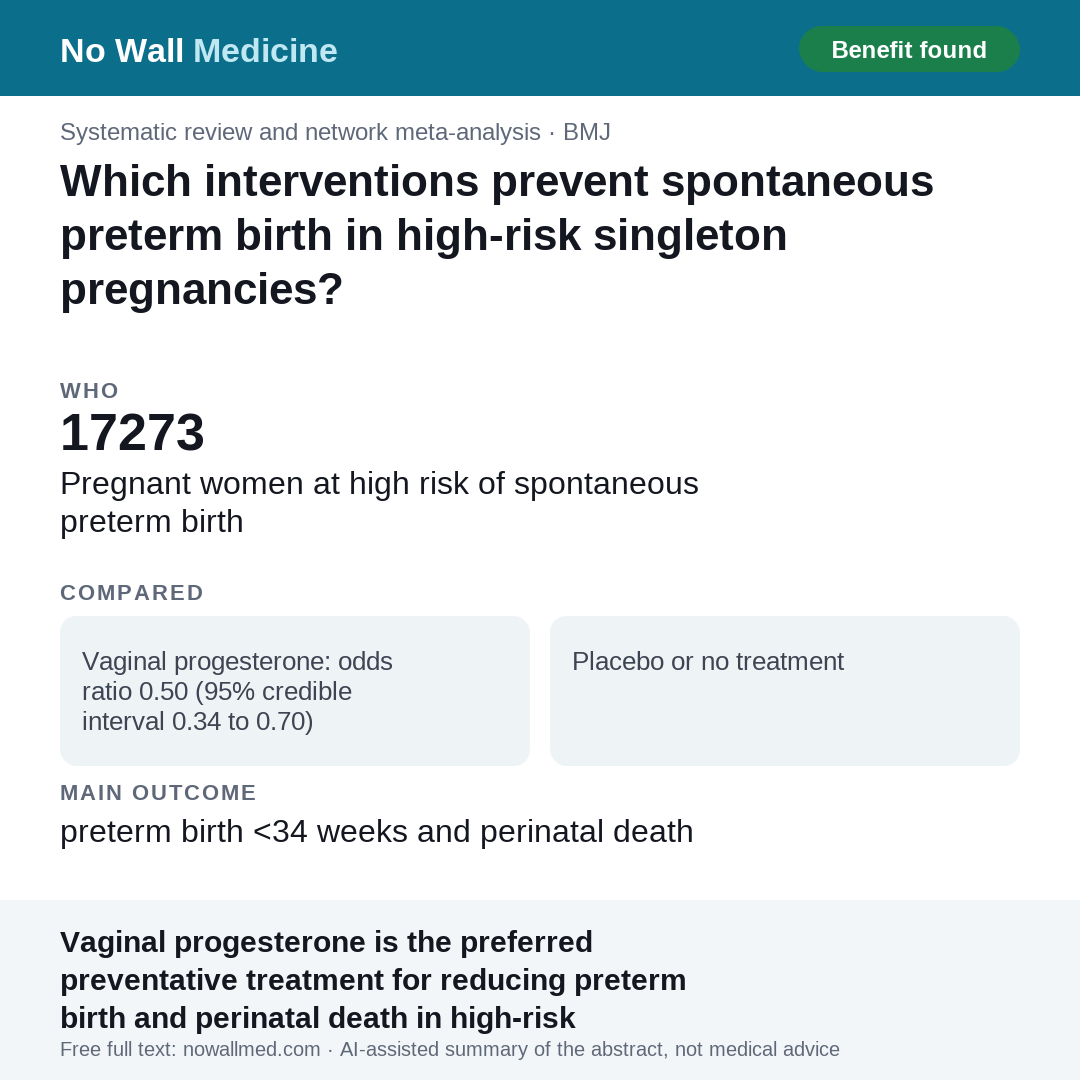
Clinical question: Which interventions prevent spontaneous preterm birth in high-risk singleton pregnancies?
Why it matters: It is unclear which interventions are most effective for preventing preterm birth in women with a history of preterm birth or a short cervix.
Key points
- Researchers analyzed 61 trials involving 17,273 pregnant women to compare various interventions for preventing spontaneous preterm birth.
- Vaginal progesterone was associated with fewer preterm births before 34 weeks (odds ratio 0.50, 95% credible interval 0.34 to 0.70) and lower perinatal death (odds ratio 0.66, 0.44 to 0.97).
- Progesterone treatments were the only interventions associated with lower rates of neonatal sepsis, necrotising enterocolitis, and intensive care unit admission.
Headline and key points written with AI from the paper’s abstract, with every number checked against it. Read the paper before relying on them.
Was this summary helpful?
Abstract
Objectives
To compare the efficacy of bed rest, cervical cerclage (McDonald, Shirodkar, or unspecified type of cerclage), cervical pessary, fish oils or omega fatty acids, nutritional supplements (zinc), progesterone (intramuscular, oral, or vaginal), prophylactic antibiotics, prophylactic tocolytics, combinations of interventions, placebo or no treatment (control) to prevent spontaneous preterm birth in women with a singleton pregnancy and a history of spontaneous preterm birth or short cervical length. Design
Systematic review with bayesian network meta-analysis. Data sources
The Cochrane Pregnancy and Childbirth Group's Database of Trials, the Cochrane Central Register of Controlled Trials, Medline, Embase, CINAHL, relevant journals, conference proceedings, and registries of ongoing trials. Eligibility criteria for selecting studies
Randomised controlled trials of pregnant women who are at high risk of spontaneous preterm birth because of a history of spontaneous preterm birth or short cervical length. No language or date restrictions were applied. Outcomes
Seven maternal outcomes and 11 fetal outcomes were analysed in line with published core outcomes for preterm birth research. Relative treatment effects (odds ratios and 95% credible intervals) and certainty of evidence are presented for outcomes of preterm birth <34 weeks and perinatal death. Results
Sixty one trials (17 273 pregnant women) contributed data for the analysis of at least one outcome. For preterm birth <34 weeks (40 trials, 13 310 pregnant women) and with placebo or no treatment as the comparator, vaginal progesterone was associated with fewer women with preterm birth <34 weeks (odds ratio 0.50, 95% credible interval 0.34 to 0.70, high certainty of evidence). Shirodkar cerclage showed the largest effect size (0.06, 0.00 to 0.84), but the certainty of evidence was low. 17OHPC (17α-hydroxyprogesterone caproate; 0.68, 0.43 to 1.02, moderate certainty), vaginal pessary (0.65, 0.39 to 1.08, moderate certainty), and fish oil or omega 3 (0.30, 0.06 to 1.23, moderate certainty) might also reduce preterm birth <34 weeks compared with placebo or no treatment. For the fetal outcome of perinatal death (30 trials, 12 119 pregnant women) and with placebo or no treatment as the comparator, vaginal progesterone was the only treatment that showed clear evidence of benefit for this outcome (0.66, 0.44 to 0.97, moderate certainty). 17OHPC (0.78, 0.50 to 1.21, moderate certainty), McDonald cerclage (0.59, 0.33 to 1.03, moderate certainty), and unspecified cerclage (0.77, 0.53 to 1.11, moderate certainty) might reduce perinatal death rates, but credible intervals could not exclude the possibility of harm. Only progesterone treatments are associated with reduction in neonatal respiratory distress syndrome, neonatal sepsis, necrotising enterocolitis, and admission to neonatal intensive care unit compared with controls. Conclusion
Vaginal progesterone should be considered the preventative treatment of choice for women with singleton pregnancy identified to be at risk of spontaneous preterm birth because of a history of spontaneous preterm birth or short cervical length. Future randomised controlled trials should use vaginal progesterone as a comparator to identify better treatments or combination treatments. Systematic review registration
PROSPERO CRD42020169006.
Abstract reproduced under the article’s CC BY NC licence.
Subject terms
Cite this article
Care A, Nevitt SJ, Medley N, et al. Interventions to prevent spontaneous preterm birth in women with singleton pregnancy who are at high risk: systematic review and network meta-analysis. BMJ. 2022. doi:10.1136/bmj-2021-064547
Spotted a mistake? Suggest a correction