Bortezomib combination therapy showed high response rates in patients with Waldenström macroglobulinemia
Long-term outcomes by bone marrow B-cell depletion from the R2W trial of bortezomib with cyclophosphamide and rituximab in Waldenstrőm macroglobulinaemia
Why it matters: There is a lack of consensus regarding the most appropriate primary therapy for patients with Waldenström macroglobulinemia.
Key points
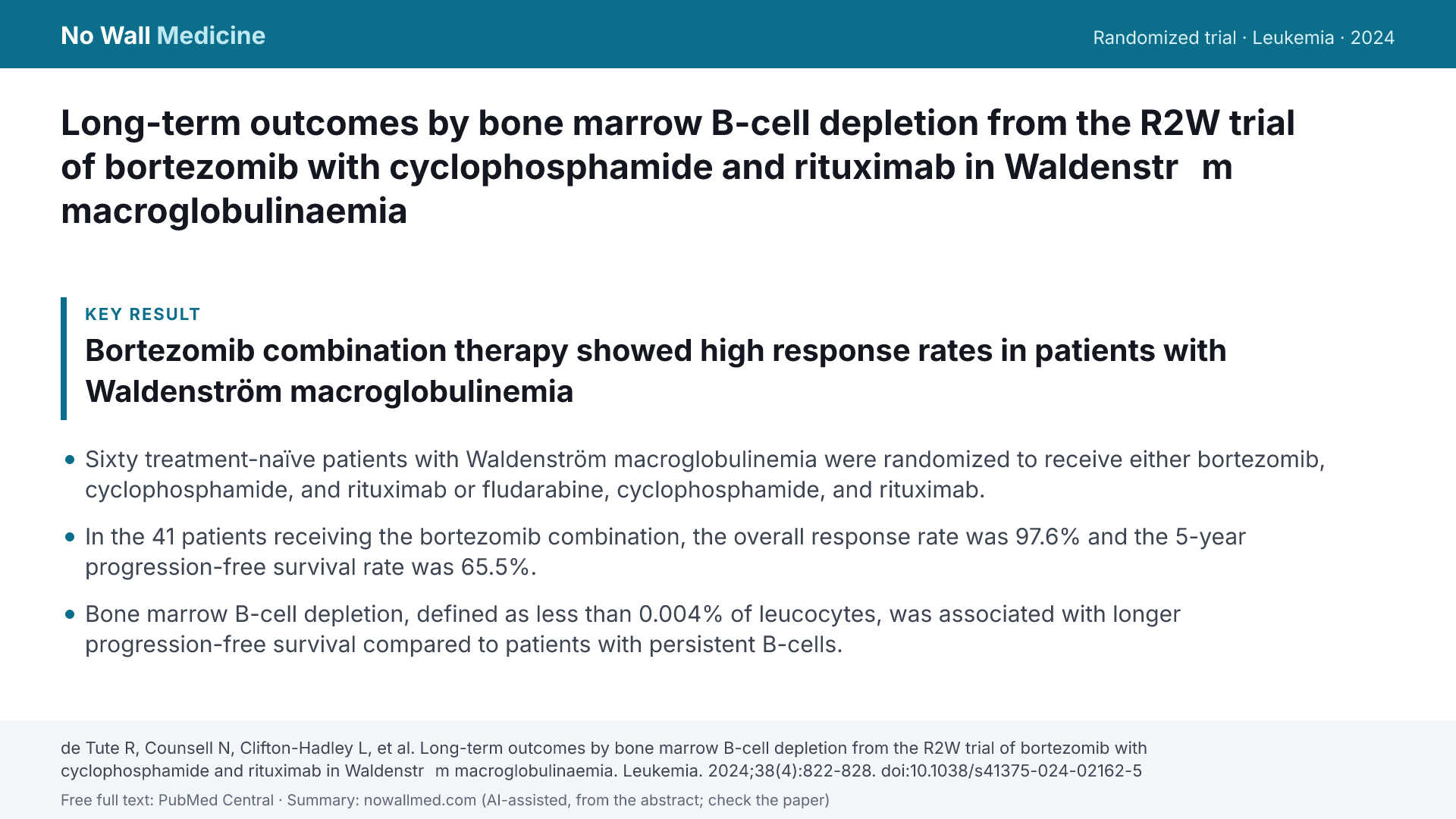
- Sixty treatment-naïve patients with Waldenström macroglobulinemia were randomized to receive either bortezomib, cyclophosphamide, and rituximab or fludarabine, cyclophosphamide, and rituximab.
- In the 41 patients receiving the bortezomib combination, the overall response rate was 97.6% and the 5-year progression-free survival rate was 65.5%.
- Bone marrow B-cell depletion, defined as less than 0.004% of leucocytes, was associated with longer progression-free survival compared to patients with persistent B-cells.
Headline and key points written with AI from the paper’s abstract, with every number checked against it. Read the paper before relying on them.
Was this summary helpful?
Subject terms
Cite this article
de Tute R, Counsell N, Clifton-Hadley L, D'Sa S, Pratt G, Campbell G. Long-term outcomes by bone marrow B-cell depletion from the R2W trial of bortezomib with cyclophosphamide and rituximab in Waldenstrőm macroglobulinaemia. Leukemia. 2024. doi:10.1038/s41375-024-02162-5
Spotted a mistake? Suggest a correction
Top studies every Monday
The week’s key trials and guidelines in your specialties, plus any topics you follow. By email, free.
Get the weekly digest