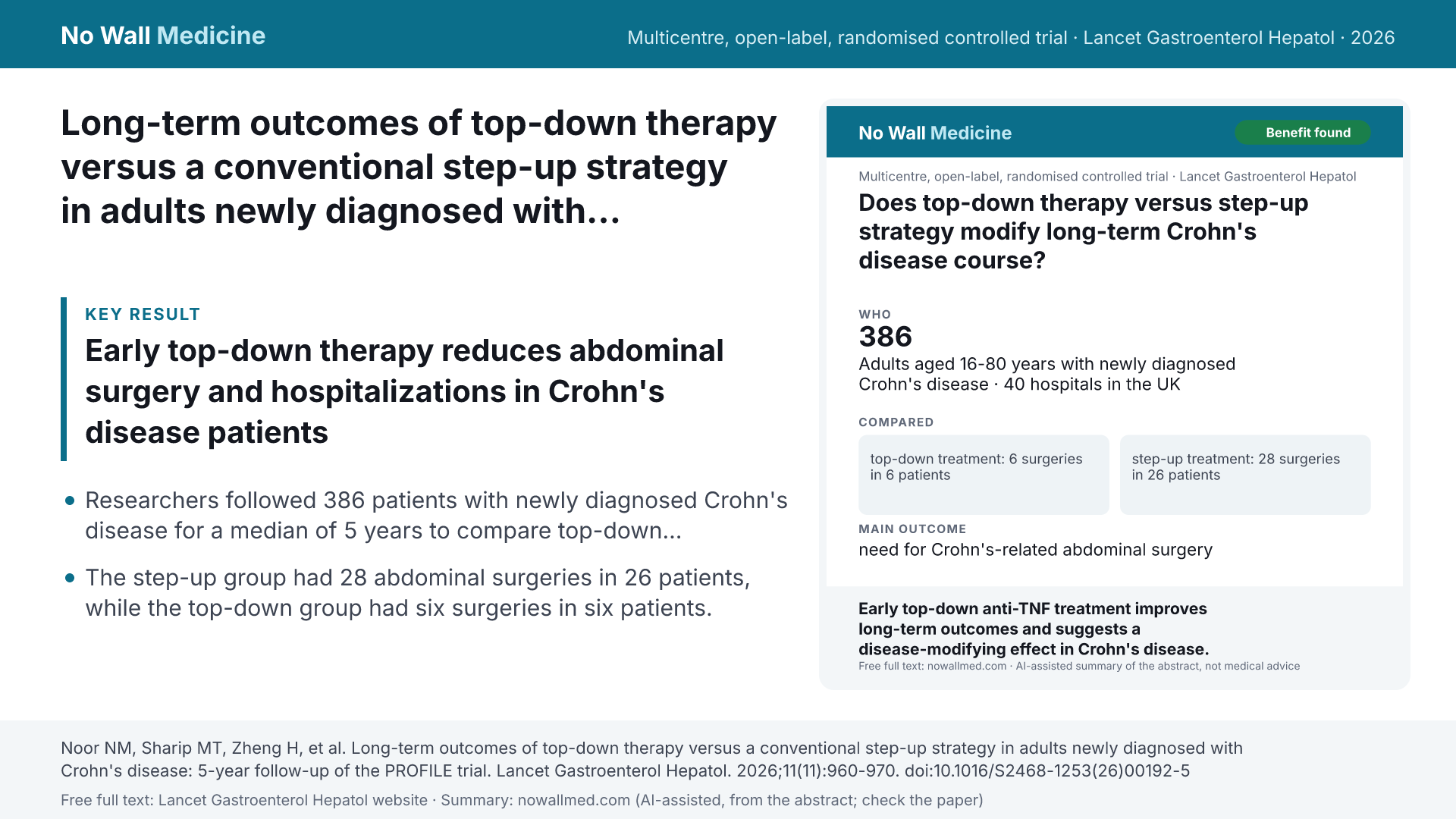
Early top-down therapy reduces abdominal surgery and hospitalizations in Crohn's disease patients
Long-term outcomes of top-down therapy versus a conventional step-up strategy in adults newly diagnosed with Crohn's disease: 5-year follow-up of the PROFILE trial
Multicentre, open-label, randomised controlled trialBenefit found
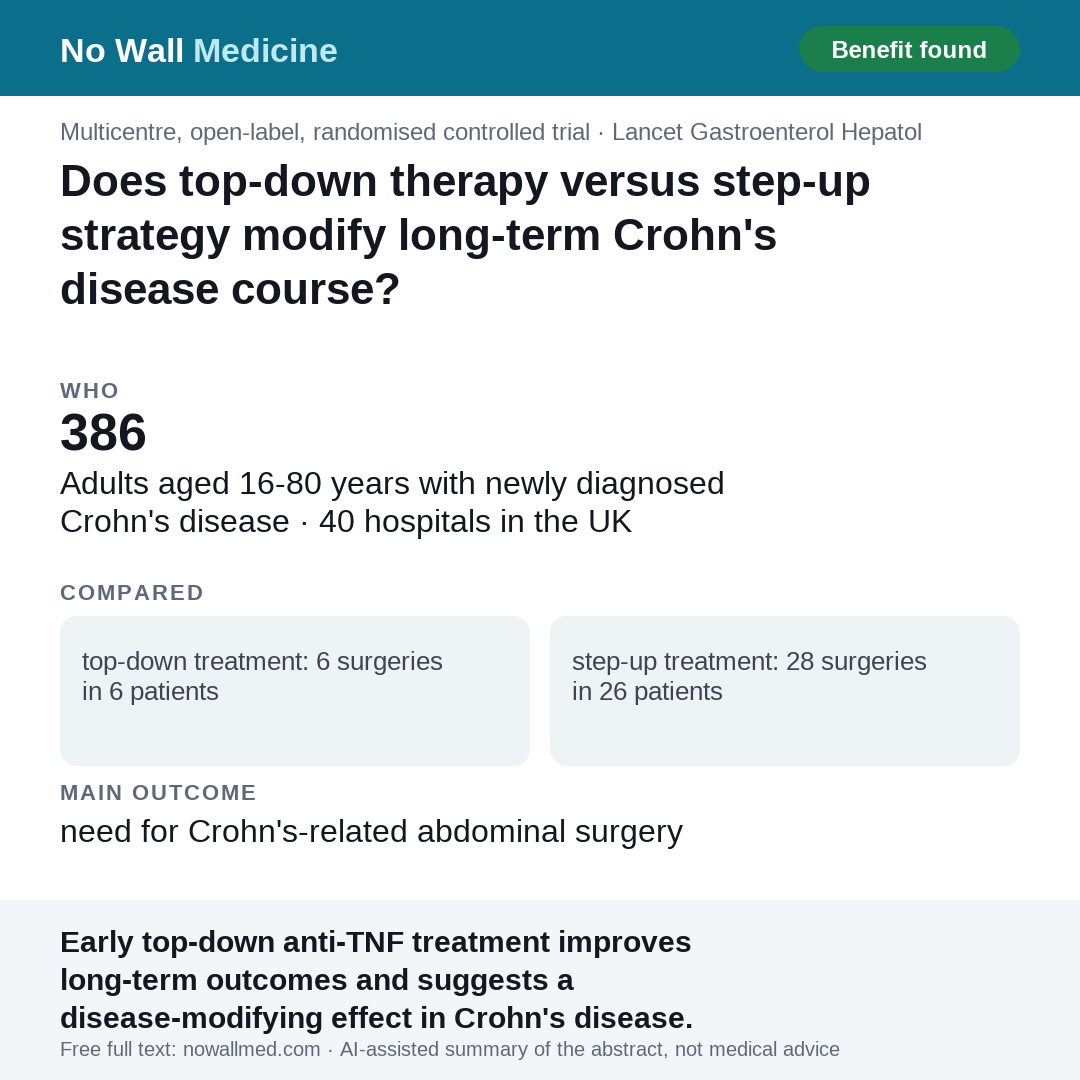
Does top-down therapy versus step-up strategy modify long-term Crohn's disease course?
Who
386
Adults aged 16-80 years with newly diagnosed Crohn's disease · 40 hospitals in the UK
Compared
top-down treatment: 6 surgeries in 6 patients
step-up treatment: 28 surgeries in 26 patients
Main outcome
need for Crohn's-related abdominal surgery
Result: adjusted hazard ratio 5·23 (95% CI 1·99-13·76)
Bottom line: Early top-down anti-TNF treatment improves long-term outcomes and suggests a disease-modifying effect in Crohn's disease.
Funded by: Wellcome and Celltrion
Lancet Gastroenterol Hepatol · 2026-09-11Download image
Clinical question: Does top-down therapy versus step-up strategy modify long-term Crohn's disease course?
Key points
- Researchers followed 386 patients with newly diagnosed Crohn's disease for a median of 5 years to compare top-down therapy with a step-up treatment strategy.
- The step-up group had 28 abdominal surgeries in 26 patients, while the top-down group had six surgeries in six patients.
- Hospital admissions were higher in the step-up group at 21% compared to 11% in the top-down group.
Headline and key points written with AI from the paper’s abstract, with every number checked against it. Read the paper before relying on them.
Was this summary helpful?
Abstract
Background
The PROFILE trial previously reported better 48-week outcomes for patients with Crohn's disease who received top-down anti-TNF treatment from diagnosis, compared with a conventional step-up strategy. Through subsequent follow-up of PROFILE participants, we aimed to assess whether the benefit of top-down treatment from diagnosis results in modification of the long-term disease course. Methods
PROFILE was a multicentre, open-label, randomised controlled trial completed in 40 hospitals in the UK, which included patients aged 16-80 years with newly diagnosed Crohn's disease. Eligible patients were randomly assigned via a secure online platform to a top-down (infliximab plus immunomodulator) or a step-up protocolised treatment strategy for 48 weeks, after which participants reverted to local standards of care. Objective outcome data were extracted for up to 5 years after the week 48 visit, including need for Crohn's-related abdominal surgery as the primary outcome. Data were analysed based on the original PROFILE randomisation and intention-to-treat population. Participants without long-term follow-up data were censored at the week 48 visit. Time-to-event analyses were performed using the Kaplan-Meier method and Cox proportional hazards model. The trial was registered with the ISRCTN registry, number 11808228 and is complete. Findings
Between Dec 29, 2017, and Jan 5, 2022, 483 patients were assessed for inclusion. 389 patients were enrolled and randomly assigned (three patients were excluded due to ineligibility), 193 to top-down treatment and 193 to step-up treatment. Of the 386 participants in the PROFILE primary trial, 358 (93%) had post-week 48 records available for review (182 [51%] top-down and 176 [49%] step-up). Median follow-up was approximately 5 years from randomisation (1809 days [IQR 1300-2101]), by which point 172 (89%) of 193 patients in the step-up group and 191 (99%) of 193 patients in the top-down group had received biological or immunomodulator therapy. Relating to the primary outcome, during follow-up there were 28 Crohn's disease-related abdominal surgeries in 26 patients treated with a step-up approach versus six surgeries in six patients treated with a top-down approach. Time to surgery was shorter in the step-up group than the top-down group (adjusted hazard ratio [aHR] 5·23 [95% CI 1·99-13·76]; p=0·0008). For the secondary outcomes, incidence of Crohn's disease-related hospital admissions was higher in patients originally managed with step-up treatment versus top-down treatment (41 [21%] of 193 patients vs 22 [11%] of 193 patients); and time to first hospital admission was shorter with step-up treatment than with top-down treatment (aHR 2·01 [95% CI 1·18-3·41], p=0·017). Progression to B2 or B3 complications was also more frequent in those originally managed with step-up treatment compared with top-down treatment (32 [17%] of 192 patients vs 13 [7%] of 193 patients); with time to disease progression being shorter in the step-up group than in the top-down group (aHR 2·46 [95% CI 1·25-4·86]; p=0·010). There was no difference in safety outcomes between groups for either serious infections (12 [6%] of 193 step-up patients and 14 [7%] of 193 top-down patients) or malignancies (five patients [3%] and three patients [2%] respectively). Interpretation
Early top-down anti-TNF treatment from diagnosis was associated with improved long-term outcomes at 5 years compared with step-up treatment and is suggestive of a disease-modifying effect in Crohn's disease. Funding
Wellcome and Celltrion.
Abstract reproduced under the article’s CC BY licence.
Subject terms
Cite this article
Noor NM, Sharip MT, Zheng H, et al. Long-term outcomes of top-down therapy versus a conventional step-up strategy in adults newly diagnosed with Crohn's disease: 5-year follow-up of the PROFILE trial. Lancet Gastroenterol Hepatol. 2026. doi:10.1016/S2468-1253(26)00192-5
Spotted a mistake? Suggest a correction