Implantable cardioverter-defibrillators did not reduce overall mortality in non-ischaemic heart failure patients
New York Heart Association functional class and implantable cardioverter-defibrillator in non-ischaemic heart failure with reduced ejection fraction: Extended follow-up of the DANISH trial
Randomized trialMixed results
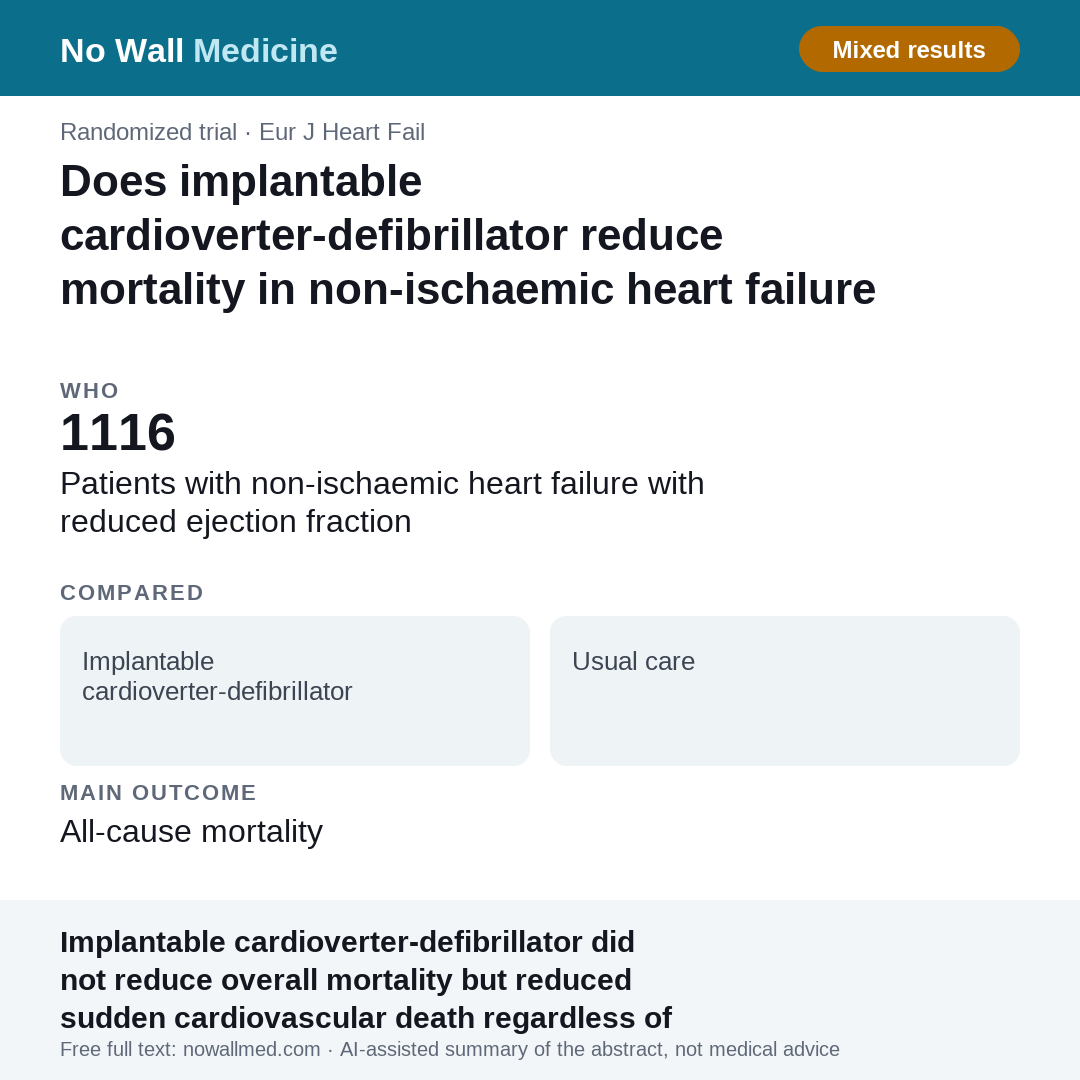
Does implantable cardioverter-defibrillator reduce mortality in non-ischaemic heart failure by New York Heart Association class?
Who
1116
Patients with non-ischaemic heart failure with reduced ejection fraction
Compared
Implantable cardioverter-defibrillator
Usual care
Main outcome
All-cause mortality
Result: hazard ratio 0.89 (95% CI 0.74-1.08)
Bottom line: Implantable cardioverter-defibrillator did not reduce overall mortality but reduced sudden cardiovascular death regardless of baseline class.
Eur J Heart Fail · 2024-05-11Download image
Clinical question: Does implantable cardioverter-defibrillator reduce mortality in non-ischaemic heart failure by New York Heart Association class?
Why it matters: Evidence regarding the benefit of primary prevention implantable cardioverter-defibrillator therapy is less consistent in patients with New York Heart Association class III heart failure.
Key points
- Researchers followed 1116 patients with non-ischaemic heart failure and reduced ejection fraction for a median of 9.5 years.
- Implantable cardioverter-defibrillator implantation was not linked to a reduction in all-cause mortality or cardiovascular death across all New York Heart Association functional classes.
- Implantable cardioverter-defibrillator implantation was associated with a reduction in sudden cardiovascular death regardless of the baseline New York Heart Association class.
Headline and key points written with AI from the paper’s abstract, with every number checked against it. Read the paper before relying on them.
Was this summary helpful?
Subject terms
Cite this article
Karacan MN, Doi SN, Yafasova A, Thune JJ, Nielsen JC, Haarbo J. New York Heart Association functional class and implantable cardioverter-defibrillator in non-ischaemic heart failure with reduced ejection fraction: Extended follow-up of the DANISH trial. Eur J Heart Fail. 2024. doi:10.1002/ejhf.3239
Spotted a mistake? Suggest a correction
Top studies every Monday
The week’s key trials and guidelines in your specialties, plus any topics you follow. By email, free.
Get the weekly digest