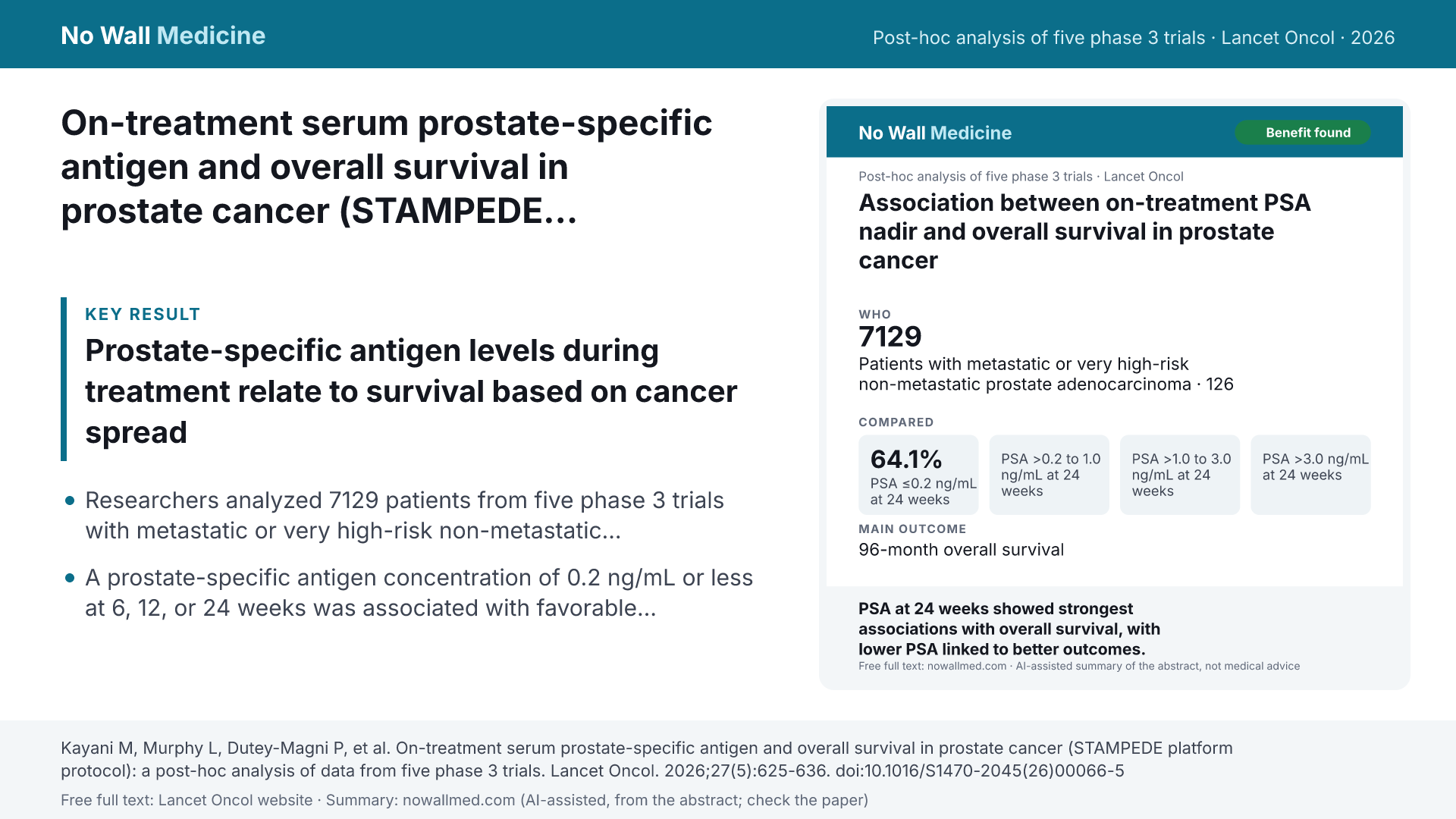
Prostate-specific antigen levels during treatment relate to survival based on cancer spread
On-treatment serum prostate-specific antigen and overall survival in prostate cancer (STAMPEDE platform protocol): a post-hoc analysis of data from five phase 3 trials
Post-hoc analysis of five phase 3 trialsBenefit found
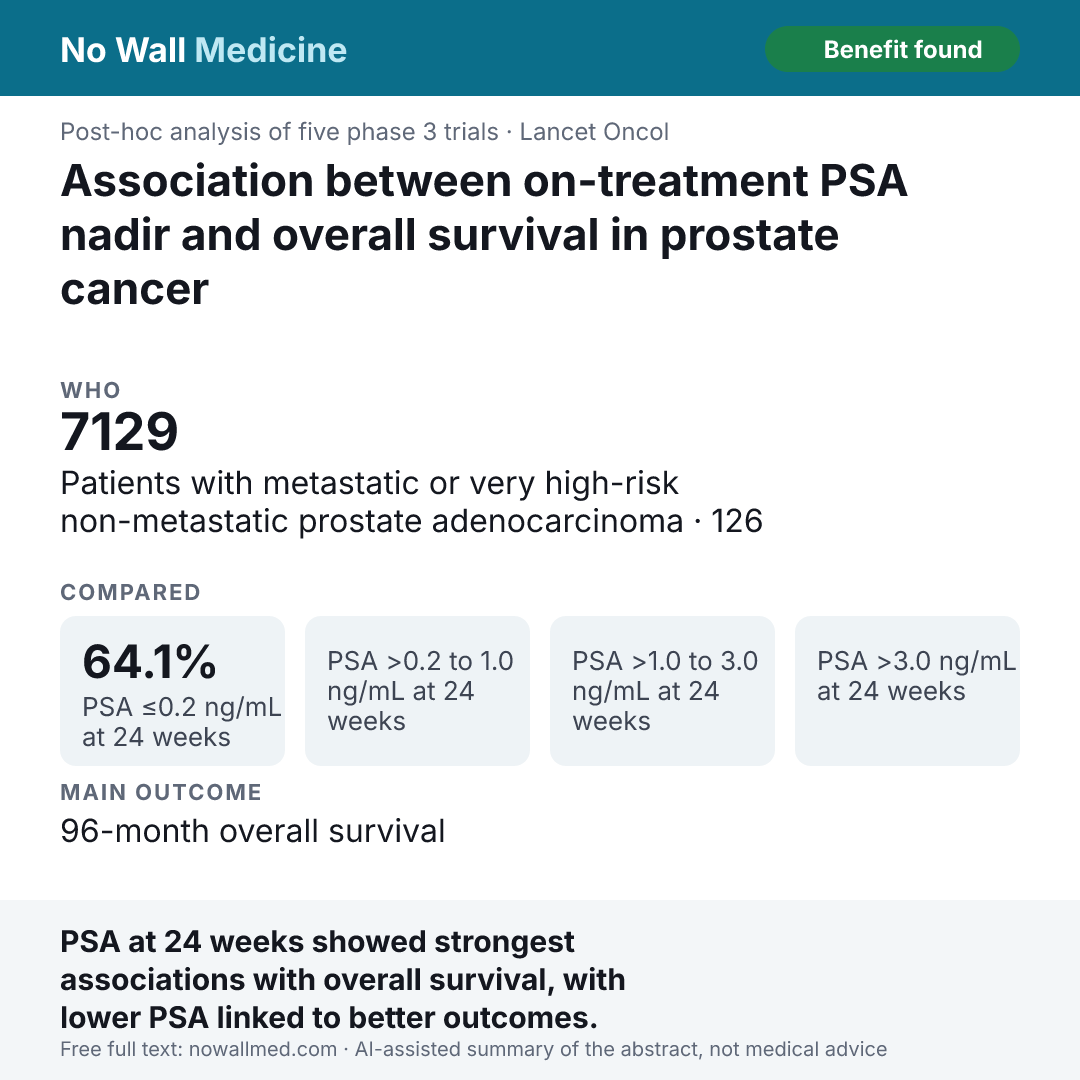
Association between on-treatment PSA nadir and overall survival in prostate cancer
Who
7129
Patients with metastatic or very high-risk non-metastatic prostate adenocarcinoma · 126 hospitals or oncology centres in Switzerland and the UK
Compared
64.1%PSA ≤0.2 ng/mL at 24 weeks (95% CI 57.8-69.8)
PSA >0.2 to 1.0 ng/mL at 24 weeks
PSA >1.0 to 3.0 ng/mL at 24 weeks
PSA >3.0 ng/mL at 24 weeks
Main outcome
96-month overall survival
Bottom line: PSA at 24 weeks showed strongest associations with overall survival, with lower PSA linked to better outcomes.
Funded by: Cancer Research UK, Prostate Cancer UK, UK Medical Research Council
Lancet Oncol · 2026-05-01 · Save PNG
Same trial (NCT00268476, ISRCTN78818544)
Papers we list that report this registered trial, oldest first. Read a secondary analysis alongside the main results.
- Secondary analysis Benefit found
Bone metastasis count and location were associated with survival benefit from prostate radiotherapy JAMA Oncol 2021-02 - Longer follow-up Mixed results
Prostate radiotherapy improved overall survival for men with low metastatic burden prostate cancer PLOS Med 2022-06 - Secondary analysis Harm found
Higher burden of genomic copy number alterations was associated with increased prostate cancer progression and death Genome Med 2022-09 - Protocol Key finding
Artificial intelligence model predicts prostate cancer death risk using biopsy images and clinical data Lancet Digit Health 2025-06 - Protocol No clear difference
Adding metformin to standard care did not improve survival in metastatic prostate cancer patients Lancet Oncol 2025-07 - Main results Benefit found
Transdermal estradiol patches were noninferior to hormone agonists for metastasis-free survival in prostate cancer NEJM 2026-03 - Protocol Benefit found
This paper Lancet Oncol 2026-05 - Secondary analysis Key finding
Artificial intelligence model predicts which prostate cancer patients benefit from adding abiraterone to therapy Ann Oncol 2026-06
Key points
- Researchers analyzed 7129 patients from five phase 3 trials with metastatic or very high-risk non-metastatic prostate cancer.
- A prostate-specific antigen concentration of 0.2 ng/mL or less at 6, 12, or 24 weeks was associated with favorable survival outcomes.
- In patients receiving abiraterone with or without enzalutamide, 96-month survival was 64.1% for low-volume metastatic disease and 44.6% for high-volume metastatic disease.
Headline and key points written with AI from the paper’s abstract, with every number checked against it. Read the paper before relying on them.
Was this summary helpful?
Abstract
Background
Serum prostate-specific antigen (PSA) concentrations decrease after hormone therapy for prostate cancer, with the nadir serving as a potentially useful prognostic biomarker. To support clinical use, we evaluated the association between PSA nadir values and survival outcomes, stratified by pre-treatment metastatic volume or, in patients with non-metastatic cancer, stratified by lymph node status. Methods
As part of the STAMPEDE platform trial, patients with metastatic or very high-risk non-metastatic prostate adenocarcinoma were recruited to five randomised, controlled, phase 3 trials conducted at 126 hospitals or oncology centres in Switzerland and the UK. Patients were randomly assigned to either standard of care (androgren deprivation therapy [ADT] alone or ADT plus docetaxel) or to one of five experimental treatment groups: ADT plus docetaxel with or without zoledronic acid, ADT plus abiraterone acetate with or without enzalutamide, or ADT plus prostate radiotherapy (only patients with metastatic disease). We used trial data from these participants to perform landmark analyses to test associations of PSA at 6, 12, and 24 weeks after randomisation with overall survival. Only patients with a PSA value were included in each landmark analysis. The Kaplan-Meier method was used to estimate 96-month overall survival rates and the corresponding 95% CIs for patients categorised by either metastatic volume or lymph node status. The STAMPEDE protocol platform is registered with ClinicalTrials.gov (NCT00268476), EUDRACT (2004-000193-31), and ISRCTN (ISRCTN78818544). Findings
This study included 7129 patients from the STAMPEDE platform, who were recruited between Oct 5, 2005, and Sept 2, 2016; 4438 had metastases and 2691 had very high-risk non-metastatic disease. Among patients with metastasis and volumetric assessment, 2211 (55·9%) of 3956 had high-volume metastases, and among those with non-metastatic disease, 1033 (38·4%) were lymph node positive. A PSA concentration of 0·2 ng/mL or less was less frequent at 6 weeks or 12 weeks, but was associated with equivalent survival rates, compared with a PSA of 0·2 ng/mL or less at 24 weeks. Survival rates of PSA subcategories (≤0·2 ng/mL, >0·2 to 1·0 ng/mL, >1·0 to 3·0 ng/mL, and >3·0 ng/mL) differed by metastatic volume or, in patients with non-metastatic disease, by nodal status. Survival was longest for patients allocated to abiraterone with or without enzalutamide. Among patients with metastatic disease in the abiraterone with or without enzalutamide group who had a PSA of 0·2 ng/mL or less at 24 weeks, 96-month overall survival in patients with low-volume metastatic disease (64·1% [95% CI 57·8-69·8]) was higher than in patients with high-volume metastatic disease (44·6% [37·1-51·9]), but lower than in patients with non-metastatic, node-positive disease (79·4% [73·8-83·9]). 96-month overall survival was highest for patients with non-metastatic, node-negative disease (82·8% [95% CI 78·7-86·1]). Interpretation
Metastatic volume or nodal status influence survival rates associated with on-treatment serum PSA categories, including for undetectable PSA. Radiological features and serum PSA could be combined to better predict survival. PSA at 24 weeks showed strongest associations with overall survival, although a PSA concentration of 0·2 ng/mL or less at any timepoint predicted favourable outcome. These findings could inform prognosis and warrant evaluation for treatment selection in clinical trials. Funding
Cancer Research UK, Prostate Cancer UK, UK Medical Research Council, and John Black Charitable Foundation.
Abstract reproduced under the article’s CC BY licence.
Subject terms
Headline, design, result, key points, caveat and citation as plain text.
Cite this article
Kayani M, Murphy L, Dutey-Magni P, et al. On-treatment serum prostate-specific antigen and overall survival in prostate cancer (STAMPEDE platform protocol): a post-hoc analysis of data from five phase 3 trials. Lancet Oncol. 2026;27(5):625-636. doi:10.1016/S1470-2045(26)00066-5
Spotted a mistake? Suggest a correction