Laryngeal mask airway reduced respiratory adverse events in children undergoing adenotonsillectomy
Perioperative respiratory adverse events in children undergoing adenotonsillectomy with laryngeal mask airway versus endotracheal tube ventilation: multicentre, randomised controlled trial
Randomised controlled trialBenefit found
Laryngeal mask airway vs endotracheal tube
Who
400
Children aged 2 to 7 years · Four hospitals in China
Compared
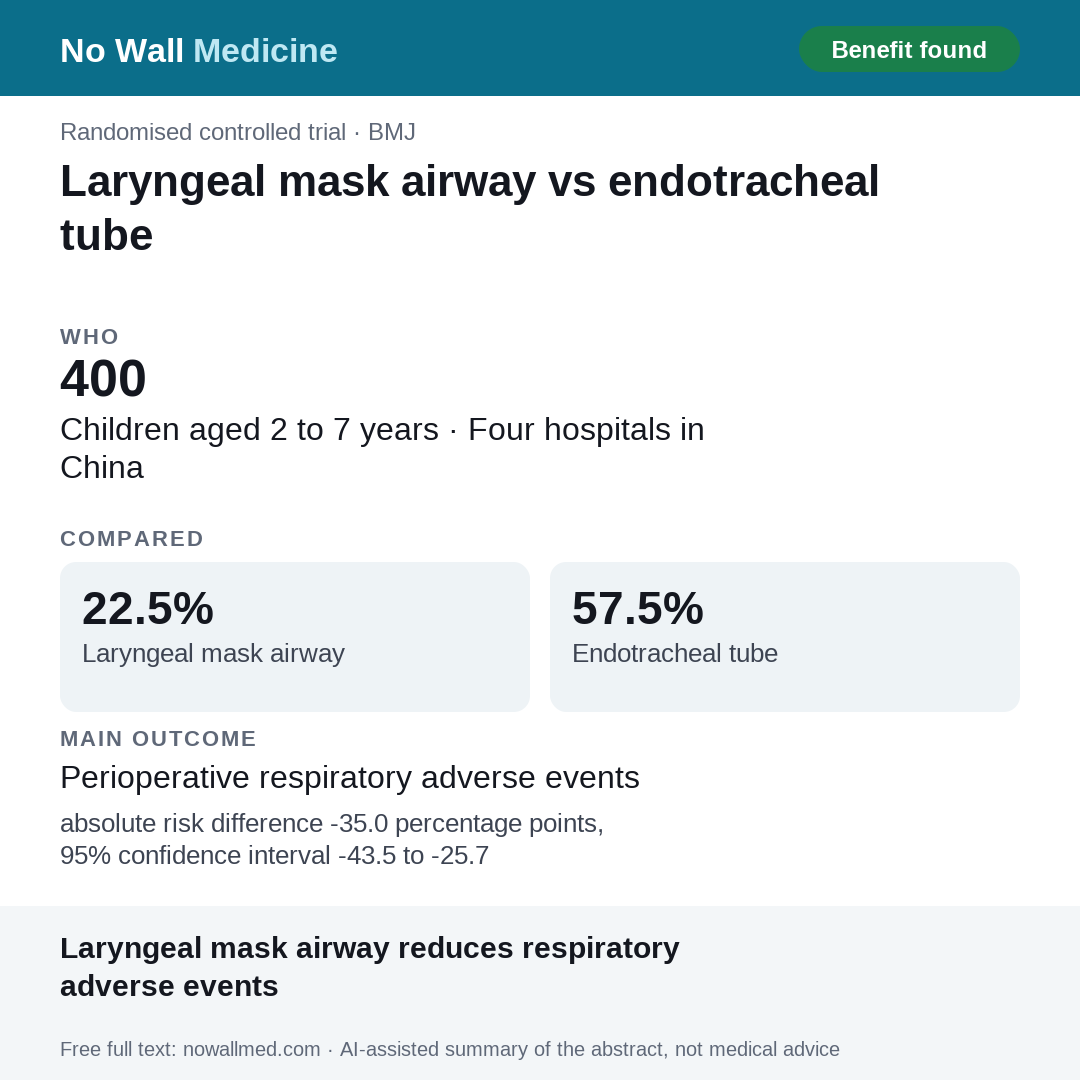
22.5%Laryngeal mask airway (45/200)
57.5%Endotracheal tube (115/200)
Main outcome
Perioperative respiratory adverse events
Result: absolute risk difference -35.0 percentage points, 95% confidence interval -43.5 to -25.7
Bottom line: Laryngeal mask airway reduces respiratory adverse events
BMJ · 2026-11-04Download image
Why it matters: Doctors have had limited evidence on the best ventilation method for children undergoing adenotonsillectomy
Key points
- 400 children aged 2 to 7 years were randomised to laryngeal mask airway or endotracheal tube ventilation.
- 22.5% of laryngeal mask airway group experienced respiratory adverse events versus 57.5% of endotracheal tube group.
- Laryngeal mask airway group had lower rates of laryngospasm, desaturation, and airway obstruction.
Headline and key points written with AI from the paper’s abstract, with every number checked against it. Read the paper before relying on them.
Abstract
Objective
To assess the effect of ventilation with a laryngeal mask airway (LMA) compared with endotracheal tube (ETT) on perioperative respiratory adverse events (PRAEs) in children undergoing adenotonsillectomy. Design
Multicentre, randomised, parallel group trial. Setting
Four tertiary hospitals in China, 2023-24. Participants
400 children aged ≥2 years and <7 years who were scheduled for adenotonsillectomy under general anaesthesia. Interventions
Participants were randomised 1:1 to receive ventilation with a laryngeal mask airway (n=200) or an endotracheal tube (n=200) during adenotonsillectomy. Main outcome measure
The primary outcome was the proportion of participants who developed any perioperative respiratory adverse event (PRAE): laryngospasm, bronchospasm, desaturation, airway obstruction, severe cough, or stridor in the intention-to-treat population. Results
400 children (mean age 4.7 (standard deviation 1.0) years; 155 (38.7%) girls) were enrolled between 24 May 2023 and 4 April 2024, with last follow-up on 4 May 2024. LMA was converted to ETT in three participants. Overall, 22.5% (45/200) participants in the LMA group experienced PRAEs versus 57.5% (115/200) in the ETT group (absolute risk difference -35.0 percentage points, 95% confidence interval -43.5 to -25.7; P<0.001). The LMA group had fewer PRAEs in both the intraoperative (9.0% (18/200) v 17.5% (35/200); -8.5, -15.2 to -1.8; P=0.01) and the postoperative period (16.5% (33/200) v 49.5% (99/200); -33.0, -41.2 to -24.0; P<0.001). The LMA group also had a lower proportion of participants with laryngospasm (0.0% v 3.0%; P=0.03), desaturation (15.0% v 28.0%; P=0.002), airway obstruction (3.5% v 12.5%; P<0.001), and severe cough (10.5% v 42.0%; P<0.001). Neither group experienced serious adverse events. Conclusion
Ventilation with an LMA by experienced anaesthesiologists resulted in fewer perioperative respiratory adverse events than ventilation with an ETT in children undergoing adenotonsillectomy. Trial registration
Chictr.org.cn ChiCTR2300071399.
Abstract reproduced under the article’s CC BY NC licence.
Topics
Cite this article
Han Y, Yi X, Xia J, Zhang W, Zhao Z, Zhu N. Perioperative respiratory adverse events in children undergoing adenotonsillectomy with laryngeal mask airway versus endotracheal tube ventilation: multicentre, randomised controlled trial. BMJ. 2026. doi:10.1136/bmj-2026-101019
Spotted a mistake? Suggest a correction