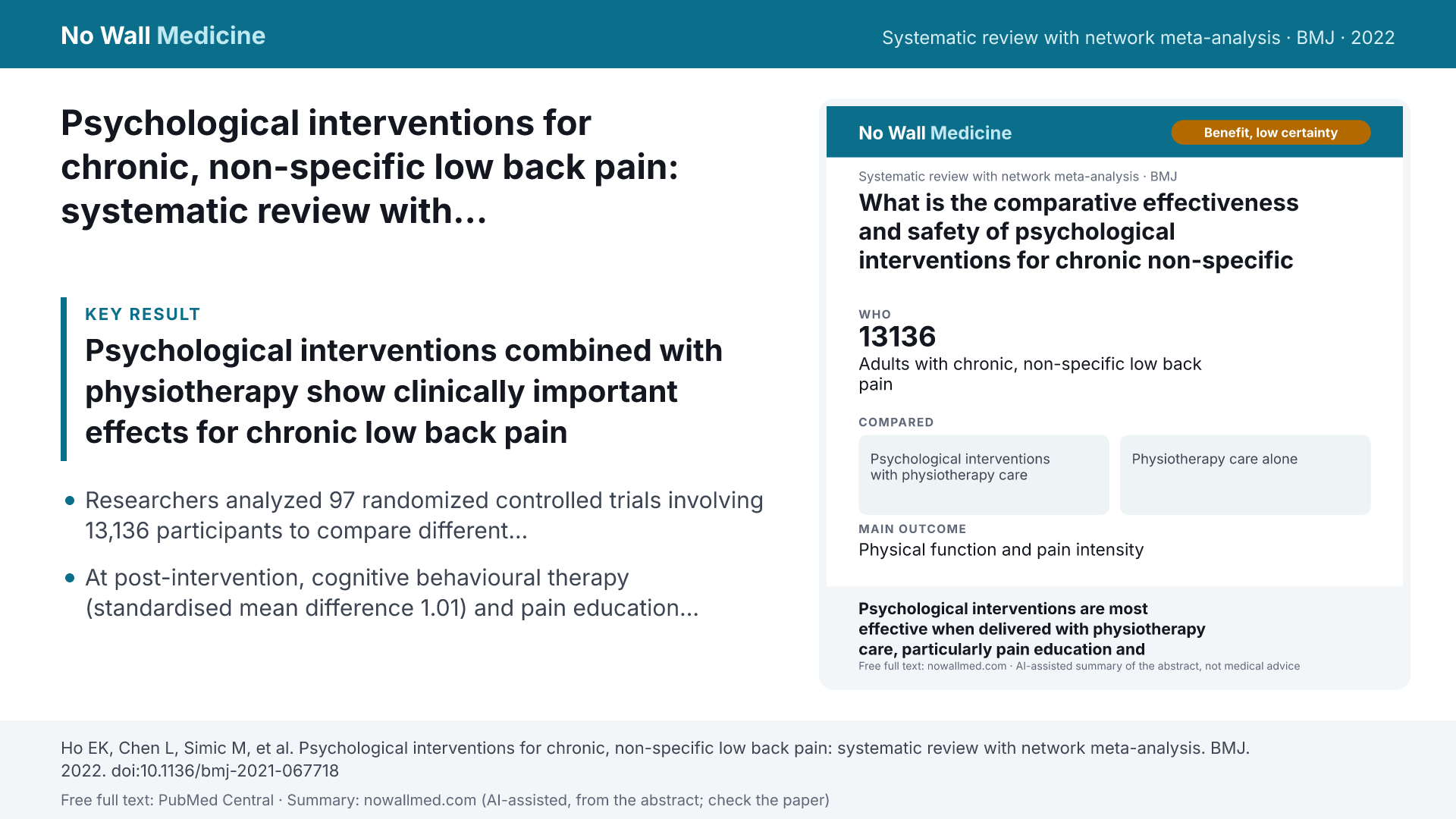
Psychological interventions combined with physiotherapy show clinically important effects for chronic low back pain
Psychological interventions for chronic, non-specific low back pain: systematic review with network meta-analysis
Systematic review with network meta-analysisBenefit, low certainty
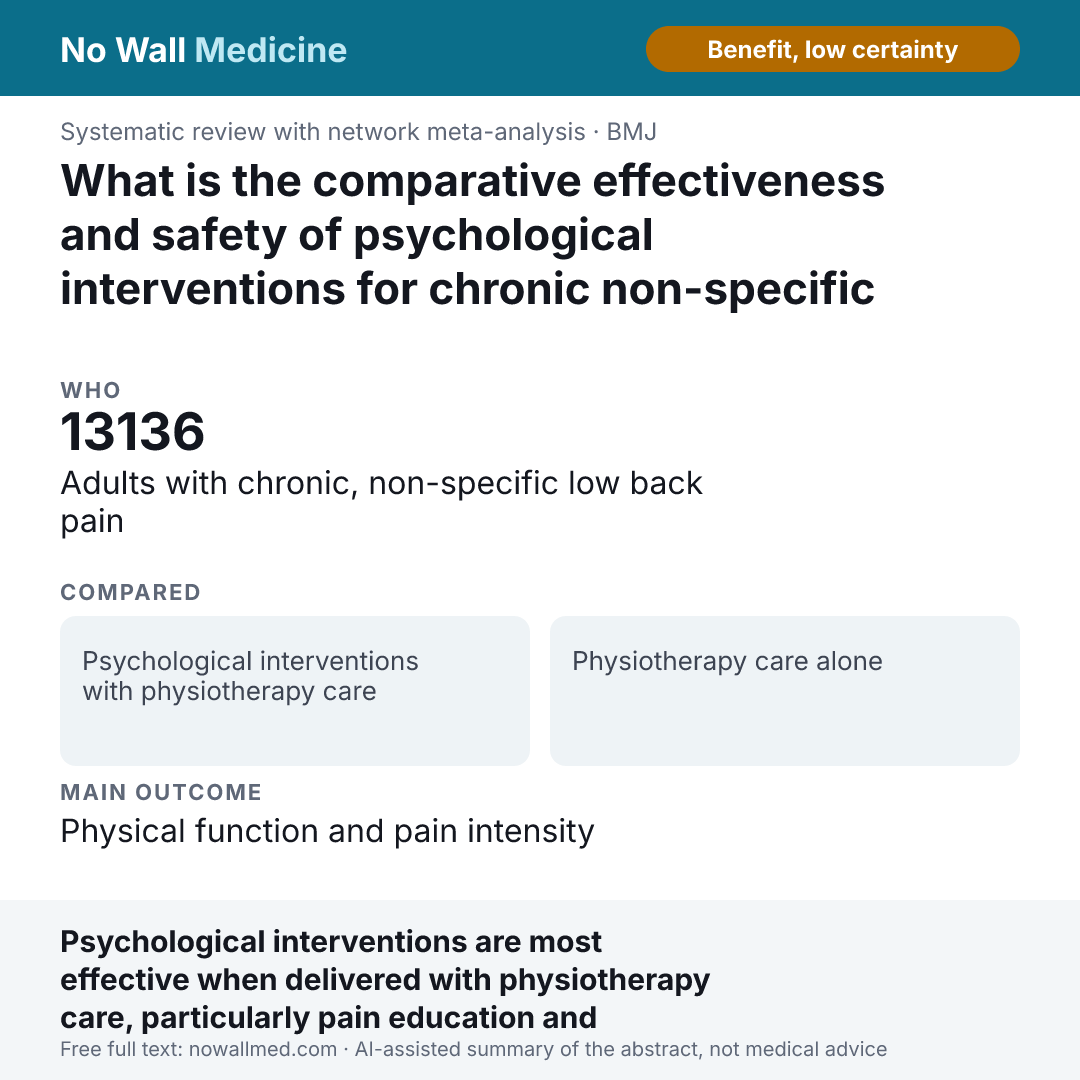
What is the comparative effectiveness and safety of psychological interventions for chronic non-specific low back pain?
Who
13136
Adults with chronic, non-specific low back pain
Compared
Psychological interventions with physiotherapy care
Physiotherapy care alone
Main outcome
Physical function and pain intensity
Bottom line: Psychological interventions are most effective when delivered with physiotherapy care, particularly pain education and behavioural therapy.
Limitation: Uncertainty remains regarding the long term effectiveness of these interventions.
BMJ · 2022-03-30 · Save PNG
Clinical question: What is the comparative effectiveness and safety of psychological interventions for chronic non-specific low back pain?
Key points
- Researchers analyzed 97 randomized controlled trials involving 13,136 participants to compare different psychological treatments for chronic, non-specific low back pain.
- At post-intervention, cognitive behavioural therapy (standardised mean difference 1.01) and pain education (0.62) combined with physiotherapy resulted in clinically important physical function improvements.
- Behavioural therapy combined with physiotherapy was the only treatment that maintained clinically important effects on pain intensity until mid-term follow-up (1.01).
Limitation the authors note: No studies investigated the long term effectiveness of pain education delivered with physiotherapy care.
Headline and key points written with AI from the paper’s abstract, with every number checked against it. Read the paper before relying on them.
Was this summary helpful?
Abstract
Objective
To determine the comparative effectiveness and safety of psychological interventions for chronic low back pain. Design
Systematic review with network meta-analysis. Data sources
Medline, Embase, PsycINFO, Cochrane Central Register of Controlled Trials, Web of Science, SCOPUS, and CINAHL from database inception to 31 January 2021. Eligibility criteria for study selection
Randomised controlled trials comparing psychological interventions with any comparison intervention in adults with chronic, non-specific low back pain. Two reviewers independently screened studies, extracted data, and assessed risk of bias and confidence in the evidence. Primary outcomes were physical function and pain intensity. A random effects network meta-analysis using a frequentist approach was performed at post-intervention (from the end of treatment to <2 months post-intervention); and at short term (≥2 to <6 months post-intervention), mid-term (≥6 to <12 months post-intervention), and long term follow-up (≥12 months post-intervention). Physiotherapy care was the reference comparison intervention. The design-by-treatment interaction model was used to assess global inconsistency and the Bucher method was used to assess local inconsistency. Results
97 randomised controlled trials involving 13 136 participants and 17 treatment nodes were included. Inconsistency was detected at short term and mid-term follow-up for physical function, and short term follow-up for pain intensity, and were resolved through sensitivity analyses. For physical function, cognitive behavioural therapy (standardised mean difference 1.01, 95% confidence interval 0.58 to 1.44), and pain education (0.62, 0.08 to 1.17), delivered with physiotherapy care, resulted in clinically important improvements at post-intervention (moderate quality evidence). The most sustainable effects of treatment for improving physical function were reported with pain education delivered with physiotherapy care, at least until mid-term follow-up (0.63, 0.25 to 1.00; low quality evidence). No studies investigated the long term effectiveness of pain education delivered with physiotherapy care. For pain intensity, behavioural therapy (1.08, 0.22 to 1.94), cognitive behavioural therapy (0.92, 0.43 to 1.42), and pain education (0.91, 0.37 to 1.45), delivered with physiotherapy care, resulted in clinically important effects at post-intervention (low to moderate quality evidence). Only behavioural therapy delivered with physiotherapy care maintained clinically important effects on reducing pain intensity until mid-term follow-up (1.01, 0.41 to 1.60; high quality evidence). Conclusions
For people with chronic, non-specific low back pain, psychological interventions are most effective when delivered in conjunction with physiotherapy care (mainly structured exercise). Pain education programmes (low to moderate quality evidence) and behavioural therapy (low to high quality evidence) result in the most sustainable effects of treatment; however, uncertainty remains as to their long term effectiveness. Although inconsistency was detected, potential sources were identified and resolved. Systematic review registration
PROSPERO CRD42019138074.
Abstract reproduced under the article’s CC BY NC licence.
Subject terms
Headline, design, result, key points, caveat and citation as plain text.
Cite this article
Ho EK, Chen L, Simic M, et al. Psychological interventions for chronic, non-specific low back pain: systematic review with network meta-analysis. BMJ. 2022. doi:10.1136/bmj-2021-067718
Spotted a mistake? Suggest a correction