Hepatocyte growth factor plasmids were associated with higher ulcer healing rates in patients with chronic limb threatening ischaemia
Recombinant Human Hepatocyte Growth Factor Plasmids for Treating Patients with Chronic Limb Threatening Ischaemia: A Systematic Review and Meta-analysis
Systematic review and meta-analysisBenefit found
Are recombinant human hepatocyte growth factor plasmids effective for treating chronic limb threatening ischaemia?
Who
655
Patients with chronic limb threatening ischaemia
Compared
HGF plasmids
Placebo
Main outcome
Complete ulcer healing rate
Result: relative risk 1.99 (95% confidence interval 1.30 - 3.04)
Bottom line: HGF treatment is associated with increased complete ulcer healing and reduced ischaemic pain in patients with chronic limb threatening ischaemia.
Eur J Vasc Endovasc Surg · 2024-07-15Download image
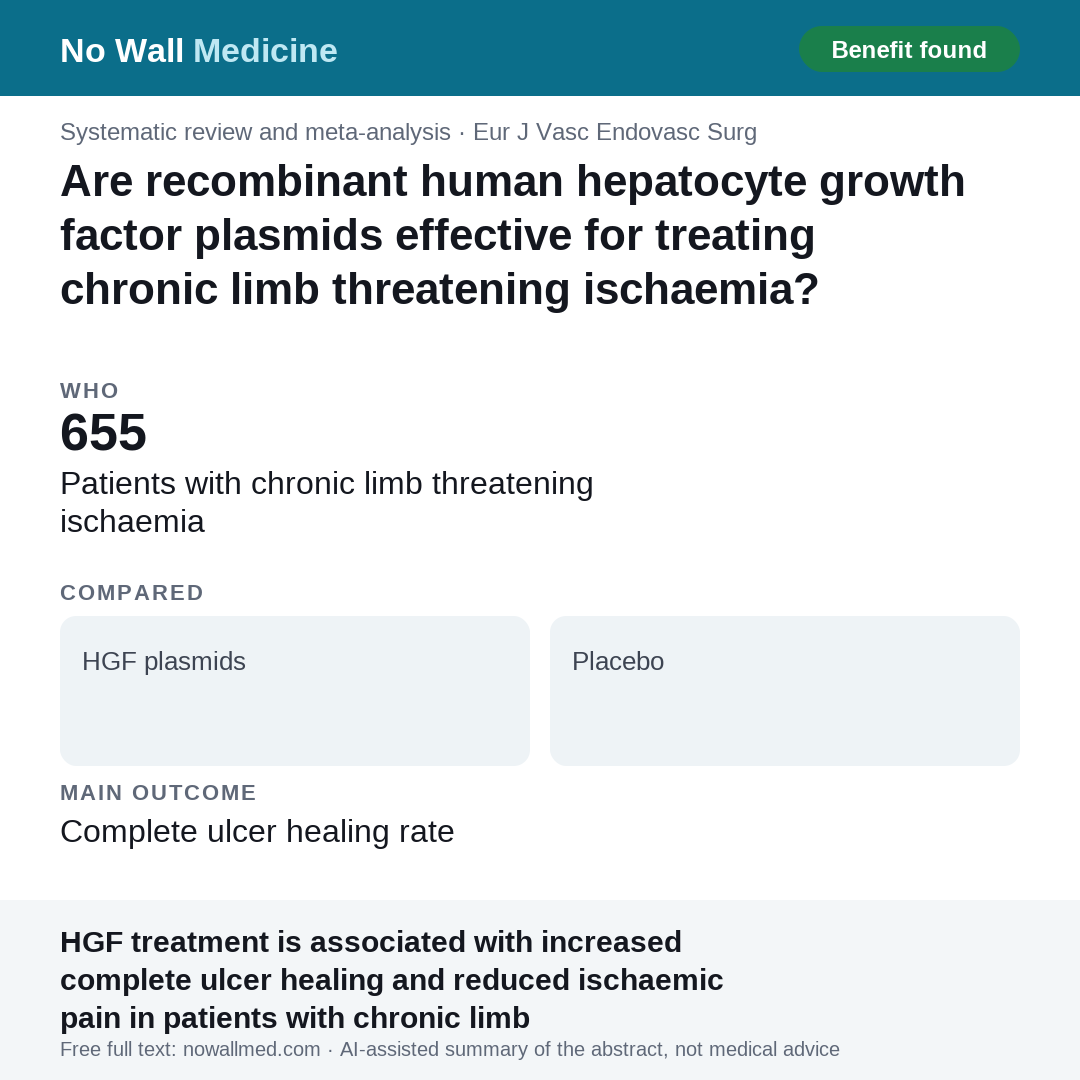
Clinical question: Are recombinant human hepatocyte growth factor plasmids effective for treating chronic limb threatening ischaemia?
Why it matters: It is unknown if recombinant human hepatocyte growth factor plasmids serve as effective alternatives to limb salvage for patients with chronic limb threatening ischaemia.
Key points
- Researchers analyzed seven randomized controlled studies involving 655 participants with chronic limb threatening ischaemia to evaluate the efficacy of recombinant human hepatocyte growth factor plasmids.
- Patients treated with the plasmids had a higher complete ulcer healing rate (RR 1.99, 95% CI 1.30 - 3.04) and lower pain severity scores (MD -1.56, 95% CI -2.12 - -1.00) at three months.
- No significant differences were observed between the treatment and placebo groups regarding major amputation rates (RR 0.91, 95% CI 0.48 - 1.73), all cause mortality (RR 0.93, 95% CI 0.38 - 2.27), or ankle brachial index changes.
Headline and key points written with AI from the paper’s abstract, with every number checked against it. Read the paper before relying on them.
Was this summary helpful?
Subject terms
Cite this article
Di X, Wang P, Li F, Han W, Ni L, Liu CW. Recombinant Human Hepatocyte Growth Factor Plasmids for Treating Patients with Chronic Limb Threatening Ischaemia: A Systematic Review and Meta-analysis. Eur J Vasc Endovasc Surg. 2024. doi:10.1016/j.ejvs.2024.07.016
Spotted a mistake? Suggest a correction
Top studies every Monday
The week’s key trials and guidelines in your specialties, plus any topics you follow. By email, free.
Get the weekly digest