Use of tumor necrosis factor alpha drugs was associated with increased multiple sclerosis risk
Risk of Multiple Sclerosis Among Users of Antitumor Necrosis Factor α in 4 Canadian Provinces: A Population-Based Study
Nested case-control study in 4 Canadian provincesKey finding
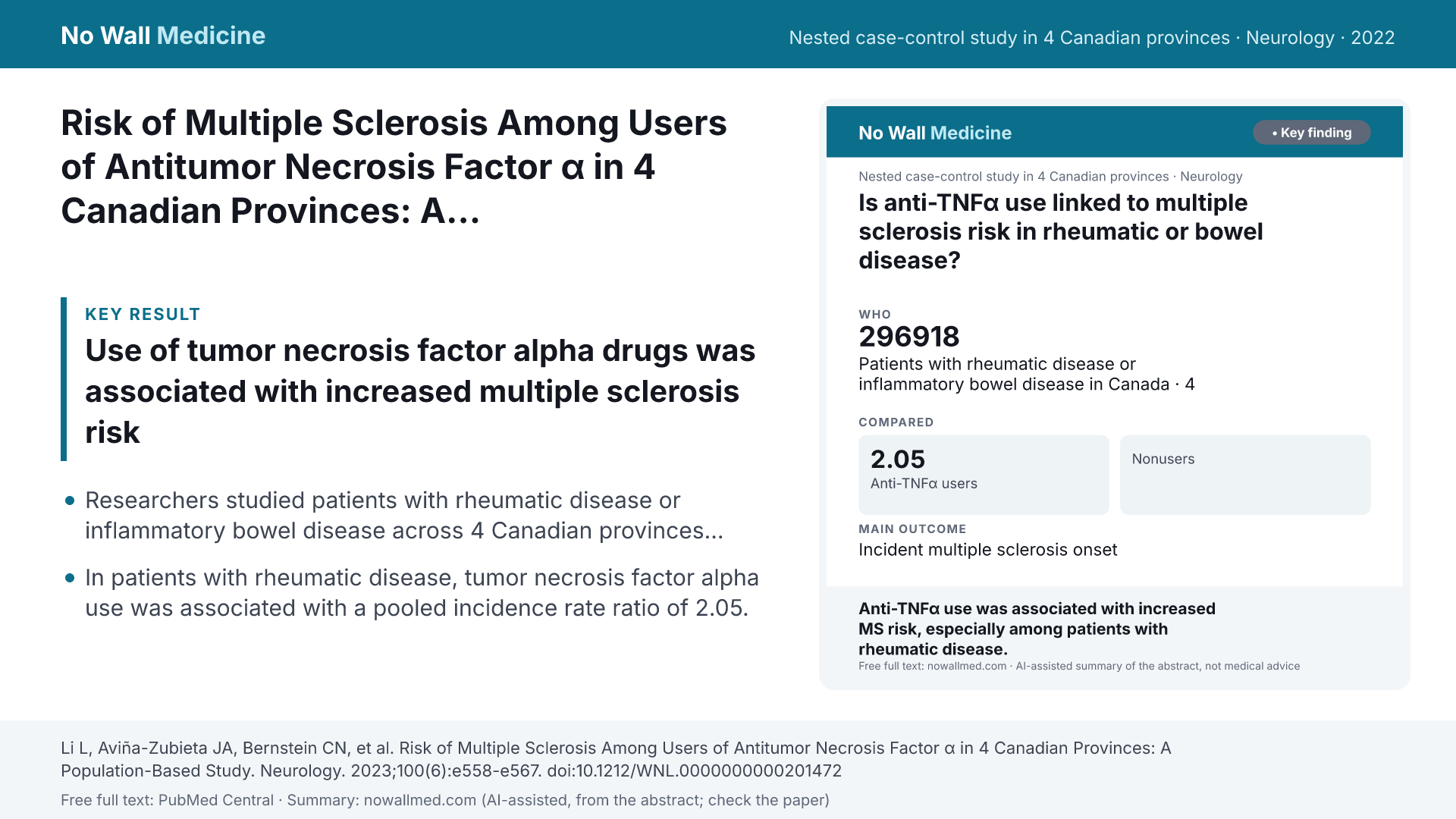
Is anti-TNFα use linked to multiple sclerosis risk in rheumatic or bowel disease?
Who
296918
Patients with rheumatic disease or inflammatory bowel disease in Canada · 4 Canadian provinces
Compared
2.05Anti-TNFα users (95% CI, 1.13-3.72)
Nonusers
Main outcome
Incident multiple sclerosis onset
Result: pooled IRR 2.05 (95% CI, 1.13-3.72)
Bottom line: Anti-TNFα use was associated with increased MS risk, especially among patients with rheumatic disease.
Limitation: Further studies are needed to validate these results for patients with IBD.
Neurology · 2022-10-28Download image

Clinical question: Is anti-TNFα use linked to multiple sclerosis risk in rheumatic or bowel disease?
Key points
- Researchers studied patients with rheumatic disease or inflammatory bowel disease across 4 Canadian provinces using linked health databases.
- In patients with rheumatic disease, tumor necrosis factor alpha use was associated with a pooled incidence rate ratio of 2.05.
- Among patients with inflammatory bowel disease, tumor necrosis factor alpha use was associated with an incidence rate ratio of 1.35, which was not statistically significant.
Headline and key points written with AI from the paper’s abstract, with every number checked against it. Read the paper before relying on them.
Was this summary helpful?
Subject terms
Headline, design, result, key points, caveat and citation as plain text.
Cite this article
Li L, Aviña-Zubieta JA, Bernstein CN, et al. Risk of Multiple Sclerosis Among Users of Antitumor Necrosis Factor α in 4 Canadian Provinces: A Population-Based Study. Neurology. 2022. doi:10.1212/WNL.0000000000201472
Spotted a mistake? Suggest a correction