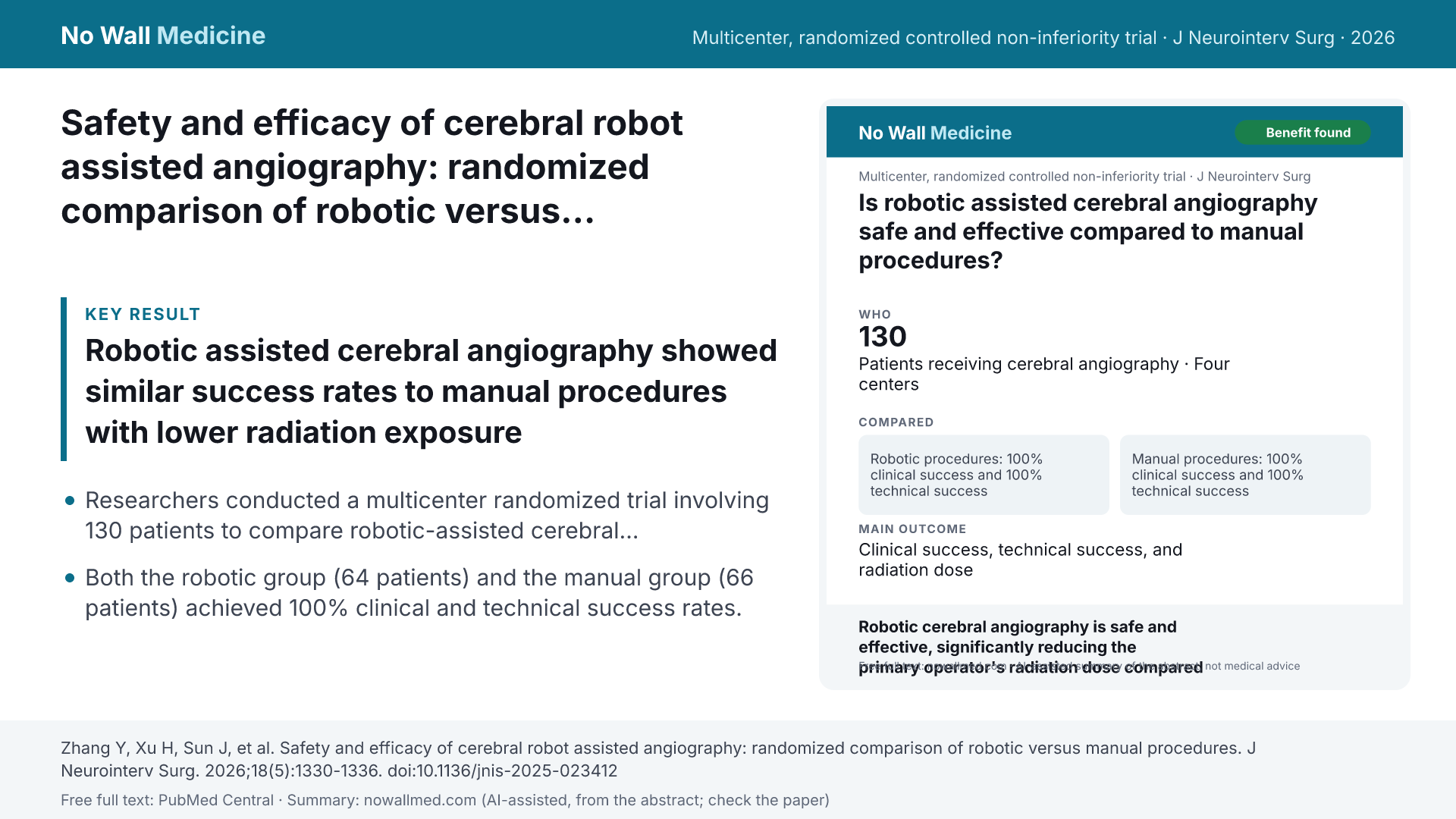
Robotic assisted cerebral angiography showed similar success rates to manual procedures with lower radiation exposure
Safety and efficacy of cerebral robot assisted angiography: randomized comparison of robotic versus manual procedures
Multicenter, randomized controlled non-inferiority trialBenefit found
Is robotic assisted cerebral angiography safe and effective compared to manual procedures?
Who
130
Patients receiving cerebral angiography · Four centers
Compared
Robotic procedures: 100% clinical success and 100% technical success
Manual procedures: 100% clinical success and 100% technical success
Main outcome
Clinical success, technical success, and radiation dose
Result: primary operator's radiation dose 1.67±3.49 μSv vs 43.63±38.95 μSv
Bottom line: Robotic cerebral angiography is safe and effective, significantly reducing the primary operator's radiation dose compared to manual procedures.
J Neurointerv Surg · 2026-04-16 · Save PNG
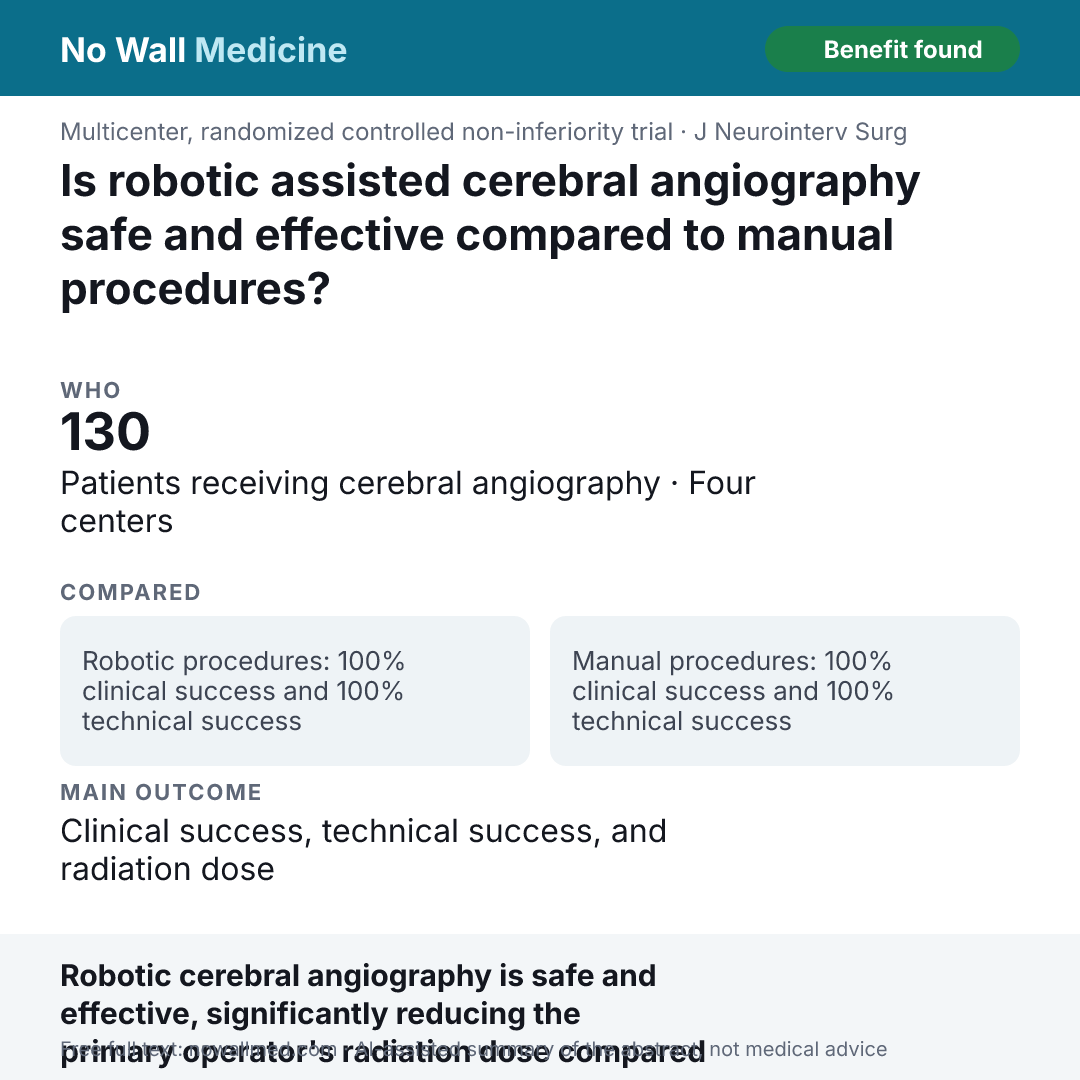
Clinical question: Is robotic assisted cerebral angiography safe and effective compared to manual procedures?
Why it matters: Neurovascular applications currently lack a robotic system for cerebral angiography, and the safety and efficacy of novel robotic systems need to be assessed.
Key points
- Researchers conducted a multicenter randomized trial involving 130 patients to compare robotic-assisted cerebral angiography with manual procedures.
- Both the robotic group (64 patients) and the manual group (66 patients) achieved 100% clinical and technical success rates.
- The robotic group had a lower primary operator radiation dose of 1.67±3.49 μSv compared to 43.63±38.95 μSv in the manual group.
Headline and key points written with AI from the paper’s abstract, with every number checked against it. Read the paper before relying on them.
Was this summary helpful?
Abstract
Background
While robotic assisted technology has advanced in cardiovascular interventions, neurovascular applications still lack a robotic system. To assess the safety and efficacy of novel robotic systems designed for cerebral angiography, we conducted a multicenter, randomized controlled non-inferiority trial. Methods
130 patients were recruited who received cerebral angiography in four centers. After identifying the target vessels, patients were randomly allocated to an experimental group for robotic procedures and a control group for manual procedures in a 1:1 ratio. Clinical success rate, technical success rate, overall surgery time, pre-puncture set-up time, puncture-to-unsheathed time, mean catheterization time per target vessel, X-ray fluoroscopy time, and primary operator's radiation dose were compared. The safety endpoints were incidence of perioperative vascular injuries, any adverse events, and device malfunctions. Results
64 patients were assigned to the experimental group and 66 to the control group. Both groups achieved 100% clinical success and a 100% technical success. Significantly, the primary operator's radiation dose in the robotic group was lower than that in the manual group (1.67±3.49 μSv vs 43.63±38.95 μSv, P<0.001). The puncture-to-unsheathed time (P=0.882), mean catheterization time per target vessel (P=0.247), and fluoroscopy time (P=0.701) were comparable. The pre-puncture set-up time in the robotic group was longer (P<0.001), attributed to prolonged robotic instrument set-up. No robot related adverse events were observed. Conclusion
The trial showed that the robotic system was safe and effective for assisting cerebral angiography, notably reducing primary operators' radiation exposure. Trial registration number
ClinicalTrials.gov NCT05778214.
Abstract reproduced under the article’s CC BY NC licence.
Subject terms
Headline, design, result, key points, caveat and citation as plain text.
Cite this article
Zhang Y, Xu H, Sun J, et al. Safety and efficacy of cerebral robot assisted angiography: randomized comparison of robotic versus manual procedures. J Neurointerv Surg. 2026;18(5):1330-1336. doi:10.1136/jnis-2025-023412
Spotted a mistake? Suggest a correction