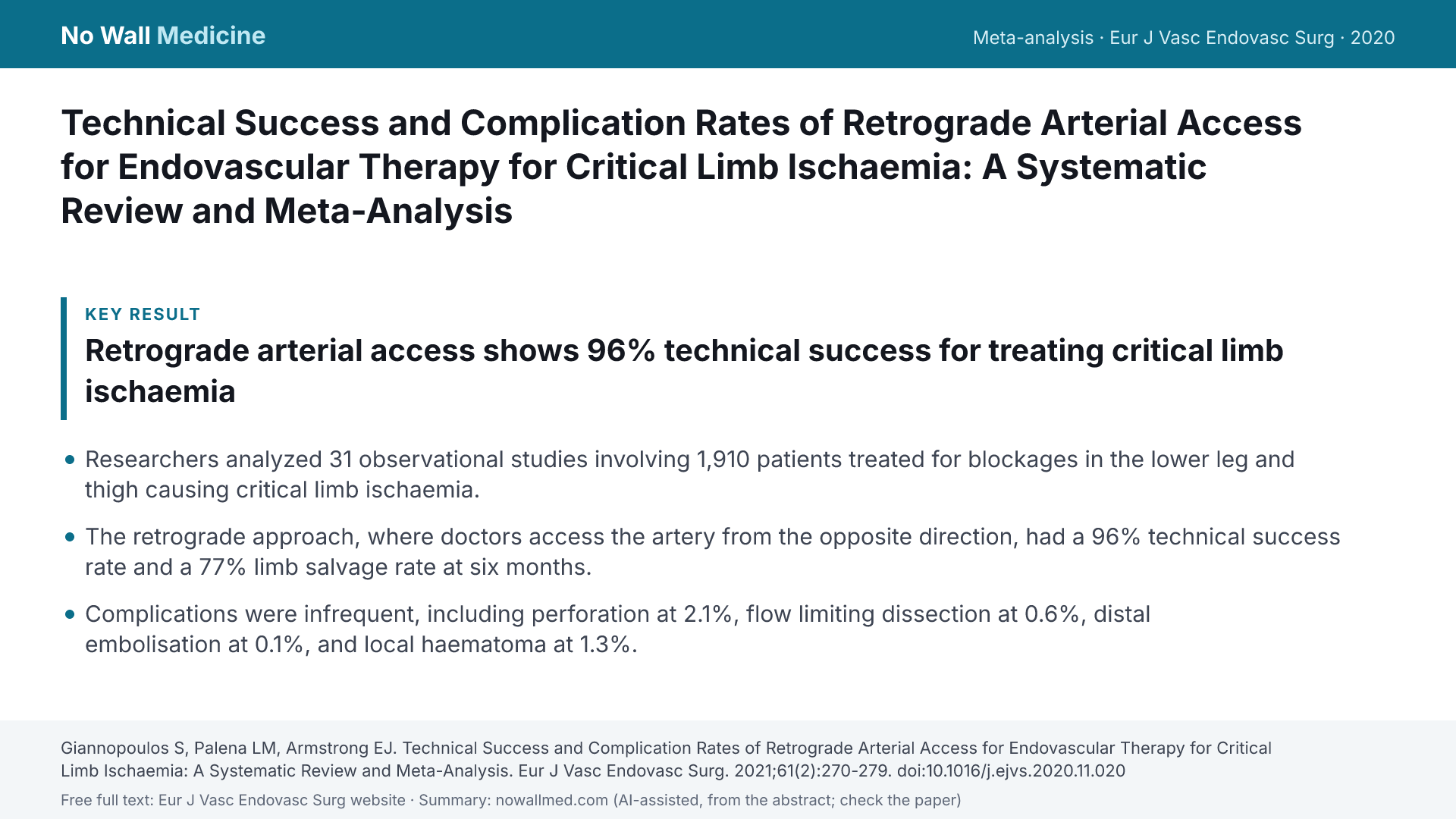
Retrograde arterial access shows 96% technical success for treating critical limb ischaemia
Technical Success and Complication Rates of Retrograde Arterial Access for Endovascular Therapy for Critical Limb Ischaemia: A Systematic Review and Meta-Analysis
Why it matters: Antegrade crossing techniques, which approach the blockage from the standard direction, can be difficult and may lead to technical or clinical failure in patients with critical limb ischaemia.
Key points
- Researchers analyzed 31 observational studies involving 1,910 patients treated for blockages in the lower leg and thigh causing critical limb ischaemia.
- The retrograde approach, where doctors access the artery from the opposite direction, had a 96% technical success rate and a 77% limb salvage rate at six months.
- Complications were infrequent, including perforation at 2.1%, flow limiting dissection at 0.6%, distal embolisation at 0.1%, and local haematoma at 1.3%.
Limitation the authors note: The meta-analysis was based on observational studies, including 29 retrospective studies, and the authors note a need for prospective studies with standardized protocols.
Headline and key points written with AI from the paper’s abstract, with every number checked against it. Read the paper before relying on them.
Was this summary helpful?
Subject terms
Headline, design, result, key points, caveat and citation as plain text.
Cite this article
Giannopoulos S, Palena LM, Armstrong EJ. Technical Success and Complication Rates of Retrograde Arterial Access for Endovascular Therapy for Critical Limb Ischaemia: A Systematic Review and Meta-Analysis. Eur J Vasc Endovasc Surg. 2021;61(2):270-279. doi:10.1016/j.ejvs.2020.11.020
Spotted a mistake? Suggest a correction