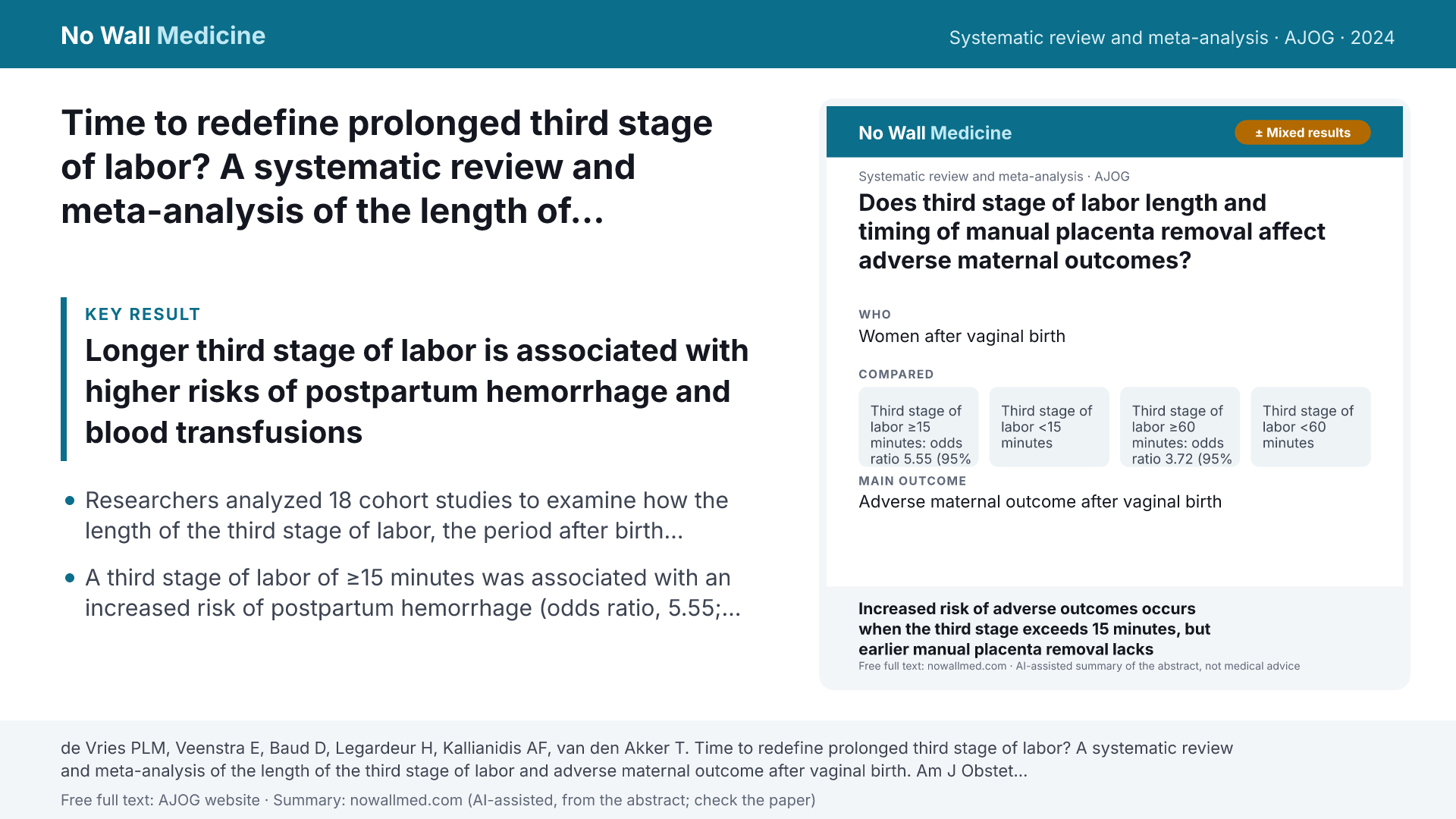
Longer third stage of labor is associated with higher risks of postpartum hemorrhage and blood transfusions
Time to redefine prolonged third stage of labor? A systematic review and meta-analysis of the length of the third stage of labor and adverse maternal outcome after vaginal birth
Systematic review and meta-analysisMixed results
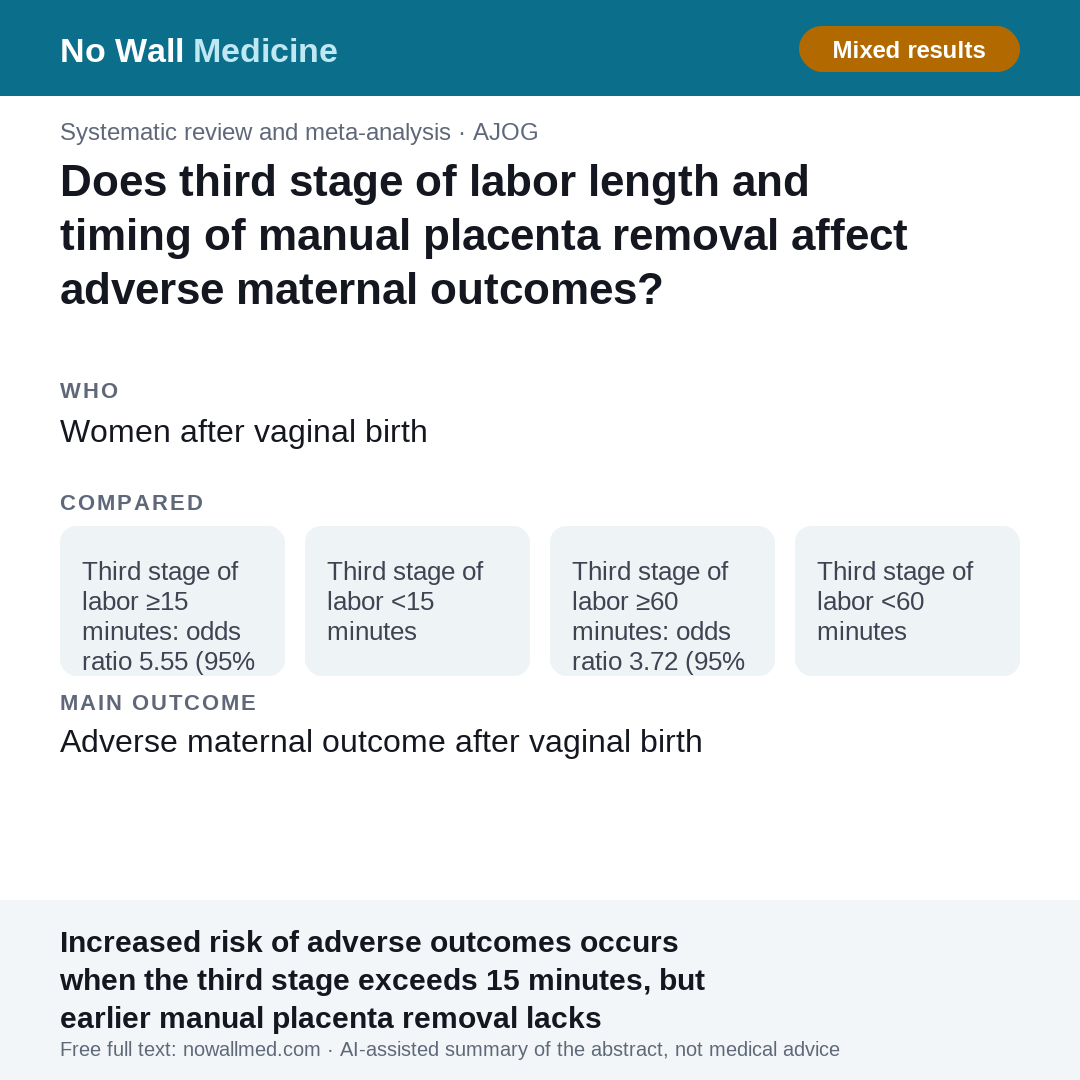
Does third stage of labor length and timing of manual placenta removal affect adverse maternal outcomes?
Who
Women after vaginal birth
Compared
Third stage of labor ≥15 minutes: odds ratio 5.55 (95% confidence interval 1.74-17.72)
Third stage of labor <15 minutes
Third stage of labor ≥60 minutes: odds ratio 3.72 (95% confidence interval 2.36-5.89)
Third stage of labor <60 minutes
Main outcome
Adverse maternal outcome after vaginal birth
Bottom line: Increased risk of adverse outcomes occurs when the third stage exceeds 15 minutes, but earlier manual placenta removal lacks convincing evidence.
Limitation: Results for timing of placenta removal could not be pooled due to different outcome measures.
AJOG · 2024-07-19Download image
Clinical question: Does third stage of labor length and timing of manual placenta removal affect adverse maternal outcomes?
Why it matters: It is unclear if reducing the length of the third stage of labor through earlier manual removal of the placenta can reduce adverse maternal outcomes.
Key points
- Researchers analyzed 18 cohort studies to examine how the length of the third stage of labor, the period after birth when the placenta is expelled, relates to maternal complications.
- A third stage of labor of ≥15 minutes was associated with an increased risk of postpartum hemorrhage (odds ratio, 5.55; 95% confidence interval, 1.74-17.72).
- A third stage of labor of ≥30 minutes was associated with a higher incidence of red blood cell transfusion (odds ratio, 3.23; 95% confidence interval, 2.26-4.61).
Limitation the authors note: The results regarding the timing of manual placenta removal could not be pooled because the included studies used different outcome measures.
Headline and key points written with AI from the paper’s abstract, with every number checked against it. Read the paper before relying on them.
Was this summary helpful?
Subject terms
Cite this article
de Vries PLM, Veenstra E, Baud D, Legardeur H, Kallianidis AF, van den Akker T. Time to redefine prolonged third stage of labor? A systematic review and meta-analysis of the length of the third stage of labor and adverse maternal outcome after vaginal birth. AJOG. 2024. doi:10.1016/j.ajog.2024.07.019
Spotted a mistake? Suggest a correction