Virtual reality interventions improved memory, attention, and executive function in older adults with mild cognitive impairment
Virtual Reality Interventions for Older Adults With Mild Cognitive Impairment: Systematic Review and Meta-Analysis of Randomized Controlled Trials
Systematic review and meta-analysis of randomized controlled trialsBenefit found
Do virtual reality interventions improve outcomes in older adults with mild cognitive impairment?
Who
722
Older adults aged 55 years or older with mild cognitive impairment
Compared
Virtual reality interventions
Control
Main outcome
Cognition, mood, quality of life, and physical fitness
Result: memory SMD 0.2 (95% CI 0.02-0.38), attention and information processing speed SMD 0.25 (95% CI 0.06-0.45), executive function SMD 0.22 (95% CI 0.02-0.42)
Bottom line: Virtual reality interventions can improve memory, attention, information processing speed, and executive function in older adults with mild cognitive impairment.
Limitation: The quality of evidence is moderate to low for certain outcomes.
J Med Internet Res · 2025-01-10Download image
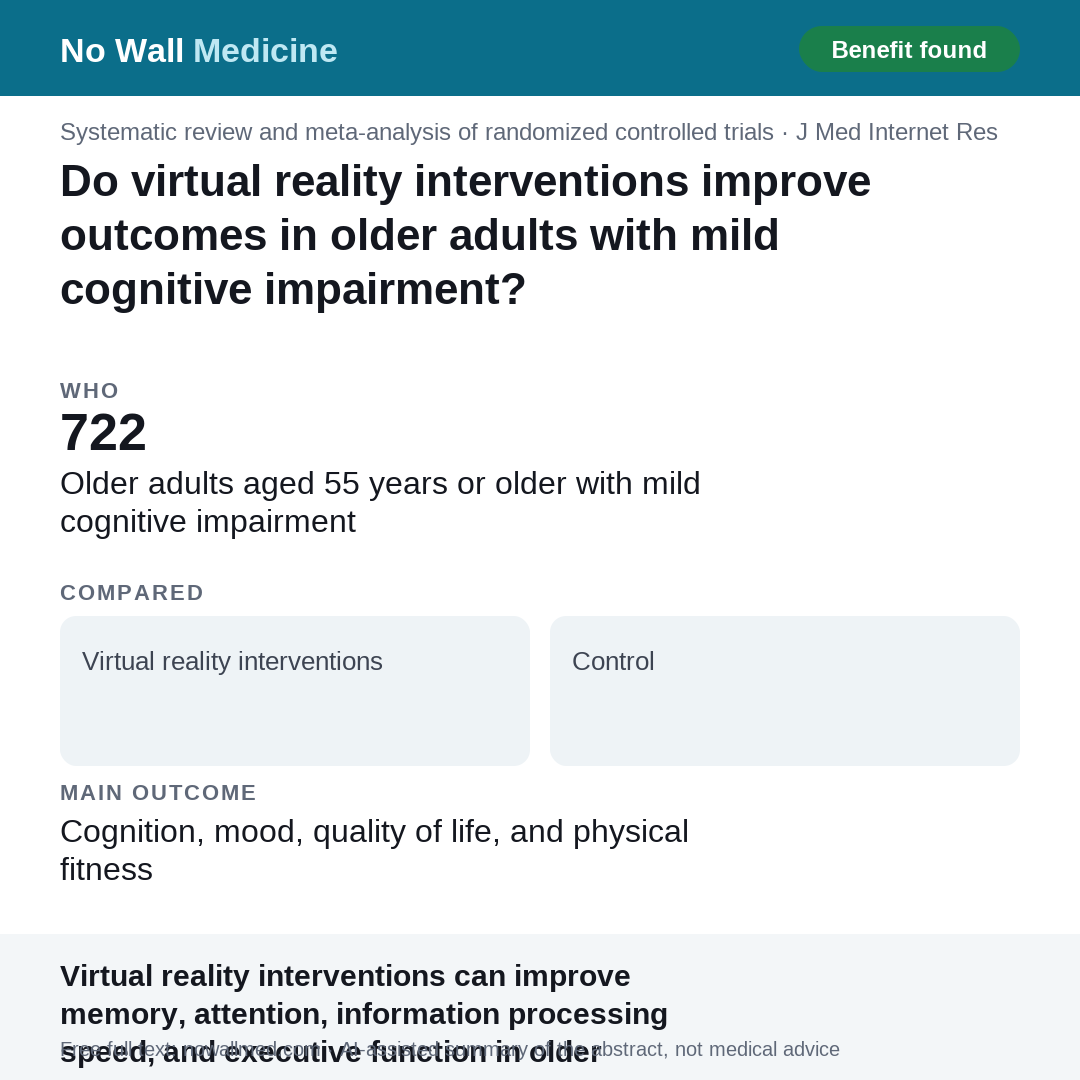
Clinical question: Do virtual reality interventions improve outcomes in older adults with mild cognitive impairment?
Why it matters: It is unknown how virtual reality technology affects cognitive abilities, mood, quality of life, and physical fitness in older adults with mild cognitive impairment.
Key points
- Researchers analyzed 18 randomized controlled trials involving 722 older adults aged 55 years or older with mild cognitive impairment.
- Virtual reality was associated with improvements in memory (SMD 0.2, 95% CI 0.02-0.38), attention and information processing speed (SMD 0.25, 95% CI 0.06-0.45), and executive function (SMD 0.22, 95% CI 0.02-0.42).
- The effects were very small for general cognitive function, language proficiency, visuospatial abilities, depression, daily living ability, muscle performance, and gait and balance.
Limitation the authors note: The quality of evidence varied from moderate to low based on the GRADE approach.
Headline and key points written with AI from the paper’s abstract, with every number checked against it. Read the paper before relying on them.
Topics
Cite this article
Yang Q, Zhang L, Chang F, Yang H, Chen B, Liu Z. Virtual Reality Interventions for Older Adults With Mild Cognitive Impairment: Systematic Review and Meta-Analysis of Randomized Controlled Trials. J Med Internet Res. 2025. doi:10.2196/59195
Spotted a mistake? Suggest a correction
Top studies every Monday
The week’s key trials and guidelines in your specialties, by email. Free.
Get the weekly digest