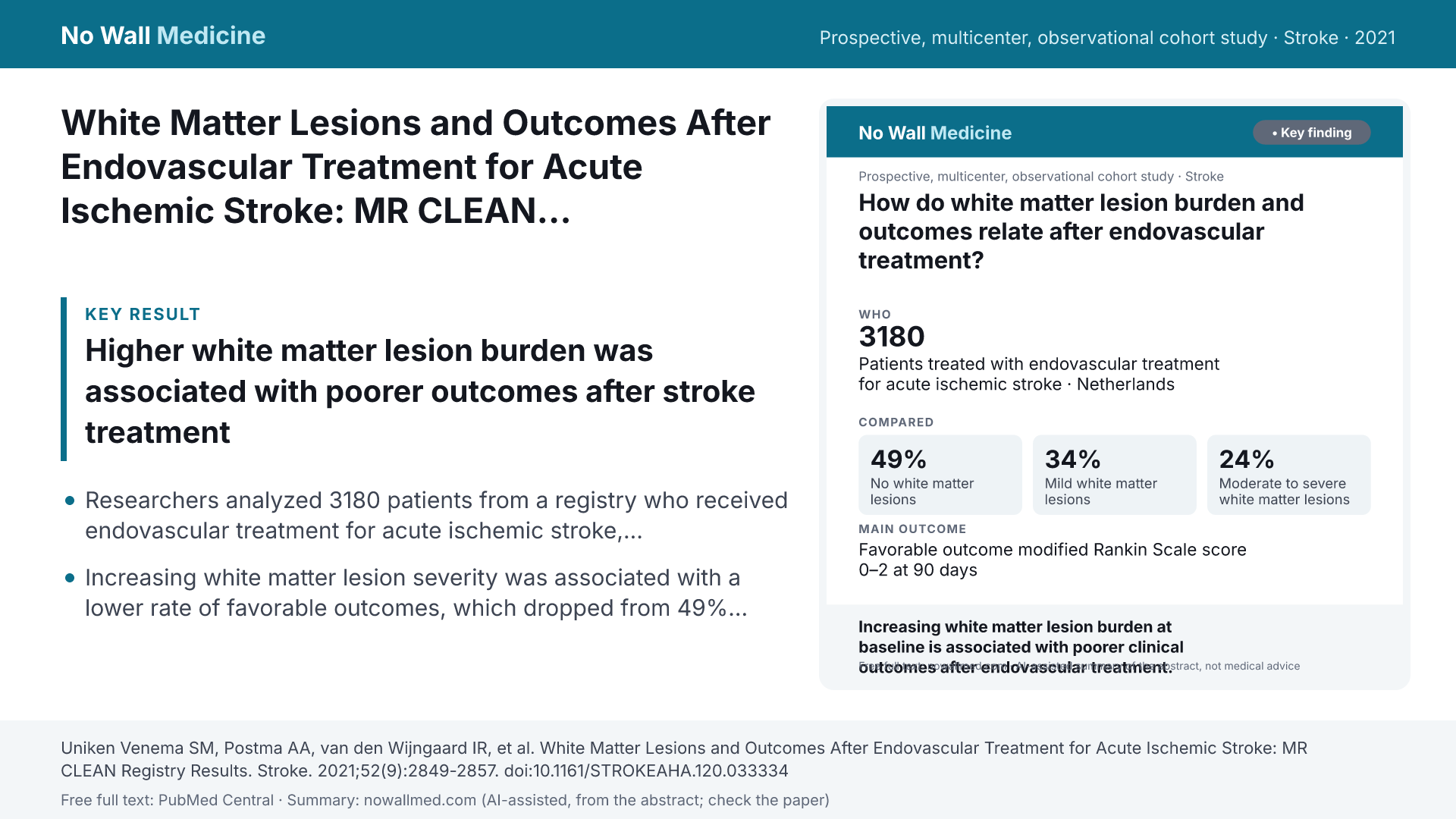
Higher white matter lesion burden was associated with poorer outcomes after stroke treatment
White Matter Lesions and Outcomes After Endovascular Treatment for Acute Ischemic Stroke: MR CLEAN Registry Results
Prospective, multicenter, observational cohort studyKey finding
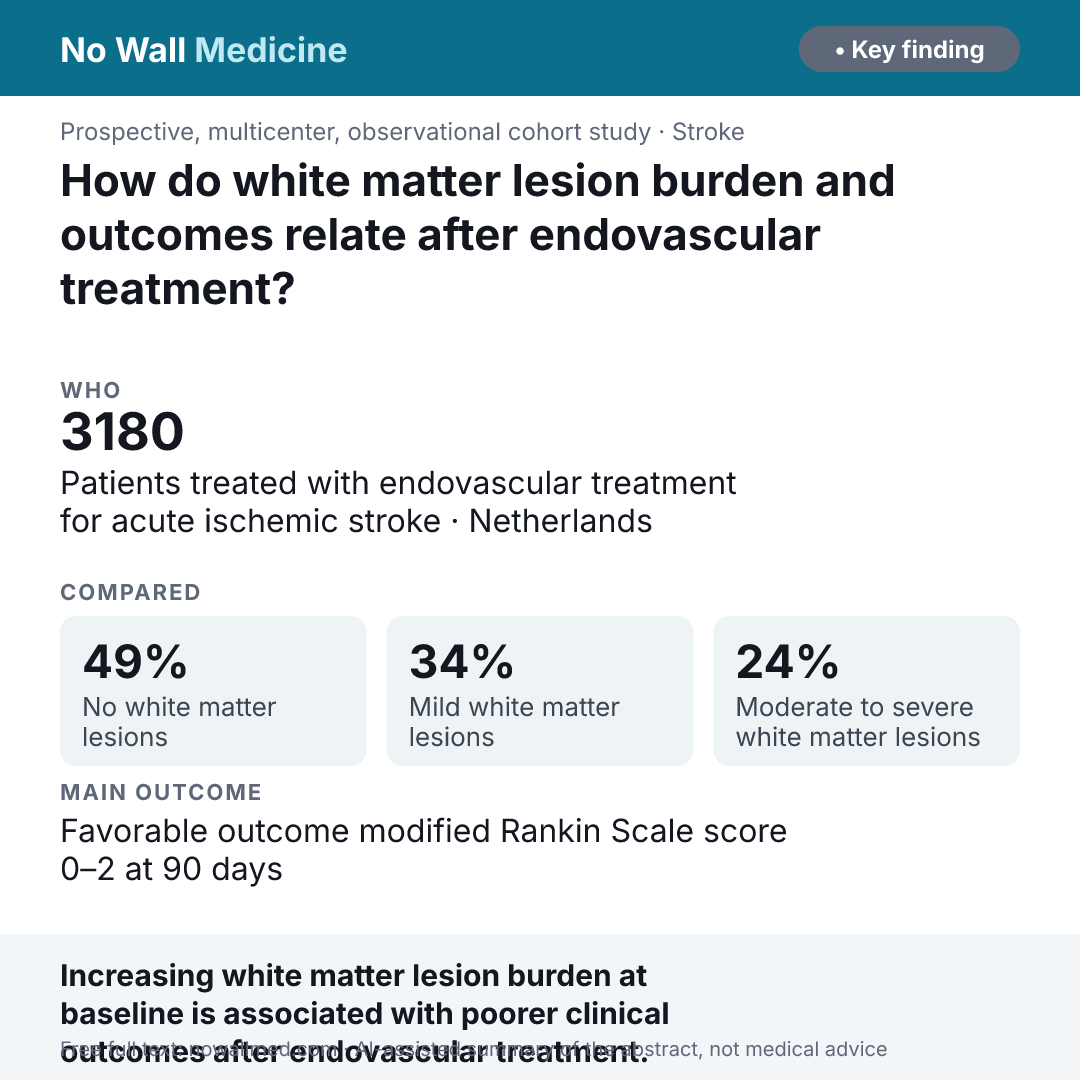
How do white matter lesion burden and outcomes relate after endovascular treatment?
Who
3180
Patients treated with endovascular treatment for acute ischemic stroke · Netherlands
Compared
49%No white matter lesions
34%Mild white matter lesions
24%Moderate to severe white matter lesions
Main outcome
Favorable outcome modified Rankin Scale score 0–2 at 90 days
Result: adjusted common odds ratio 1.67 (95% CI 1.39 to 2.01) for moderate-to-severe
Bottom line: Increasing white matter lesion burden at baseline is associated with poorer clinical outcomes after endovascular treatment.
Stroke · 2021-06-03 · Save PNG
Clinical question: How do white matter lesion burden and outcomes relate after endovascular treatment?
Key points
- Researchers analyzed 3180 patients from a registry who received endovascular treatment for acute ischemic stroke, measuring white matter lesions on brain scans.
- Increasing white matter lesion severity was associated with a lower rate of favorable outcomes, which dropped from 49% in patients with no lesions to 24% in those with moderate-to-severe lesions.
- Higher lesion grades were associated with futile recanalization and lower early neurological recovery, but were not linked to successful reperfusion or symptomatic intracranial hemorrhage.
Limitation the authors note: The study used an observational cohort design.
Headline and key points written with AI from the paper’s abstract, with every number checked against it. Read the paper before relying on them.
Was this summary helpful?
Subject terms
Headline, design, result, key points, caveat and citation as plain text.
Cite this article
Uniken Venema SM, Postma AA, van den Wijngaard IR, et al. White Matter Lesions and Outcomes After Endovascular Treatment for Acute Ischemic Stroke: MR CLEAN Registry Results. Stroke. 2021;52(9):2849-2857. doi:10.1161/STROKEAHA.120.033334
Spotted a mistake? Suggest a correction