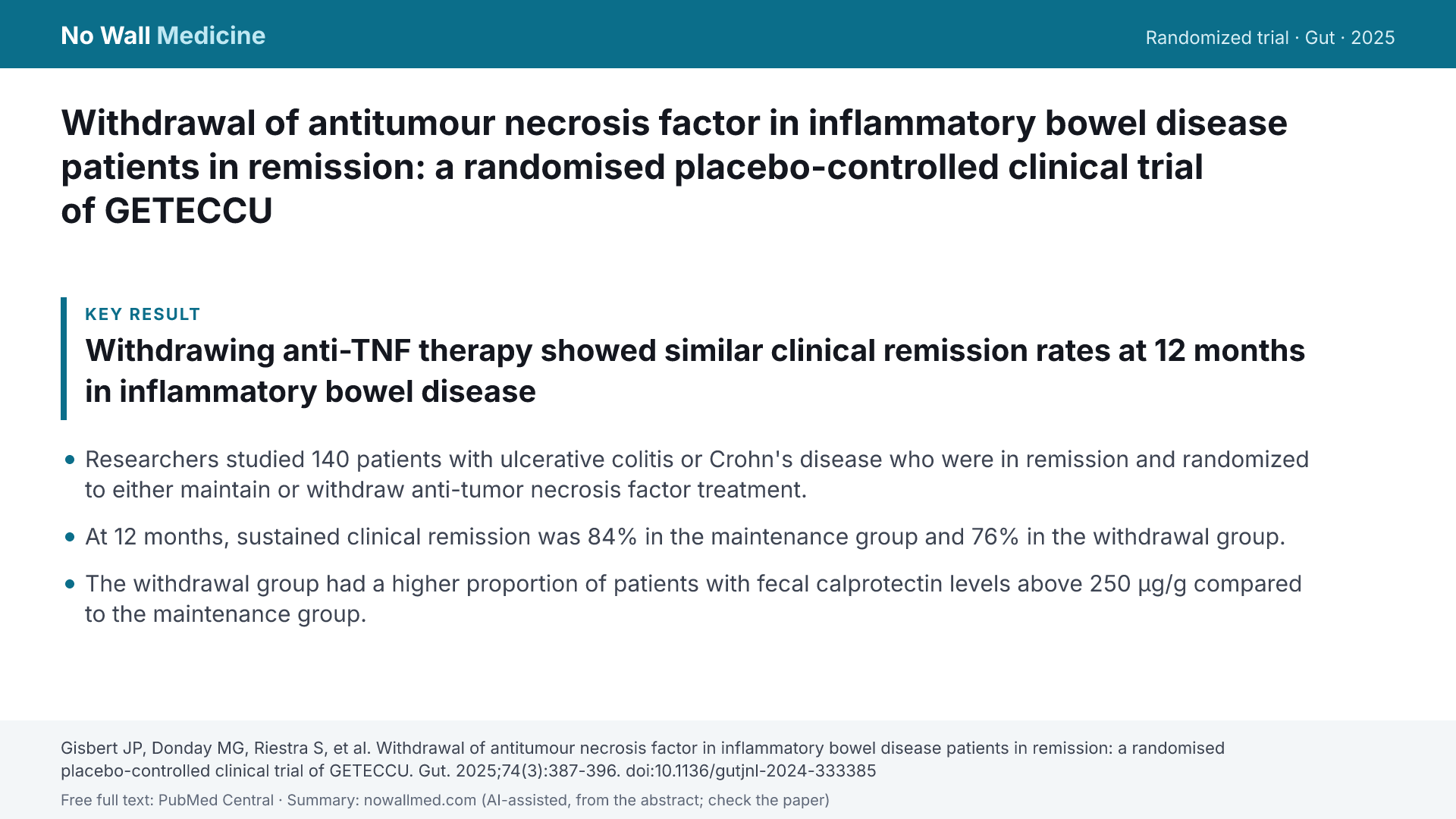
Withdrawing anti-TNF therapy showed similar clinical remission rates at 12 months in inflammatory bowel disease
Withdrawal of antitumour necrosis factor in inflammatory bowel disease patients in remission: a randomised placebo-controlled clinical trial of GETECCU
Key points
- Researchers studied 140 patients with ulcerative colitis or Crohn's disease who were in remission and randomized to either maintain or withdraw anti-tumor necrosis factor treatment.
- At 12 months, sustained clinical remission was 84% in the maintenance group and 76% in the withdrawal group.
- The withdrawal group had a higher proportion of patients with fecal calprotectin levels above 250 µg/g compared to the maintenance group.
Headline and key points written with AI from the paper’s abstract, with every number checked against it. Read the paper before relying on them.
Was this summary helpful?
Abstract
Background and objectives
Primary objectives: to compare the rates of sustained clinical remission at 12 months in patients treated with antitumour necrosis factor (anti-TNF) and immunomodulators who withdraw anti-TNF treatment versus those who maintain it. Secondary objectives
to evaluate the effect of anti-TNF withdrawal on relapse-free time, endoscopic and radiological activity, safety, quality of life and work productivity; and to identify predictive factors for relapse. Design
Prospective, quadruple-blind, multicentre, randomised, controlled trial. Patients with ulcerative colitis or Crohn's disease in clinical remission for >6 months and absence of severe endoscopic (and radiological in Crohn's disease) lesions were randomised to maintain anti-TNF treatment (maintenance arm (MA)) or to withdraw it (withdrawal arm (WA)). All patients maintained immunomodulators. Patients were followed-up until month 12 or up to clinical relapse. Results
One-hundred forty patients were randomised: 70 were allocated to the MA and 70 to the WA. The proportion of patients with sustained clinical remission at 12 months was similar in the MA and WA: 59/70 (84%), 95% CI=74% to 92% versus 53/70 (76%), 95% CI=64% to 85%. The proportion of patients with significant endoscopic lesions at the end of follow-up was 8.5% in the MA and 19% in the WA (p=0.1); a higher proportion of patients had faecal calprotectin >250 µg/g at the end of follow-up in the WA (p=0.01). The same percentage of patients in both groups had at least one adverse event (69%). The proportion of patients with serious adverse events was also similar in both groups (4% in MA vs 7% in WA). Conclusion
Anti-TNF withdrawal in selected patients with IBD in clinical, endoscopic and radiological remission has no impact on sustained clinical remission at 1 year although objective markers of activity were higher in patients who withdrew treatment. Trial registration number
https://www.clinicaltrialsregister.eu/ctr-search/search?query=2015-001410-10 https://clinicaltrials.gov/study/NCT02994836.
Abstract reproduced under the article’s CC BY NC licence.
Subject terms
Headline, design, result, key points, caveat and citation as plain text.
Cite this article
Gisbert JP, Donday MG, Riestra S, et al. Withdrawal of antitumour necrosis factor in inflammatory bowel disease patients in remission: a randomised placebo-controlled clinical trial of GETECCU. Gut. 2025;74(3):387-396. doi:10.1136/gutjnl-2024-333385
Spotted a mistake? Suggest a correction