Visual abstracts
New randomized trials and meta-analyses from leading journals at a glance: who was studied, what was compared, and what was found. Every paper is free to read in full.
All specialtiesCardiology 4877Oncology 4138Gastroenterology & Hepatology 1942Infectious Disease 3837Neurology 1905Psychiatry & Mental Health 2273Pulmonology 2143Critical Care 1365Endocrinology & Diabetes 2580Pediatrics 2980Surgery 2559Orthopedics & Sports Medicine 931Neurosurgery 537Cardiothoracic & Vascular Surgery 674Plastic & Reconstructive Surgery 591Nephrology 1133Rheumatology 823Hematology 1109Dermatology 621Ophthalmology 543Obstetrics & Gynecology 1686Public & Global Health 1058Radiology & Imaging 648Anesthesiology 986Urology 764ENT (Otolaryngology) 503Emergency Medicine 511Allergy & Immunology 313Geriatrics 981Family Medicine & Primary Care 562Medical Genetics & Genomics 676Pathology & Laboratory Medicine 159Physical Medicine & Rehabilitation 757Palliative Care 444Nutrition 1588Digital Health & AI 2201General Medicine 321
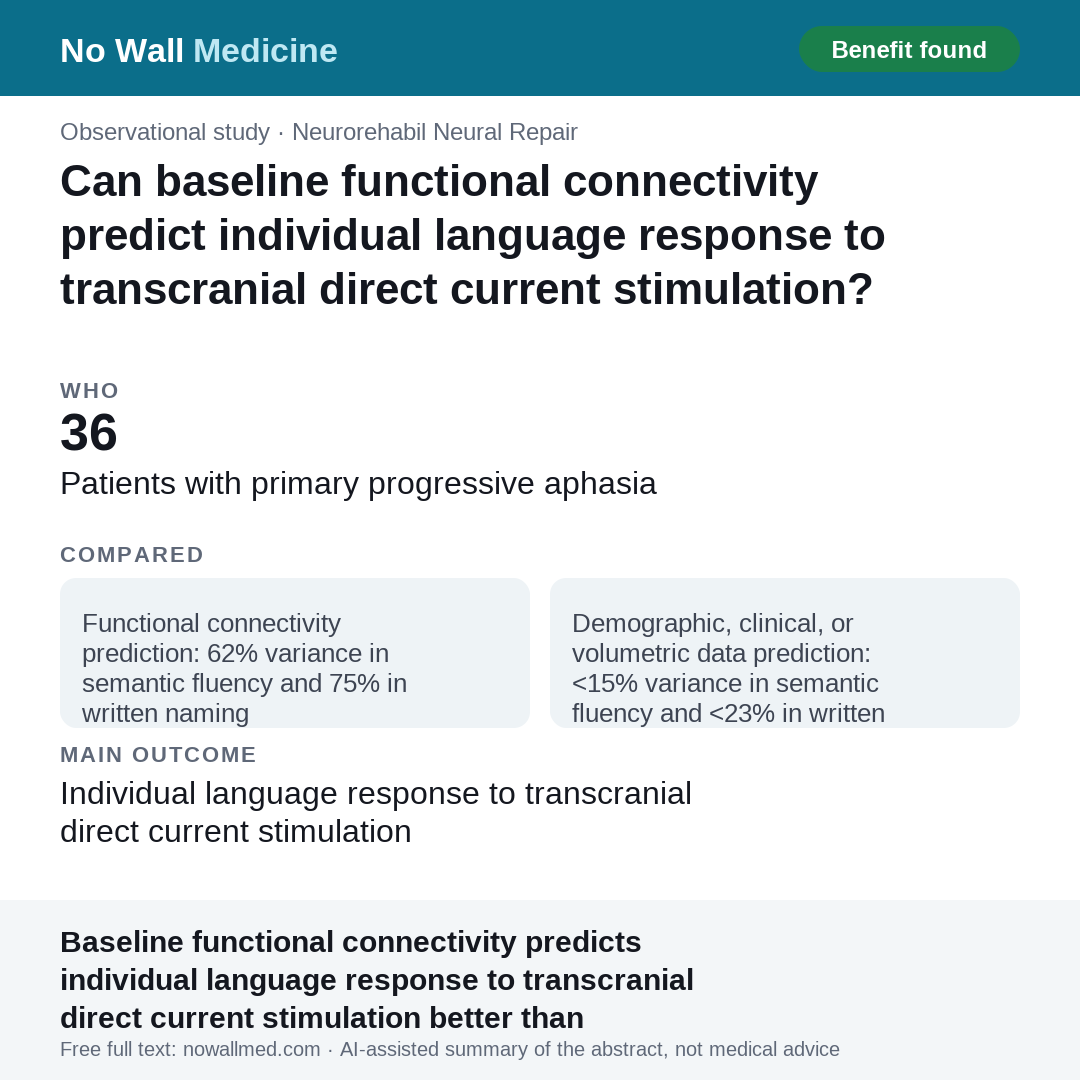
Baseline Functional Connectivity Predicts Who Will Benefit From Neuromodulation: Evidence From Primary Progressive Aphasia
Observational studyBenefit found
Can baseline functional connectivity predict individual language response to transcranial direct current stimulation?
Who
36
Patients with primary progressive aphasia
Compared
Functional connectivity prediction: 62% variance in semantic fluency and 75% in written naming
Demographic, clinical, or volumetric data prediction: <15% variance in semantic fluency and <23% in written naming
Main outcome
Individual language response to transcranial direct current stimulation
Bottom line: Baseline functional connectivity predicts individual language response to transcranial direct current stimulation better than clinical or volumetric data.
Neurorehabil Neural Repair · 2026-01-09Download image
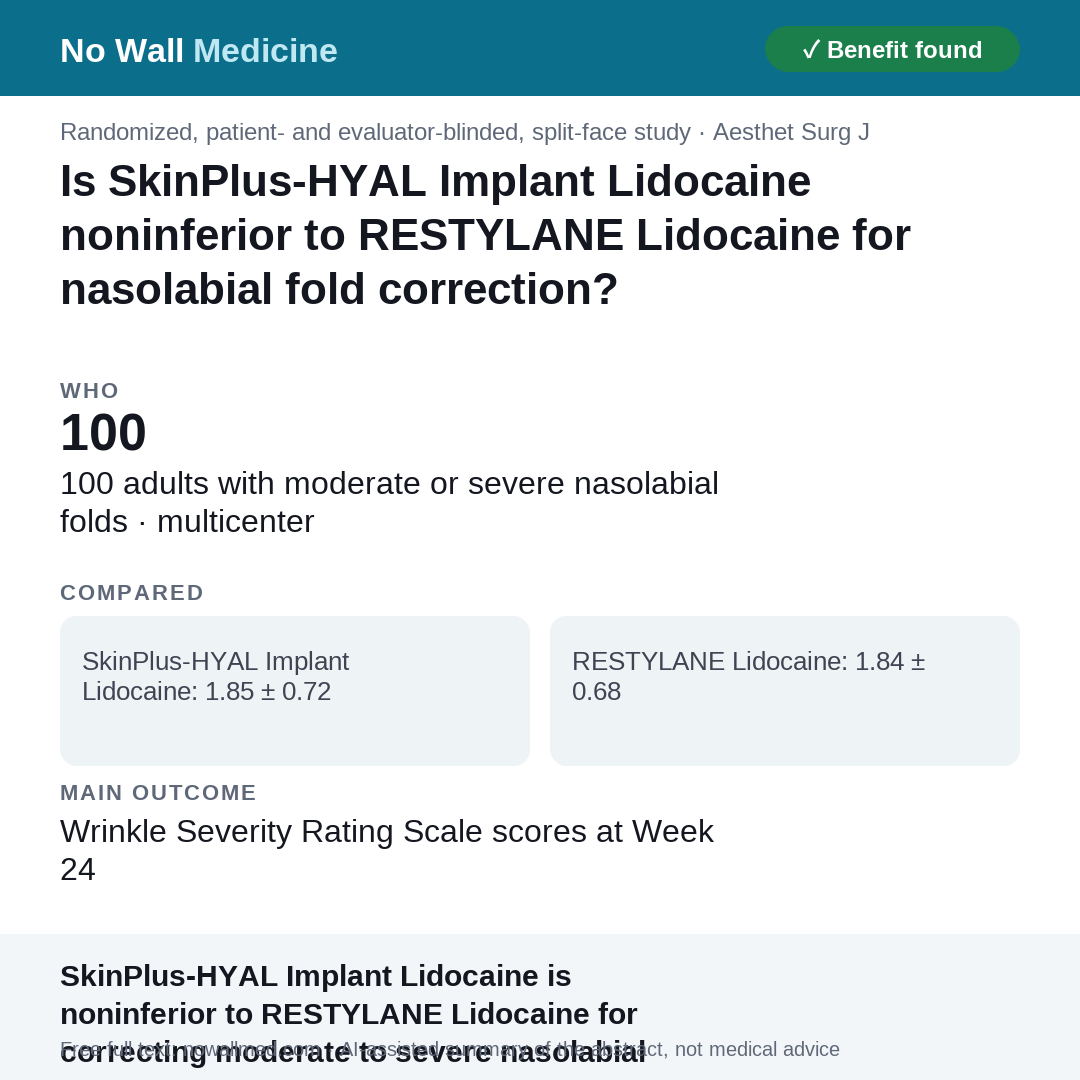
Safety and Effectiveness of a Crosslinked Hyaluronic Acid Filler in Korean Patients for the Correction of Nasolabial Folds: A Randomized, Patient- and Evaluator-Blinded, Paired Study
Randomized, patient- and evaluator-blinded, split-face studyBenefit found
Is SkinPlus-HYAL Implant Lidocaine noninferior to RESTYLANE Lidocaine for nasolabial fold correction?
Who
100
100 adults with moderate or severe nasolabial folds · multicenter
Compared
SkinPlus-HYAL Implant Lidocaine: 1.85 ± 0.72
RESTYLANE Lidocaine: 1.84 ± 0.68
Main outcome
Wrinkle Severity Rating Scale scores at Week 24
Result: mean difference 0.01 ± 0.48, upper 97.5% 1-sided confidence limit 0.2136
Bottom line: SkinPlus-HYAL Implant Lidocaine is noninferior to RESTYLANE Lidocaine for correcting moderate to severe nasolabial folds.
Aesthet Surg J · 2026-01-09Download image
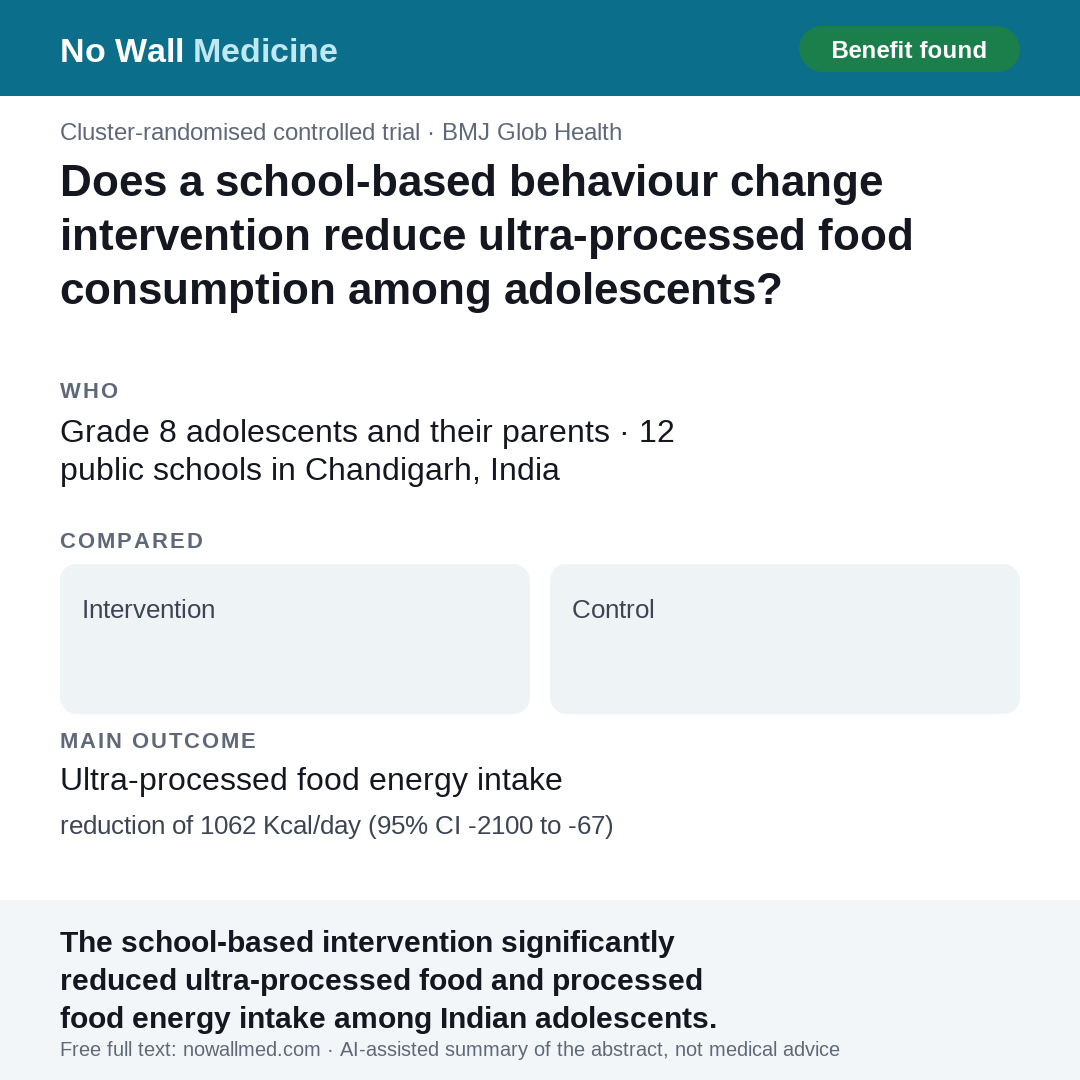
School-based behaviour change intervention to reduce ultra-processed food consumption among adolescents: evidence from a cluster-randomised controlled trial in India
Cluster-randomised controlled trialBenefit found
Does a school-based behaviour change intervention reduce ultra-processed food consumption among adolescents?
Who
Grade 8 adolescents and their parents · 12 public schools in Chandigarh, India
Compared
Intervention
Control
Main outcome
Ultra-processed food energy intake
Result: reduction of 1062 Kcal/day (95% CI -2100 to -67)
Bottom line: The school-based intervention significantly reduced ultra-processed food and processed food energy intake among Indian adolescents.
BMJ Glob Health · 2026-01-09Download image
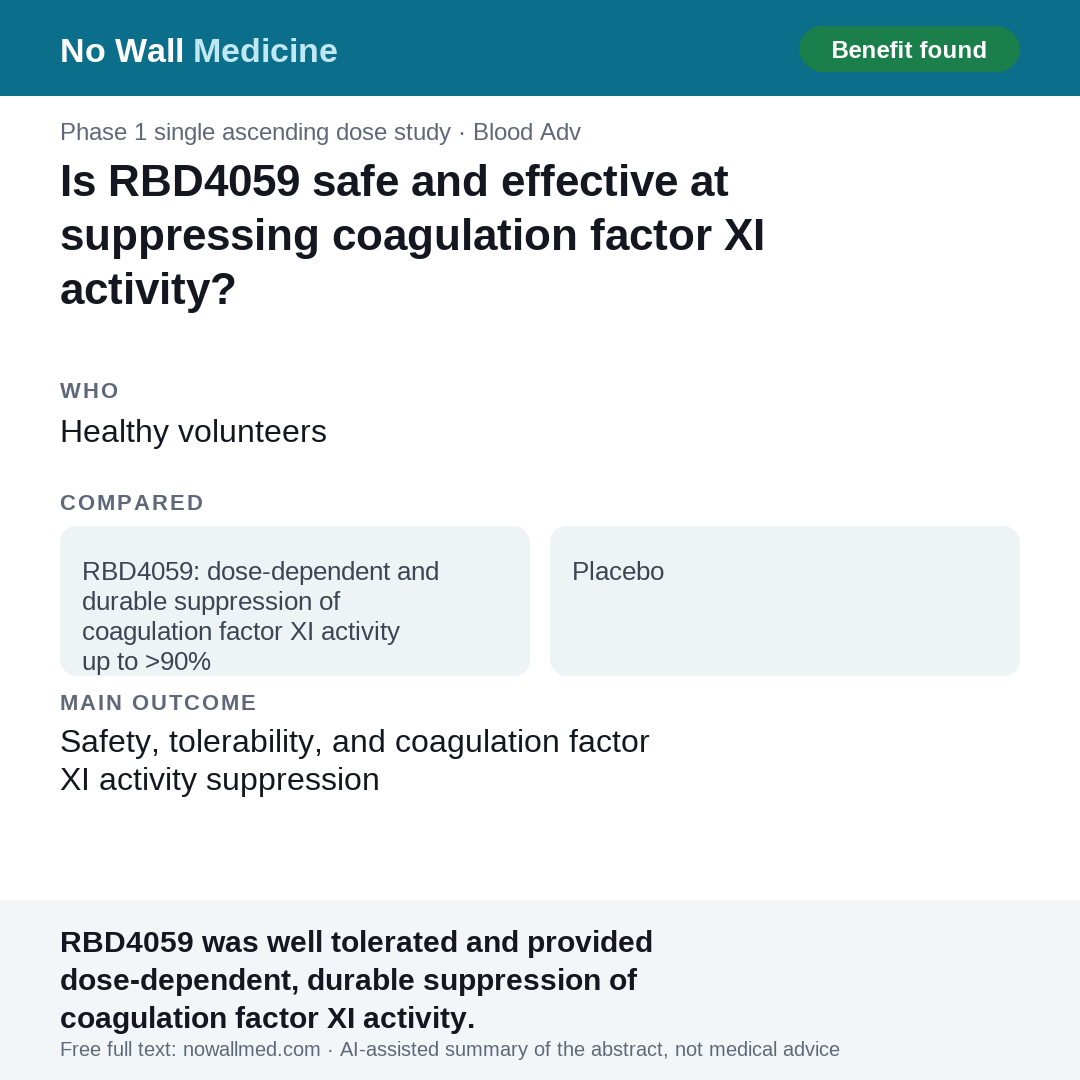
RNA interference therapy targeting coagulation factor XI: a first-in-human trial of RBD4059 (vortosiran)
Phase 1 single ascending dose studyBenefit found
Is RBD4059 safe and effective at suppressing coagulation factor XI activity?
Who
Healthy volunteers
Compared
RBD4059: dose-dependent and durable suppression of coagulation factor XI activity up to >90%
Placebo
Main outcome
Safety, tolerability, and coagulation factor XI activity suppression
Bottom line: RBD4059 was well tolerated and provided dose-dependent, durable suppression of coagulation factor XI activity.
Blood Adv · 2026-01-09Download image
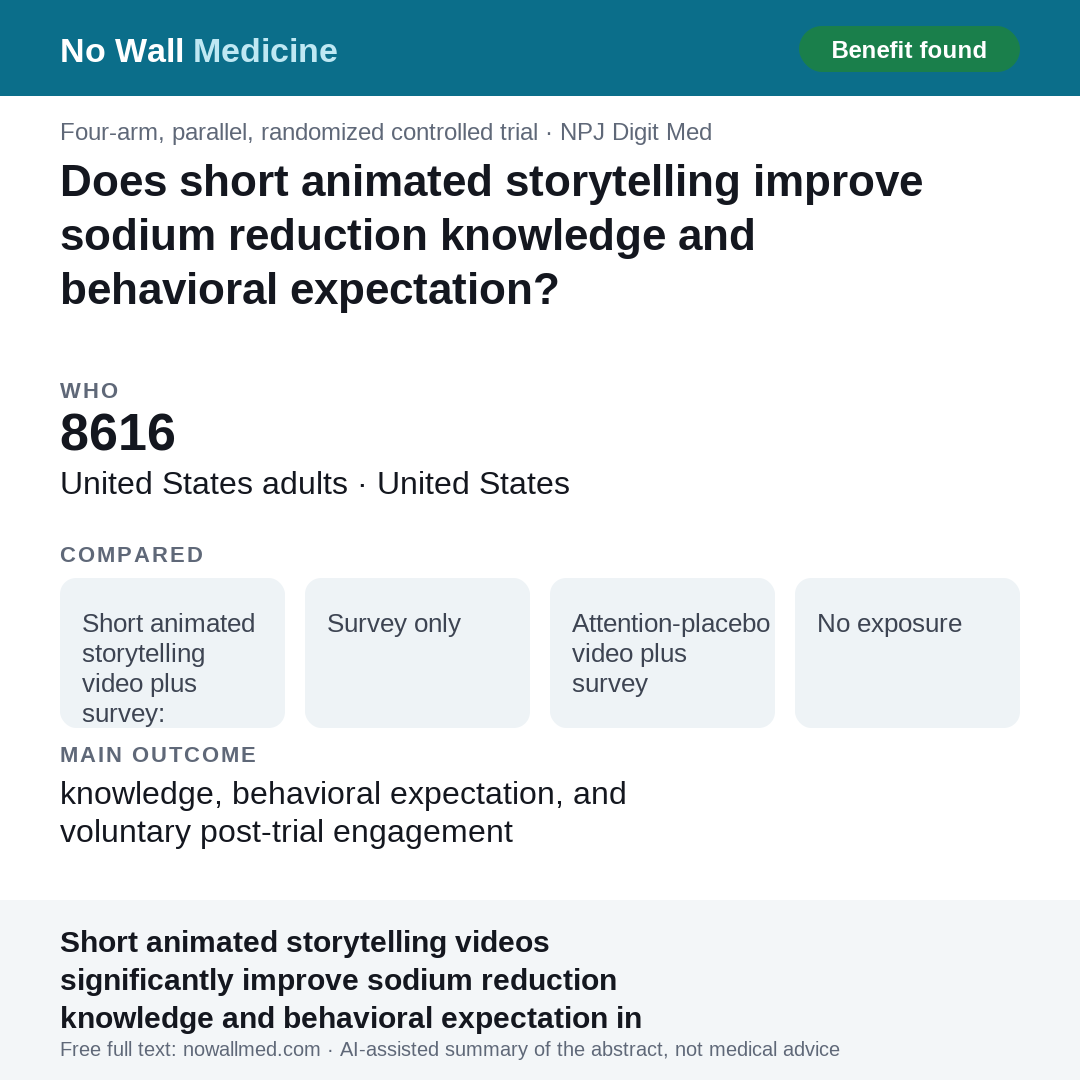
Digital storytelling boosts knowledge and behavioral expectation to reduce dietary sodium: a randomized controlled trial
Four-arm, parallel, randomized controlled trialBenefit found
Does short animated storytelling improve sodium reduction knowledge and behavioral expectation?
Who
8616
United States adults · United States
Compared
Short animated storytelling video plus survey: significantly improved knowledge and increased behavioral expectation
Survey only
Attention-placebo video plus survey
No exposure
Main outcome
knowledge, behavioral expectation, and voluntary post-trial engagement
Bottom line: Short animated storytelling videos significantly improve sodium reduction knowledge and behavioral expectation in United States adults.
NPJ Digit Med · 2026-01-09Download image
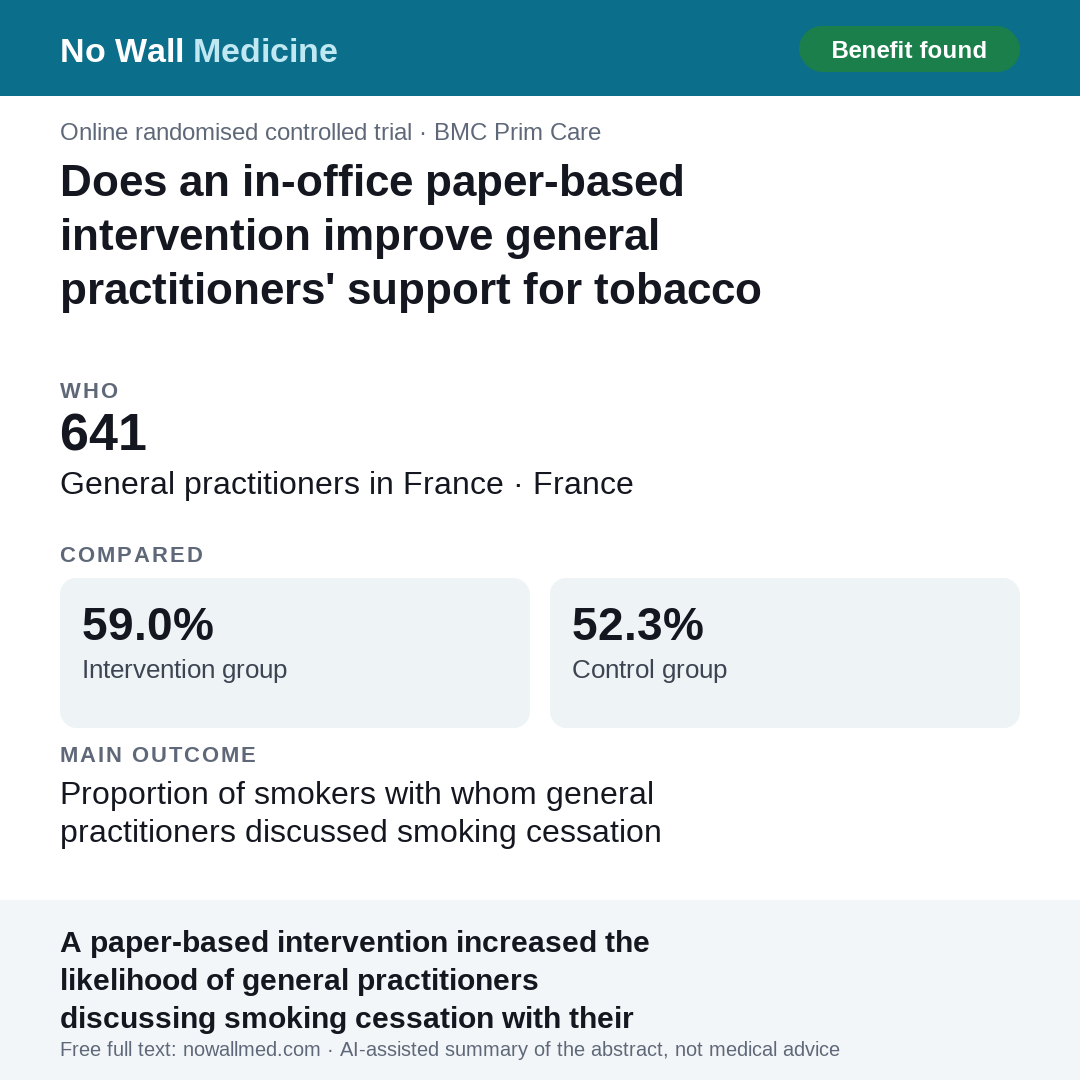
Effectiveness of an in-office intervention to improve general practitioners' support for tobacco smoking cessation: results from a randomised controlled trial (TABAC-PRO)
Online randomised controlled trialBenefit found
Does an in-office paper-based intervention improve general practitioners' support for tobacco smoking cessation?
Who
641
General practitioners in France · France
Compared
59.0%Intervention group
52.3%Control group
Main outcome
Proportion of smokers with whom general practitioners discussed smoking cessation
Bottom line: A paper-based intervention increased the likelihood of general practitioners discussing smoking cessation with their patients.
BMC Prim Care · 2026-01-09Download image
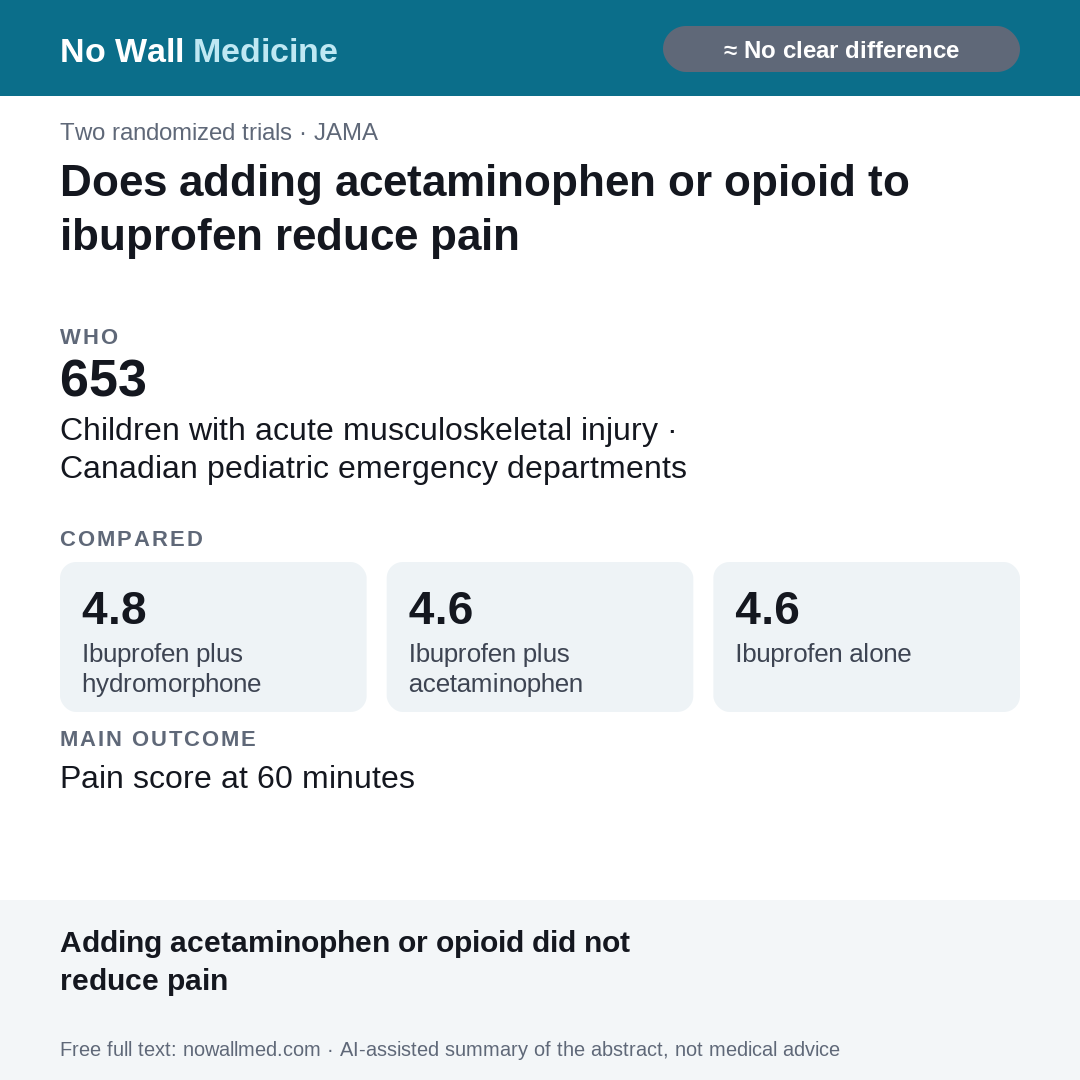
Acetaminophen (Paracetamol) or Opioid Analgesia Added to Ibuprofen for Children's Musculoskeletal Injury: Two Randomized Clinical Trials
Two randomized trialsNo clear difference
Does adding acetaminophen or opioid to ibuprofen reduce pain
Who
653
Children with acute musculoskeletal injury · Canadian pediatric emergency departments
Compared
4.8Ibuprofen plus hydromorphone (2.6)
4.6Ibuprofen plus acetaminophen (2.4)
4.6Ibuprofen alone (2.3)
Main outcome
Pain score at 60 minutes
Bottom line: Adding acetaminophen or opioid did not reduce pain
JAMA · 2026-01-08Download image
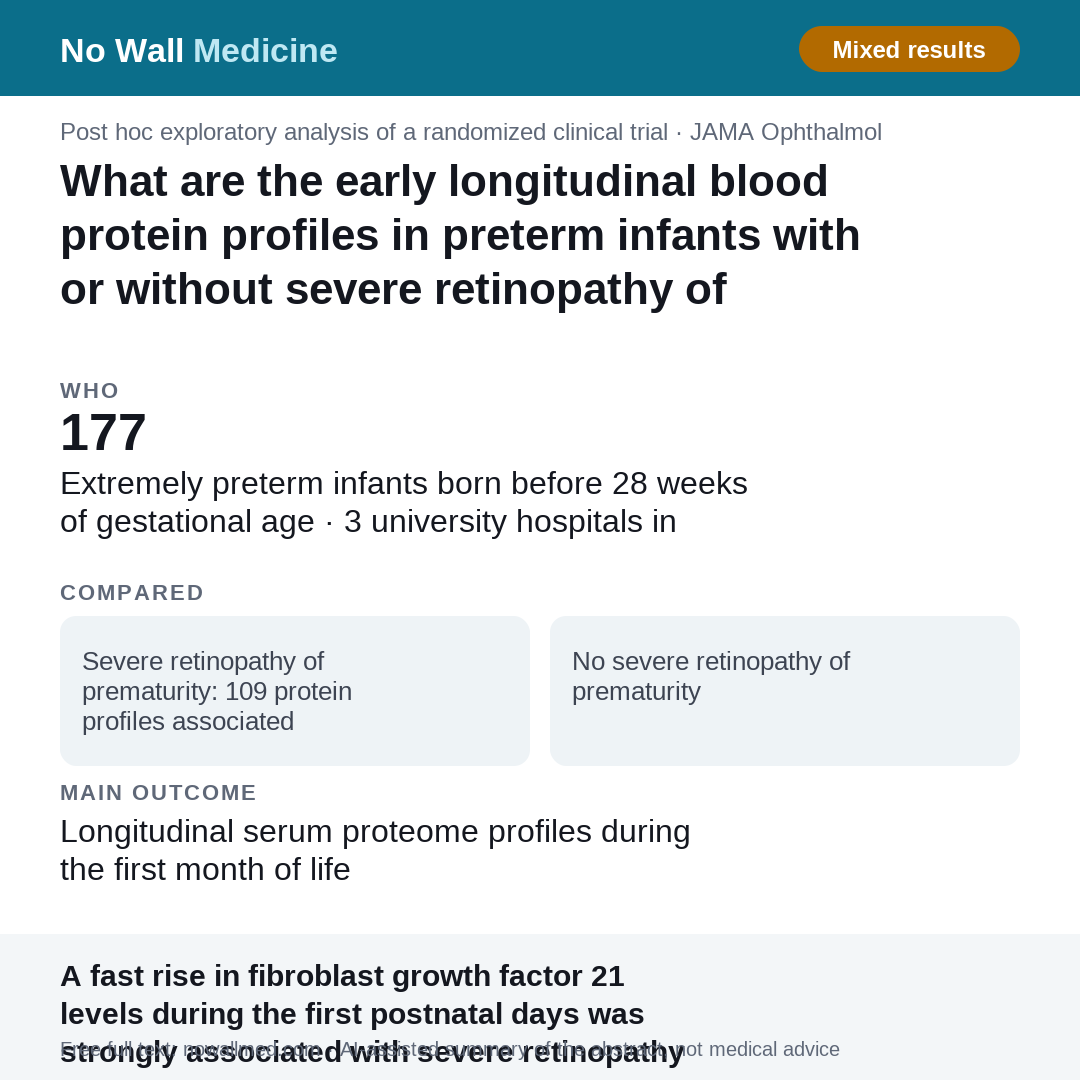
Proteomic Profile in Retinopathy of Prematurity: A Secondary Analysis of the Mega Donna Mega Randomized Clinical Trial
Post hoc exploratory analysis of a randomized clinical trialMixed results
What are the early longitudinal blood protein profiles in preterm infants with or without severe retinopathy of prematurity?
Who
177
Extremely preterm infants born before 28 weeks of gestational age · 3 university hospitals in Sweden
Compared
Severe retinopathy of prematurity: 109 protein profiles associated
No severe retinopathy of prematurity
Main outcome
Longitudinal serum proteome profiles during the first month of life
Result: fibroblast growth factor 21 β = 0.68 (95% CI, 0.39-0.97)
Bottom line: A fast rise in fibroblast growth factor 21 levels during the first postnatal days was strongly associated with severe retinopathy of prematurity.
JAMA Ophthalmol · 2026-01-08Download image
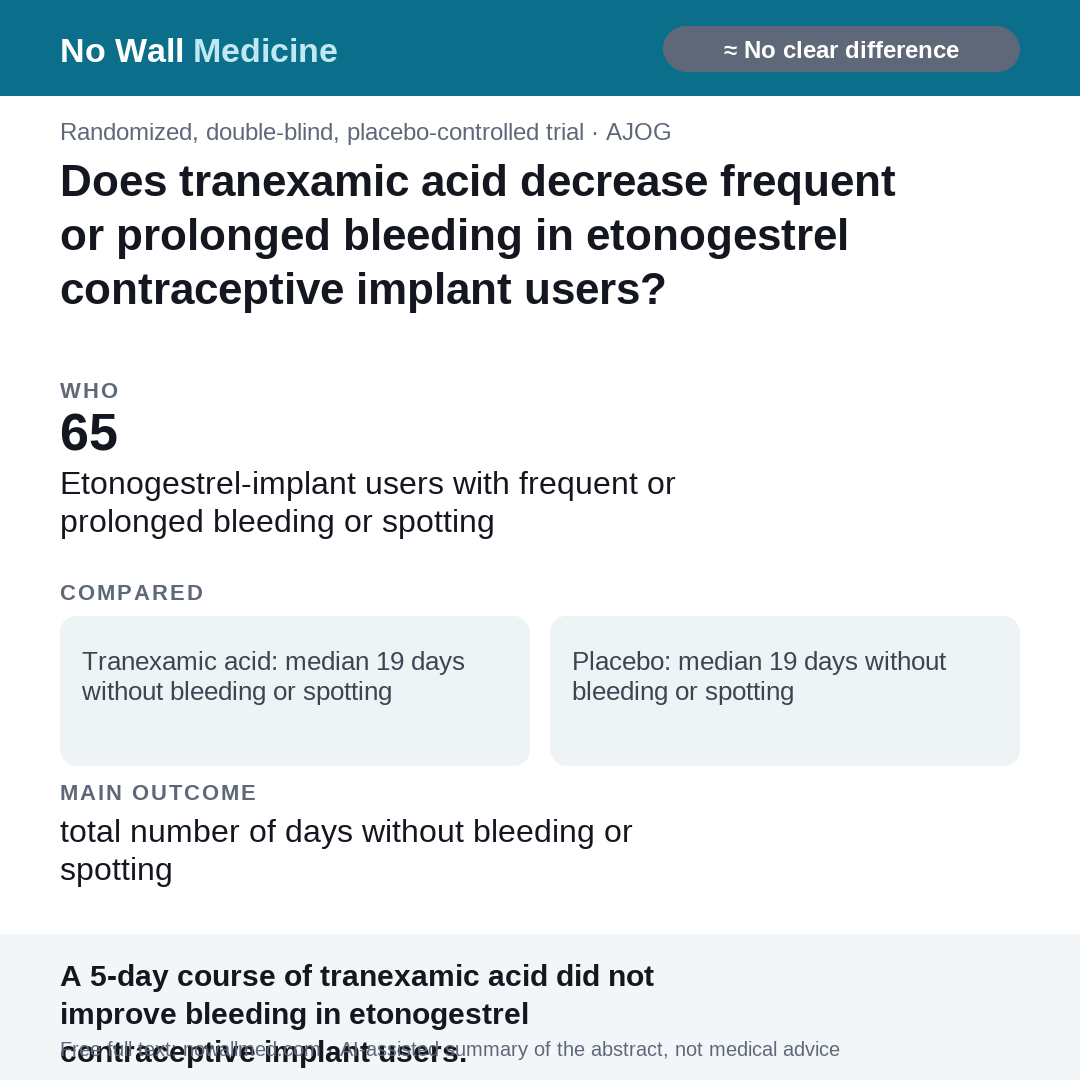
Treatment of unfavorable bleeding patterns in contraceptive implant users with tranexamic acid: randomized clinical trial
Randomized, double-blind, placebo-controlled trialNo clear difference
Does tranexamic acid decrease frequent or prolonged bleeding in etonogestrel contraceptive implant users?
Who
65
Etonogestrel-implant users with frequent or prolonged bleeding or spotting
Compared
Tranexamic acid: median 19 days without bleeding or spotting
Placebo: median 19 days without bleeding or spotting
Main outcome
total number of days without bleeding or spotting
Bottom line: A 5-day course of tranexamic acid did not improve bleeding in etonogestrel contraceptive implant users.
AJOG · 2026-01-08Download image
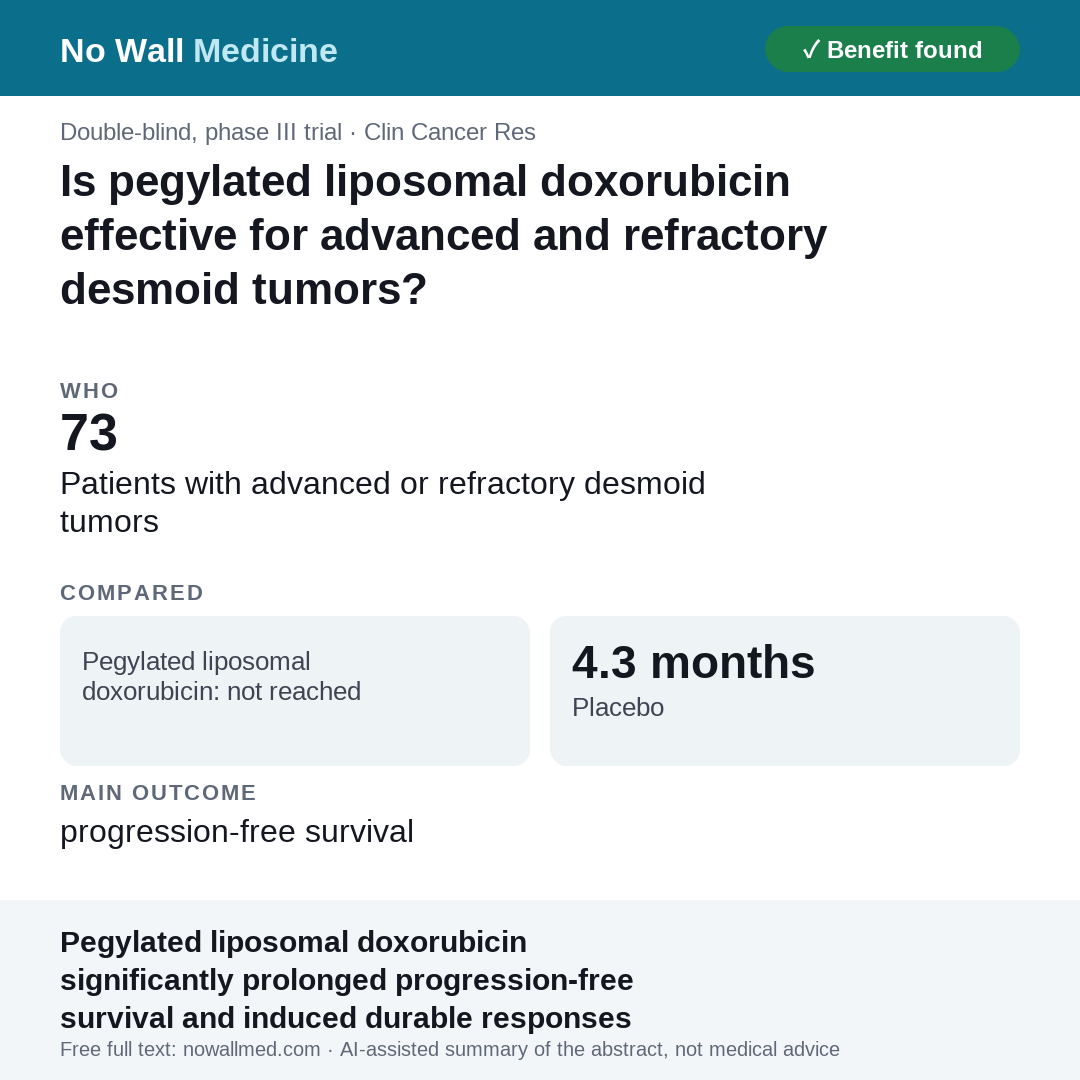
Phase III Trial of Pegylated Liposomal Doxorubicin for Patients with Advanced and Refractory Desmoid Tumors
Double-blind, phase III trialBenefit found
Is pegylated liposomal doxorubicin effective for advanced and refractory desmoid tumors?
Who
73
Patients with advanced or refractory desmoid tumors
Compared
Pegylated liposomal doxorubicin: not reached
4.3 monthsPlacebo
Main outcome
progression-free survival
Result: hazard ratio 0.05 (95% confidence interval, 0.01-0.17)
Bottom line: Pegylated liposomal doxorubicin significantly prolonged progression-free survival and induced durable responses compared with placebo in desmoid tumors.
Clin Cancer Res · 2026-01-08Download image
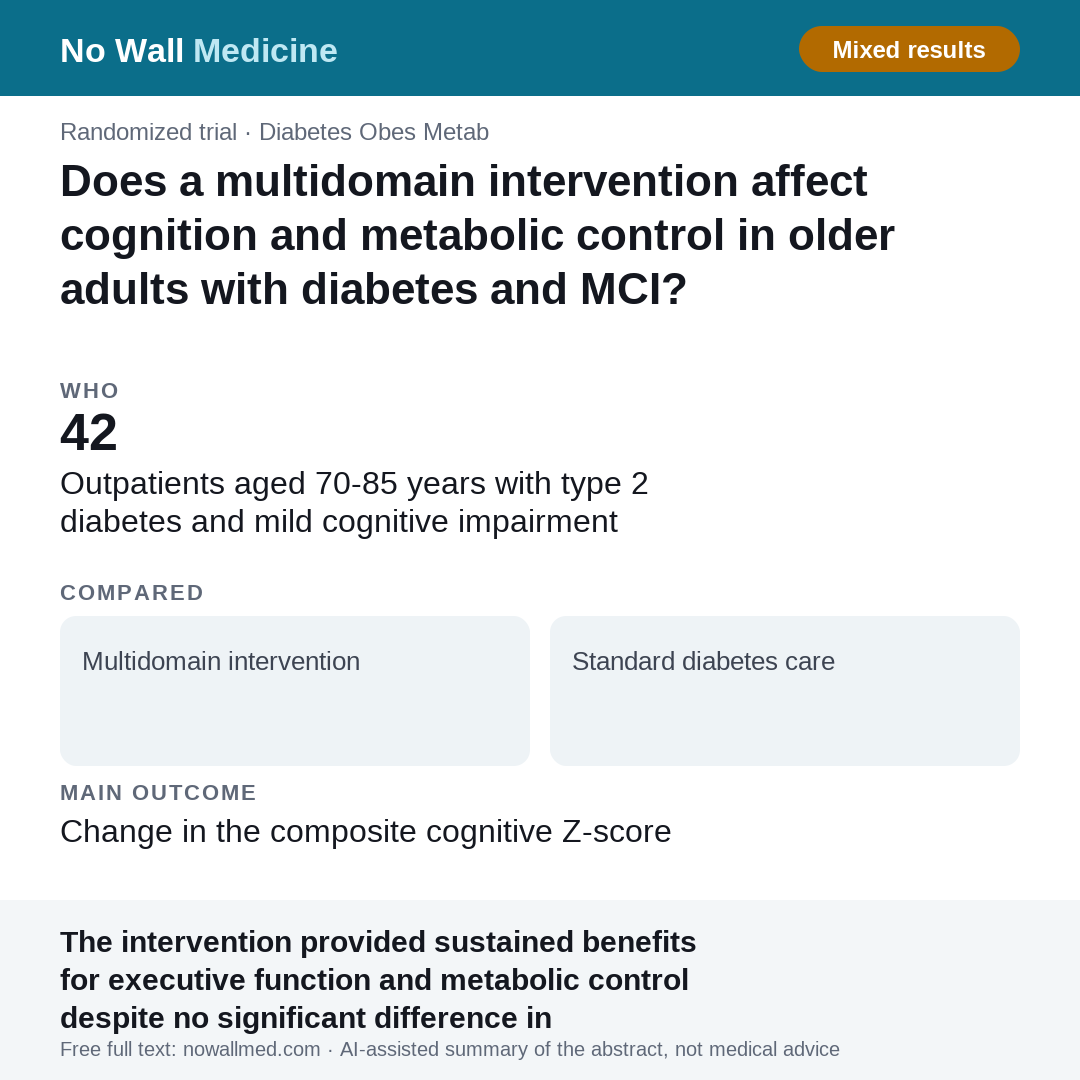
Long-term effects of a multidomain intervention on cognitive function and metabolic control in older adults with type 2 diabetes and mild cognitive impairment: A 42-month follow-up of the J-MIND-Diabetes study
Randomized trialMixed results
Does a multidomain intervention affect cognition and metabolic control in older adults with diabetes and MCI?
Who
42
Outpatients aged 70-85 years with type 2 diabetes and mild cognitive impairment
Compared
Multidomain intervention
Standard diabetes care
Main outcome
Change in the composite cognitive Z-score
Result: 0.19 (95% CI -0.14 to 0.52)
Bottom line: The intervention provided sustained benefits for executive function and metabolic control despite no significant difference in composite cognitive Z-score.
Limitation: Further studies should be performed to validate these findings.
Diabetes Obes Metab · 2026-01-08Download image
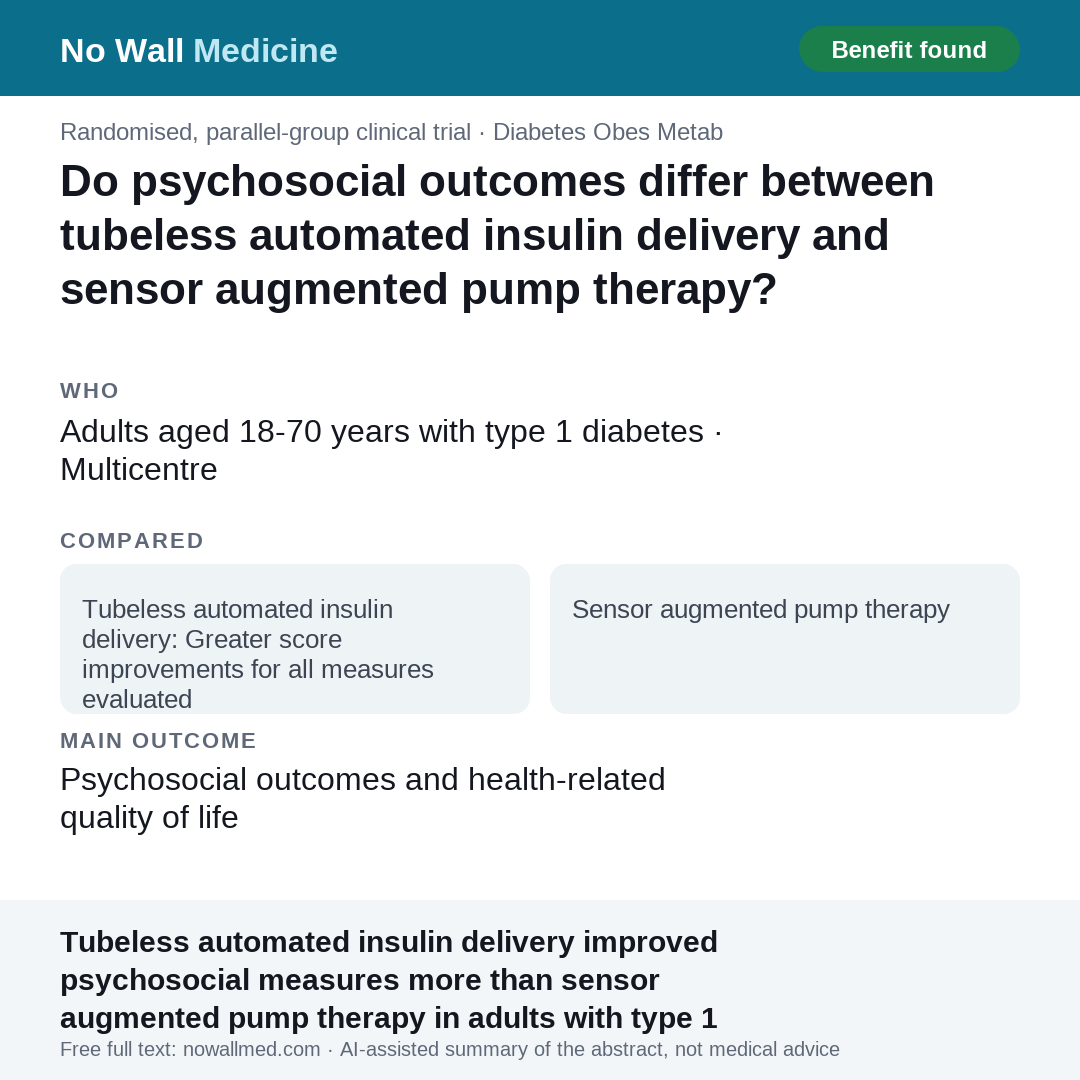
Psychosocial outcomes among adults with type 1 diabetes using a tubeless automated insulin delivery system compared with sensor augmented pump therapy: A randomised, parallel-group clinical trial sub-study
Randomised, parallel-group clinical trialBenefit found
Do psychosocial outcomes differ between tubeless automated insulin delivery and sensor augmented pump therapy?
Who
Adults aged 18-70 years with type 1 diabetes · Multicentre
Compared
Tubeless automated insulin delivery: Greater score improvements for all measures evaluated
Sensor augmented pump therapy
Main outcome
Psychosocial outcomes and health-related quality of life
Bottom line: Tubeless automated insulin delivery improved psychosocial measures more than sensor augmented pump therapy in adults with type 1 diabetes.
Diabetes Obes Metab · 2026-01-08Download image
Comparing postprandial inflammatory responses to a plant-based meat alternative, grass-finished beef, and grain-finished beef in healthy middle-aged adults: a 3-group randomized crossover trial
Randomized crossover trialNo clear difference
How do grass-finished beef, plant-based meat, and grain-finished beef affect postprandial inflammation?
Who
36
36 healthy middle-aged adults with body mass index 25-35 kg/m2
Compared
Grass-finished beef
Plant-based meat alternative
Grain-finished beef
Main outcome
Postprandial inflammatory markers
Bottom line: Acute consumption of grass-finished beef, plant-based meat, or grain-finished beef did not significantly change inflammatory responses.
Am J Clin Nutr · 2026-01-08Download image

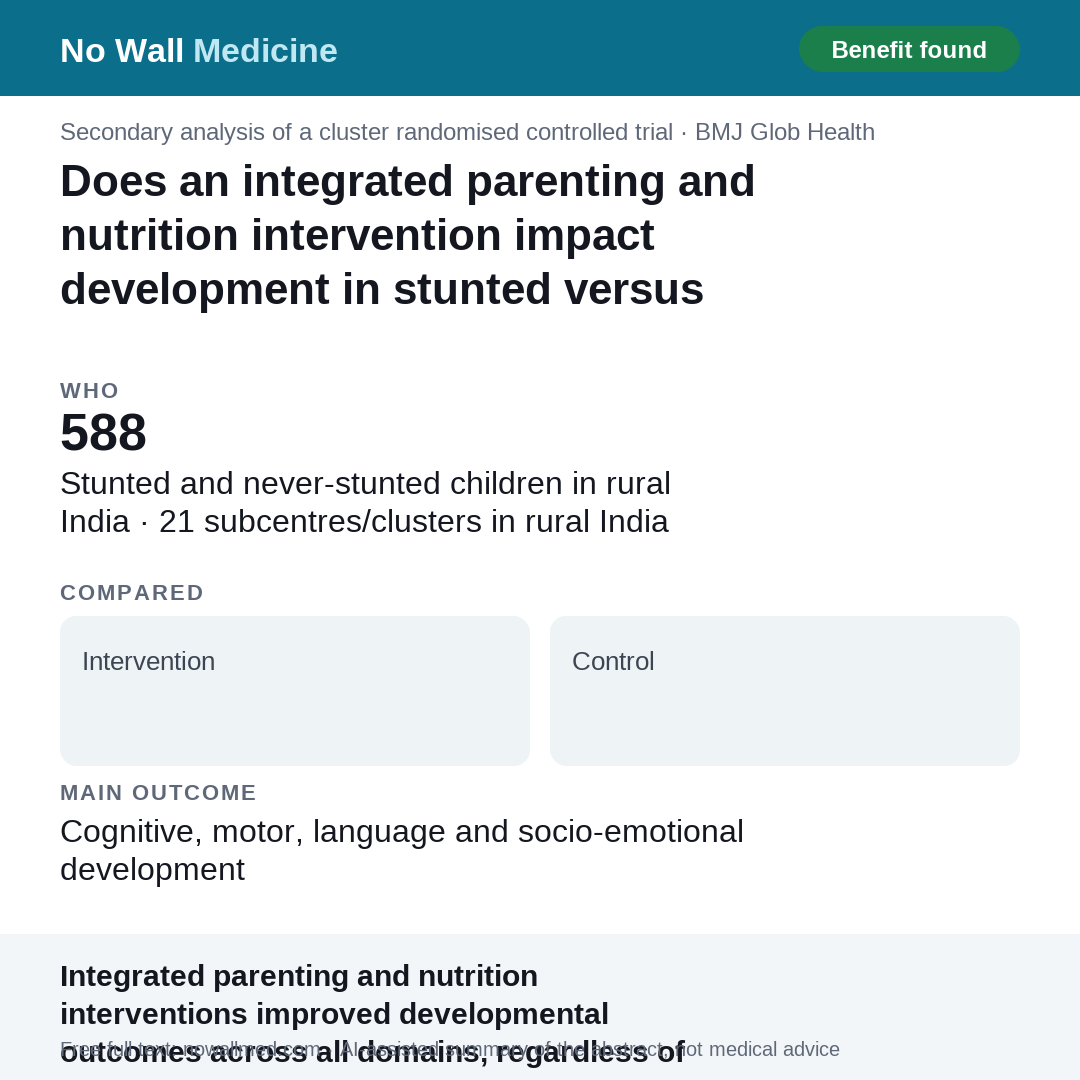
Impact of an integrated parenting and nutrition intervention on growth and development in stunted children at 24 months: evidence from the Stepping Stones programme in rural India
Secondary analysis of a cluster randomised controlled trialBenefit found
Does an integrated parenting and nutrition intervention impact development in stunted versus never-stunted children?
Who
588
Stunted and never-stunted children in rural India · 21 subcentres/clusters in rural India
Compared
Intervention
Control
Main outcome
Cognitive, motor, language and socio-emotional development
Bottom line: Integrated parenting and nutrition interventions improved developmental outcomes across all domains, regardless of stunting status.
BMJ Glob Health · 2026-01-08Download image
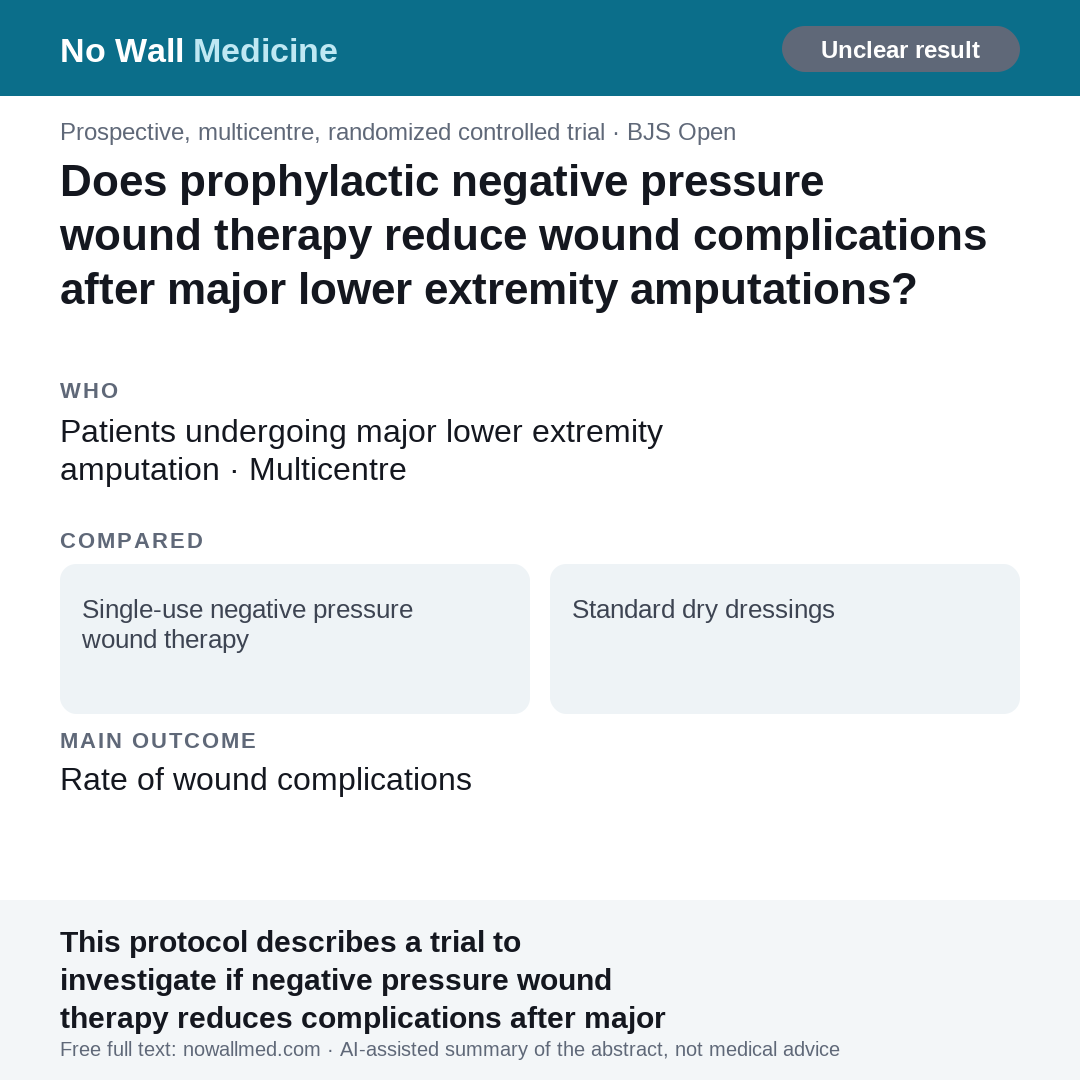
Prophylactic Incisional Negative Pressure wound therapy (NPWT) for major Amputations (PINTA): protocol for randomized controlled trial of single-use NPWT devices for closed-incision major lower extremity amputations
Prospective, multicentre, randomized controlled trialUnclear result
Does prophylactic negative pressure wound therapy reduce wound complications after major lower extremity amputations?
Who
Patients undergoing major lower extremity amputation · Multicentre
Compared
Single-use negative pressure wound therapy
Standard dry dressings
Main outcome
Rate of wound complications
Bottom line: This protocol describes a trial to investigate if negative pressure wound therapy reduces complications after major amputations.
BJS Open · 2026-01-08Download image
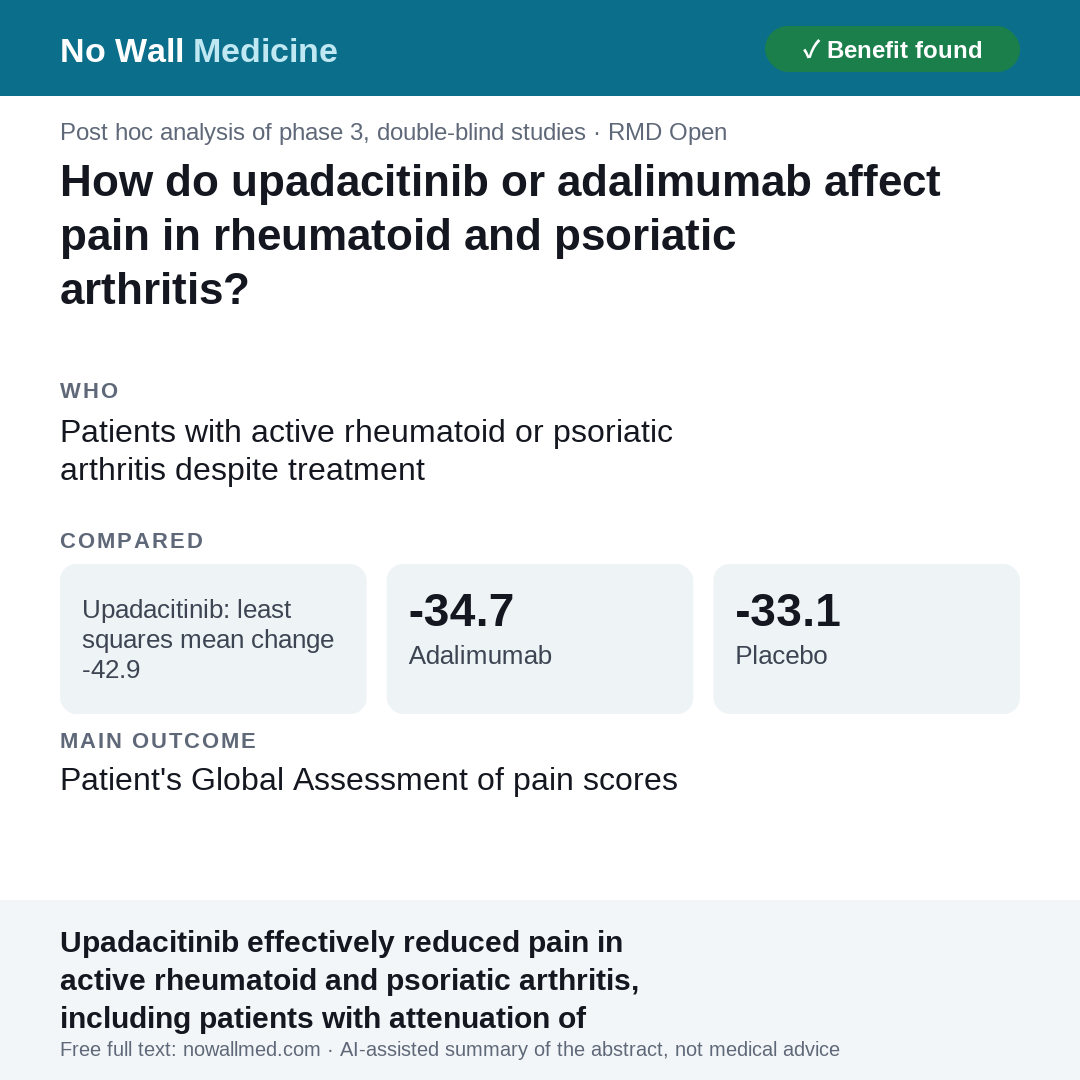
Effects of upadacitinib or adalimumab on pain in rheumatoid arthritis and psoriatic arthritis: results from randomised phase 3 studies
Post hoc analysis of phase 3, double-blind studiesBenefit found
How do upadacitinib or adalimumab affect pain in rheumatoid and psoriatic arthritis?
Who
Patients with active rheumatoid or psoriatic arthritis despite treatment
Compared
Upadacitinib: least squares mean change -42.9
-34.7Adalimumab
-33.1Placebo
Main outcome
Patient's Global Assessment of pain scores
Bottom line: Upadacitinib effectively reduced pain in active rheumatoid and psoriatic arthritis, including patients with attenuation of inflammation.
RMD Open · 2026-01-08Download image
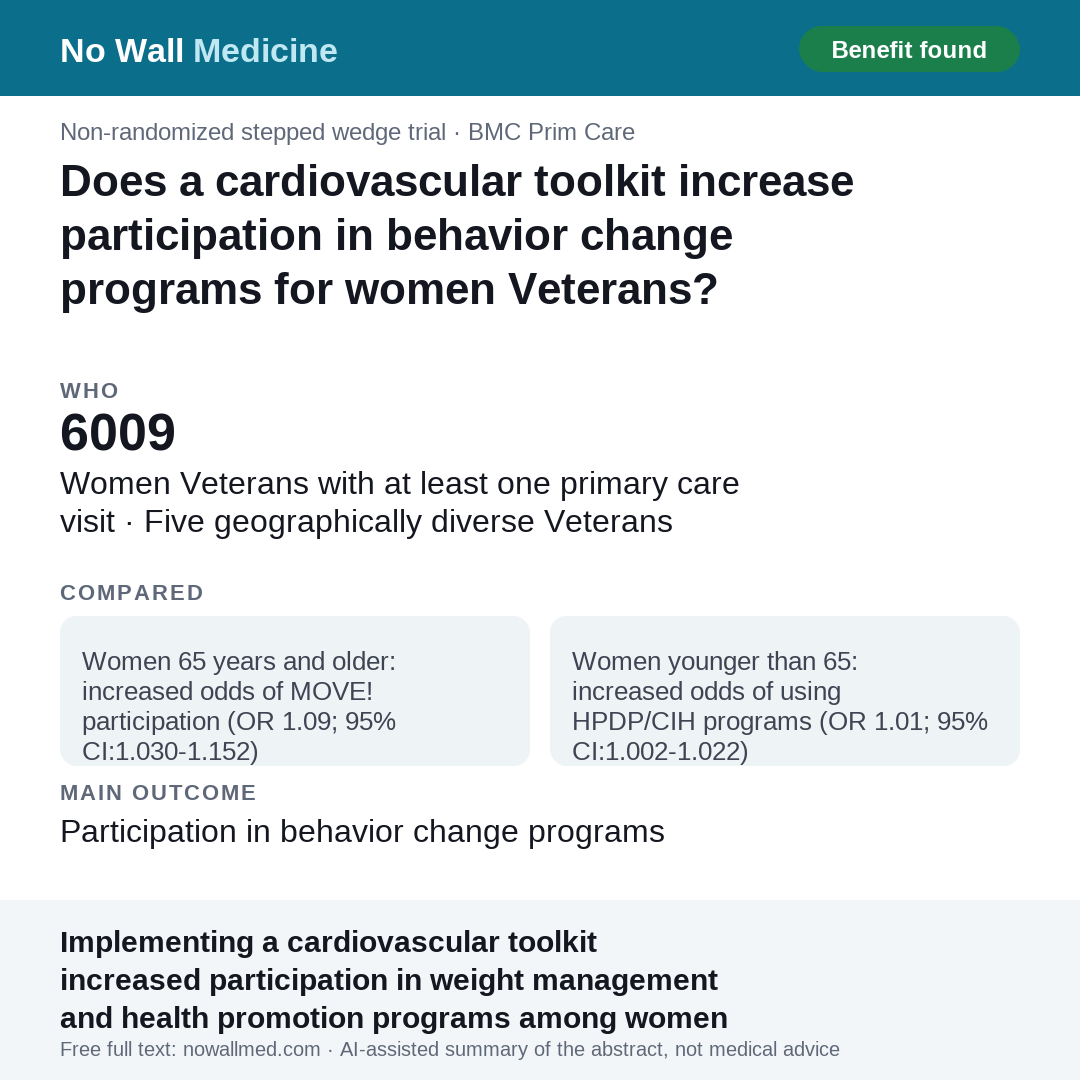
Implementation of a cardiovascular toolkit in primary care increased women Veterans' engagement in behavior change programs: results from a non-randomized stepped wedge trial
Non-randomized stepped wedge trialBenefit found
Does a cardiovascular toolkit increase participation in behavior change programs for women Veterans?
Who
6009
Women Veterans with at least one primary care visit · Five geographically diverse Veterans Health Administration sites
Compared
Women 65 years and older: increased odds of MOVE! participation (OR 1.09; 95% CI:1.030-1.152)
Women younger than 65: increased odds of using HPDP/CIH programs (OR 1.01; 95% CI:1.002-1.022)
Main outcome
Participation in behavior change programs
Bottom line: Implementing a cardiovascular toolkit increased participation in weight management and health promotion programs among women Veterans.
Limitation: The study used a non-randomized stepped wedge design.
Funded by: Veterans Health Administration Office of Women's Health
BMC Prim Care · 2026-01-08Download image
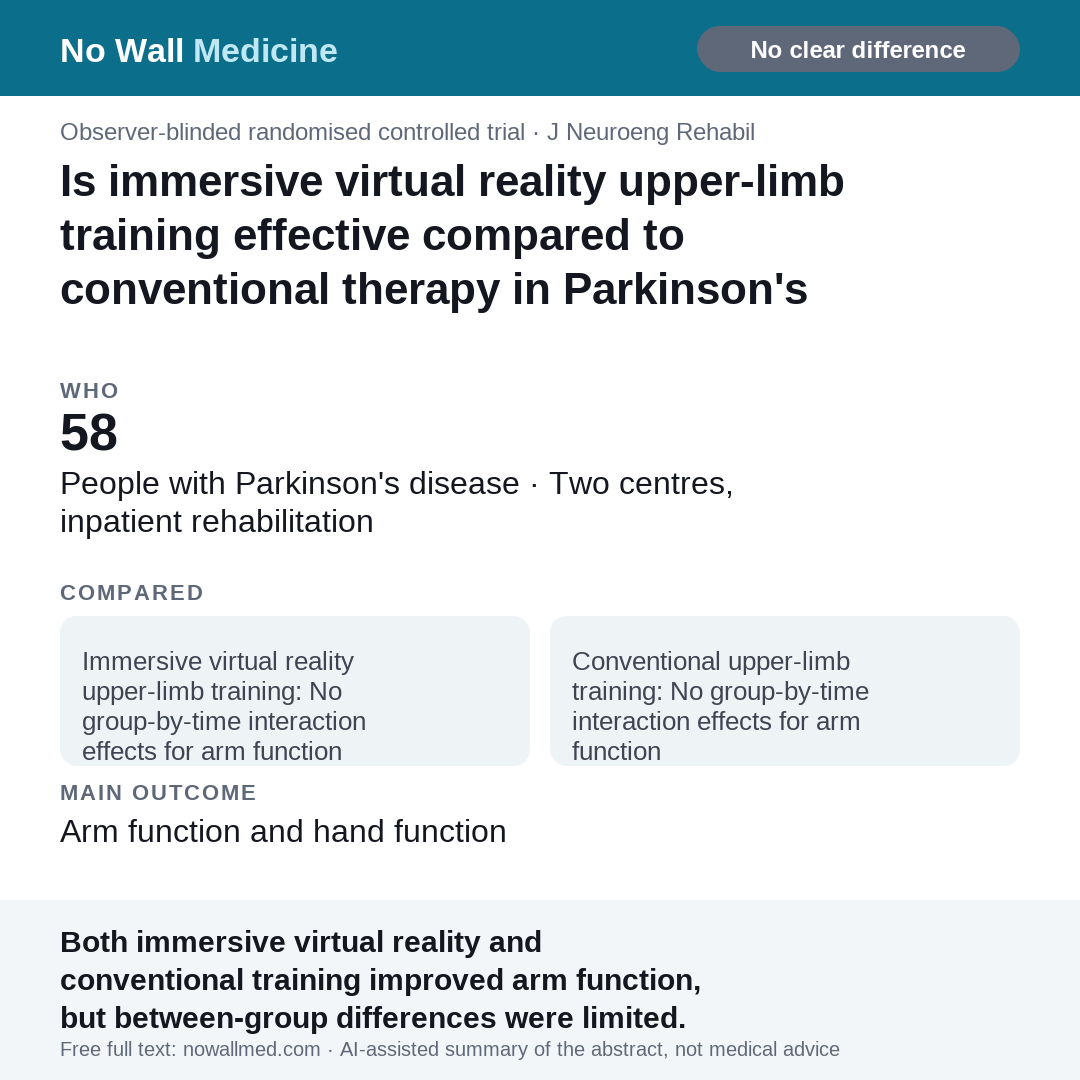
Immersive virtual reality upper-limb exercises in people with Parkinson's disease: an observer-blinded randomised controlled trial
Observer-blinded randomised controlled trialNo clear difference
Is immersive virtual reality upper-limb training effective compared to conventional therapy in Parkinson's disease?
Who
58
People with Parkinson's disease · Two centres, inpatient rehabilitation
Compared
Immersive virtual reality upper-limb training: No group-by-time interaction effects for arm function
Conventional upper-limb training: No group-by-time interaction effects for arm function
Main outcome
Arm function and hand function
Result: small between-group effect (r = 0.275, p = 0.038) for hand function
Bottom line: Both immersive virtual reality and conventional training improved arm function, but between-group differences were limited.
Limitation: warranting further evaluation in larger trials
J Neuroeng Rehabil · 2026-01-08Download image
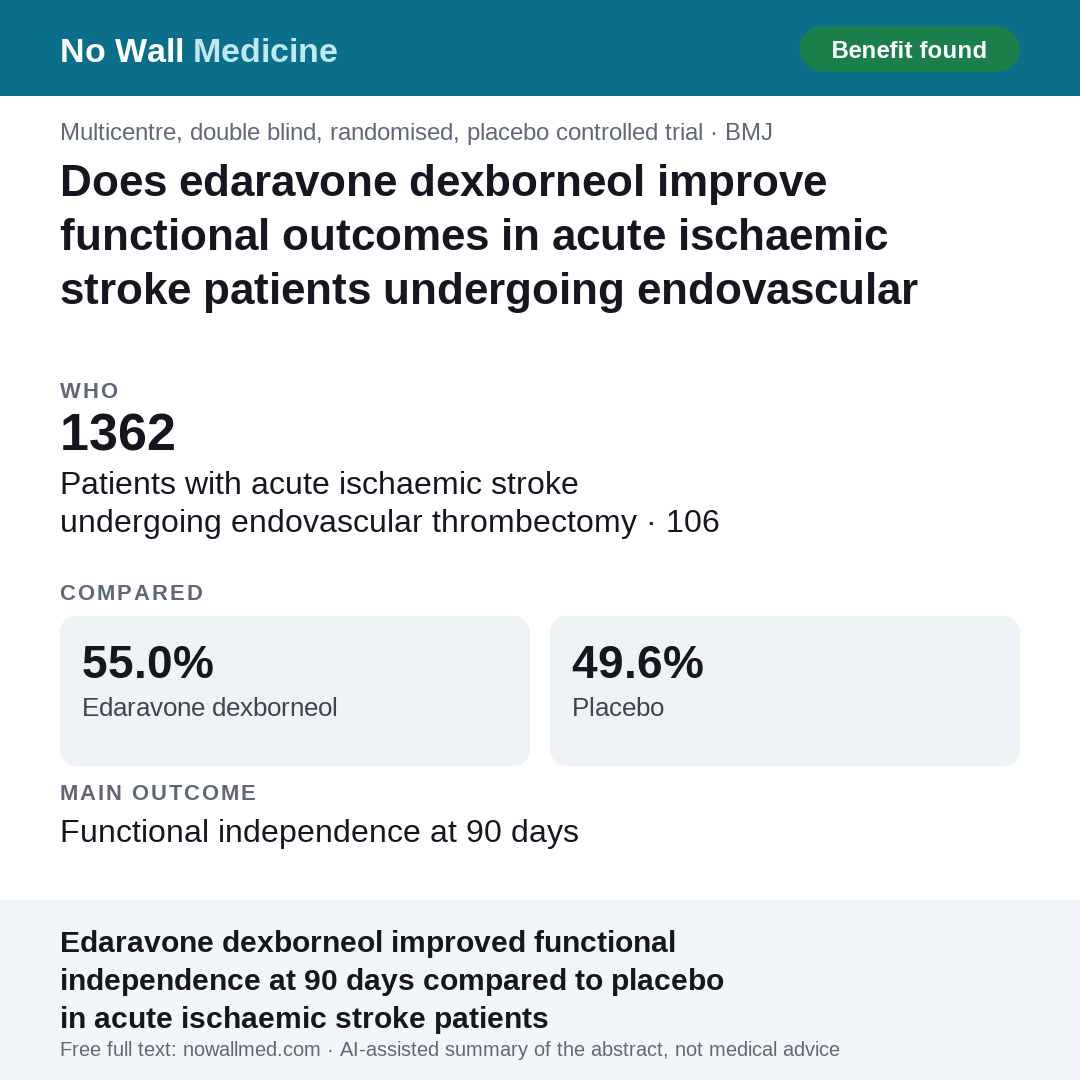
Edaravone dexborneol versus placebo on functional outcomes in patients with acute ischaemic stroke undergoing endovascular thrombectomy (TASTE-2): randomised controlled trial
Multicentre, double blind, randomised, placebo controlled trialBenefit found
Does edaravone dexborneol improve functional outcomes in acute ischaemic stroke patients undergoing endovascular thrombectomy?
Who
1362
Patients with acute ischaemic stroke undergoing endovascular thrombectomy · 106 hospitals in China
Compared
55.0%Edaravone dexborneol (379/689)
49.6%Placebo (333/671)
Main outcome
Functional independence at 90 days
Result: risk ratio 1.11, 95% confidence interval (CI) 1.00 to 1.23
Bottom line: Edaravone dexborneol improved functional independence at 90 days compared to placebo in acute ischaemic stroke patients undergoing endovascular thrombectomy.
BMJ · 2026-01-07Download image
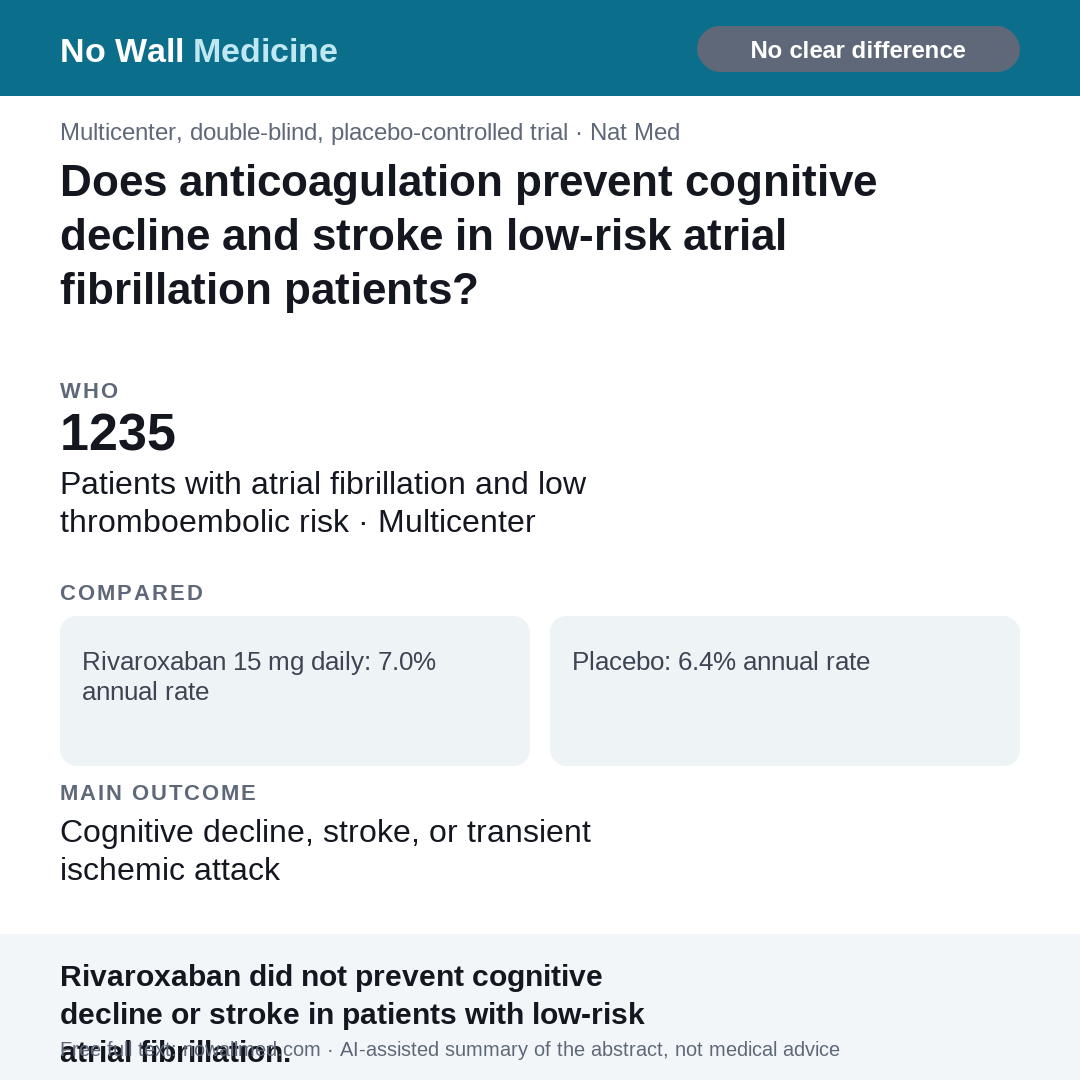
Anticoagulation to prevent ischemic stroke and neurocognitive impairment in atrial fibrillation: the BRAIN-AF randomized clinical trial
Multicenter, double-blind, placebo-controlled trialNo clear difference
Does anticoagulation prevent cognitive decline and stroke in low-risk atrial fibrillation patients?
Who
1235
Patients with atrial fibrillation and low thromboembolic risk · Multicenter
Compared
Rivaroxaban 15 mg daily: 7.0% annual rate
Placebo: 6.4% annual rate
Main outcome
Cognitive decline, stroke, or transient ischemic attack
Result: hazard ratio 1.10 (95% confidence interval 0.86-1.40)
Bottom line: Rivaroxaban did not prevent cognitive decline or stroke in patients with low-risk atrial fibrillation.
Nat Med · 2026-01-07Download image