Visual abstracts
New randomized trials and meta-analyses from leading journals at a glance: who was studied, what was compared, and what was found. Every paper is free to read in full.
All specialtiesCardiology 4877Oncology 4138Gastroenterology & Hepatology 1942Infectious Disease 3837Neurology 1905Psychiatry & Mental Health 2273Pulmonology 2143Critical Care 1365Endocrinology & Diabetes 2580Pediatrics 2980Surgery 2559Orthopedics & Sports Medicine 931Neurosurgery 537Cardiothoracic & Vascular Surgery 674Plastic & Reconstructive Surgery 591Nephrology 1133Rheumatology 823Hematology 1109Dermatology 621Ophthalmology 543Obstetrics & Gynecology 1686Public & Global Health 1058Radiology & Imaging 648Anesthesiology 986Urology 764ENT (Otolaryngology) 503Emergency Medicine 511Allergy & Immunology 313Geriatrics 981Family Medicine & Primary Care 562Medical Genetics & Genomics 676Pathology & Laboratory Medicine 159Physical Medicine & Rehabilitation 757Palliative Care 444Nutrition 1588Digital Health & AI 2201General Medicine 321
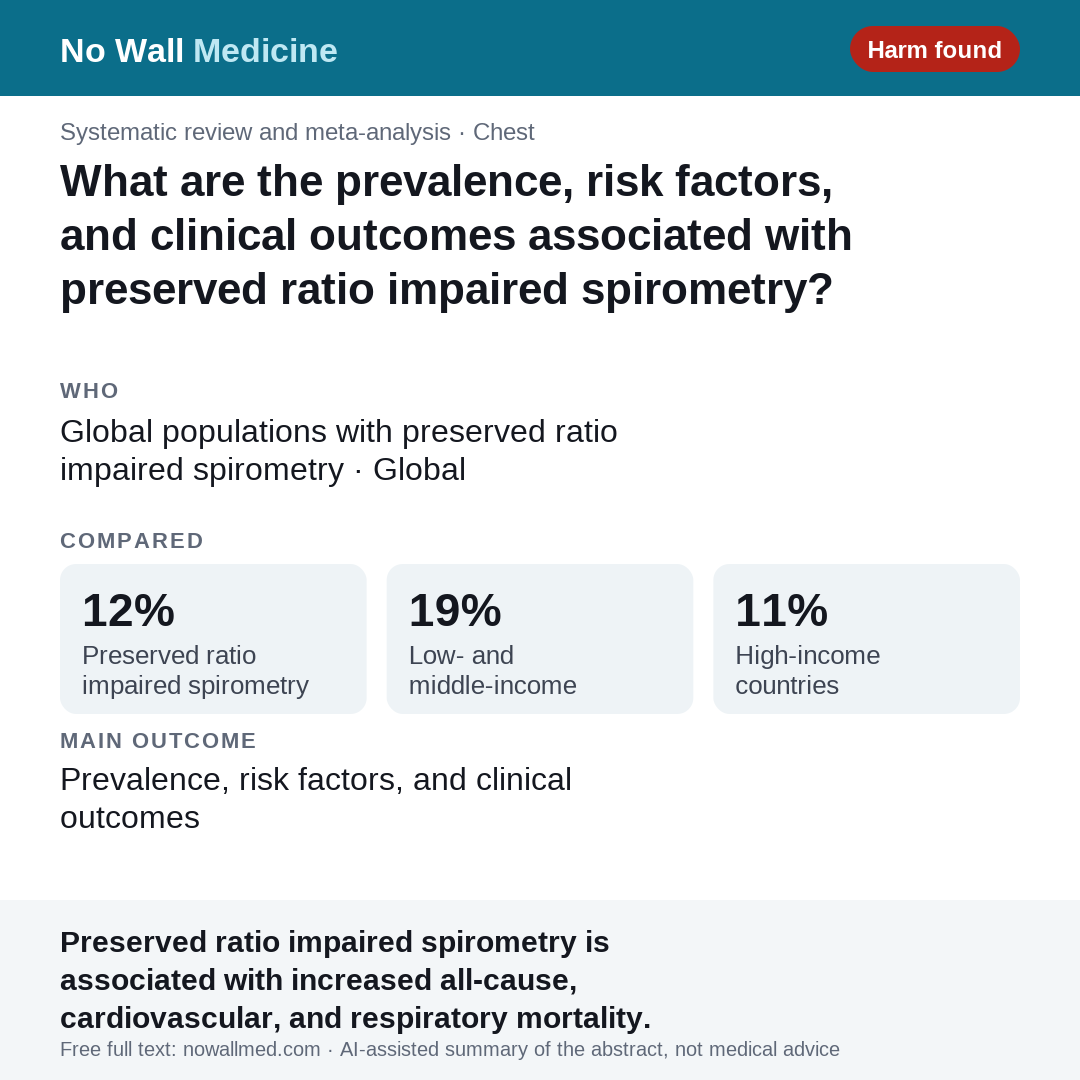
Preserved Ratio Impaired Spirometry Prevalence, Risk Factors, and Outcomes: A Systematic Review and Meta-Analysis
Systematic review and meta-analysisHarm found
What are the prevalence, risk factors, and clinical outcomes associated with preserved ratio impaired spirometry?
Who
Global populations with preserved ratio impaired spirometry · Global
Compared
12%Preserved ratio impaired spirometry (95% CI, 0.10-0.15)
19%Low- and middle-income countries
11%High-income countries
Main outcome
Prevalence, risk factors, and clinical outcomes
Result: all-cause mortality OR 1.41 (95% CI 1.08-1.83)
Bottom line: Preserved ratio impaired spirometry is associated with increased all-cause, cardiovascular, and respiratory mortality.
Chest · 2024-12-30Download image
Prediction of good neurological outcome after return of circulation following paediatric cardiac arrest: A systematic review and meta-analysis
Systematic review and meta-analysisBenefit found
Can predictors assess good neurological outcome in children after cardiac arrest?
Who
2974
Children following out-of-hospital or in-hospital cardiac arrest
Compared
High sensitivity predictors: FPR < 30%
Low sensitivity predictors: FPR < 30%
Main outcome
good neurological outcome
Bottom line: Individual clinical, electrophysiological, neuroimaging, or biomarker tests can predict good neurological outcomes in children.
Limitation: Moderate to high risk of bias and heterogeneity in studies.
Resuscitation · 2024-12-30Download image

Intraosseous and intravenous vascular access during adult cardiac arrest: A systematic review and meta-analysis
Systematic review and meta-analysis of three randomized clinical trialsNo clear difference
Is intraosseous vascular access more effective than intravenous access in adult cardiac arrest?
Who
9,332
Adults with out-of-hospital cardiac arrest
Compared
Intraosseous route
Intravenous route
Main outcome
30-day survival
Result: odds ratio 0.99 (95% confidence interval 0.84-1.17)
Bottom line: Intraosseous access compared with intravenous access did not improve 30-day survival in adult cardiac arrest.
Limitation: Low-certainty evidence for favourable neurological outcome at 30-days or hospital discharge.
Resuscitation · 2024-12-30Download image

miRNAome-metabolome wide association study reveals effects of miRNA regulation in eosinophilia and airflow obstruction in childhood asthma
Meta-analysis of two childhood asthma cohortsBenefit found
How do miRNA and metabolite associations relate to childhood asthma phenotypes?
Who
Children with asthma in two cohorts · Costa Rica and Childhood Asthma Management Program
Compared
Meta-analysis associations: 369 significant contemporaneous associations
Persistent associations in CAMP: 9 associations
Main outcome
Peripheral blood eosinophilia, airway hyper-responsiveness, and airflow obstruction
Bottom line: MicroRNAs indirectly influence eosinophilia, airway hyper-responsiveness, and airflow obstruction through five central hub metabolites in childhood asthma.
Funded by: National Heart, Lung, and Blood Institute
eBioMedicine · 2024-12-30Download image

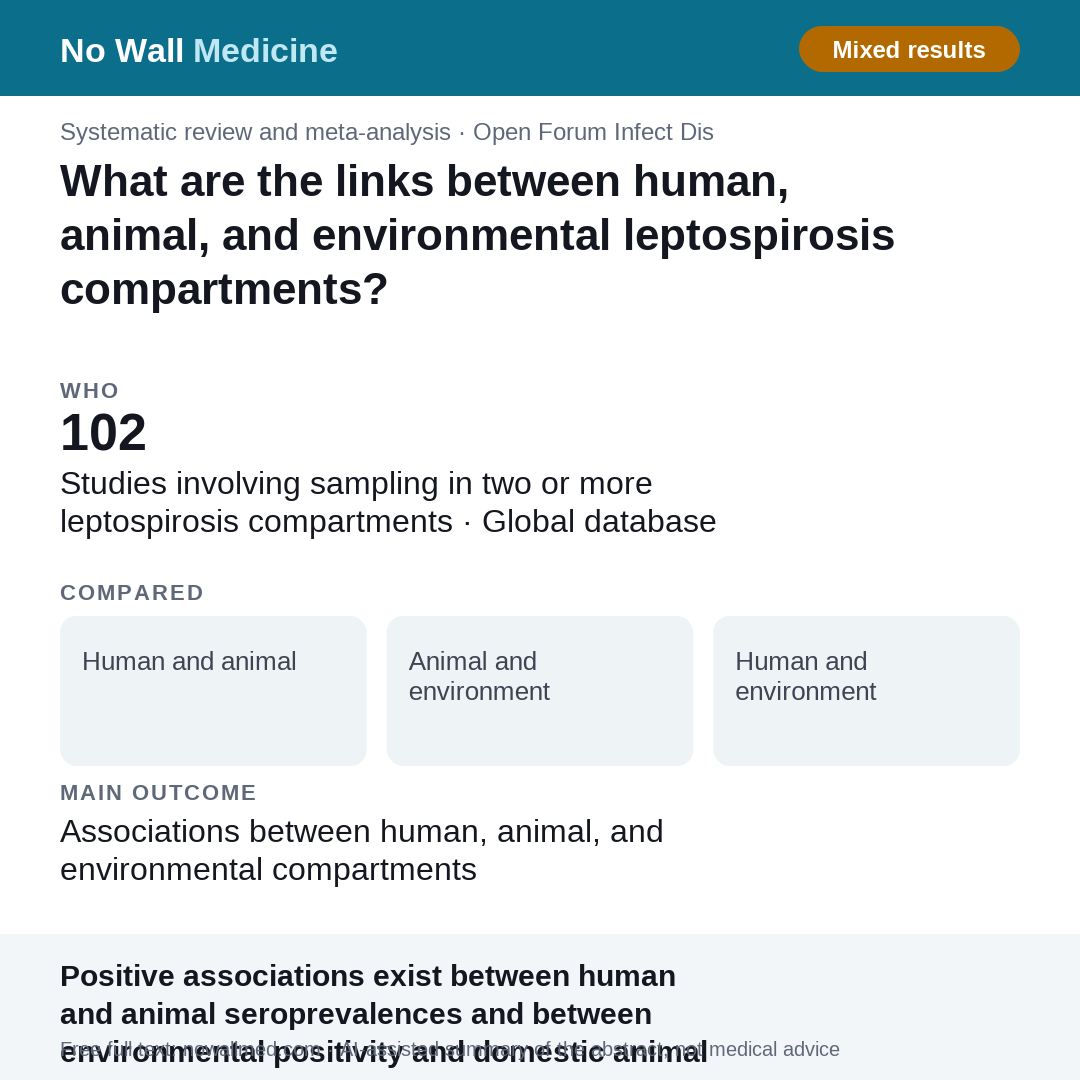
One Health Field Approach Applied to Leptospirosis: A Systematic Review and Meta-Analysis Across Humans, Animals and the Environment
Systematic review and meta-analysisMixed results
What are the links between human, animal, and environmental leptospirosis compartments?
Who
102
Studies involving sampling in two or more leptospirosis compartments · Global database search
Compared
Human and animal
Animal and environment
Human and environment
Main outcome
Associations between human, animal, and environmental compartments
Bottom line: Positive associations exist between human and animal seroprevalences and between environmental positivity and domestic animal seroprevalence.
Limitation: Limited number of studies included and quality of protocols.
Open Forum Infect Dis · 2024-12-30Download image
Non-adrenergic vasopressors for vasodilatory shock or perioperative vasoplegia: a meta-analysis of randomized controlled trials
Meta-analysis of 51 randomized controlled trialsMixed results
Do non-adrenergic vasopressors improve mortality in vasodilatory shock or perioperative vasoplegia?
Who
5715
Adult patients receiving vasopressor therapy for vasodilatory shock or perioperative vasoplegia
Compared
Non-adrenergic vasopressors: 43% (960/2232) in septic shock
Adrenergic vasopressors or placebo: 48% (898/1890) in septic shock
Main outcome
Mortality at longest follow-up
Result: risk ratio 0.92 (95% CI 0.86-0.97) in septic shock
Bottom line: Non-adrenergic vasopressors reduced mortality in septic shock, but showed no significant mortality difference in cardiac or non-cardiac surgery patients.
Limitation: No single non-adrenergic vasopressor showed significant survival benefits in separate analyses.
Crit Care · 2024-12-30Download image

The Effectiveness of Video Animations as a Tool to Improve Health Information Recall for Patients: Systematic Review
Systematic review of 15 randomized controlled trialsBenefit found
Do animation videos improve health information recall in adult patients compared to usual delivery?
Who
2454
Adult patients aged 18 years or older · Multiple countries including United States, France, Australia, Canada
Compared
Animation videos
Usual information delivery
Main outcome
Short-term and long-term health information recall
Bottom line: Animation videos significantly improve short-term health information recall in adult patients compared to usual care methods.
Limitation: Some studies had risk of bias concerns and lacked long-term follow-up or validated outcome measures.
J Med Internet Res · 2024-12-30Download image

Prevalence and natural development of thoracolumbar kyphosis in achondroplasia: A systematic review and meta-analysis
Systematic review and meta-analysisMixed results
What is the prevalence and natural development of thoracolumbar kyphosis in achondroplasia?
Who
852
Individuals with achondroplasia
Compared
87%Under two years old (95% CI 80%-91%)
33%Age three (24%-43%)
26%Five to ten years (19%-35%)
23%10-20 years (16%-31%)
Main outcome
Pooled prevalence of thoracolumbar kyphosis stratified by age
Bottom line: Thoracolumbar kyphosis is most prevalent in early childhood and often resolves, but persists in one-fourth of cases into adulthood.
Brain Spine · 2024-12-30Download image

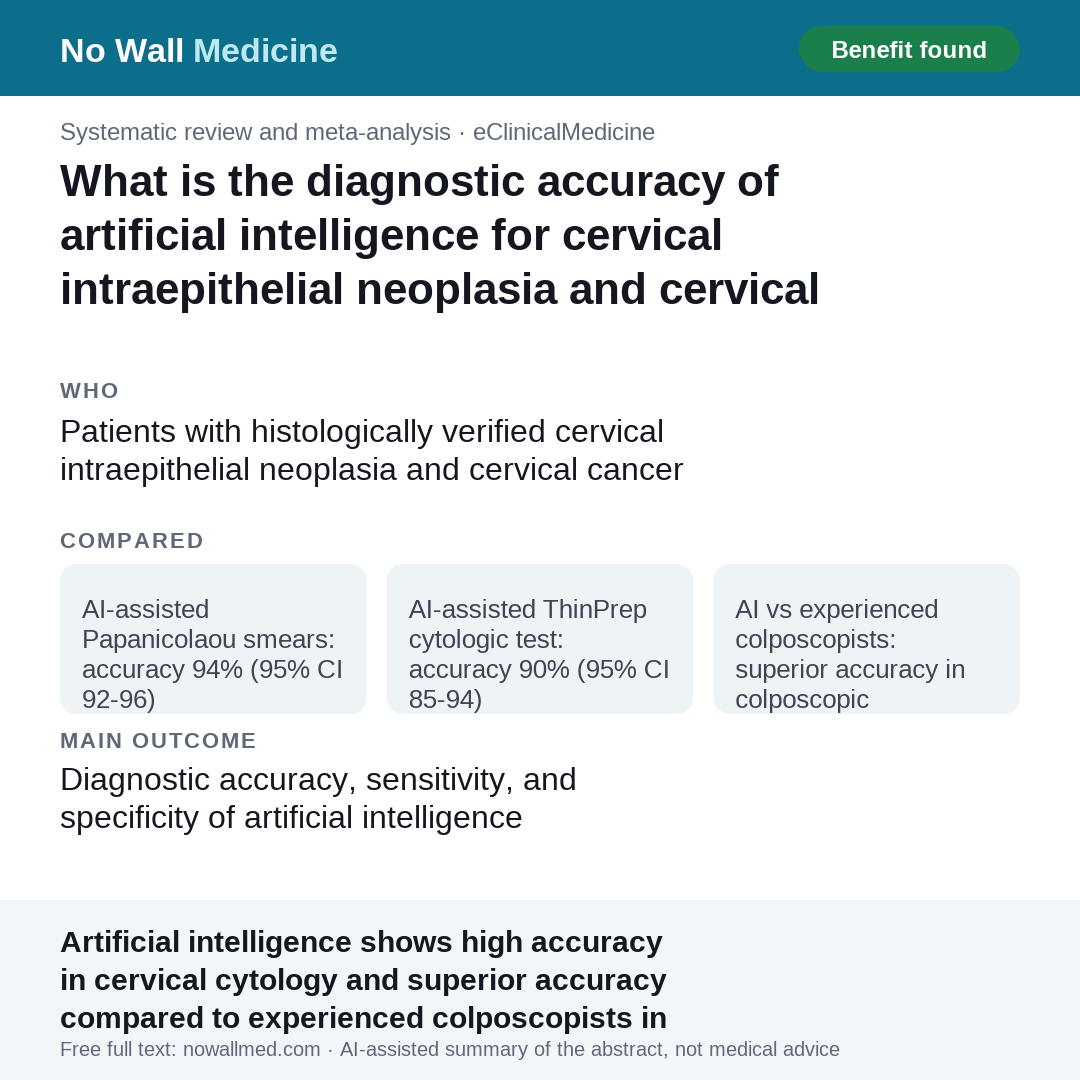
Performance of artificial intelligence for diagnosing cervical intraepithelial neoplasia and cervical cancer: a systematic review and meta-analysis
Systematic review and meta-analysisBenefit found
What is the diagnostic accuracy of artificial intelligence for cervical intraepithelial neoplasia and cervical cancer?
Who
Patients with histologically verified cervical intraepithelial neoplasia and cervical cancer
Compared
AI-assisted Papanicolaou smears: accuracy 94% (95% CI 92-96)
AI-assisted ThinPrep cytologic test: accuracy 90% (95% CI 85-94)
AI vs experienced colposcopists: superior accuracy in colposcopic examinations
Main outcome
Diagnostic accuracy, sensitivity, and specificity of artificial intelligence
Result: odds ratio 1.75 (95% CI 1.33-2.31)
Bottom line: Artificial intelligence shows high accuracy in cervical cytology and superior accuracy compared to experienced colposcopists in colposcopic examinations.
Limitation: Further research is needed for low- and middle-income countries with limited resources.
Funded by: National Natural Science Foundation of China and Shanghai Pujiang Program
eClinicalMedicine · 2024-12-28Download image
Safety and effects of anti-obesity medications on weight loss, cardiometabolic, and psychological outcomes in people living with overweight or obesity: a systematic review and meta-analysis
Systematic review and meta-analysisMixed results
What are the effects of anti-obesity medications on weight, cardiometabolic, and psychological outcomes?
Who
112515
People living with overweight or obesity
Compared
Tirzepatide: WMD -11.69
Semaglutide: WMD -8.48
Liraglutide: RR 0.87
Naltrexone/bupropion: RR 1.72
Main outcome
Weight, cardiometabolic, psychological outcomes, and adverse events
Bottom line: Tirzepatide and semaglutide effectively reduce weight, but medications carry various cardiometabolic or psychological risks.
Limitation: Limitations related to study heterogeneity.
Funded by: National Natural Science Foundation of China and others
eClinicalMedicine · 2024-12-27Download image

Comparative efficacy and acceptability of non-invasive neuromodulation technologies and botulinum toxin injections for post-stroke spasticity and motor function: a network meta-analysis of randomised controlled trials
Network meta-analysis of randomized controlled trialsBenefit found
Which non-invasive neuromodulation or botulinum toxin is most effective for post-stroke spasticity and motor function?
Who
11,185
Participants with post-stroke spasticity and motor function impairments
Compared
Non-invasive neuromodulation and botulinum toxin
Control treatments
Main outcome
Spasticity measured by modified Ashworth scale and motor function
Bottom line: Three forms of transcranial direct current stimulation effectively treat post-stroke spasticity and motor impairments.
Limitation: Confidence in accordance with CINeMA ranged from high to low.
Funded by: China Postdoctoral Science Foundation
eClinicalMedicine · 2024-12-27Download image

Virologic Failure and Emergent Integrase Strand Transfer Inhibitor Drug Resistance With Long-Acting Cabotegravir for HIV Treatment: A Meta-analysis
Meta-analysisHarm found
What are the virologic failure and integrase strand transfer inhibitor resistance rates for cabotegravir plus rilpivirine?
Who
9224
Individuals initiating or switching to cabotegravir plus rilpivirine
Compared
1%Induction-maintenance studies (95% CI: 1%-3%)
1%Switch-suppressed studies (1%-2%)
5%Switch-viremic studies (3%-10%)
Main outcome
Virologic failure and treatment-emergent integrase strand transfer inhibitor resistance
Bottom line: Virologic failure rates were low, but integrase strand transfer inhibitor resistance emerged in 40%-70% of those experiencing failure.
Clin Infect Dis · 2024-12-26Download image

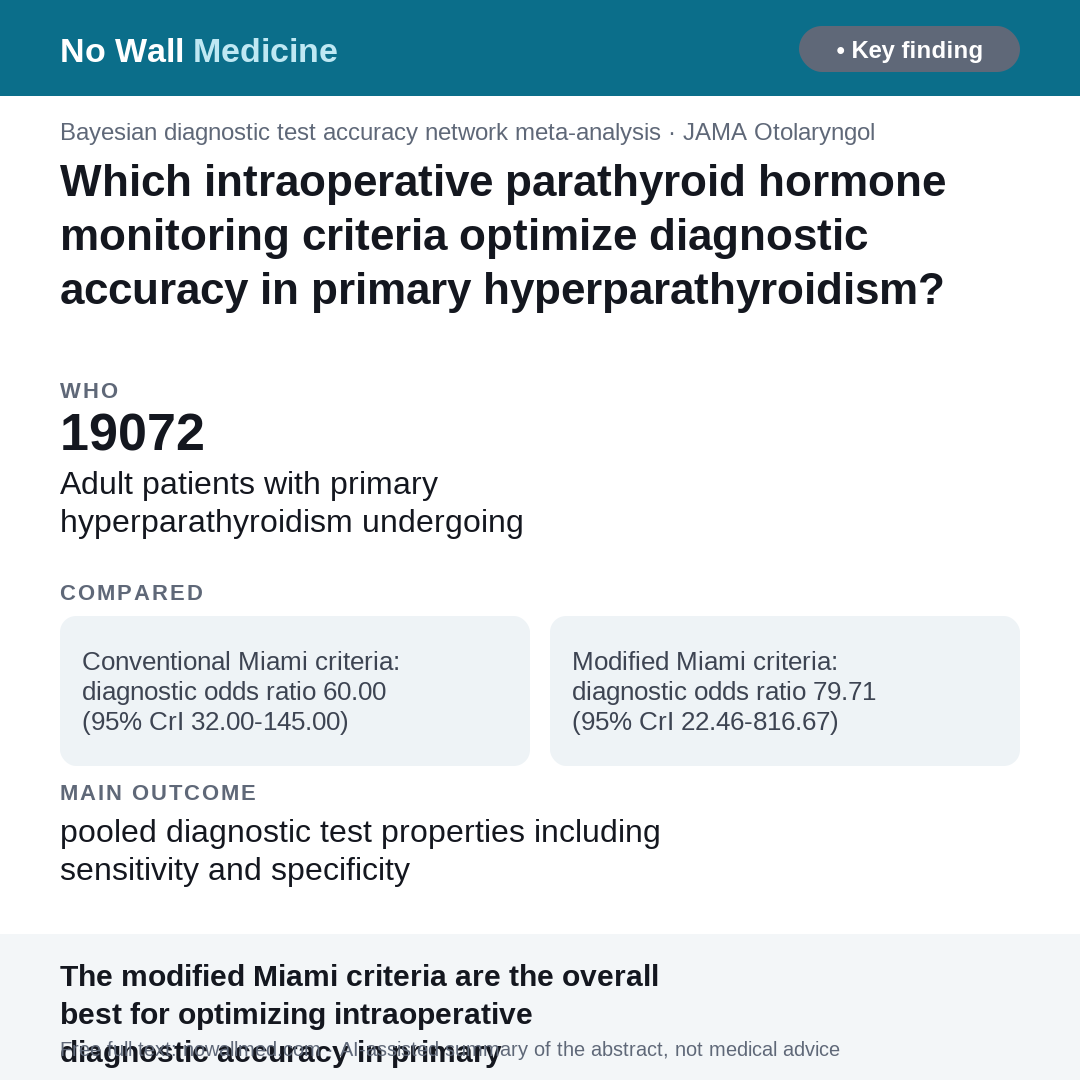
Intraoperative Parathyroid Hormone Monitoring Criteria in Primary Hyperparathyroidism: A Network Meta-Analysis of Diagnostic Test Accuracy
Bayesian diagnostic test accuracy network meta-analysisBenefit found
Which intraoperative parathyroid hormone monitoring criteria optimize diagnostic accuracy in primary hyperparathyroidism?
Who
19072
Adult patients with primary hyperparathyroidism undergoing parathyroidectomy
Compared
Conventional Miami criteria: diagnostic odds ratio 60.00 (95% CrI 32.00-145.00)
Modified Miami criteria: diagnostic odds ratio 79.71 (95% CrI 22.46-816.67)
Main outcome
pooled diagnostic test properties including sensitivity and specificity
Result: diagnostic odds ratio 79.71 (95% CrI 22.46-816.67)
Bottom line: The modified Miami criteria are the overall best for optimizing intraoperative diagnostic accuracy in primary hyperparathyroidism surgery.
Limitation: There are no published Grading of Recommendations, Assessment, Development, and Evaluation resources for diagnostic test accuracy network meta-analysis.
JAMA Otolaryngol · 2024-12-26Download image
Differential Efficacy of Advanced Therapies in Inducing Remission in Ulcerative Colitis Based on Prior Exposure to TNF Antagonists
Systematic review and meta-analysis of 17 trialsMixed results
How does prior tumor necrosis factor antagonist exposure impact advanced therapy efficacy in ulcerative colitis?
Who
8871
8871 adults with moderate-severe ulcerative colitis
Compared
Lymphocyte trafficking inhibitors: odds ratio 1.88 (95% confidence interval 1.02-3.49)
Janus kinase inhibitors: ratio of odds ratio 0.47 (95% confidence interval 0.22-1.01)
Selective interleukin-23 antagonists: ratio of odds ratio 1.07 (95% confidence interval 0.64-1.80)
Main outcome
induction of clinical remission
Bottom line: Efficacy of advanced therapies in inducing remission varies based on prior tumor necrosis factor antagonist exposure.
Clin Gastroenterol Hepatol · 2024-12-26Download image

Comparative efficacy and safety of treatment regimens for Pneumocystis jirovecii pneumonia in people living with HIV: a systematic review and network meta-analysis of randomized controlled trials
Network meta-analysis of randomized controlled trialsMixed results
What are the efficacy and safety of different treatment regimens for Pneumocystis jirovecii pneumonia?
Who
1788
People living with HIV
Compared
Trimethoprim-sulfamethoxazole
Alternative regimens
Main outcome
treatment failure, mortality, and discontinuation because of toxicity
Bottom line: Alternative regimens offer comparable efficacy to trimethoprim-sulfamethoxazole but with better tolerability for treating Pneumocystis jirovecii pneumonia.
Clin Microbiol Infect · 2024-12-26Download image

Assessing the benefit-risk profile of newer glucose-lowering drugs: A systematic review and network meta-analysis of randomized outcome trials
Systematic review and network meta-analysisMixed results
What are the benefits and risks of GLP-1RA, DPP4i, and SGLT2i?
Who
198177
Adults with type 2 diabetes, heart failure, or chronic kidney disease
Compared
Glucagon-like peptide-1 receptor agonists: MACE odds ratio 0.85 (95% CI 0.79 to 0.92)
Sodium-glucose cotransporter 2 inhibitors: Hospitalization for heart failure odds ratio 0.68 (95% CI 0.64, 0.73)
Dipeptidyl peptidase 4 inhibitors: Parkinson's disease odds ratio 0.54 (95% CI 0.32, 0.92)
Main outcome
Major adverse cardiovascular events, stroke, and hospitalization for heart failure
Bottom line: Drug selection should be individualized based on distinct benefit-risk profiles for cardiovascular, renal, and other outcomes.
Diabetes Obes Metab · 2024-12-26Download image

Systematic review: Mechanisms of photoactive nanocarriers for imaging and therapy including controlled drug delivery
Systematic reviewUnclear result
What are the mechanisms of photoactive nanocarriers for imaging and controlled drug delivery?
Who
117
Light-responsive small molecules, polymers, and nanocarriers
Compared
Photocleavage
Photoisomerization
Photopolymerization
Photosensitization
Main outcome
Mechanisms for light-triggered drug release and imaging
Bottom line: Six mechanisms enable light-triggered drug delivery and imaging using ultraviolet, visible, or near infrared light.
Eur J Nucl Med Mol Imaging · 2024-12-26Download image

Neurovascular Structure-adjacent Frozen-section Examination (NeuroSAFE) During Radical Prostatectomy: A Systematic Review and Meta-analysis
Systematic review and meta-analysisBenefit found
Does NeuroSAFE during radical prostatectomy improve oncological and functional outcomes?
Who
15446
Men undergoing radical prostatectomy for prostate cancer
Compared
NeuroSAFE
Controls
Main outcome
positive surgical margins and biochemical recurrence
Result: odds ratio 0.68 (95% CI 0.51-0.91)
Bottom line: NeuroSAFE reduces positive surgical margins and improves potency with similar biochemical recurrence rates.
Limitation: Lack of randomization resulting in selection bias and varying risk of bias.
Eur Urol Oncol · 2024-12-26Download image

Genotype-Guided Asthma Treatment Reduces Exacerbations in Children: Meta-Analysis of Two Randomized Control Trials
Individual participant data meta-analysis of two randomized controlled trialsBenefit found
Does genotype-guided treatment reduce asthma exacerbations in children?
Who
193
Children with uncontrolled asthma despite inhaled corticosteroids · Netherlands, Switzerland, England, and Scotland
Compared
Genotype-guided treatment
Control group
Main outcome
Asthma exacerbation rates
Result: -0.08 (95%CI -0.16 to -0.00, p = 0.04)
Bottom line: Genotype-guided step-up treatment may lower asthma exacerbation rates in children with uncontrolled asthma.
Allergy · 2024-12-26Download image

What helps or hinders the communication of poor prognosis between secondary and primary care? A systematic review with narrative synthesis
International systematic review and narrative synthesisMixed results
How is poor prognosis communicated from secondary care to primary care?
Who
Studies regarding communication of poor prognosis between care levels · International
Compared
Communication occurrence: not commonly communicated
Imminent death context: more likely to occur
Main outcome
Communication of poor prognosis from secondary to primary care
Bottom line: Communication of poor prognosis is highly valued but rare due to cultural and systemic challenges.
Limitation: Few studies had a focus on the interprofessional communication of poor prognosis.
Br J Gen Pract · 2024-12-26Download image