Visual abstracts
New randomized trials and meta-analyses from leading journals at a glance: who was studied, what was compared, and what was found. Every paper is free to read in full.
All specialtiesCardiology 4763Oncology 4042Gastroenterology & Hepatology 1902Infectious Disease 3756Neurology 1872Psychiatry & Mental Health 2214Pulmonology 2042Critical Care 1319Endocrinology & Diabetes 2544Pediatrics 2889Surgery 2479Orthopedics & Sports Medicine 917Neurosurgery 525Cardiothoracic & Vascular Surgery 656Plastic & Reconstructive Surgery 574Nephrology 1107Rheumatology 810Hematology 1090Dermatology 611Ophthalmology 532Obstetrics & Gynecology 1645Public & Global Health 1037Radiology & Imaging 617Anesthesiology 957Urology 745ENT (Otolaryngology) 494Emergency Medicine 481Allergy & Immunology 309Geriatrics 972Family Medicine & Primary Care 533Medical Genetics & Genomics 659Pathology & Laboratory Medicine 156Physical Medicine & Rehabilitation 734Palliative Care 421Nutrition 1560Digital Health & AI 2133General Medicine 318
Perioperative, Oncological, and Functional Outcomes of New Multiport Robotic Platforms in Urology: A Systematic Review and Meta-analysis
Systematic review and meta-analysisNo clear difference
Are new multiport surgical robots as safe and effective as Da Vinci multiport robots?
Who
5487
Patients undergoing major urological surgeries
Compared
New multiport surgical robots
Da Vinci multiport surgical robot
Main outcome
Perioperative, oncological, and functional outcomes
Result: no difference in safety, functional, and oncological outcomes
Bottom line: New multiport surgical robots show similar safety, oncological, and functional outcomes compared to the Da Vinci system.
Limitation: Small sample size of the included studies and the preliminary nature of the results.
Eur Urol Open Sci · 2025-03-03 · Save PNG

Effectiveness of Digital Diabetes Management Technology on Blood Glucose in Patients With Type 2 Diabetes at Home: Systematic Review and Meta-Analysis
Systematic review and meta-analysisBenefit found
Does digital diabetes management technology improve blood glucose in patients with type 2 diabetes?
Who
1669
Patients with type 2 diabetes mellitus at home
Compared
Digital diabetes management: hemoglobin A1c mean difference -0.52%
Control group
Main outcome
blood glucose levels and body mass index
Result: hemoglobin A1c mean difference -0.52% (95% CI -0.63% to -0.42%)
Bottom line: Digital diabetes management effectively improves hemoglobin A1c, fasting blood sugar, postprandial blood sugar, and body mass index.
J Med Internet Res · 2025-03-03 · Save PNG

Somatosensory training: a systematic review and meta-analysis with methodological considerations and clinical insights
Systematic review and meta-analysisBenefit found
Is somatosensory training effective in healthy individuals and stroke patients?
Who
Healthy individuals and stroke patients
Compared
Somatosensory training: 61.2% datasets improved performance
Non-stimulated site: no significant changes
Main outcome
Somatosensory performance and tactile two-point discrimination
Bottom line: Somatosensory training improves performance and tactile discrimination in healthy individuals at the stimulated site.
Limitation: Methodological concerns including randomization, control conditions, blinding, and missing data.
J Neuroeng Rehabil · 2025-03-03 · Save PNG

Microsurgical resection of intracranial meningiomas in patients aged 80 years old or more: A systematic review and meta-analysis
Systematic review and meta-analysisBenefit found
Are surgical outcomes for intracranial meningiomas similar in patients aged 80 or older?
Who
690
Patients aged 80 years or older with intracranial meningiomas
Compared
88%Total tumor resection
12%Partial tumor resection
Main outcome
Extent of resection, morbidity, and mortality
Bottom line: Achieving high total resection rates of 88% is feasible with a 5% surgical mortality rate in patients aged 80 or older.
Brain Spine · 2025-03-03 · Save PNG

Exercise-based cardiac rehabilitation for patients undergoing coronary artery operation: a systematic review and meta-analysis based on current randomized controlled trials
Meta-analysis of 25 randomized controlled trialsBenefit found
Does exercise-based cardiac rehabilitation improve outcomes for patients after coronary artery operation?
Who
4106
Patients after coronary artery bypass graft and percutaneous coronary interventions
Compared
Exercise-based cardiac rehabilitation
Usual care
Main outcome
Mortality, complications, hospital admissions, and health related quality of life
Result: standardized mean difference 0.24 (95% CI 0.11-0.38) for health related quality of life
Bottom line: Exercise-based cardiac rehabilitation improves health related quality of life without increasing mortality or coronary artery complications.
Int J Surg · 2025-03-01 · Save PNG

Iatrogenic nerve injury following pelvic ring injury: a network meta-analysis
Network meta-analysis of 29 comparative studiesUnclear result
What are the incidence rates of iatrogenic nerve injury across different pelvic ring fixation methods?
Who
1561
1561 adult patients with pelvic ring injuries
Compared
Robotic-assisted techniques: OR 0.22 (95% CI: 0.02-2.16)
Closed reduction internal fixation with anterior approach: OR 0.71 (95% CI: 0.21-2.48)
Open reduction internal fixation with anterior approach
Main outcome
Incidence of iatrogenic nerve injuries
Bottom line: Robotic-assisted techniques may result in the fewest iatrogenic nerve injuries during pelvic ring injury treatment.
Int J Surg · 2025-03-01 · Save PNG

Comparison of the efficacy of neoadjuvant chemotherapy and neoadjuvant chemoradiotherapy in locally advanced rectal cancer patients: meta-analysis of randomized controlled trials
Meta-analysis of randomized controlled trialsBenefit found
Is neoadjuvant chemotherapy non-inferior to neoadjuvant chemoradiotherapy for locally advanced rectal cancer?
Who
2706
Patients with locally advanced rectal cancer
Compared
Neoadjuvant chemotherapy
Neoadjuvant chemoradiotherapy
Main outcome
Overall survival and disease-free survival
Bottom line: Neoadjuvant chemotherapy showed non-inferior survival and fewer complications compared to neoadjuvant chemoradiotherapy in locally advanced rectal cancer.
Limitation: Radiotherapy may still be necessary for patients requiring guaranteed conversion effect or organ preservation.
Int J Surg · 2025-03-01 · Save PNG

Characterization changes and research waste in randomized controlled trials of global gastroesophageal reflux disease and hiatus hernia over the past 20 years
Cross-sectional analysisHarm found
Research waste in gastroesophageal reflux disease trials
Who
Gastroesophageal reflux disease patients · Global, multiple continents
Compared
69.8%Drug-related (127 trials)
Procedure and other
Main outcome
Research waste
Result: 86.7% of RCTs had research waste
Bottom line: Most trials had research waste
Int J Surg · 2025-03-01 · Save PNG

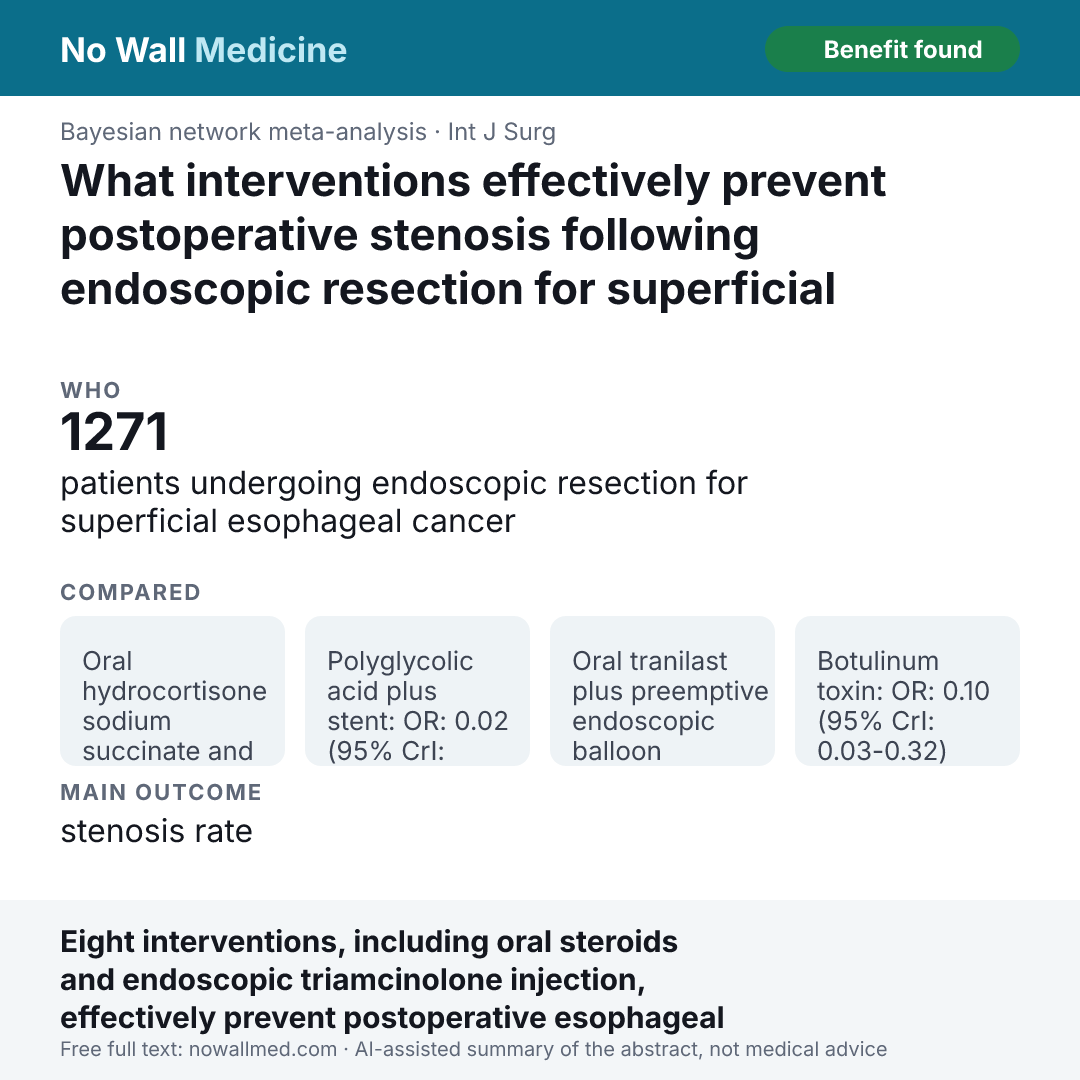
Prevention strategies of esophageal stenosis after endoscopic resection for superficial esophageal cancer: a Bayesian network meta-analysis
Bayesian network meta-analysisBenefit found
What interventions effectively prevent postoperative stenosis following endoscopic resection for superficial esophageal cancer?
Who
1271
patients undergoing endoscopic resection for superficial esophageal cancer
Compared
Oral hydrocortisone sodium succinate and aluminum phosphate gel: OR: 0.02 (95% CrI: 0.00-0.11)
Polyglycolic acid plus stent: OR: 0.02 (95% CrI: 0.00-0.23)
Oral tranilast plus preemptive endoscopic balloon dilatation: OR: 0.08 (95% CrI: 0.01-0.77)
Botulinum toxin: OR: 0.10 (95% CrI: 0.03-0.32)
Main outcome
stenosis rate
Bottom line: Eight interventions, including oral steroids and endoscopic triamcinolone injection, effectively prevent postoperative esophageal stenosis.
Int J Surg · 2025-03-01 · Save PNG
The association between diabetes mellitus and postoperative cognitive dysfunction: a systematic review and meta-analysis
Systematic review and meta-analysisHarm found
Is there an association between diabetes mellitus and postoperative cognitive dysfunction risk?
Who
8748
Individuals undergoing surgery
Compared
Diabetes mellitus
Nondiabetic individuals
Main outcome
Incidence of postoperative cognitive dysfunction
Result: relative risk 1.44 (95% CI 1.26-1.65)
Bottom line: Diabetic patients face a significantly higher risk of postoperative cognitive dysfunction compared to nondiabetic patients.
Limitation: Further research is warranted to clarify the precise mechanisms of this relationship.
Int J Surg · 2025-03-01 · Save PNG

Serum Sickness-Like Reactions Clinical Characteristics and Management: A Systematic Review
Systematic review of case reports and case seriesUnclear result
What are the clinical characteristics, implicated agents, and management of serum sickness-like reactions?
Who
468
Patients with serum sickness-like reactions
Compared
Children: Antibiotics more associated with reaction than adults
Adults
Main outcome
Clinical characteristics, implicated agents, symptomatology, and management
Bottom line: Beta-lactam antibiotics are common triggers, and corticosteroids may resolve symptoms, but standardized management guidelines are needed.
J Allergy Clin Immunol Pract · 2025-03-01 · Save PNG

Natural language processing of electronic health records for early detection of cognitive decline: a systematic review
Systematic reviewBenefit found
Can natural language processing detect cognitive impairment in electronic health record clinical notes?
Who
1,064,530
Patients in electronic health record clinical notes
Compared
Rule-based algorithms
Traditional machine learning
Deep learning: area under the receiver operating characteristic curves up to 0.997
Main outcome
Detection of cognitive impairment
Bottom line: Natural language processing shows robust performance in identifying cognitive decline from electronic health record clinical notes.
Limitation: Incomplete data capture, inconsistent documentation practices, and limited external validation.
NPJ Digit Med · 2025-03-01 · Save PNG

Patient participation in self-monitoring regarding healthcare of heart failure: an integrated systematic review
Integrative systematic literature reviewMixed results
What is the research knowledge on patient participation in heart failure self-monitoring?
Who
1393
Patients aged between 52-77 years, predominantly men · International spread
Compared
Qualitative studies: increased understanding of disease situations
Quantitative studies: conformity is not shown
Main outcome
Patient participation in self-monitoring regarding heart failure healthcare
Bottom line: Self-monitoring shows positive effects on self-care and satisfaction, but empirical data remains incoherent and lacks proven knowledge increases.
BMC Prim Care · 2025-03-01 · Save PNG

Prognostic models for survival predictions in advanced cancer patients: a systematic review and meta-analysis
Systematic review and meta-analysisMixed results
What are the predictive performances of prognostic models for survival in advanced cancer?
Who
Patients with incurable solid tumors
Compared
0.68Palliative Prognostic Index 30-day survival (95% CI: 0.62-0.73)
0.76Palliative Prognostic Score 30-day survival (95% CI: 0.70-0.80)
0.69Objective Prognostic Score 30-day survival (95% CI: 0.65-0.72)
Main outcome
Predictive performance measured by C-statistic
Bottom line: Palliative Prognostic Score appears to perform better, but all included studies had high risk of bias.
Limitation: All included studies had high risk of bias.
BMC Palliat Care · 2025-03-01 · Save PNG

Comparative therapeutic efficacy and safety of first-line and second-line therapies for metastatic castration-resistant prostate cancer: a systematic review and network meta-analysis
Network meta-analysis of 24 randomized controlled trialsBenefit found
What are the comparative therapeutic efficacies and safety of first-line and second-line therapies for metastatic castration-resistant prostate cancer?
Who
13,059
Patients with metastatic castration-resistant prostate cancer
Compared
First-line combination therapies with second-generation androgen receptor inhibitors
Post-docetaxel second-line treatments
Main outcome
Radiographic progression-free survival, overall survival, and PSA progression
Result: HR of Lu177 + ARI: 0.07 (0.01,0.87) for time to PSA progression
Bottom line: Second-generation androgen receptor inhibitors show good efficacy, particularly when combined with other treatments for first-line metastatic castration-resistant prostate cancer.
Limitation: Efficacies of post-androgen receptor inhibitor second-line treatments were not evaluated due to lack of related randomized controlled trials.
Funded by: The National Natural Science Foundation of China
eClinicalMedicine · 2025-02-28 · Save PNG

A systematic analysis of temporal trends, characteristics, and citations of retracted stem cell publications
Systematic analysisHarm found
What are the characteristics and citation impacts of retracted stem cell publications?
Who
Retracted stem cell publications and matched non-retracted controls
Compared
Retracted publications: 366 (77.5%) accumulated 4884 post-retraction citations
Non-retracted control publications: mean rank: 351.08
Main outcome
Citation patterns and risk of subsequent retraction
Result: odds ratio 11.09 (95% confidence interval 7.06-17.43)
Bottom line: Retracted stem cell papers continue to be cited, and citing them increases the risk of subsequent retraction eleven-fold.
BMC Med · 2025-02-28 · Save PNG

Global and regional incidence of intrahepatic cholestasis of pregnancy: a systematic review and meta-analysis
Systematic review and meta-analysisNo clear difference
What is the global and regional incidence of intrahepatic cholestasis of pregnancy?
Who
42972872
Pregnant women · Global
Compared
2.9%Overall pooled incidence
Large sample size studies: 1.6% [1.3, 2]
Small sample size studies: 4.7% [3.9, 5.5]
Main outcome
Incidence of intrahepatic cholestasis of pregnancy
Result: 2.9% [95% confidence interval 2.5, 3.3]
Bottom line: The global incidence of intrahepatic cholestasis of pregnancy is 2.9%, with variations based on region and socioeconomic status.
BMC Med · 2025-02-28 · Save PNG

Safety of colchicine on fertility, pregnancy, and lactation: a systematic review and meta-analysis informing the EULAR/PReS recommendations for familial Mediterranean fever
Systematic review and meta-analysisKey finding
Is colchicine safe for fertility, pregnancy, and lactation in familial Mediterranean fever?
Who
Patients with familial Mediterranean fever
Compared
Colchicine exposed
Nonexposed
Main outcome
Miscarriage or foetal loss
Result: risk ratio 0.87 (95% CI, 0.67-1.12)
Bottom line: Colchicine appears to have a good risk-benefit profile regarding reproductive safety in familial Mediterranean fever.
Limitation: Higher-quality studies should be performed, especially regarding male fertility.
Ann Rheum Dis · 2025-02-28 · Save PNG

Effectiveness of home-based cardiac rehabilitation interventions delivered via mHealth technologies: a systematic review and meta-analysis
Systematic review and meta-analysis of 13 trialsBenefit, low certainty
Do mHealth home-based cardiac rehabilitation interventions improve outcomes compared to usual care or centre-based rehabilitation?
Who
1508
Adults with heart disease, myocardial infarction, angina pectoris, or heart failure
Compared
mHealth home-based cardiac rehabilitation
Usual care or centre-based cardiac rehabilitation
Main outcome
Aerobic exercise capacity assessed with VO2 peak or 6-min walk test
Result: 6-min walk test mean difference 24·74 (95% CI 9·88-39·60); VO2 peak 1·77 (95% CI 1·19-2·35)
Bottom line: mHealth home-based cardiac rehabilitation significantly improves aerobic exercise capacity compared to usual care, but shows no difference from centre-based rehabilitation.
Limitation: Quality of evidence was low to very low due to risk of bias and imprecision.
Lancet Digit Health · 2025-02-28 · Save PNG

Pulmonary microbiology and microbiota in adults with non-cystic fibrosis bronchiectasis: a systematic review and meta-analysis
Systematic review and meta-analysisNo clear difference
What are the pulmonary microbiology and microbiota patterns in adults with non-cystic fibrosis bronchiectasis?
Who
54,384
Adults with non-cystic fibrosis bronchiectasis · Worldwide
Compared
Stable disease stage: Pseudomonas aeruginosa 26[19-34]%
Exacerbation disease stage: Pseudomonas aeruginosa 23[20-25]%
Undetermined disease stage: Pseudomonas aeruginosa 20[16-25]%
Main outcome
Pulmonary microbial presence and diversity
Bottom line: Bacterial patterns remain consistent across bronchiectasis stages, though lower bacterial diversity may associate with exacerbation risks.
Respir Res · 2025-02-28 · Save PNG