Continuous and intermittent pulmonary artery thermodilution show limited interchangeability for measuring cardiac output
Agreement between continuous and intermittent pulmonary artery thermodilution for cardiac output measurement in perioperative and intensive care medicine: a systematic review and meta-analysis
Systematic review and meta-analysisMixed results
Are continuous and intermittent pulmonary artery thermodilution methods interchangeable for cardiac output measurement?
Who
1522
Adult surgical and critically ill patients
Compared
Continuous pulmonary artery thermodilution
Intermittent pulmonary artery thermodilution
Main outcome
Cardiac output measurement agreement
Result: mean difference 0.08 (95% confidence interval 0.01 to 0.16) L/min
Bottom line: Continuous pulmonary artery thermodilution barely passes interchangeability criteria with intermittent pulmonary artery thermodilution.
Crit Care · 2021-03-29Download image
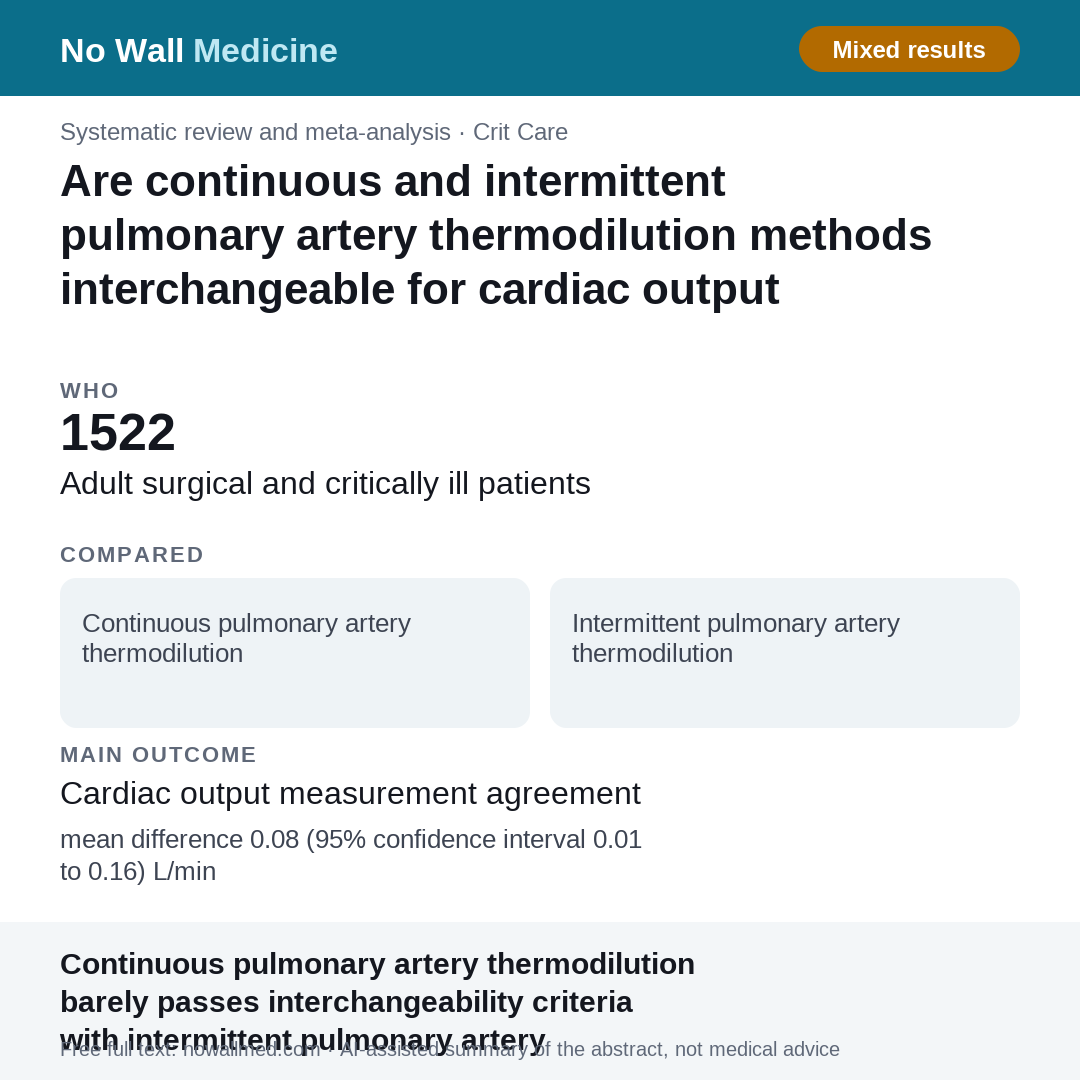
Clinical question: Are continuous and intermittent pulmonary artery thermodilution methods interchangeable for cardiac output measurement?
Why it matters: It is unknown whether continuous and intermittent pulmonary artery thermodilution, which measures the volume of blood pumped by the heart, are clinically interchangeable.
Key points
- Researchers analyzed 54 studies involving 1522 adult surgical and critically ill patients to compare continuous and intermittent pulmonary artery thermodilution for measuring cardiac output.
- The analysis found a pooled mean difference of 0.08 (95%-confidence interval 0.01 to 0.16) L/min and a pooled percentage error of 29.7 (95%-confidence interval 20.5 to 38.9)%.
- The pooled 95%-limits of agreement were -1.68 to 1.85 L/min, suggesting the two methods barely meet criteria for being used interchangeably.
Headline and key points written with AI from the paper’s abstract, with every number checked against it. Read the paper before relying on them.
Was this summary helpful?
Abstract
Background
Pulmonary artery thermodilution is the clinical reference method for cardiac output monitoring. Because both continuous and intermittent pulmonary artery thermodilution are used in clinical practice it is important to know whether cardiac output measurements by the two methods are clinically interchangeable. Methods
We performed a systematic review and meta-analysis of clinical studies comparing cardiac output measurements assessed using continuous and intermittent pulmonary artery thermodilution in adult surgical and critically ill patients. 54 studies with 1522 patients were included in the analysis. Results
The heterogeneity across the studies was high. The overall random effects model-derived pooled estimate of the mean of the differences was 0.08 (95%-confidence interval 0.01 to 0.16) L/min with pooled 95%-limits of agreement of - 1.68 to 1.85 L/min and a pooled percentage error of 29.7 (95%-confidence interval 20.5 to 38.9)%. Conclusion
The heterogeneity across clinical studies comparing continuous and intermittent pulmonary artery thermodilution in adult surgical and critically ill patients is high. The overall trueness/accuracy of continuous pulmonary artery thermodilution in comparison with intermittent pulmonary artery thermodilution is good (indicated by a pooled mean of the differences < 0.1 L/min). Pooled 95%-limits of agreement of - 1.68 to 1.85 L/min and a pooled percentage error of 29.7% suggest that continuous pulmonary artery thermodilution barely passes interchangeability criteria with intermittent pulmonary artery thermodilution. PROSPERO registration number CRD42020159730.
Abstract reproduced under the article’s CC BY licence.
Subject terms
Cite this article
Kouz K, Michard F, Bergholz A, Vokuhl C, Briesenick L, Hoppe P. Agreement between continuous and intermittent pulmonary artery thermodilution for cardiac output measurement in perioperative and intensive care medicine: a systematic review and meta-analysis. Crit Care. 2021. doi:10.1186/s13054-021-03523-7
Spotted a mistake? Suggest a correction
Top studies every Monday
The week’s key trials and guidelines in your specialties, plus any topics you follow. By email, free.
Get the weekly digest