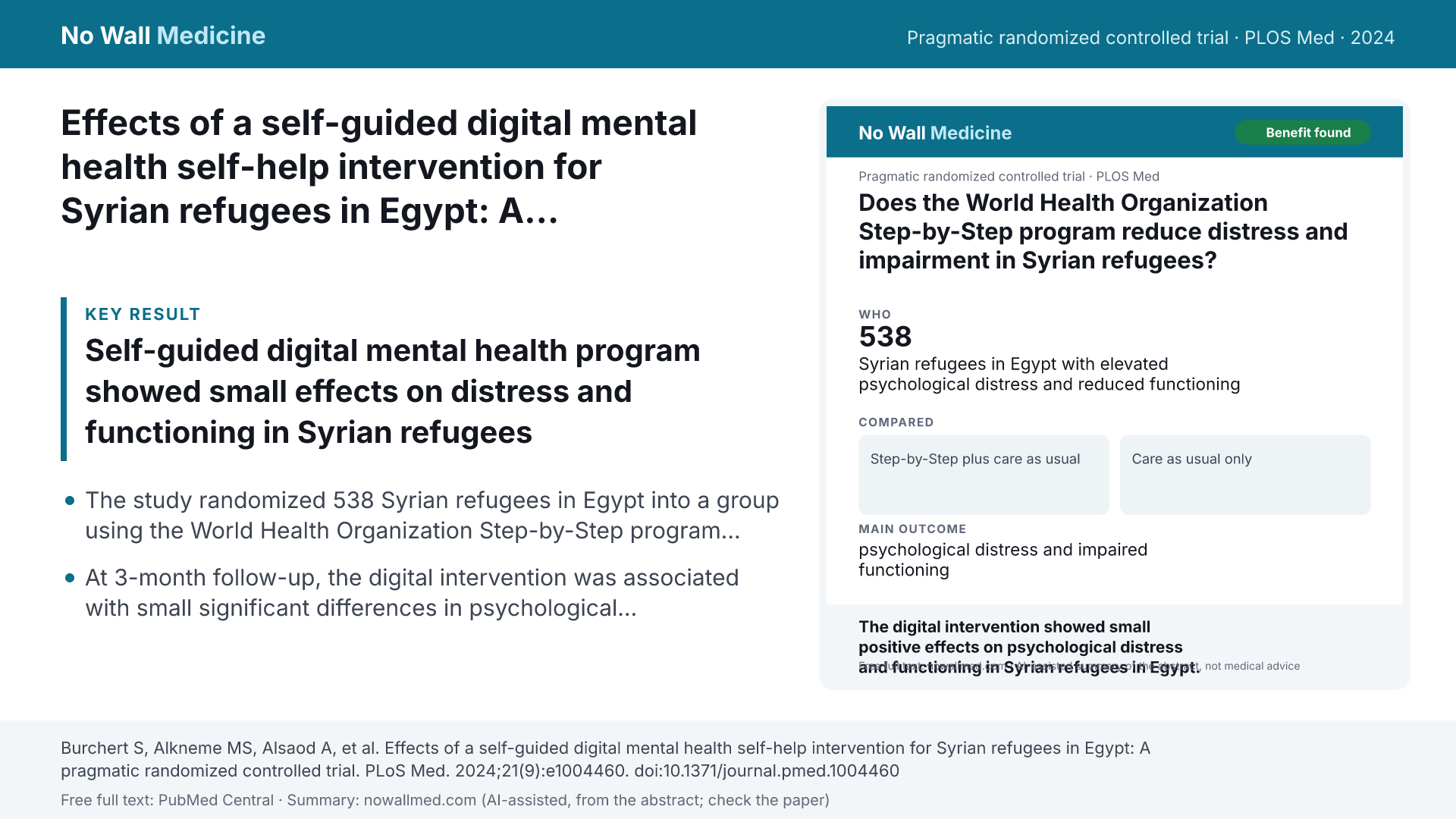
Self-guided digital mental health program showed small effects on distress and functioning in Syrian refugees
Effects of a self-guided digital mental health self-help intervention for Syrian refugees in Egypt: A pragmatic randomized controlled trial
Pragmatic randomized controlled trialBenefit found
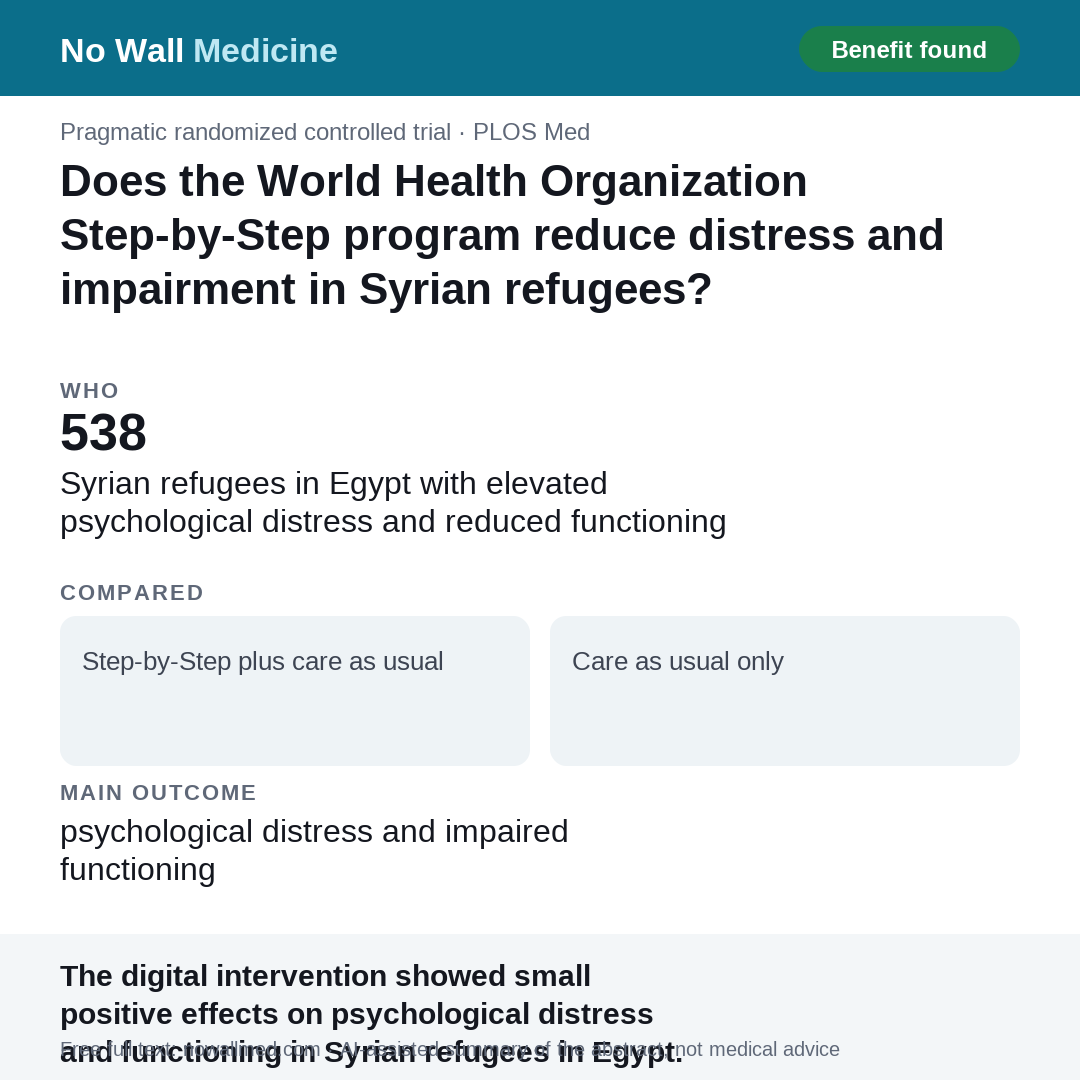
Does the World Health Organization Step-by-Step program reduce distress and impairment in Syrian refugees?
Who
538
Syrian refugees in Egypt with elevated psychological distress and reduced functioning · Egypt
Compared
Step-by-Step plus care as usual
Care as usual only
Main outcome
psychological distress and impaired functioning
Result: mean difference: -0.15 (95% CI: -0.28, -0.02) for distress; mean difference: -2.04 (95% CI: -3.87, -0.22) for functioning
Bottom line: The digital intervention showed small positive effects on psychological distress and functioning in Syrian refugees in Egypt.
Limitation: High intervention dropout and low utilization of contact-on-demand support.
PLOS Med · 2024-09-09Download image
Clinical question: Does the World Health Organization Step-by-Step program reduce distress and impairment in Syrian refugees?
Why it matters: It was unknown if a self-guided digital mental health intervention could effectively reduce psychological distress and functional impairment in Syrian refugee populations.
Key points
- The study randomized 538 Syrian refugees in Egypt into a group using the World Health Organization Step-by-Step program plus usual care or a group receiving usual care only.
- At 3-month follow-up, the digital intervention was associated with small significant differences in psychological distress (mean difference: -0.15) and functional impairment (mean difference: -2.04).
- There were no significant differences between the groups regarding posttraumatic stress disorder symptoms or self-identified problems, and remission rates did not differ.
Limitation the authors note: The authors stated that the main limitations were high intervention dropout and low utilization of the contact-on-demand support.
Headline and key points written with AI from the paper’s abstract, with every number checked against it. Read the paper before relying on them.
Was this summary helpful?
Subject terms
Cite this article
Burchert S, Alkneme MS, Alsaod A, et al. Effects of a self-guided digital mental health self-help intervention for Syrian refugees in Egypt: A pragmatic randomized controlled trial. PLOS Med. 2024. doi:10.1371/journal.pmed.1004460
Spotted a mistake? Suggest a correction