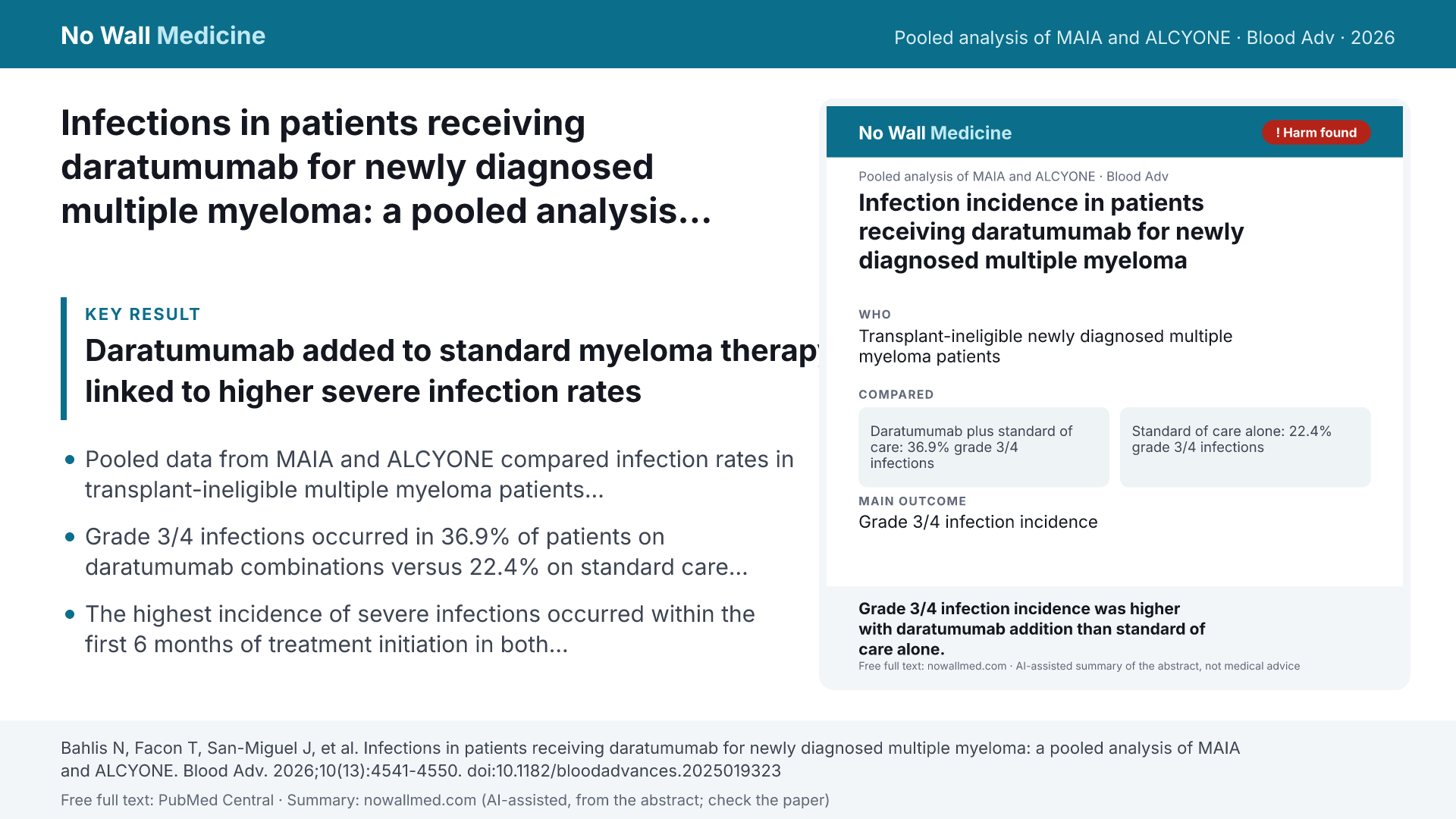
Daratumumab added to standard myeloma therapy linked to higher severe infection rates
Infections in patients receiving daratumumab for newly diagnosed multiple myeloma: a pooled analysis of MAIA and ALCYONE
Pooled analysis of MAIA and ALCYONEHarm found
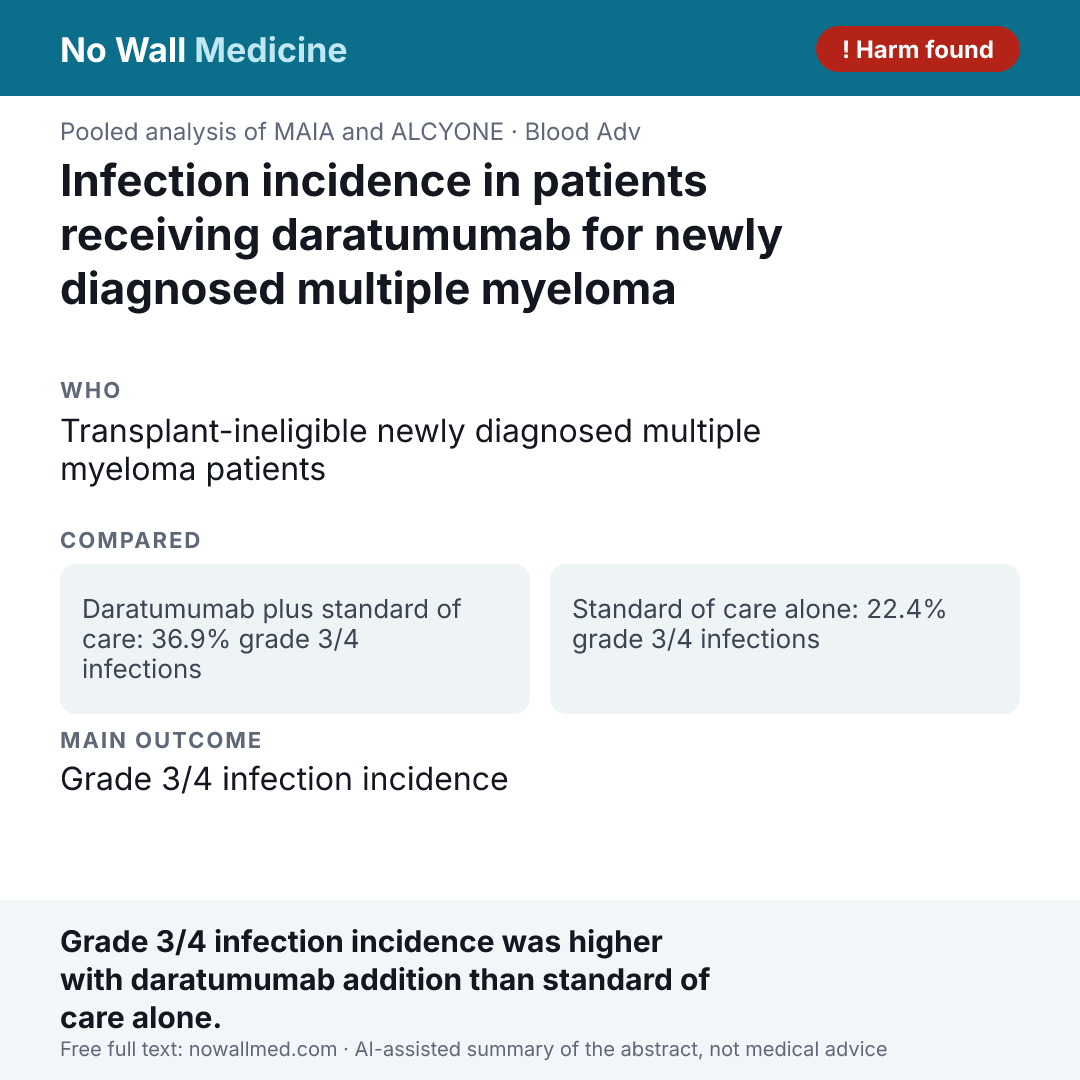
Infection incidence in patients receiving daratumumab for newly diagnosed multiple myeloma
Who
Transplant-ineligible newly diagnosed multiple myeloma patients
Compared
Daratumumab plus standard of care: 36.9% grade 3/4 infections
Standard of care alone: 22.4% grade 3/4 infections
Main outcome
Grade 3/4 infection incidence
Bottom line: Grade 3/4 infection incidence was higher with daratumumab addition than standard of care alone.
Blood Adv · 2026-05-05 · NCT02252172 · NCT02195479
Same trial (NCT02252172, NCT02195479)
Papers we list that report this registered trial, oldest first. Read a secondary analysis alongside the main results.
- Secondary analysis Benefit found
Daratumumab linked to higher rates of sustained minimal residual disease negativity in myeloma Blood 2021-07 - Pooled analysis
Achieving minimal residual disease negativity was associated with longer progression-free survival in multiple myeloma Blood 2021-07 - Pooled analysis Harm found
This paper Blood Adv 2026-05
Why it matters: Patients with newly diagnosed multiple myeloma are highly susceptible to infection, and understanding incidence helps mitigate future risk.
Headline and visual abstract written with AI from the paper’s abstract, with every number checked against it. Read the paper before relying on them.
Was this summary helpful?
Abstract
Both the phase 3 MAIA and ALCYONE studies demonstrated significant survival benefit with the addition of daratumumab to standard-of-care Rd (Revlimid [lenalidomide] and dexamethasone; D-Rd) or to VMP (Velcade [bortezomib], melphalan, and prednisone; D-VMP), respectively, vs Rd or VMP alone in transplant-ineligible newly diagnosed multiple myeloma (NDMM). Patients with NDMM are highly susceptible to infection; therefore, gaining a greater understanding of infection incidence may help to mitigate future risk. We conducted a pooled analysis of infection incidence, timing, and management strategies from MAIA and ALCYONE. The median (range) age of the pooled population was 72 (40-93) years. Incidence was higher with D-Rd/D-VMP vs Rd/VMP for grade 3/4 (36.9% vs 22.4%) and grade 5 (3.0% vs 1.5%) infections; however, exposure-adjusted incidence rates were generally comparable between groups. Any-grade infections led to the discontinuation of study treatment in ∼2% of patients across treatment groups. Of the timing intervals explored, the highest incidence of grade 3/4 infection occurred within the first 6-month interval of study treatment initiation in both groups. Median time to the first onset of grade 3/4 infections (per Kaplan-Meier estimates) was 83.3 months and not estimable in the D-Rd/D-VMP and Rd/VMP groups, respectively. Although the rates of D-Rd/D-VMP treatment discontinuation due to infection remained low in MAIA and ALCYONE, clinicians should remain vigilant about infections throughout treatment and follow local guidelines and International Myeloma Working Group recommendations to minimize the risk of infection. These trials were registered at www.ClinicalTrials.gov as NCT02252172 (MAIA) and NCT02195479 (ALCYONE).
Abstract reproduced under the article’s CC BY NC ND licence.
Subject terms
Cite this article
Bahlis N, Facon T, San-Miguel J, et al. Infections in patients receiving daratumumab for newly diagnosed multiple myeloma: a pooled analysis of MAIA and ALCYONE. Blood Adv. 2026;10(13):4541-4550. doi:10.1182/bloodadvances.2025019323
Spotted a mistake? Suggest a correction