Visual abstracts
New randomized trials and meta-analyses from leading journals at a glance: who was studied, what was compared, and what was found. Every paper is free to read in full.
All specialtiesCardiology 4877Oncology 4138Gastroenterology & Hepatology 1942Infectious Disease 3837Neurology 1905Psychiatry & Mental Health 2273Pulmonology 2143Critical Care 1365Endocrinology & Diabetes 2580Pediatrics 2980Surgery 2559Orthopedics & Sports Medicine 931Neurosurgery 537Cardiothoracic & Vascular Surgery 674Plastic & Reconstructive Surgery 591Nephrology 1133Rheumatology 823Hematology 1109Dermatology 621Ophthalmology 543Obstetrics & Gynecology 1686Public & Global Health 1058Radiology & Imaging 648Anesthesiology 986Urology 764ENT (Otolaryngology) 503Emergency Medicine 511Allergy & Immunology 313Geriatrics 981Family Medicine & Primary Care 562Medical Genetics & Genomics 676Pathology & Laboratory Medicine 159Physical Medicine & Rehabilitation 757Palliative Care 444Nutrition 1588Digital Health & AI 2201General Medicine 321
Performance of molecular tests for diagnosis of bloodstream infections in the clinical setting: a systematic literature review and meta-analysis
Systematic review and meta-analysisBenefit found
What is the diagnostic accuracy of molecular tests for bloodstream infection pathogens and resistance?
Who
24
Patients with positive blood cultures
Compared
Molecular tests
Traditional phenotypic identification and susceptibility testing
Main outcome
Diagnostic test accuracy for pathogens and antimicrobial resistance
Bottom line: Molecular tests show high diagnostic accuracy for identifying pathogens and antimicrobial resistance in positive blood cultures.
Limitation: Sensitivity was lower for IMP and VIM carbapenemases due to low prevalence.
Clin Microbiol Infect · 2024-12-11Download image

Genetic and environment influences on childhood victimization: a systematic review and meta-analysis
Systematic review and meta-analysis of twin studiesMixed results
What are the genetic and environmental influences on childhood victimization?
Who
62,794
Participants in twin studies
Compared
40%Genetic influences
20%Shared environmental influences
40%Non-shared environmental influences
Main outcome
Variance in childhood victimization
Bottom line: Genetic and non-shared environmental influences account for 40% each, while shared environment accounts for 20% of variance.
Mol Psychiatry · 2024-12-11Download image

Personality disorders, violence and antisocial behaviour: updated systematic review and meta-regression analysis
Systematic review and meta-regression analysisHarm found
What is the risk of antisocial outcomes and recidivism associated with personality disorders?
Who
83418
Individuals with personality disorders compared to controls · 10 to 13 countries
Compared
Any personality disorder: odds ratio 4.5 (95% CI 3.0-6.7) for violence
Controls
Main outcome
Antisocial behaviour, interpersonal violence, and recidivism
Result: odds ratio 4.5 (95% CI 3.0-6.7) for violence
Bottom line: Personality disorders are associated with increased risks of violence and recidivism, particularly antisocial and borderline personality disorders.
Br J Psychiatry · 2024-12-11Download image

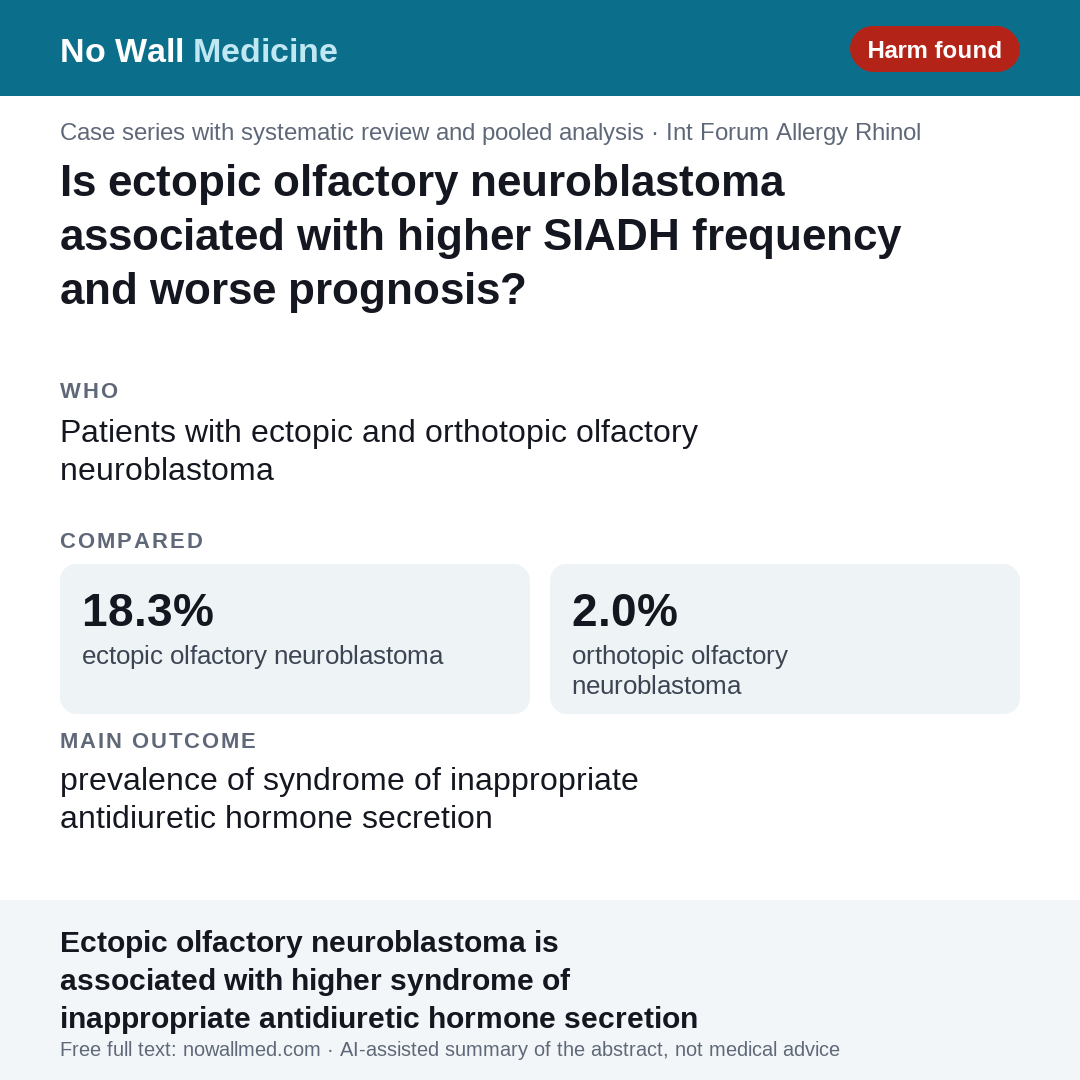
Ectopic olfactory neuroblastoma is associated with increased frequency of syndrome of inappropriate antidiuretic hormone secretion and reduced disease control: Case series with systematic review and pooled analysis
Case series with systematic review and pooled analysisHarm found
Is ectopic olfactory neuroblastoma associated with higher SIADH frequency and worse prognosis?
Who
Patients with ectopic and orthotopic olfactory neuroblastoma
Compared
18.3%ectopic olfactory neuroblastoma
2.0%orthotopic olfactory neuroblastoma
Main outcome
prevalence of syndrome of inappropriate antidiuretic hormone secretion
Bottom line: Ectopic olfactory neuroblastoma is associated with higher syndrome of inappropriate antidiuretic hormone secretion prevalence and worse prognosis.
Int Forum Allergy Rhinol · 2024-12-11Download image
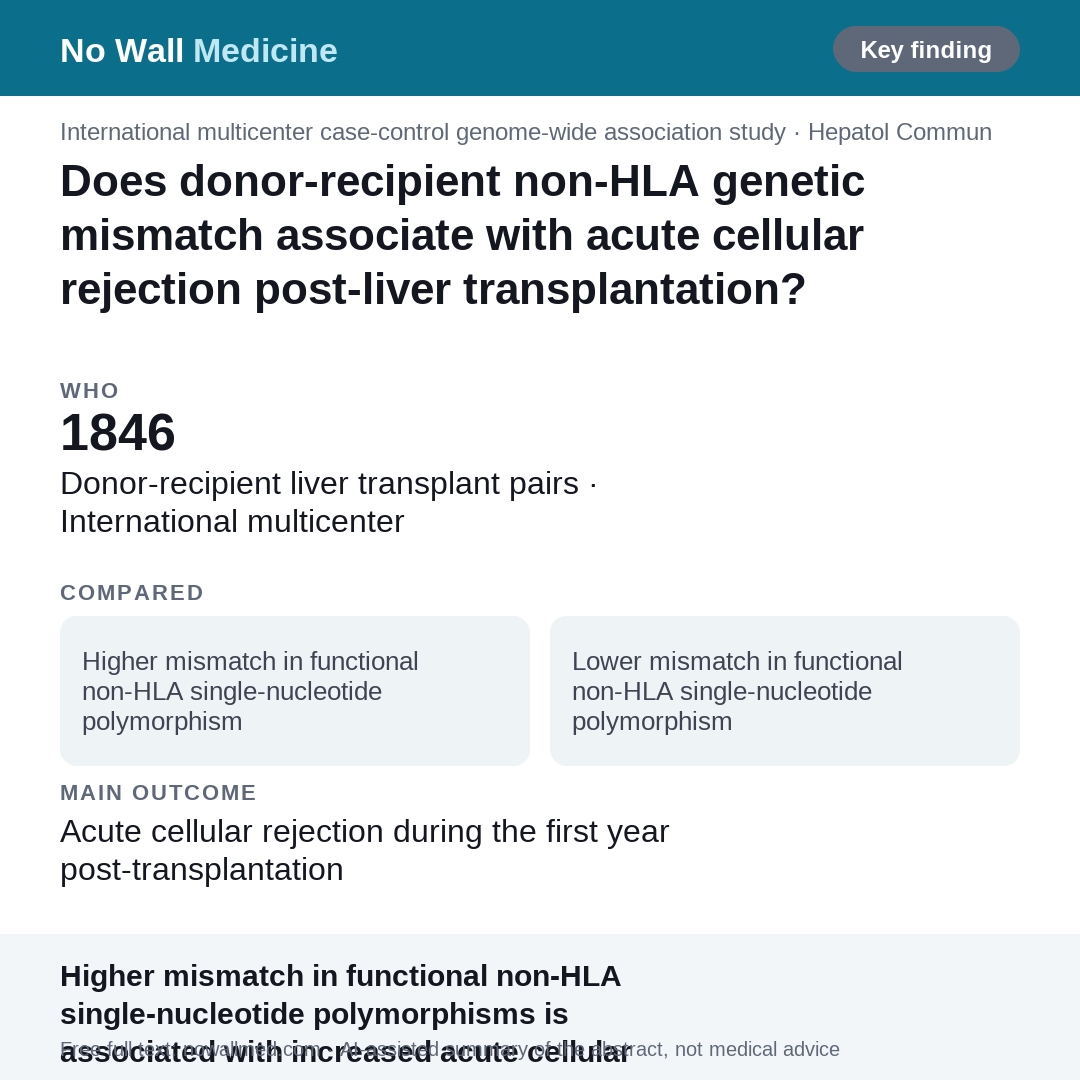
Genome-wide meta-analysis associates donor-recipient non-HLA genetic mismatch with acute cellular rejection post-liver transplantation
International multicenter case-control genome-wide association studyBenefit found
Does donor-recipient non-HLA genetic mismatch associate with acute cellular rejection post-liver transplantation?
Who
1846
Donor-recipient liver transplant pairs · International multicenter
Compared
Higher mismatch in functional non-HLA single-nucleotide polymorphism
Lower mismatch in functional non-HLA single-nucleotide polymorphism
Main outcome
Acute cellular rejection during the first year post-transplantation
Result: hazard ratio 5.99 (95% CI 1.39-20.08)
Bottom line: Higher mismatch in functional non-HLA single-nucleotide polymorphisms is associated with increased acute cellular rejection after liver transplantation.
Limitation: Future studies are needed to validate findings using a genotyped human leukocyte antigen cohort.
Hepatol Commun · 2024-12-11Download image
Perioperative patient safety recommendations: systematic review of clinical practice guidelines
Systematic review of clinical practice guidelinesMixed results
What are the perioperative patient safety recommendations for adults?
Who
Adults in the perioperative care continuum
Compared
4666Total recommendations extracted
44.9%Strongly recommended (2095)
Main outcome
Perioperative patient safety recommendations
Bottom line: There is noteworthy variability in guideline quality and discordance between recommendation strength and evidence levels.
BJS Open · 2024-12-11Download image

The clinical impact of conventional therapies for adults and adolescents suffering from eosinophilic esophagitis, a type 2 inflammatory chronic disease, and their economic consequences in Italy: Systematic literature review and meta-analysis
Systematic literature review and meta-analysisMixed results
How effective and safe are topical corticosteroids and proton pump inhibitors for eosinophilic esophagitis?
Who
Adults and adolescents with eosinophilic esophagitis · Italy
Compared
Topical corticosteroids: superior efficacy over proton pump inhibitors in histologic, endoscopic, and partial clinical responses
Proton pump inhibitors: effective in reducing symptoms
Main outcome
histologic, endoscopic, and partial clinical responses
Bottom line: Topical corticosteroids are more effective for histologic and endoscopic responses, while proton pump inhibitors reduce symptoms.
JACI Glob · 2024-12-11Download image

Success Factors of Growth-Stage Digital Health Companies: Systematic Literature Review
Systematic literature reviewUnclear result
What are the success factors for growth-stage digital health companies?
Who
Growth-stage digital health companies
Compared
Digital health companies: 19 specific success factors
General digital companies
Main outcome
Identification of success factors for digital health companies
Bottom line: Growth-stage digital health companies rely on specific factors like regulatory alignment, data security, and system interoperability.
J Med Internet Res · 2024-12-11Download image

Psychological Factors That Contribute to the Use of Video Consultations in Health Care: Systematic Review
Systematic reviewUnclear result
Psychological factors in video consultations
Who
90
health care professionals · Australia
Compared
positive perspective
negative perspective
Main outcome
video consultation use
Result: cyclical relationship between factors and intention
Bottom line: Psychological factors influence video consultation use
J Med Internet Res · 2024-12-11Download image

Factors Associated With Digital Intervention Engagement and Adherence in Patients With Cancer: Systematic Review
Systematic reviewMixed results
What factors influence adherence to and engagement with digital interventions in cancer care?
Who
61
Adult patients with cancer
Compared
Comorbidity: consistently predicted lower adherence and engagement
Higher social support: associated with lower adherence and engagement
Main outcome
Adherence to and engagement with digital interventions
Bottom line: Factors influencing digital intervention engagement in cancer patients are complex, with comorbidities and low social support consistently linked to lower adherence.
Limitation: Results regarding many factors were inconsistent across studies.
J Med Internet Res · 2024-12-11Download image

Large Language Models and Empathy: Systematic Review
Systematic reviewBenefit found
What is the capacity of large language models in demonstrating empathy?
Who
Large language model outputs
Compared
ChatGPT-3.5 responses to patient questions: preferred over humans in 78.6% of cases
GPT-4 on US Medical Licensing Examination: 90% of questions correctly
Main outcome
Capacity of large language models in demonstrating empathy
Bottom line: Large language models exhibit elements of cognitive empathy, including emotion recognition and providing emotionally supportive responses.
Limitation: Repetitive empathic phrases, sensitivity to prompts, and subjective evaluation metrics influenced by evaluator background.
J Med Internet Res · 2024-12-11Download image

Accuracy of Machine Learning in Detecting Pediatric Epileptic Seizures: Systematic Review and Meta-Analysis
Systematic review and meta-analysisBenefit found
How accurate is machine learning and deep learning in detecting pediatric epileptic seizures?
Who
28
Children with epileptic seizures using electroencephalography data
Compared
Machine learning in training set: accuracy 0.75 (95% CI 0.72-0.77)
Machine learning in validation set: accuracy 0.78 (95% CI 0.73-0.82)
Deep learning in validation set: accuracy 0.89 (95% CI 0.86-0.92)
Main outcome
Diagnostic accuracy using C-index, sensitivity, specificity, and accuracy
Result: deep learning validation C-index 0.91 (95% CI 0.88-0.94)
Bottom line: Deep learning shows higher accuracy than machine learning for detecting pediatric epileptic seizures in validation sets.
J Med Internet Res · 2024-12-11Download image

Number of Doses of Systemic Antibiotic Prophylaxis May Be Reduced in Cemented Primary Knee Arthroplasty Irrespective of Use of Antibiotic in the Cement: A Multiregistry-Based Meta-Analysis
Meta-analysis of 289,926 primary total knee arthroplastiesNo clear difference
Does antibiotic-loaded bone cement plus systemic antibiotic prophylaxis reduce periprosthetic joint infection risk?
Who
289926
Patients undergoing primary total knee arthroplasty for osteoarthritis · Denmark, New Zealand, Norway, Romania, and United States
Compared
Antibiotic-loaded bone cement and systemic antibiotic prophylaxis: 0.34%-0.80%
Plain bone cement and systemic antibiotic prophylaxis: 0.54%-0.69%
Main outcome
One-year revision for periprosthetic joint infection
Result: hazard rate ratio 1.21 (95% confidence interval 0.79 to 1.87)
Bottom line: Antibiotic-loaded bone cement and plain bone cement show similar periprosthetic joint infection risks when systemic antibiotic prophylaxis is used.
JBJS Open Access · 2024-12-11Download image

The role of deep learning in diagnostic imaging of spondyloarthropathies: a systematic review
Systematic reviewBenefit found
How can deep learning models improve diagnostic accuracy in imaging for spondyloarthropathies?
Who
21
Patients undergoing MRI, CT, and X-ray imaging for spondyloarthropathies
Compared
Deep learning models: AUCs up to 0.98
Traditional methods and experts
Main outcome
Diagnostic accuracy in spondyloarthropathies imaging
Bottom line: Deep learning models show high diagnostic accuracy in spondyloarthropathies imaging across multiple modalities, potentially matching expert radiologists.
Limitation: Small sample sizes in some studies and need for prospective and external validation.
Eur Radiol · 2024-12-10Download image

Is Frequent Imaging Necessary? Impact of Computed Tomography During Follow-up After Surgical Treatment for Nonmetastatic Renal Cell Carcinoma: A Systematic Review
Systematic reviewNo clear difference
Is more frequent computed tomography advantageous compared to 2022 European Association of Urology guidelines?
Who
Patients with nonmetastatic renal cell carcinoma after curative surgery
Compared
Higher imaging frequency
European Association of Urology guidelines
Main outcome
Recurrence and survival
Bottom line: More frequent imaging than recommended by guidelines may not be necessary for survival and recurrence rates.
Limitation: A meta-analysis was not suited due to clinical diversity and high risk of bias.
Eur Urol Oncol · 2024-12-10Download image

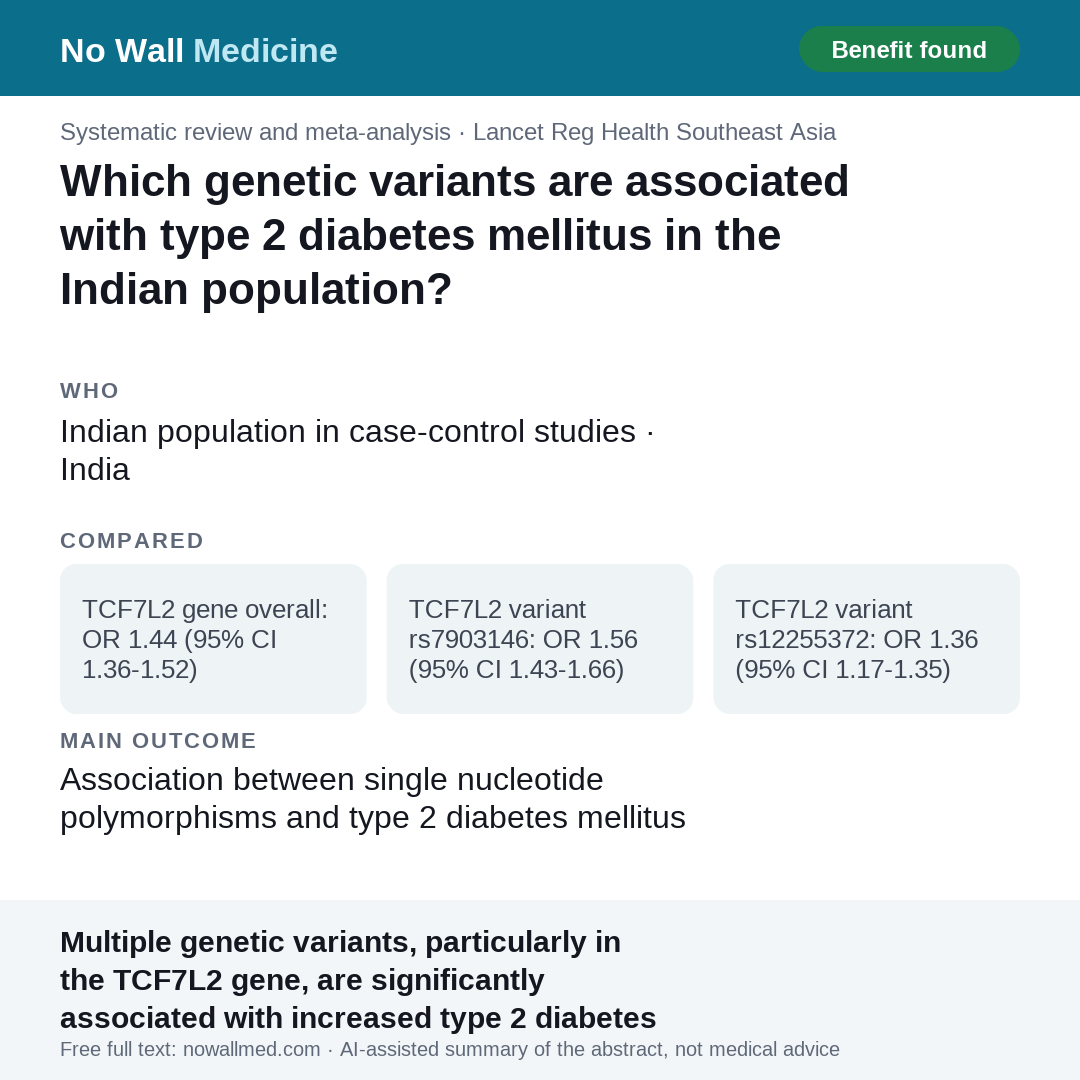
Genetic variants and type 2 diabetes in India: a systematic review and meta-analysis of associated polymorphisms in case-control studies
Systematic review and meta-analysisBenefit found
Which genetic variants are associated with type 2 diabetes mellitus in the Indian population?
Who
Indian population in case-control studies · India
Compared
TCF7L2 gene overall: OR 1.44 (95% CI 1.36-1.52)
TCF7L2 variant rs7903146: OR 1.56 (95% CI 1.43-1.66)
TCF7L2 variant rs12255372: OR 1.36 (95% CI 1.17-1.35)
Main outcome
Association between single nucleotide polymorphisms and type 2 diabetes mellitus risk
Result: OR 1.44 (95% CI 1.36-1.52)
Bottom line: Multiple genetic variants, particularly in the TCF7L2 gene, are significantly associated with increased type 2 diabetes risk in Indians.
Funded by: Department of Biotechnology and Indian Council of Medical Research
Lancet Reg Health Southeast Asia · 2024-12-10Download image
Sex differences in the pharmacokinetics of anticancer drugs: a systematic review
Systematic reviewBenefit found
Do sex differences exist in the pharmacokinetics of anticancer drugs?
Who
Patients receiving Food and Drug Administration-approved anticancer drugs
Compared
Significant pharmacokinetic differences identified: 14 drugs
Potentially significant pharmacokinetic differences: 8 drugs
Main outcome
Significant pharmacokinetic differences in clearance or trough concentration
Bottom line: Significant sex differences in pharmacokinetics exist for several anticancer drugs, suggesting a need for sex-specific dosing strategies.
Limitation: None of the studies included sex-based summaries to assess impact on efficacy or safety.
ESMO Open · 2024-12-10Download image

Characteristics and Popularity of Videos of Abusive Head Trauma Prevention: Systematic Appraisal
Systematic appraisalMixed results
What are the characteristics and popularity of abusive head trauma prevention videos?
Who
53
English or French videos of abusive head trauma prevention · Internet
Compared
Depicting infant being shaken: β=1.74, 95% CI 1.06-2.85
Use of text or headers: β=2.15, 95% CI 1.08-4.26
Main outcome
Video Power Index popularity
Bottom line: Prevention videos were high quality but popularity was associated with depicting shaking and using text or headers.
J Med Internet Res · 2024-12-10Download image

Face Masking and Risk of Endophthalmitis after Intravitreal Injection: A Network Meta-analysis of 2.6 Million Injections
Network meta-analysis of 17 studiesBenefit found
Which face-masking protocols reduce post-intravitreal injection endophthalmitis risk?
Who
2595219
2,595,219 intravitreal injections
Compared
Standard care
No-talking: OR, 0.56 (95% CI, 0.39-0.82)
Physician masking: OR, 0.72 (95% CI, 0.53-0.99)
Universal masking: OR, 0.83 (95% CI, 0.67-1.02)
Main outcome
post-intravitreal injection endophthalmitis incidence
Result: no-talking OR, 0.56 (95% CI, 0.39-0.82)
Bottom line: No-talking and physician masking policies may reduce endophthalmitis rates compared to standard care.
Limitation: Low- or very low-certainty evidence and limited study power for specific culture outcomes.
Ophthalmology · 2024-12-09Download image

Pregnancy outcomes in type 2 diabetes: a systematic review and meta-analysis
Systematic review and meta-analysisHarm found
How do pregnancy outcomes in type 2 diabetes compare to other diabetes types and nondiabetes?
Who
723
Pregnancies with type 2 diabetes, type 1 diabetes, gestational diabetes, or nondiabetes
Compared
Type 2 diabetes vs Type 1 diabetes: SGA (OR 2.29), neonatal mortality (OR 1.53), perinatal mortality (OR 1.31)
Type 2 diabetes vs Gestational diabetes: congenital anomalies (OR 1.91), LGA (OR 3.49), neonatal mortality (OR 3.96), stillbirth (OR 16.55)
Type 2 diabetes vs Nondiabetes: congenital anomalies (OR 1.76), LGA (OR 2.79), perinatal mortality (OR 4.18), stillbirth (OR 7.27)
Main outcome
Congenital anomalies, stillbirths, neonatal and perinatal mortality, birthweight, LGA, SGA, and macrosomia
Bottom line: Type 2 diabetes pregnancies are associated with greater perinatal mortality and adverse outcomes compared to other diabetes types and nondiabetes.
AJOG · 2024-12-09Download image