Visual abstracts
New randomized trials and meta-analyses from leading journals at a glance: who was studied, what was compared, and what was found. Every paper is free to read in full.
All specialtiesCardiology 4877Oncology 4138Gastroenterology & Hepatology 1942Infectious Disease 3837Neurology 1905Psychiatry & Mental Health 2273Pulmonology 2143Critical Care 1365Endocrinology & Diabetes 2580Pediatrics 2980Surgery 2559Orthopedics & Sports Medicine 931Neurosurgery 537Cardiothoracic & Vascular Surgery 674Plastic & Reconstructive Surgery 591Nephrology 1133Rheumatology 823Hematology 1109Dermatology 621Ophthalmology 543Obstetrics & Gynecology 1686Public & Global Health 1058Radiology & Imaging 648Anesthesiology 986Urology 764ENT (Otolaryngology) 503Emergency Medicine 511Allergy & Immunology 313Geriatrics 981Family Medicine & Primary Care 562Medical Genetics & Genomics 676Pathology & Laboratory Medicine 159Physical Medicine & Rehabilitation 757Palliative Care 444Nutrition 1588Digital Health & AI 2201General Medicine 321
Interventions to achieve environmentally sustainable operating theatres: an umbrella systematic review using the behaviour change wheel
Umbrella systematic reviewBenefit found
Interventions for sustainable operating theatres
Who
operating theatre staff and settings
Compared
reduce strategy
other strategies
Main outcome
sustainability improvements
Bottom line: Reduce strategy guarantees environmental savings
Limitation: comparing outcomes is difficult
Int J Surg · 2024-11-01Download image

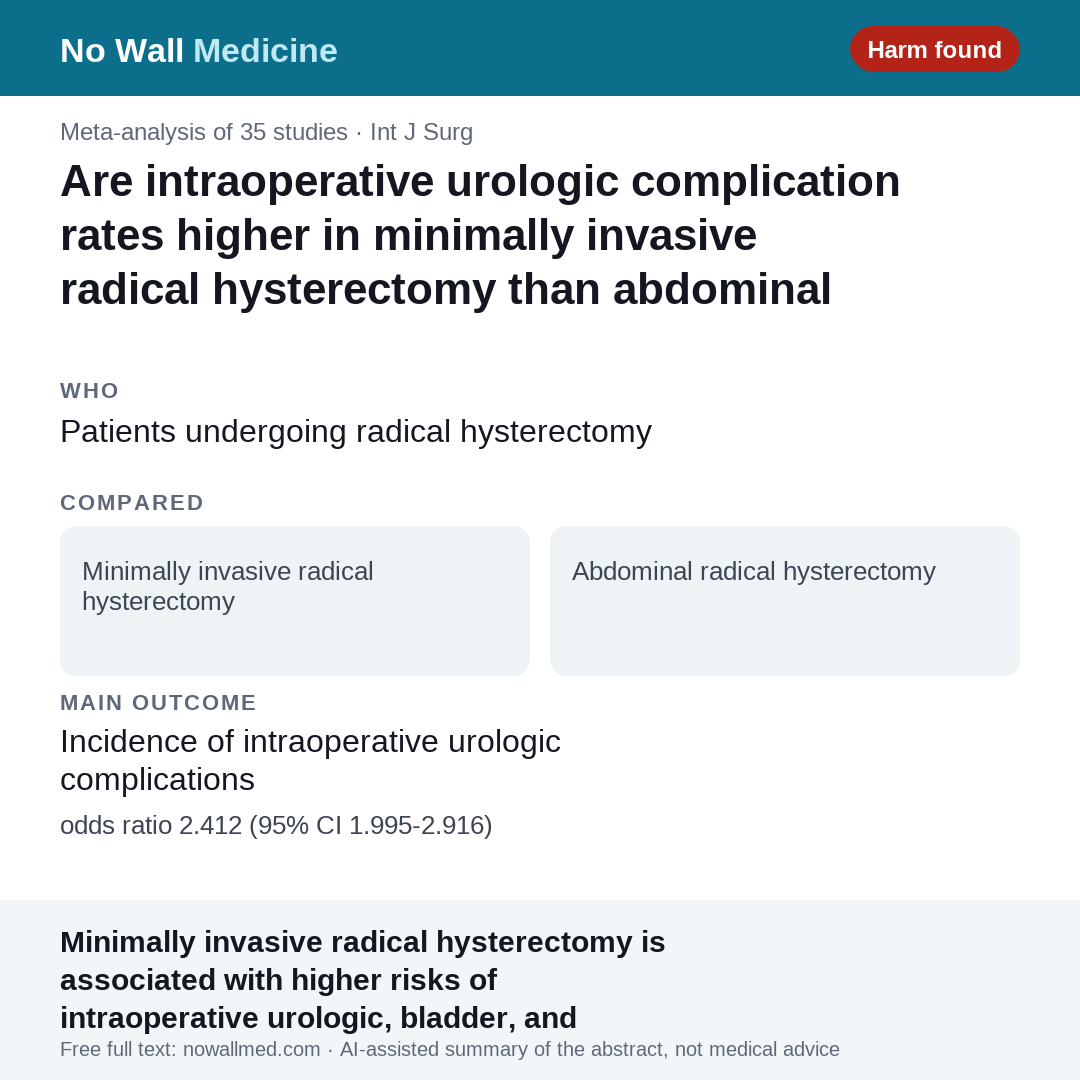
Meta-analysis reveals higher intraoperative urologic complication rates in minimally invasive radical hysterectomy compared to abdominal radical hysterectomy
Meta-analysis of 35 studiesHarm found
Are intraoperative urologic complication rates higher in minimally invasive radical hysterectomy than abdominal radical hysterectomy?
Who
Patients undergoing radical hysterectomy
Compared
Minimally invasive radical hysterectomy
Abdominal radical hysterectomy
Main outcome
Incidence of intraoperative urologic complications
Result: odds ratio 2.412 (95% CI 1.995-2.916)
Bottom line: Minimally invasive radical hysterectomy is associated with higher risks of intraoperative urologic, bladder, and ureteral injuries.
Int J Surg · 2024-11-01Download image
Postprocedural infection rate after minor surgical procedures performed with and without sterile gloves: a systematic review and meta-analysis
Meta-analysis of 14 comparative studiesNo clear difference
Does using sterile gloves reduce postprocedural infection rates during minor surgical procedures?
Who
12625
Patients undergoing minor surgical procedures
Compared
With sterile gloves
Without sterile gloves
Main outcome
Postprocedural infection
Result: odds ratio 0.88 (95% CI 0.71-1.10)
Bottom line: The use of sterile gloves does not provide extra benefit for preventing infections during minor surgical procedures.
Int J Surg · 2024-11-01Download image

Clinical guidelines for early hepatocellular carcinoma treatment options: a systematic review and bibliometric analysis
Systematic review and bibliometric analysisMixed results
What are the current clinical guidelines for early hepatocellular carcinoma treatment options?
Who
23
Clinical guidelines from major liver societies
Compared
Radiofrequency ablation: increasing endorsement for certain patient groups
Surgical resection: sustained strong support
Main outcome
Treatment recommendations for early hepatocellular carcinoma
Bottom line: Guidelines show evolving recommendations for radiofrequency ablation and sustained support for surgical resection.
Int J Surg · 2024-11-01Download image

A systematic review and meta-analysis of morbidity and pancreatic fistula after distal pancreatectomy with versus without prophylactic intra-abdominal drainage
Systematic review and meta-analysisBenefit found
Does omitting prophylactic intra-abdominal drainage after distal pancreatectomy reduce morbidity and pancreatic fistula?
Who
3610
Patients undergoing distal pancreatectomy
Compared
No prophylactic drainage
Prophylactic drainage
Main outcome
Postoperative pancreatic fistula and morbidity
Result: OR 0.38 (95% CI: 0.25-0.56) for postoperative pancreatic fistula
Bottom line: A no-drainage policy is associated with reduced postoperative pancreatic fistula, morbidity, reinterventions, readmissions, and shorter hospital stays.
Int J Surg · 2024-11-01Download image

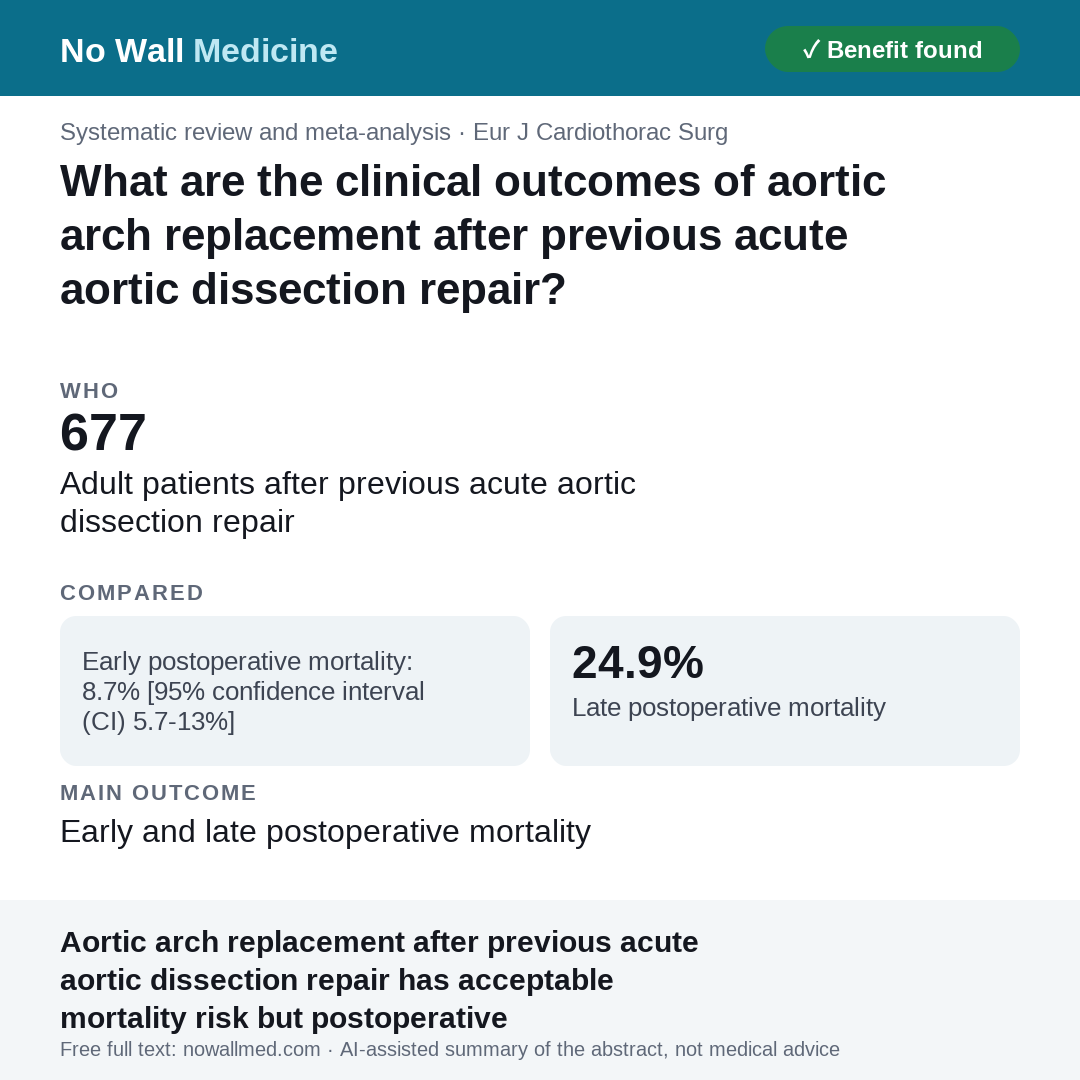
Aortic arch replacement in patients with previous repair of acute aortic dissection: a systematic review and meta-analysis
Systematic review and meta-analysisBenefit found
What are the clinical outcomes of aortic arch replacement after previous acute aortic dissection repair?
Who
677
Adult patients after previous acute aortic dissection repair
Compared
Early postoperative mortality: 8.7% [95% confidence interval (CI) 5.7-13%]
24.9%Late postoperative mortality (95% CI 19.5-31.1%)
Main outcome
Early and late postoperative mortality
Result: 8.7% [95% CI 5.7-13%] early and 24.9% (95% CI 19.5-31.1%) late mortality
Bottom line: Aortic arch replacement after previous acute aortic dissection repair has acceptable mortality risk but postoperative neurological deficit remains an issue.
Eur J Cardiothorac Surg · 2024-11-01Download image
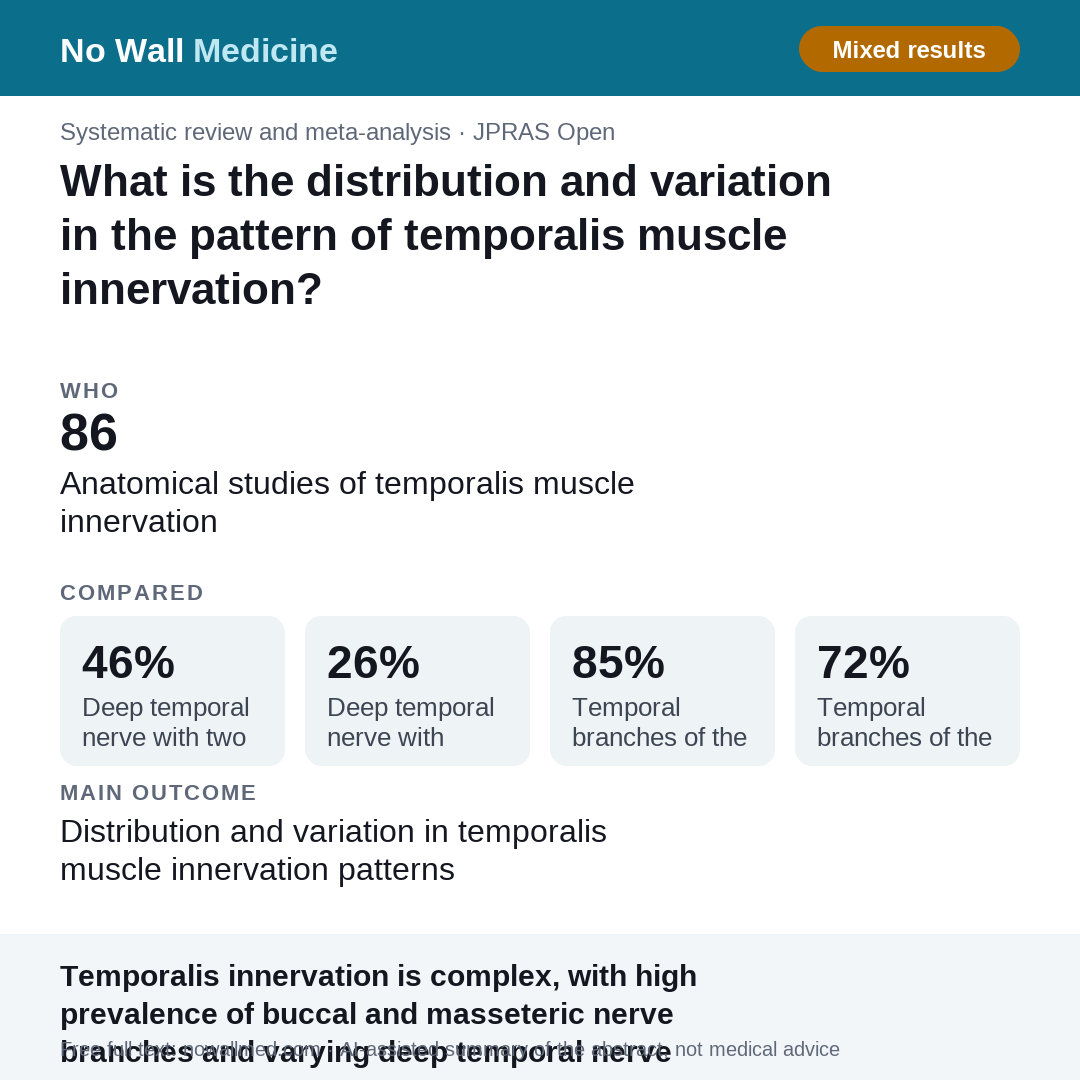
Variation and distribution in temporalis muscle innervation: A systematic review and meta-analysis of anatomical studies
Systematic review and meta-analysisMixed results
What is the distribution and variation in the pattern of temporalis muscle innervation?
Who
86
Anatomical studies of temporalis muscle innervation
Compared
46%Deep temporal nerve with two branches (95% CI: 46%-63%)
26%Deep temporal nerve with three branches (95% CI: 24%-39%)
85%Temporal branches of the buccal nerve (95% CI: 76%-92%)
72%Temporal branches of the masseteric nerve (95% CI: 63%-81%)
Main outcome
Distribution and variation in temporalis muscle innervation patterns
Bottom line: Temporalis innervation is complex, with high prevalence of buccal and masseteric nerve branches and varying deep temporal nerve patterns.
JPRAS Open · 2024-11-01Download image
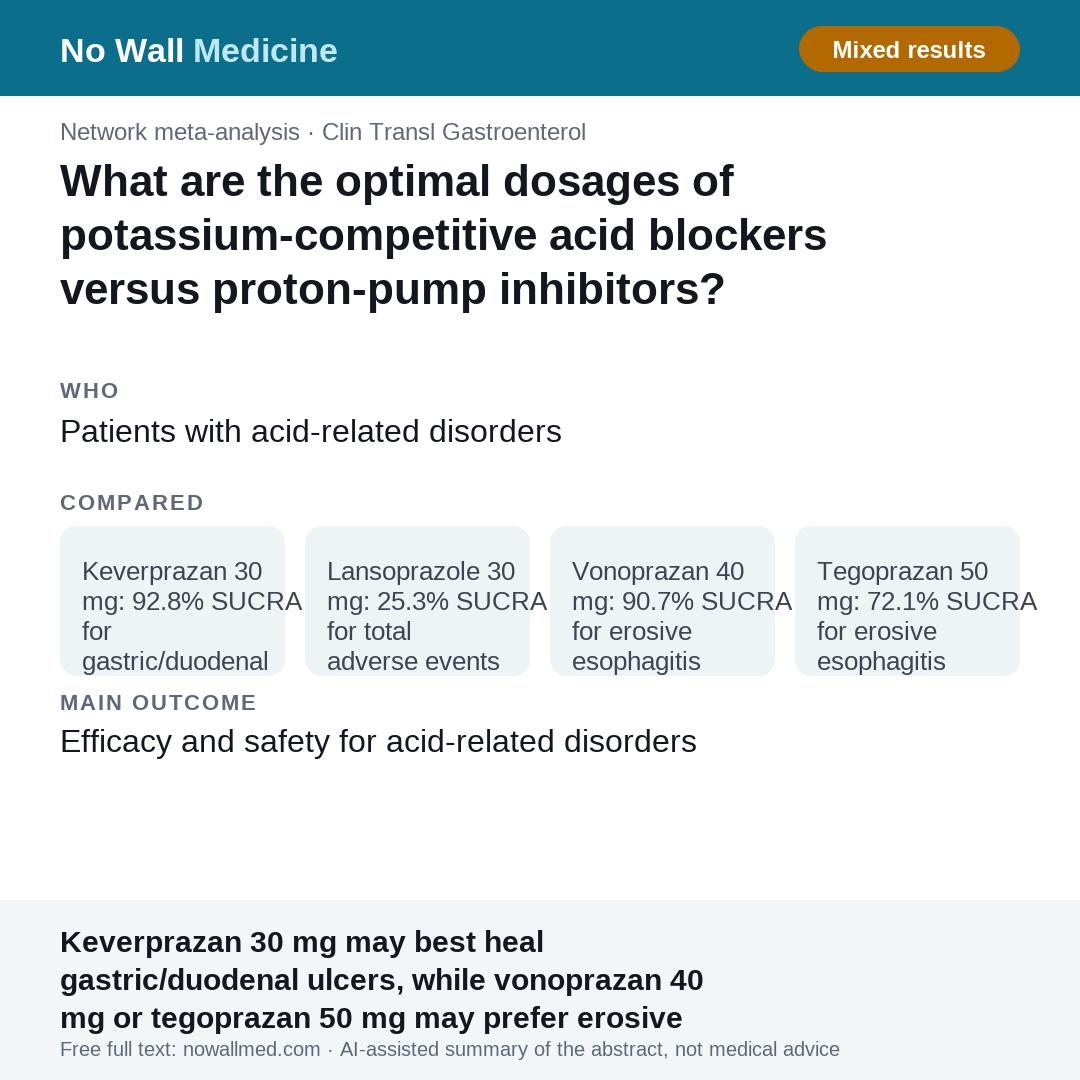
Network Meta-Analysis of Comparing Different Dosages of Potassium-Competitive Acid Blocker With Proton-Pump Inhibitor in Acid-Related Disorders
Network meta-analysisMixed results
What are the optimal dosages of potassium-competitive acid blockers versus proton-pump inhibitors?
Who
Patients with acid-related disorders
Compared
Keverprazan 30 mg: 92.8% SUCRA for gastric/duodenal ulcer healing rate
Lansoprazole 30 mg: 25.3% SUCRA for total adverse events in gastric/duodenal ulcers
Vonoprazan 40 mg: 90.7% SUCRA for erosive esophagitis healing rate
Tegoprazan 50 mg: 72.1% SUCRA for erosive esophagitis healing rate
Main outcome
Efficacy and safety for acid-related disorders
Bottom line: Keverprazan 30 mg may best heal gastric/duodenal ulcers, while vonoprazan 40 mg or tegoprazan 50 mg may prefer erosive esophagitis.
Clin Transl Gastroenterol · 2024-11-01Download image
The Relation Between Passively Collected GPS Mobility Metrics and Depressive Symptoms: Systematic Review and Meta-Analysis
Systematic review and meta-analysisBenefit found
Are there correlations between GPS mobility features and depressive symptoms?
Who
2930
Adults with no other mental health disorders
Compared
Distance: r=-0.25
Normalized entropy: r=-0.17
Location variance: r=-0.17
Entropy: r=-0.13
Main outcome
Between-person correlations between GPS features and depression symptoms
Result: distance r=-0.25 (95% CI -0.29 to -0.21)
Bottom line: GPS mobility and activity features show significant between-person correlations with depressive symptoms, potentially aiding future depression diagnostics.
Limitation: Low study quality, lack of adherence to reporting guidelines, and potential publication bias.
J Med Internet Res · 2024-11-01Download image

Fat embolism: a systematic review to facilitate the development of standardised procedures in pathology
Systematic reviewUnclear result
What is the current scientific evidence regarding fat embolism in forensic pathology?
Who
58 articles including 45 case reports and 21 experimental studies
Compared
Case reports
Experimental studies
Main outcome
Aetiopathogenesis, causal role in death, and diagnostic methodologies
Bottom line: The review provides an overview of fat embolism but notes diagnostic techniques have not yet bridged the reliability gap.
Limitation: Lack of detailed premortem clinical information and methodological heterogeneity in included studies.
Histopathology · 2024-10-31Download image

Effects of Varying Protein Amounts and Types on Diet-Induced Thermogenesis: A Systematic Review and Meta-Analysis
Systematic review and meta-analysisBenefit found
How do different amounts and types of protein impact diet-induced thermogenesis and energy expenditure?
Who
52
Participants in studies of acute meals or longer-term diets
Compared
Higher protein
Lower protein
Main outcome
diet-induced thermogenesis and total daily energy expenditure
Result: SMD 0.45 (95% CI 0.26, 0.65) for acute diet-induced thermogenesis
Bottom line: Higher protein intake increases diet-induced thermogenesis and total daily energy expenditure in acute and chronic settings.
Adv Nutr · 2024-10-31Download image

Seroprevalence of seven arboviruses of public health importance in sub-Saharan Africa: a systematic review and meta-analysis
Systematic review and meta-analysisMixed results
What is the seroprevalence of seven arboviruses in sub-Saharan Africa?
Who
186332
Human populations residing in sub-Saharan Africa · 27 countries in sub-Saharan Africa
Compared
23.7%Chikungunya virus (17.9-30.0%)
22.7%dengue virus (17.5-28.4%)
22.6%West Nile virus (14.1-32.5%)
16.4%yellow fever virus (7.1-28.5%)
Main outcome
Immunoglobulin G antibody seroprevalence
Bottom line: Significant circulation of seven arboviruses was found in sub-Saharan Africa, highlighting the need for surveillance and vaccine planning.
Limitation: Seroprevalence differed considerably between countries, study populations, age categories, sample sizes and laboratory methods.
BMJ Glob Health · 2024-10-31Download image

Electronic Health Interventions and Cervical Cancer Screening: Systematic Review and Meta-Analysis
Systematic review and meta-analysis of randomized controlled trialsBenefit found
Are electronic health interventions effective in promoting cervical cancer screening?
Who
23,102
Adults
Compared
Electronic health interventions
Control interventions
Main outcome
Cervical cancer screening rates
Result: relative risk 1.464 (95% CI 1.285-1.667)
Bottom line: Electronic health interventions increase cervical cancer screening rates compared to control interventions.
Limitation: Significant heterogeneity remained in this meta-analysis.
J Med Internet Res · 2024-10-31Download image

The effectiveness of various CSF diversion surgeries in idiopathic normal pressure hydrocephalus: a systematic review and meta-analysis
Systematic review and meta-analysisMixed results
What is the effectiveness of various cerebrospinal fluid diversion surgeries in idiopathic normal pressure hydrocephalus?
Who
4811
Patients with idiopathic normal pressure hydrocephalus
Compared
75%Ventriculoperitoneal shunting (95% CI 70-79%)
75%Ventriculoatrial shunting (95% CI: 70-80%)
70%Lumboperitoneal shunting (95% CI: 52-83%)
69%Endoscopic third-ventriculostomy (95% CI: 58-78%)
Main outcome
Efficacy defined as symptomatic improvement
Result: more than 74% (95% CI: 70-78%)
Bottom line: Most patients show symptomatic improvement, but only half see improvements in urinary and cognitive dysfunction.
Limitation: The stagnant efficacy and frequent complications highlight the need for improved patient selection criteria.
eClinicalMedicine · 2024-10-30Download image

Social Disadvantage and Disparities in Chronic Liver Disease: A Systematic Review
Systematic reviewHarm found
How do social determinants of health impact chronic liver disease outcomes?
Who
27
Patients with chronic liver disease
Compared
Unfavorable social determinants
Favorable social determinants
Main outcome
Mortality, hospitalizations, or readmissions
Bottom line: Unfavorable social determinants of health are associated with increased mortality and hospital readmissions among patients with chronic liver disease.
Limitation: Most included studies had some concern or high risk of bias.
Am J Gastroenterol · 2024-10-30Download image

Impact of social transition in relation to gender for children and adolescents: a systematic review
Systematic review and narrative synthesisUnclear result
What are the outcomes of social transition for children and adolescents experiencing gender dysphoria?
Who
Children and adolescents under 18 years experiencing gender dysphoria or incongruence · Primarily United States
Compared
Children who socially transitioned: no difference in mental health outcomes
Adolescents who socially transitioned: mixed evidence
Main outcome
Mental health and gender identity outcomes
Bottom line: There is an absence of robust evidence regarding the benefits or harms of social transition for children and adolescents.
Arch Dis Child · 2024-10-30Download image

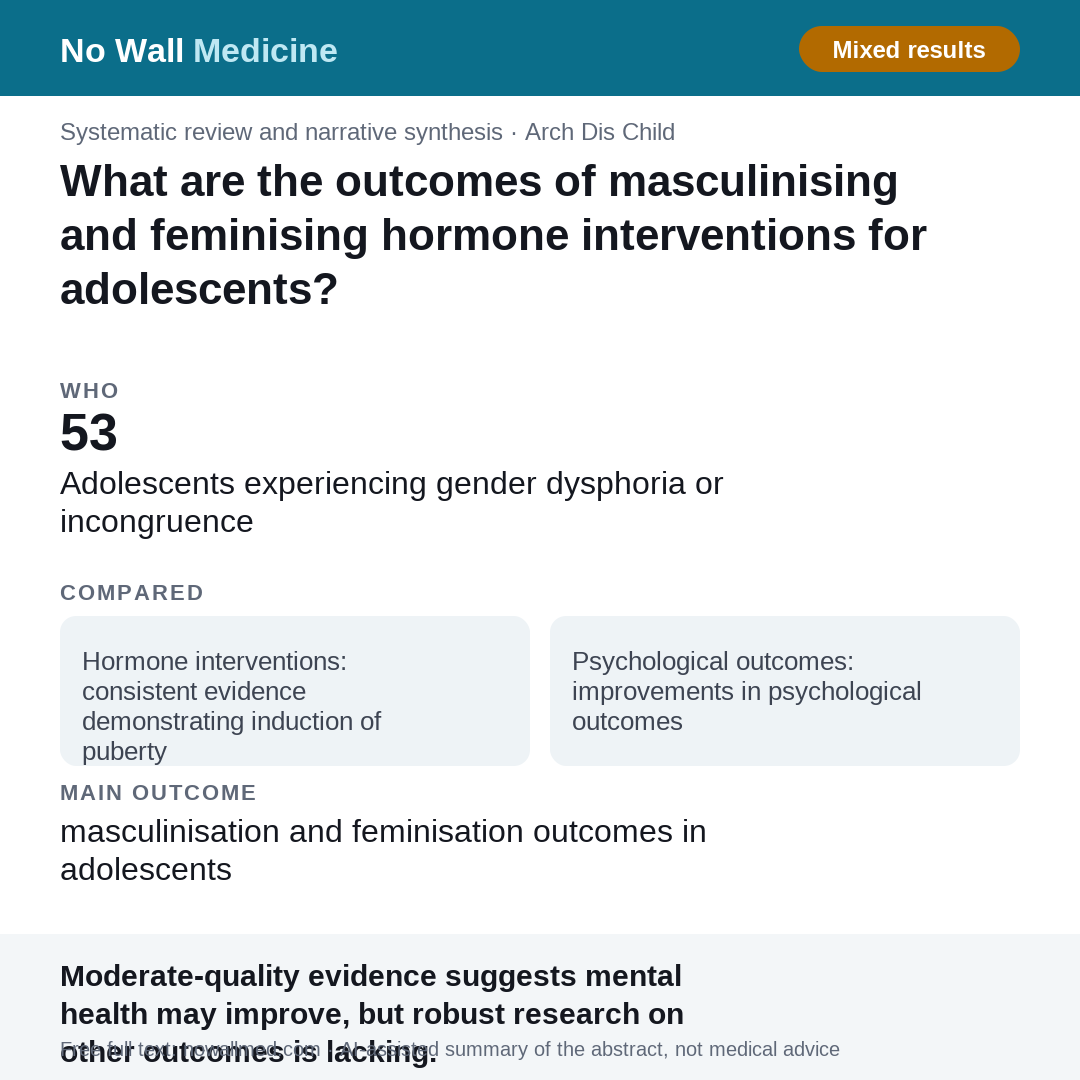
Masculinising and feminising hormone interventions for adolescents experiencing gender dysphoria or incongruence: a systematic review
Systematic review and narrative synthesisMixed results
What are the outcomes of masculinising and feminising hormone interventions for adolescents?
Who
53
Adolescents experiencing gender dysphoria or incongruence
Compared
Hormone interventions: consistent evidence demonstrating induction of puberty
Psychological outcomes: improvements in psychological outcomes
Main outcome
masculinisation and feminisation outcomes in adolescents
Bottom line: Moderate-quality evidence suggests mental health may improve, but robust research on other outcomes is lacking.
Limitation: Most studies included adolescents receiving puberty suppression, making it difficult to determine hormone effects alone.
Arch Dis Child · 2024-10-30Download image
Care pathways of children and adolescents referred to specialist gender services: a systematic review
Systematic review and meta-analysisUnclear result
What are the care pathways of children and adolescents referred to specialist gender services?
Who
6133
Children and adolescents under 18 years old · Nine countries
Compared
36%Puberty suppression (95% CI 27% to 45%)
51%Masculinising or feminising hormones (95% CI 40% to 62%)
68%Puberty suppression and/or hormones (95% CI 57% to 77%)
16%Surgery (95% CI 10% to 24%)
Main outcome
Proportions accessing different types of care and treatment
Bottom line: A significant proportion of referred youth receive puberty suppression, hormones, or surgery, but full care pathways remain unknown.
Limitation: No study systematically reported information about the full pathway or psychological care received.
Arch Dis Child · 2024-10-30Download image

Clinical guidelines for children and adolescents experiencing gender dysphoria or incongruence: a systematic review of recommendations (part 2)
Systematic review and narrative synthesisMixed results
What are the recommendations for managing children and adolescents with gender dysphoria or incongruence?
Who
Children and adolescents aged 0 to 18 years · International, regional, and national guidelines
Compared
Prepubertal children: psychosocial care
Eligible adolescents: puberty suppressants followed by hormones
Adolescents entering adulthood: surgical interventions
Main outcome
Management recommendations in published clinical guidelines
Bottom line: Guidelines show similar care pathways but lack consensus on assessment processes and timing for psychological or hormonal interventions.
Limitation: Limited guidance on psychological care, prepubertal management, or non-binary gender identity.
Arch Dis Child · 2024-10-30Download image

Interventions to suppress puberty in adolescents experiencing gender dysphoria or incongruence: a systematic review
Systematic review and narrative synthesisMixed results
What are the outcomes of puberty suppression in adolescents experiencing gender dysphoria or incongruence?
Who
50
Adolescents experiencing gender dysphoria or incongruence
Compared
Puberty suppression: consistent evidence demonstrating efficacy for suppressing puberty
Bone density and height: reductions in bone density and increased height
Main outcome
Efficacy of puberty suppression and related health outcomes
Bottom line: Puberty suppression is effective but may compromise bone health and height, with limited evidence for psychological outcomes.
Limitation: Lack of high-quality research assessing various health and psychological impacts.
Arch Dis Child · 2024-10-30Download image