Visual abstracts
New randomized trials and meta-analyses from leading journals at a glance: who was studied, what was compared, and what was found. Every paper is free to read in full.
All specialtiesCardiology 128Oncology 94Gastroenterology & Hepatology 52Infectious Disease 99Neurology 47Psychiatry & Mental Health 63Pulmonology 46Critical Care 30Endocrinology & Diabetes 56Pediatrics 50Surgery 36Orthopedics & Sports Medicine 19Neurosurgery 4Cardiothoracic & Vascular Surgery 8Plastic & Reconstructive Surgery 23Nephrology 20Rheumatology 22Hematology 30Dermatology 12Ophthalmology 19Obstetrics & Gynecology 35Public & Global Health 36Radiology & Imaging 10Anesthesiology 18Urology 24ENT (Otolaryngology) 9Emergency Medicine 13Allergy & Immunology 9Geriatrics 33Family Medicine & Primary Care 7Medical Genetics & Genomics 12Pathology & Laboratory Medicine 1Physical Medicine & Rehabilitation 25Palliative Care 13Nutrition 39Digital Health & AI 109General Medicine 20
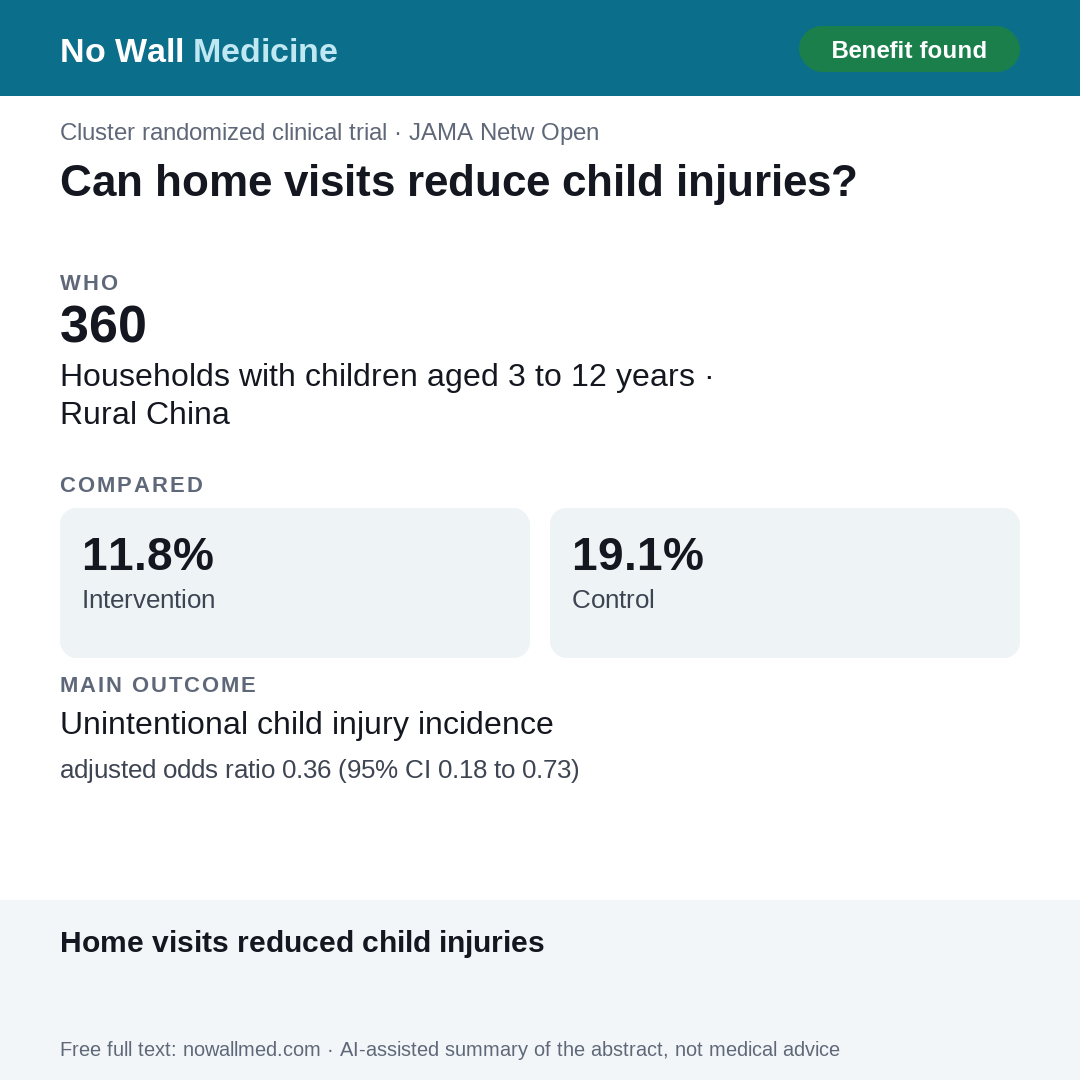
Civil Society Organization-Led Home Visit Intervention to Reduce Unintentional Child Injury in Rural China: A Cluster Randomized Clinical Trial
Cluster randomized clinical trialBenefit found
Can home visits reduce child injuries?
Who
360
Households with children aged 3 to 12 years · Rural China
Compared
11.8%Intervention (21/178)
19.1%Control (33/173)
Main outcome
Unintentional child injury incidence
Result: adjusted odds ratio 0.36 (95% CI 0.18 to 0.73)
Bottom line: Home visits reduced child injuries
Limitation: Short follow-up period
JAMA Netw Open · 2026-11-02Download image
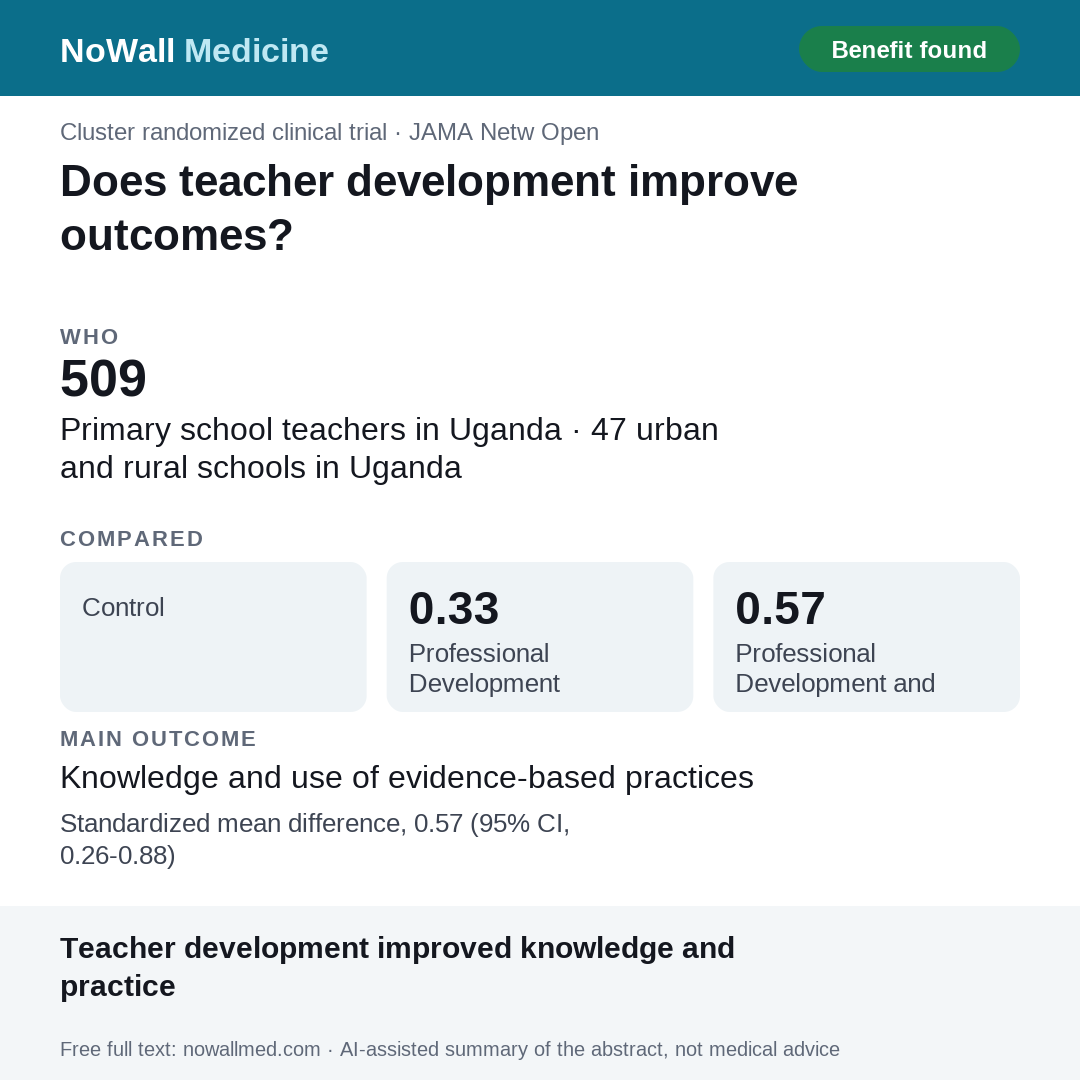
A Scalable Teacher Professional Development and Wellness Program in Primary Schools: A Cluster Randomized Clinical Trial
Cluster randomized clinical trialBenefit found
Does teacher development improve outcomes?
Who
509
Primary school teachers in Uganda · 47 urban and rural schools in Uganda
Compared
Control
0.33Professional Development (95% CI, 0.03-0.62)
0.57Professional Development and Teacher Wellness (95% CI, 0.26-0.88)
Main outcome
Knowledge and use of evidence-based practices
Result: Standardized mean difference, 0.57 (95% CI, 0.26-0.88)
Bottom line: Teacher development improved knowledge and practice
JAMA Netw Open · 2026-11-02Download image
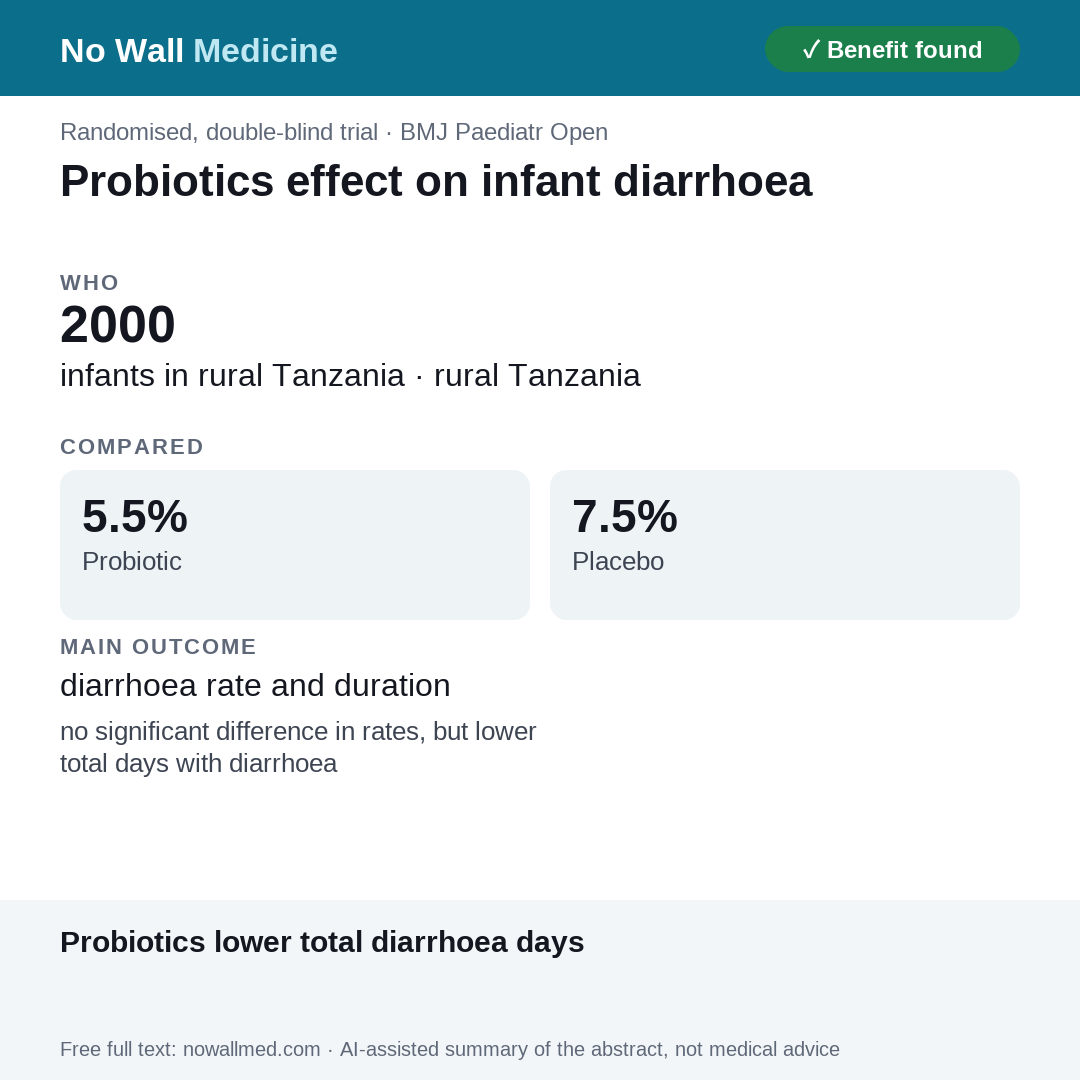
Probiotics and diarrhoea morbidity among infants in Tanzania: secondary analysis of a randomised clinical trial
Randomised, double-blind trialBenefit found
Probiotics effect on infant diarrhoea
Who
2000
infants in rural Tanzania · rural Tanzania
Compared
5.5%Probiotic (53/970)
7.5%Placebo (73/975)
Main outcome
diarrhoea rate and duration
Result: no significant difference in rates, but lower total days with diarrhoea
Bottom line: Probiotics lower total diarrhoea days
BMJ Paediatr Open · 2026-10-31Download image
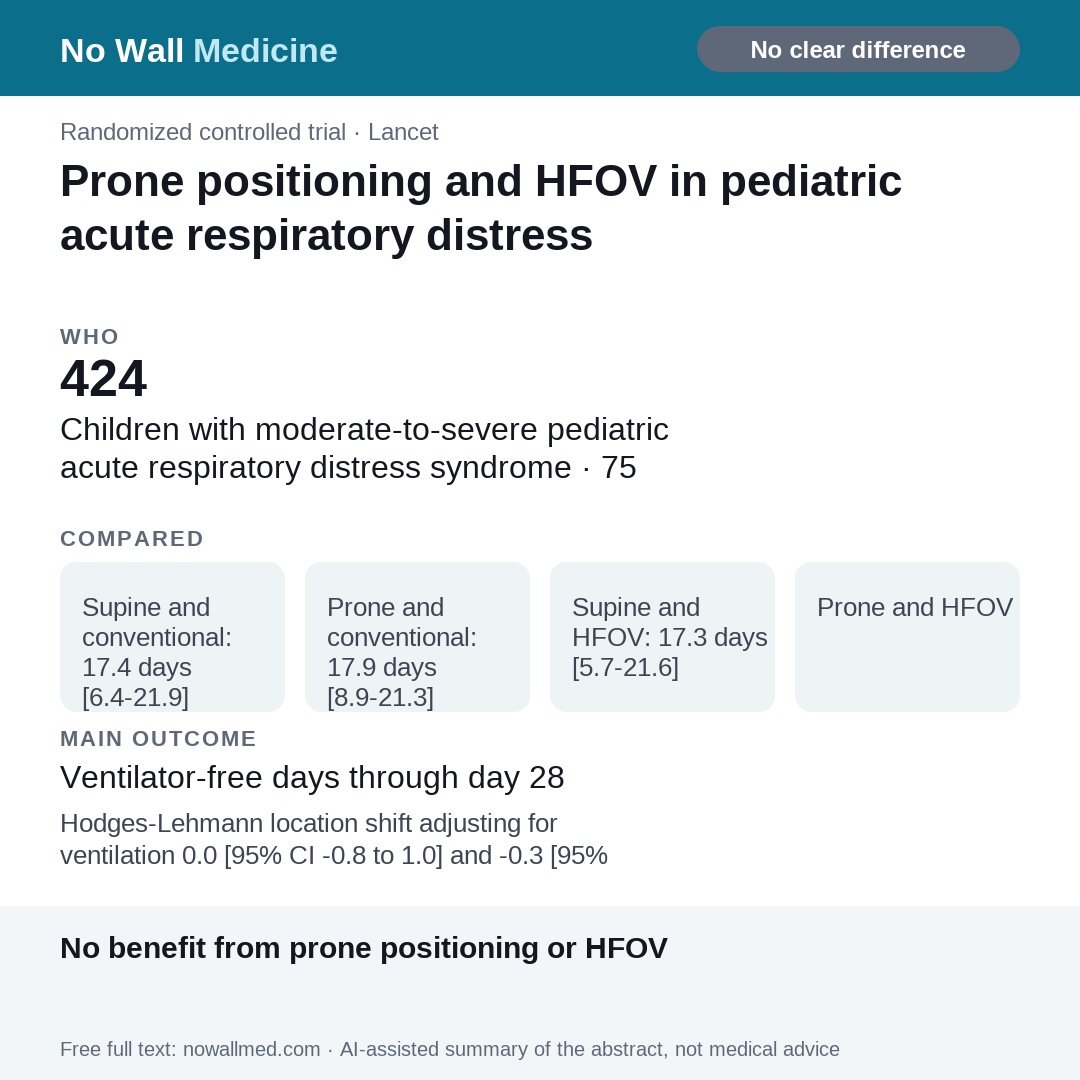
Prone positioning and high-frequency oscillatory ventilation in early paediatric acute respiratory distress syndrome (PROSpect): an international, two-by-two factorial, response-adaptive, phase 3, randomised controlled trial
Randomized controlled trialNo clear difference
Prone positioning and HFOV in pediatric acute respiratory distress
Who
424
Children with moderate-to-severe pediatric acute respiratory distress syndrome · 75 pediatric intensive care units in 18 countries
Compared
Supine and conventional: 17.4 days [6.4-21.9]
Prone and conventional: 17.9 days [8.9-21.3]
Supine and HFOV: 17.3 days [5.7-21.6]
Prone and HFOV
Main outcome
Ventilator-free days through day 28
Result: Hodges-Lehmann location shift adjusting for ventilation 0.0 [95% CI -0.8 to 1.0] and -0.3 [95% CI -1.5 to 0.5]
Bottom line: No benefit from prone positioning or HFOV
Lancet · 2026-10-29Download image
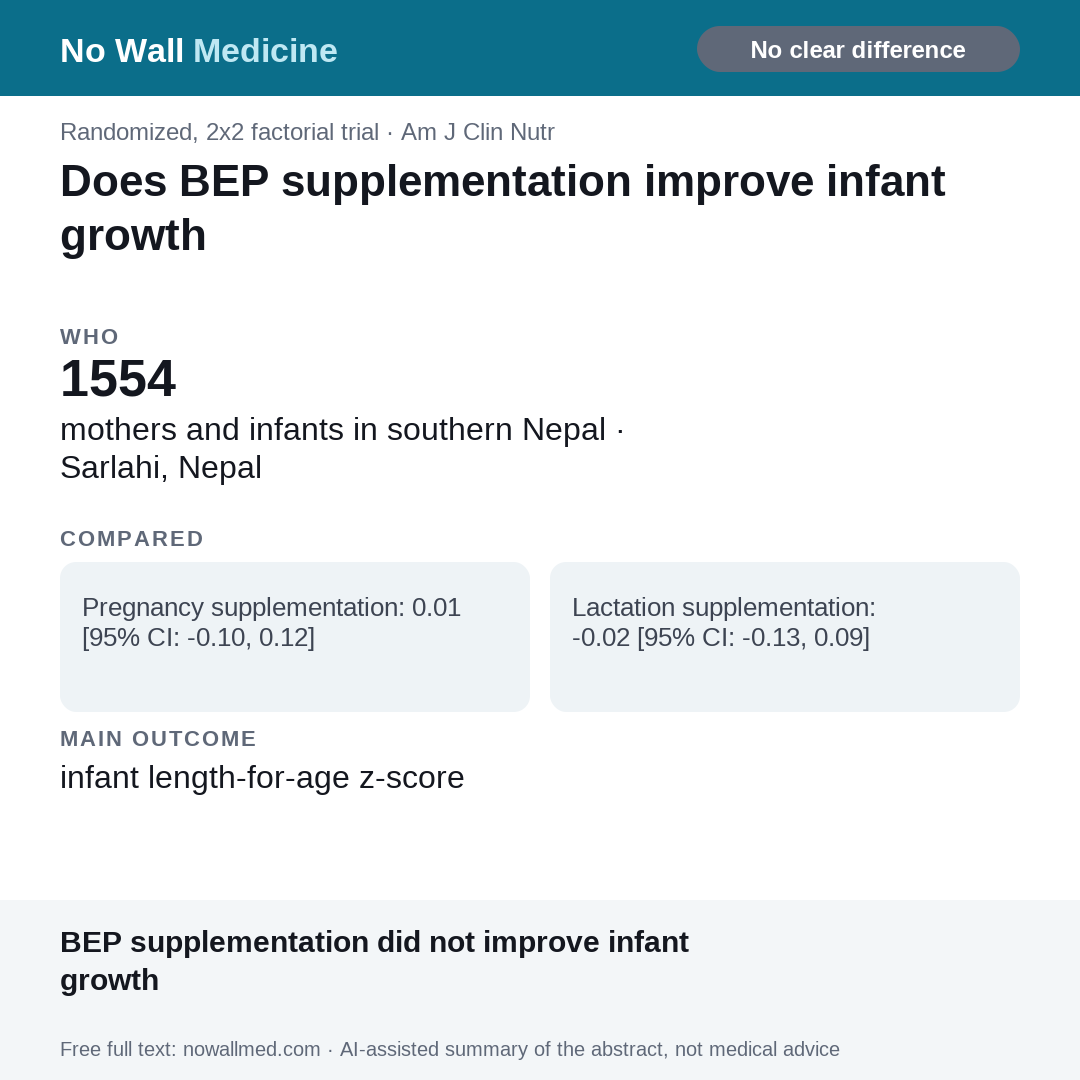
Supplementation with fortified balanced energy-protein during pregnancy and lactation and infant growth outcomes in southern Nepal: a community-based 2 × 2 factorial randomized trial
Randomized, 2x2 factorial trialNo clear difference
Does BEP supplementation improve infant growth
Who
1554
mothers and infants in southern Nepal · Sarlahi, Nepal
Compared
Pregnancy supplementation: 0.01 [95% CI: -0.10, 0.12]
Lactation supplementation: -0.02 [95% CI: -0.13, 0.09]
Main outcome
infant length-for-age z-score
Bottom line: BEP supplementation did not improve infant growth
Am J Clin Nutr · 2026-10-29Download image
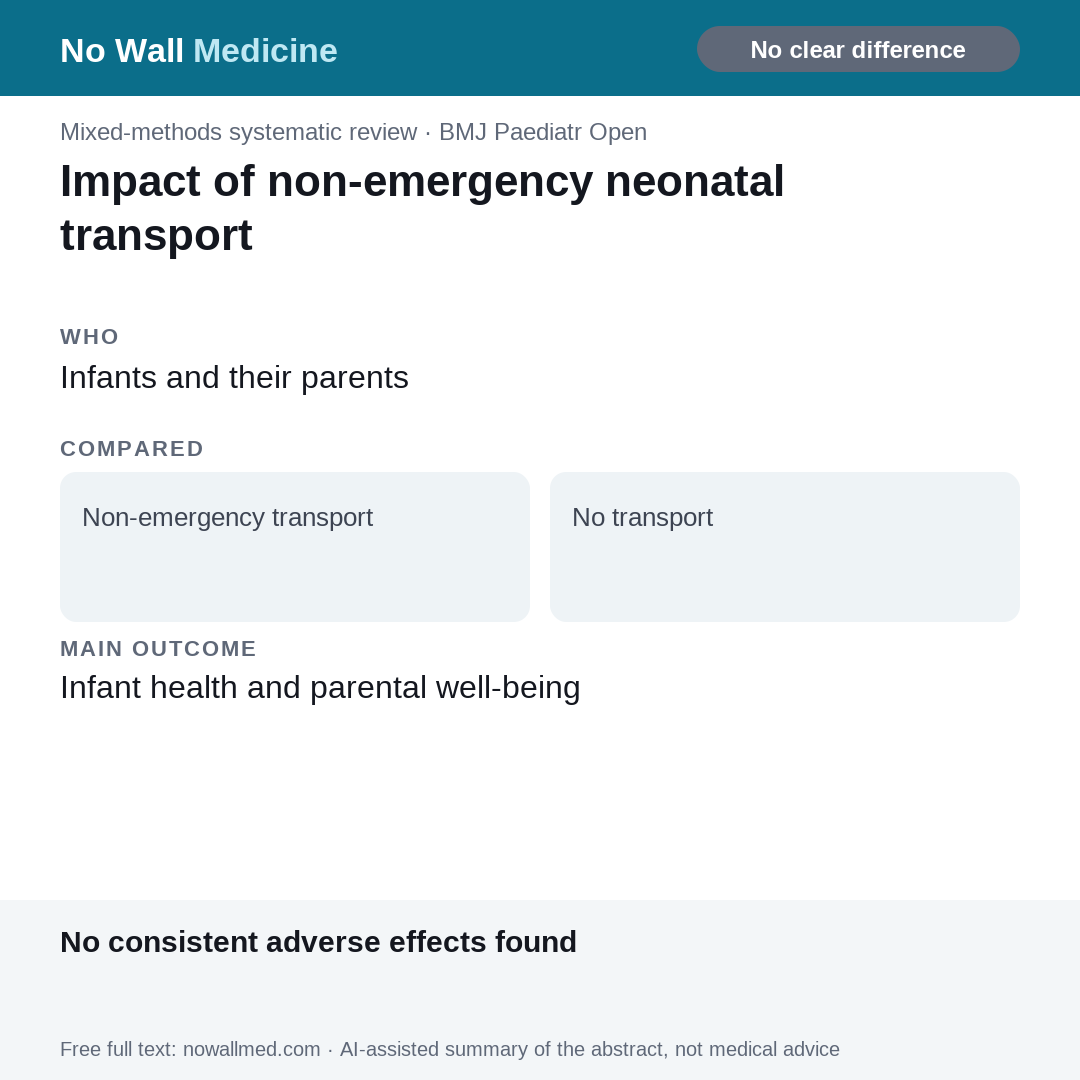
Exploring the impact of non-emergency inter-hospital neonatal transport on infants and their parents: a mixed-methods systematic review
Mixed-methods systematic reviewNo clear difference
Impact of non-emergency neonatal transport
Who
Infants and their parents
Compared
Non-emergency transport
No transport
Main outcome
Infant health and parental well-being
Bottom line: No consistent adverse effects found
Limitation: Substantial heterogeneity in outcome reporting
BMJ Paediatr Open · 2026-10-28Download image
Food supplementation and behavioural counselling to reduce the double burden of malnutrition among pregnant women and their infants: protocol for the K'ASLEM hybrid type 1 effectiveness-implementation randomised controlled trial
Randomized controlled trialUnclear result
Does food supplementation reduce malnutrition?
Who
766
Pregnant women and their infants · Guatemala
Compared
Intervention
Comparator
Main outcome
Maternal weight and child length
Bottom line: Study will assess food supplementation impact
BMJ Paediatr Open · 2026-10-28Download image

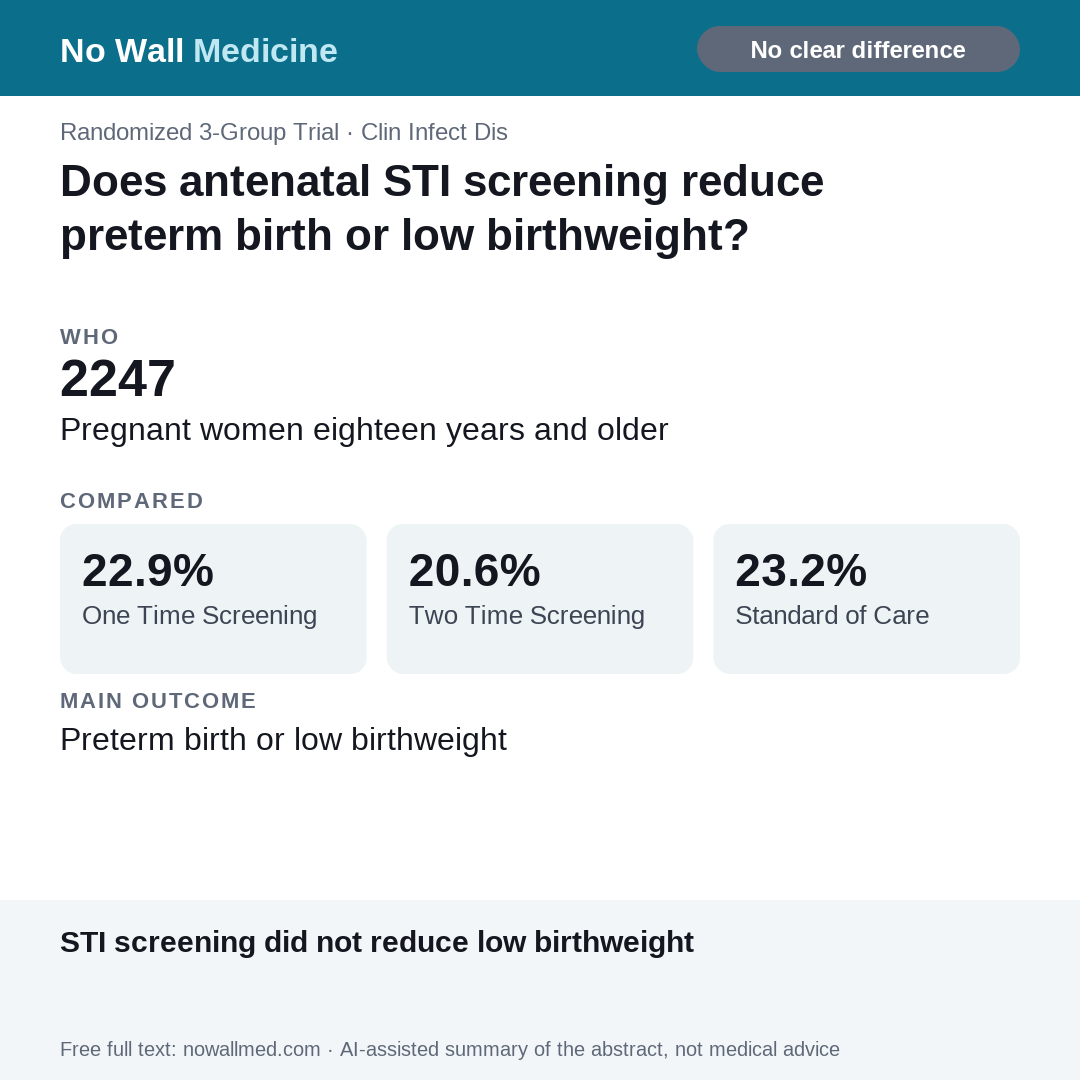
Antenatal Screening for Sexually Transmitted Infections to Reduce Preterm Birth or Low Birthweight (Philani Ndiphile Study): A Randomized 3-Group Trial
Randomized 3-Group TrialNo clear difference
Does antenatal STI screening reduce preterm birth?
Who
2247
Pregnant women eighteen years and older
Compared
22.9%One Time Screening
20.6%Two Time Screening
23.2%Standard of Care
Main outcome
Preterm birth or low birthweight
Bottom line: STI screening did not reduce low birthweight
Clin Infect Dis · 2026-10-27Download image
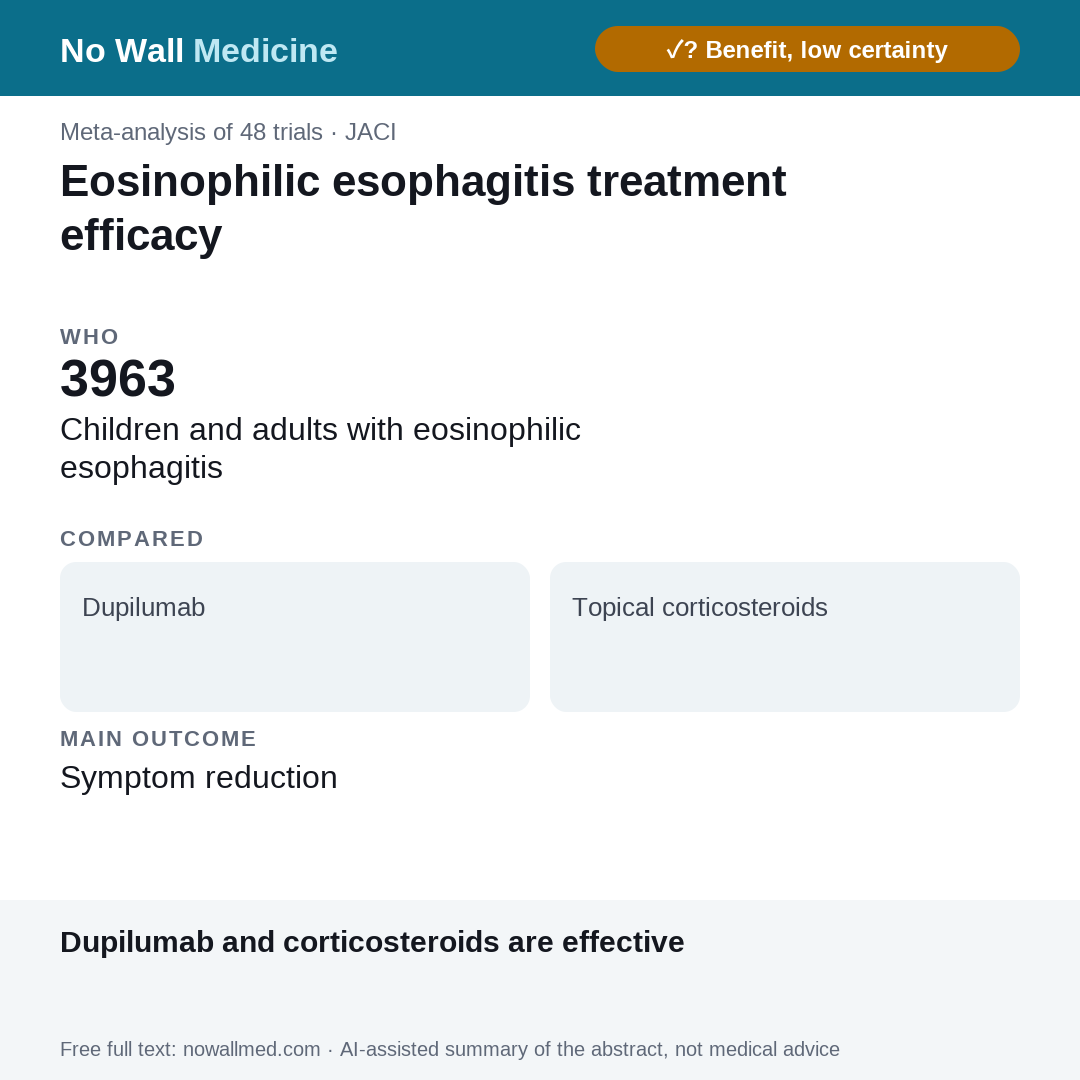
Comparative efficacy and safety of treatments for eosinophilic esophagitis: Systematic review and network meta-analysis of randomized controlled trials
Meta-analysis of 48 trialsBenefit found
Eosinophilic esophagitis treatment efficacy
Who
3963
Children and adults with eosinophilic esophagitis
Compared
Dupilumab
Topical corticosteroids
Main outcome
Symptom reduction
Bottom line: Dupilumab and corticosteroids are effective
Limitation: Low certainty for diets
JACI · 2026-10-20Download image
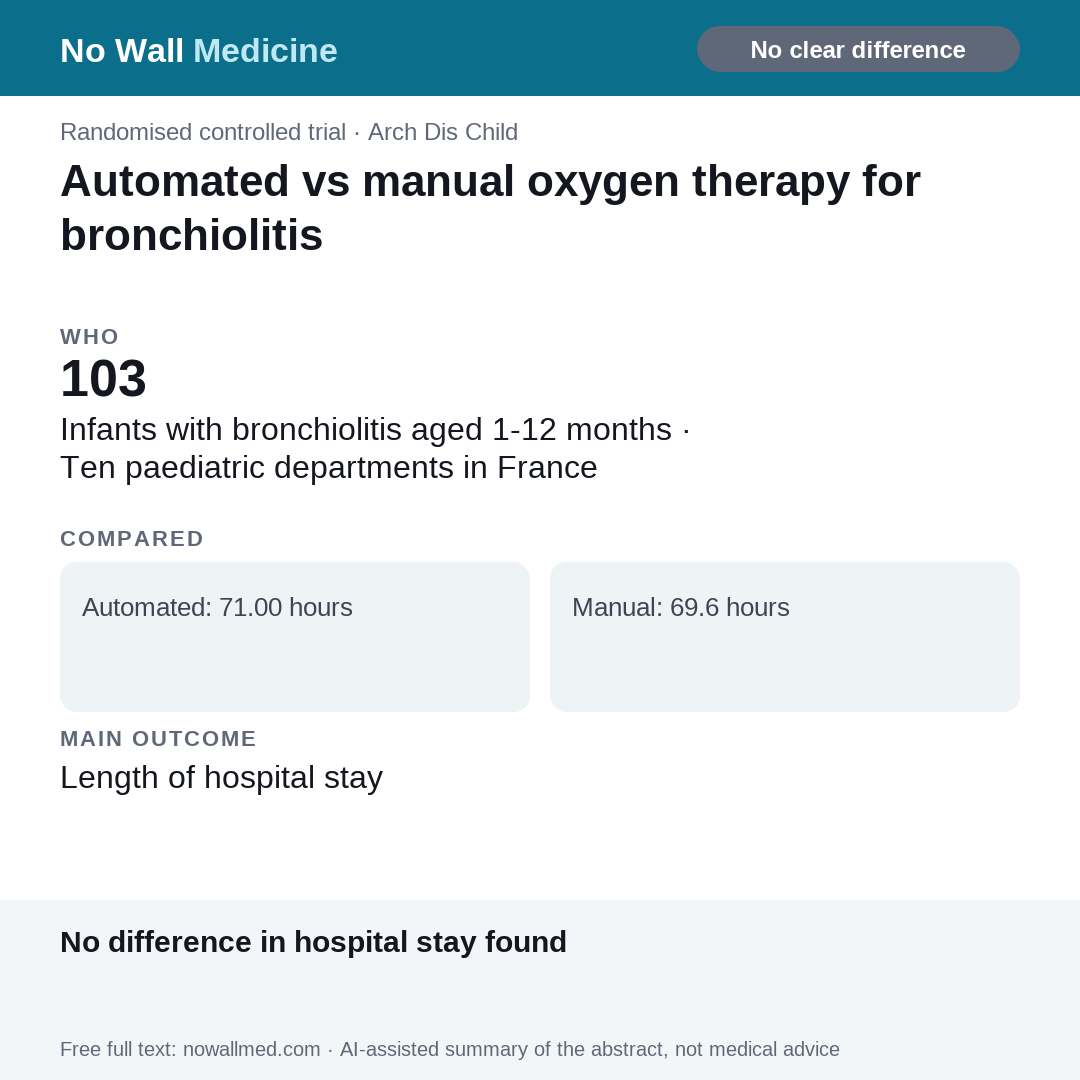
Automated oxygen flow titration for infants with bronchiolitis: a multicentre randomised controlled trial
Randomised controlled trialNo clear difference
Automated vs manual oxygen therapy for bronchiolitis
Who
103
Infants with bronchiolitis aged 1-12 months · Ten paediatric departments in France
Compared
FreeO2 device: 71.00 hours
Manual therapy: 69.6 hours
Main outcome
Length of hospital stay
Bottom line: No difference in hospital stay found
Arch Dis Child · 2026-10-20Download image
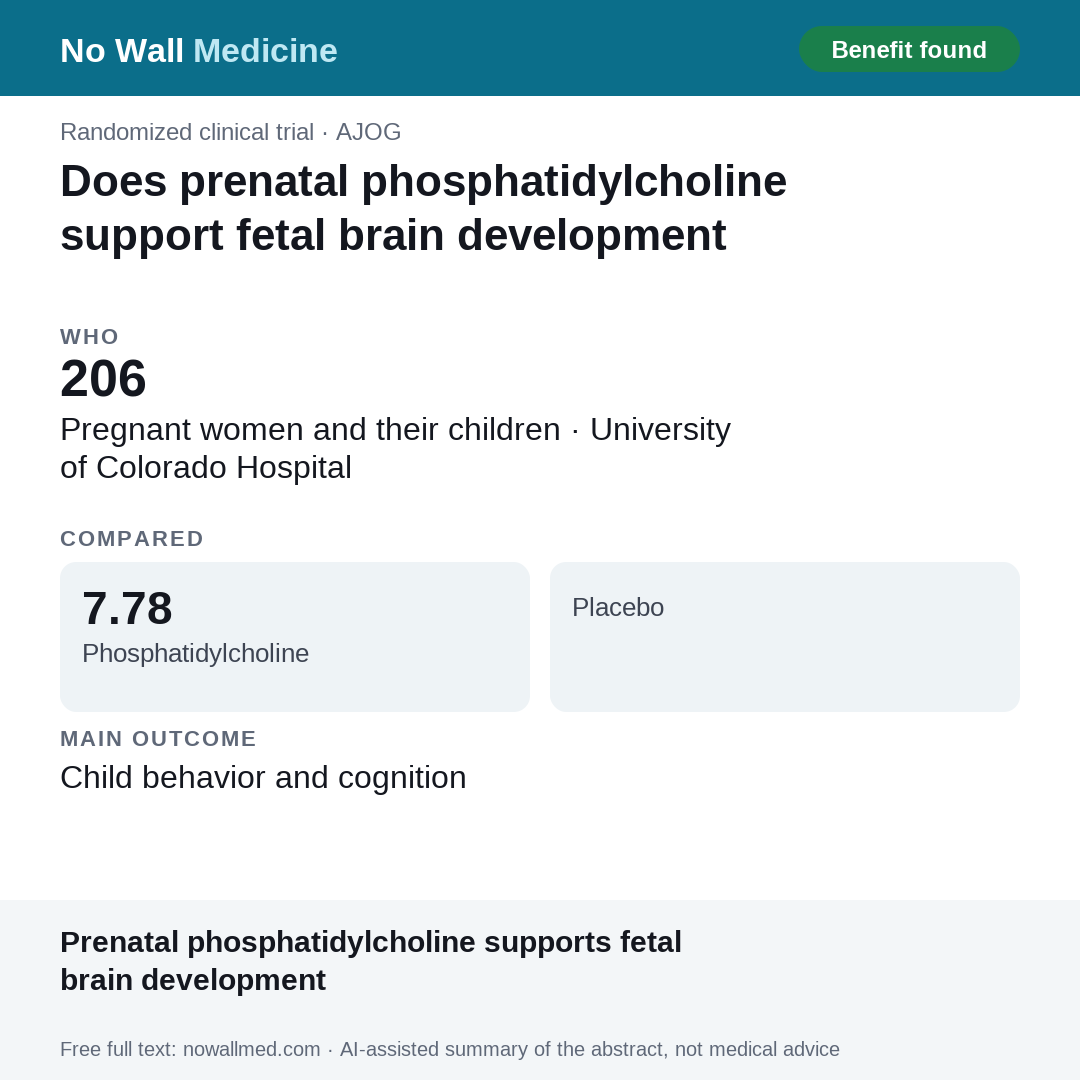
Prenatal maternal phosphatidylcholine and children's behavior and cognition through 4 years of age: a randomized clinical trial
Randomized clinical trialBenefit found
Does prenatal phosphatidylcholine support fetal brain development
Who
206
Pregnant women and their children · University of Colorado Hospital
Compared
7.78Phosphatidylcholine (95% CI 1.88-13.7)
Placebo
Main outcome
Child behavior and cognition
Bottom line: Prenatal phosphatidylcholine supports fetal brain development
Limitation: Loss of women between enrollment and assessments
AJOG · 2026-10-19Download image
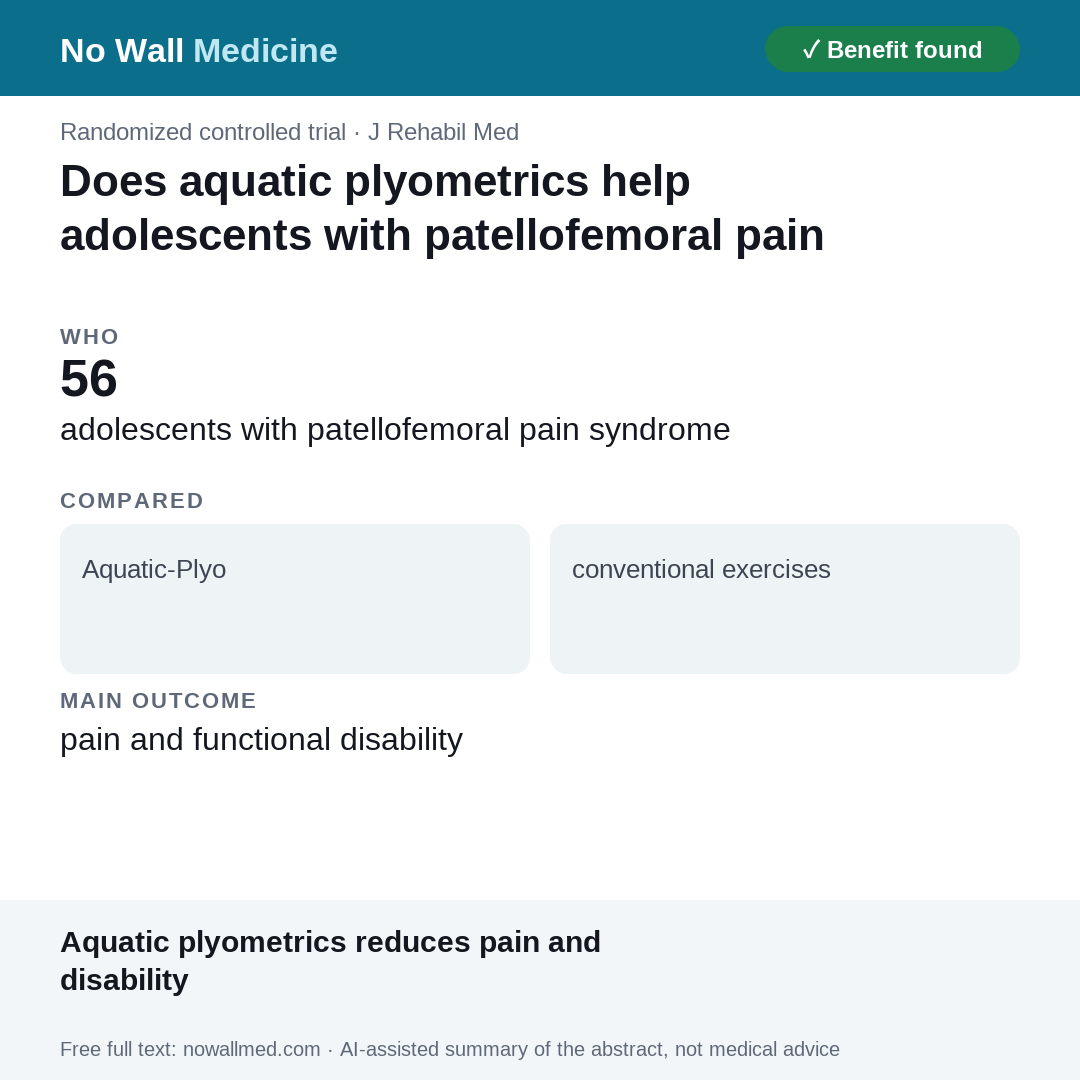
Clinical and functional outcomes of aquatic plyometrics in adolescent patellofemoral pain syndrome: a dual-arm randomized controlled trial
Randomized controlled trialBenefit found
Does aquatic plyometrics help adolescents with patellofemoral pain
Who
56
adolescents with patellofemoral pain syndrome
Compared
Aquatic-Plyo
conventional exercises
Main outcome
pain and functional disability
Bottom line: Aquatic plyometrics reduces pain and disability
J Rehabil Med · 2026-10-19Download image
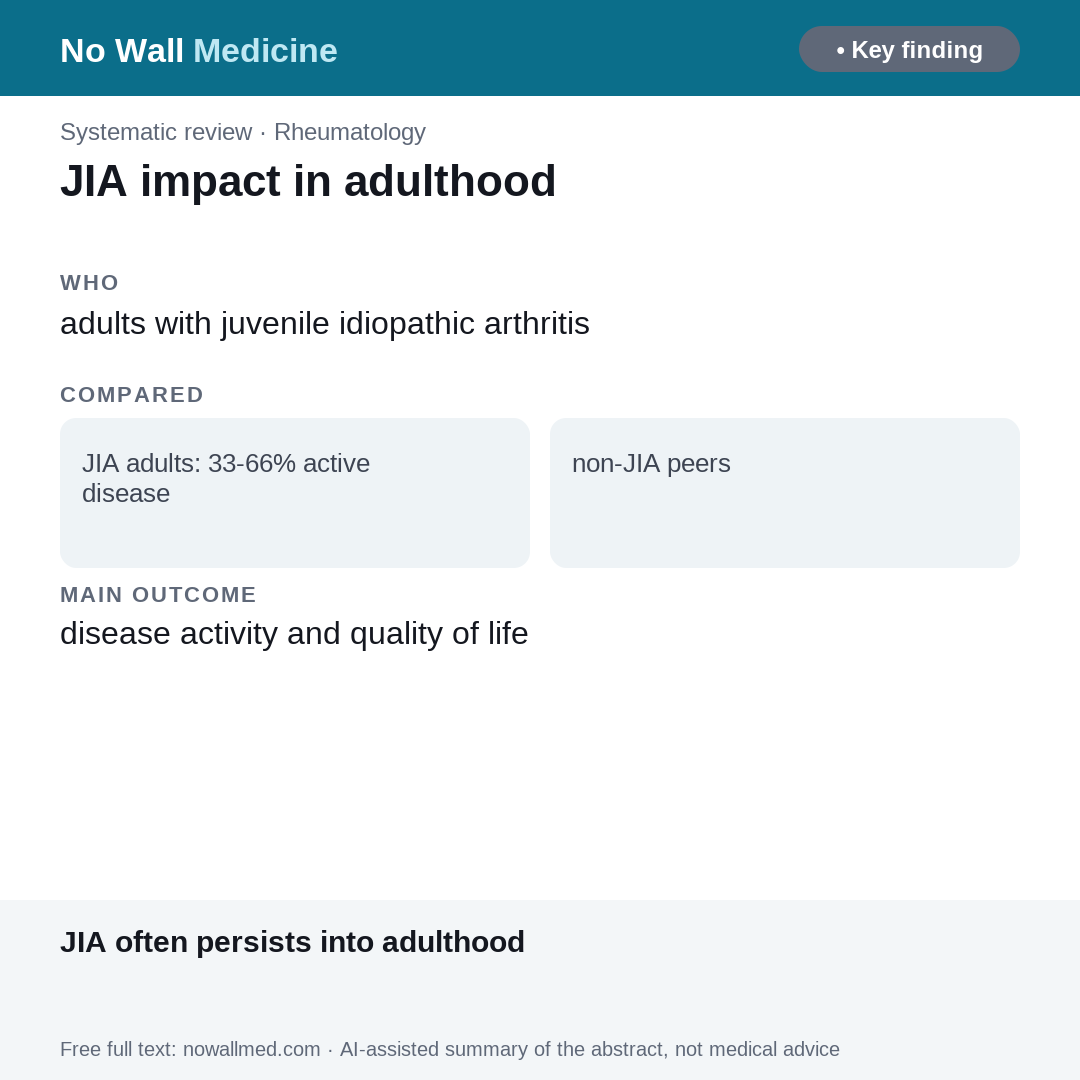
The long-term impact of juvenile idiopathic arthritis into adulthood: a systematic review
Systematic reviewHarm found
JIA impact in adulthood
Who
adults with juvenile idiopathic arthritis
Compared
JIA adults: 33-66% active disease
non-JIA peers
Main outcome
disease activity and quality of life
Bottom line: JIA often persists into adulthood
Rheumatology · 2026-10-16Download image
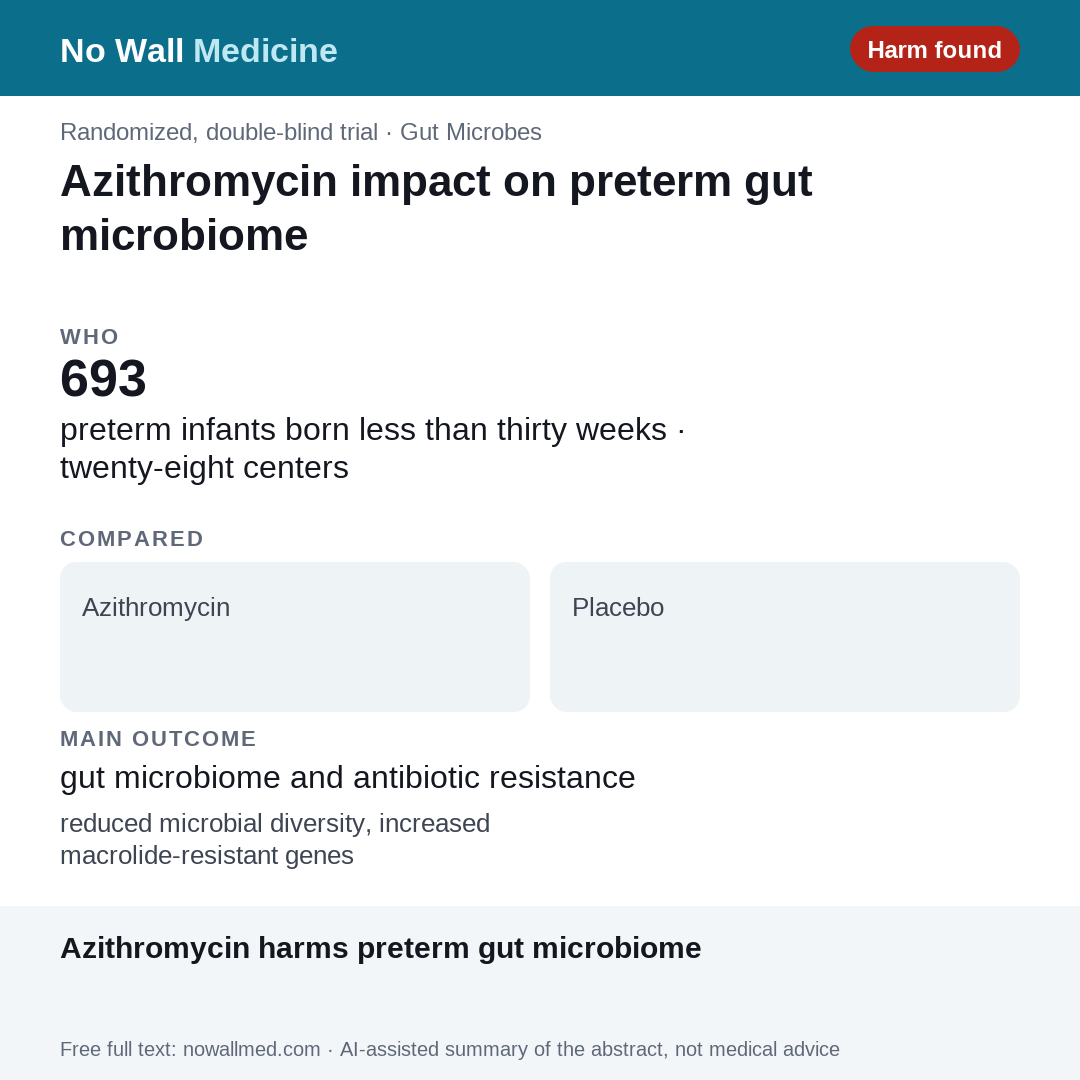
The impact of prophylactic azithromycin on the developing preterm gut microbiome and resistome
Randomized, double-blind trialHarm found
Azithromycin impact on preterm gut microbiome
Who
693
preterm infants born less than thirty weeks · twenty-eight centers
Compared
Azithromycin
Placebo
Main outcome
gut microbiome and antibiotic resistance
Result: reduced microbial diversity, increased macrolide-resistant genes
Bottom line: Azithromycin harms preterm gut microbiome
Gut Microbes · 2026-10-15Download image
Immunogenicity and shedding of live-attenuated intranasal respiratory syncytial virus vaccine in children aged 6-18 months by baseline serostatus: a multicentre, randomised, placebo-controlled, phase 1/2 trial
Randomised, placebo-controlled trialBenefit found
RSV vaccine immunogenicity in children
Who
180
Healthy children aged 6-18 months · USA, Chile, Honduras
Compared
67·9%RSVt-LD (19/28)
61·9%RSVt-HD (13/21)
7·4%Placebo (2/27)
Main outcome
RSV-neutralising antibodies
Bottom line: Vaccine increased RSV antibodies
Lancet Microbe · 2026-10-13Download image

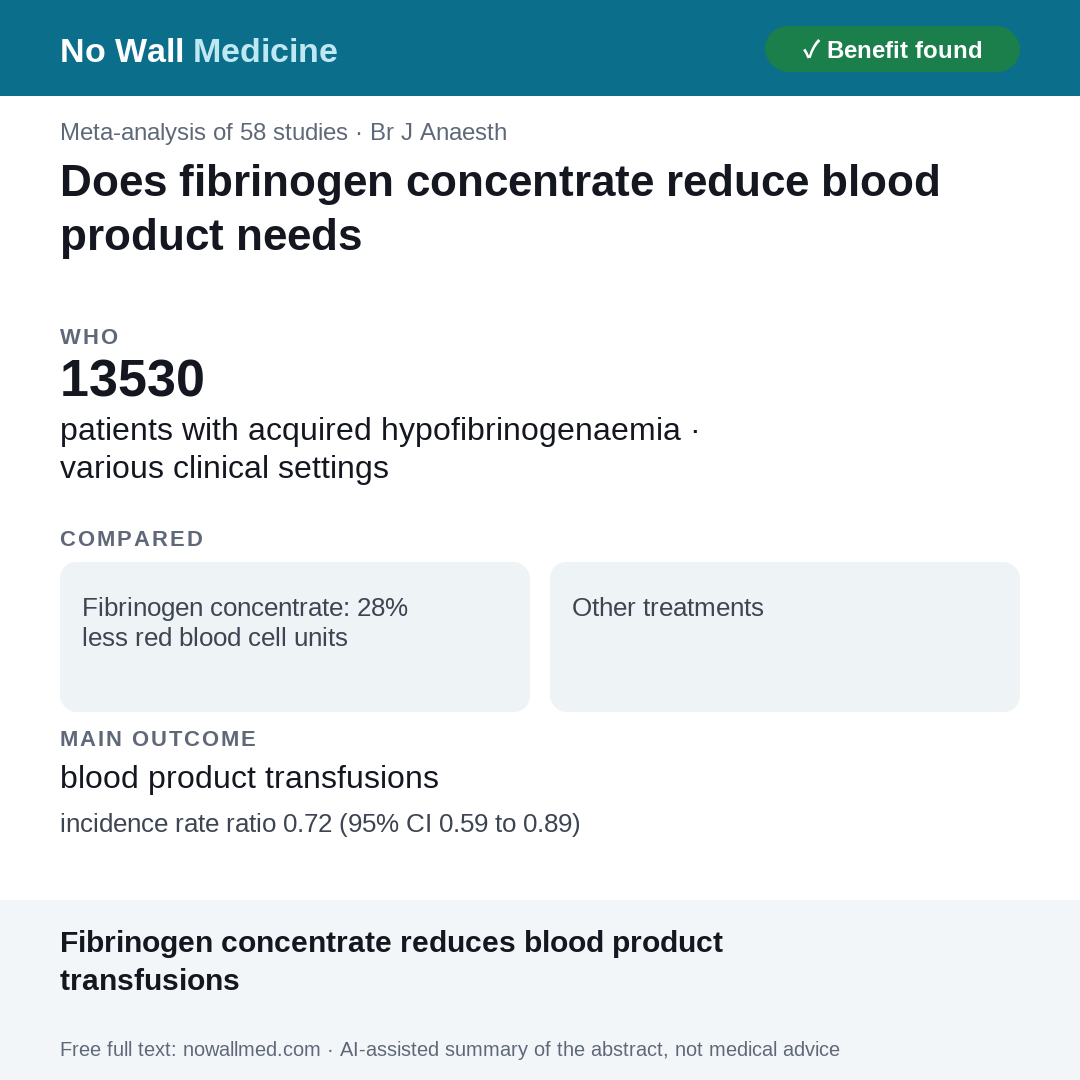
The role of fibrinogen concentrate in the reduction of allogeneic blood product requirements: a systematic review and meta-analysis
Meta-analysis of 58 studiesBenefit found
Does fibrinogen concentrate reduce blood product needs
Who
13530
patients with acquired hypofibrinogenaemia · various clinical settings
Compared
Fibrinogen concentrate: 28% less red blood cell units
Other treatments
Main outcome
blood product transfusions
Result: incidence rate ratio 0.72 (95% CI 0.59 to 0.89)
Bottom line: Fibrinogen concentrate reduces blood product transfusions
Br J Anaesth · 2026-10-12Download image
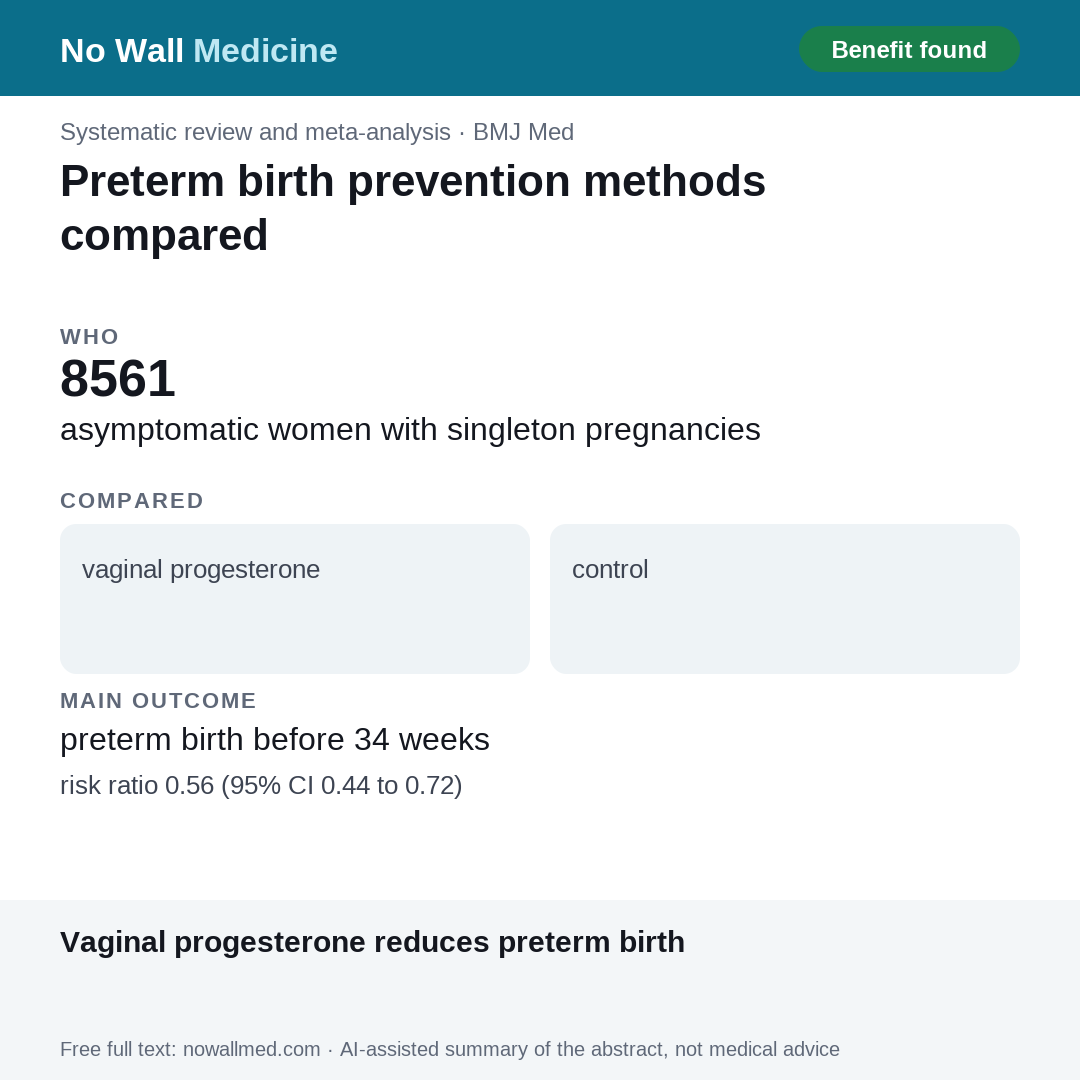
Progestogens, cervical cerclage, and cervical pessary for preventing preterm birth in asymptomatic singleton pregnancies with a sonographic short cervix and no previous history of spontaneous preterm birth: systematic review and bayesian network meta-analysis
Systematic review and meta-analysisBenefit found
Preterm birth prevention methods compared
Who
8561
asymptomatic women with singleton pregnancies
Compared
vaginal progesterone
control
Main outcome
preterm birth before 34 weeks
Result: risk ratio 0.56 (95% CI 0.44 to 0.72)
Bottom line: Vaginal progesterone reduces preterm birth
BMJ Med · 2026-10-12Download image
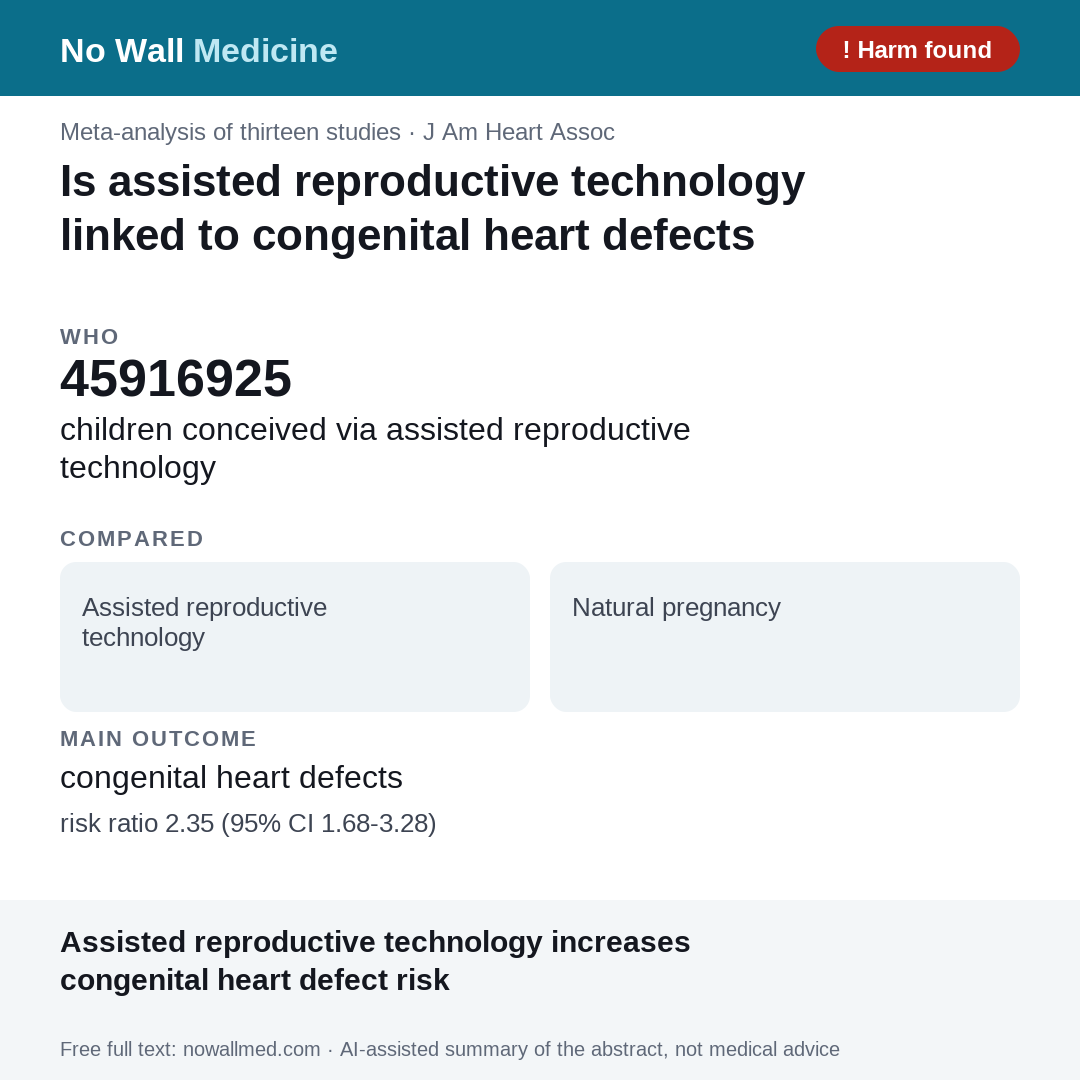
Assisted Reproductive Technology and Risk of Congenital Heart Defects in the Offspring: A Systematic Review and Meta-Analysis
Meta-analysis of thirteen studiesHarm found
Is assisted reproductive technology linked to congenital heart defects
Who
45916925
children conceived via assisted reproductive technology
Compared
Assisted reproductive technology
Natural pregnancy
Main outcome
congenital heart defects
Result: risk ratio 2.35 (95% CI 1.68-3.28)
Bottom line: Assisted reproductive technology increases congenital heart defect risk
Limitation: significant heterogeneity across studies
J Am Heart Assoc · 2026-10-10Download image
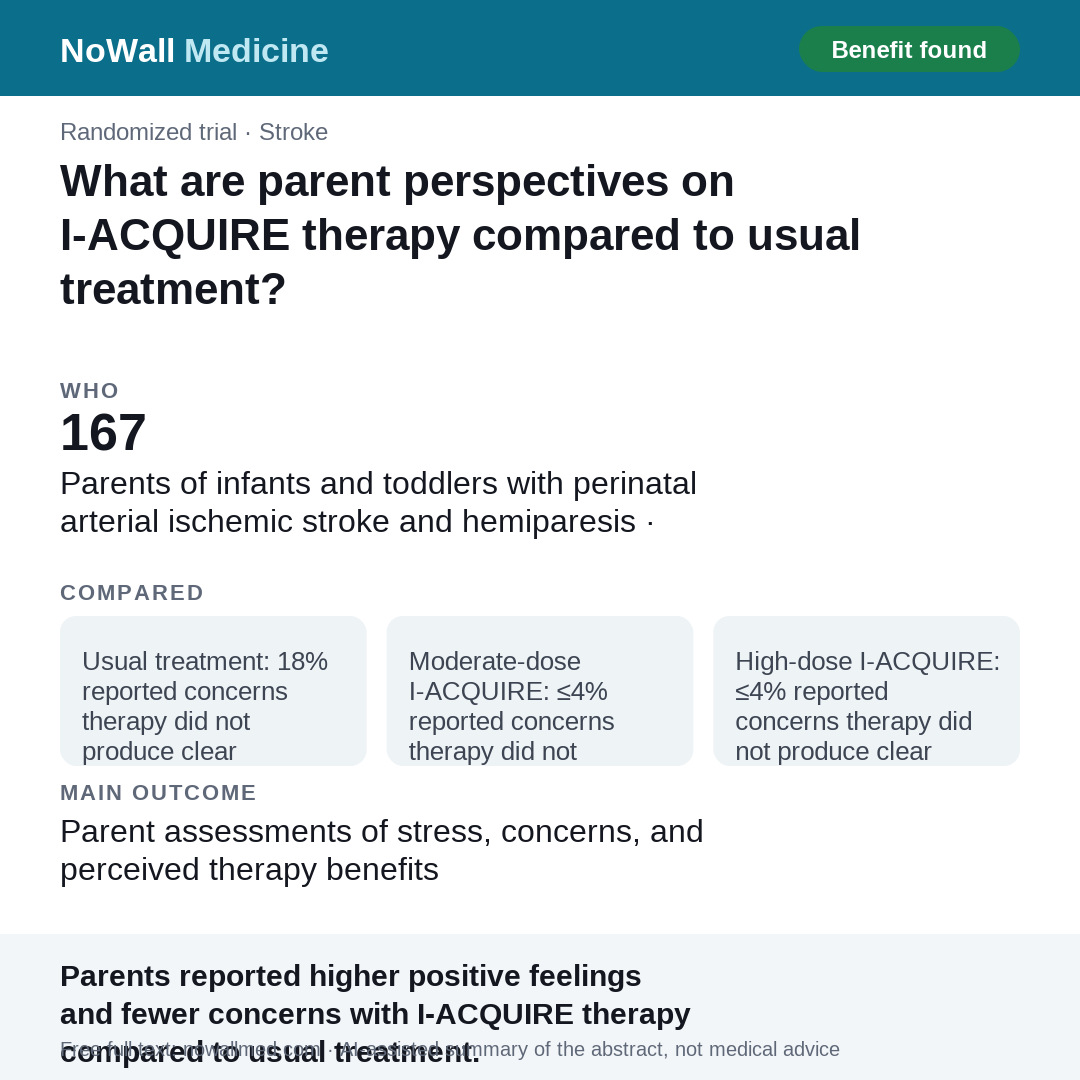
Parent Perspectives on I-ACQUIRE Therapy
Randomized trialBenefit found
What are parent perspectives on I-ACQUIRE therapy compared to usual treatment?
Who
167
Parents of infants and toddlers with perinatal arterial ischemic stroke and hemiparesis · United States 15-site
Compared
Usual treatment: 18% reported concerns therapy did not produce clear benefits
Moderate-dose I-ACQUIRE: ≤4% reported concerns therapy did not produce clear benefits
High-dose I-ACQUIRE: ≤4% reported concerns therapy did not produce clear benefits
Main outcome
Parent assessments of stress, concerns, and perceived therapy benefits
Bottom line: Parents reported higher positive feelings and fewer concerns with I-ACQUIRE therapy compared to usual treatment.
Stroke · 2026-10-09Download image
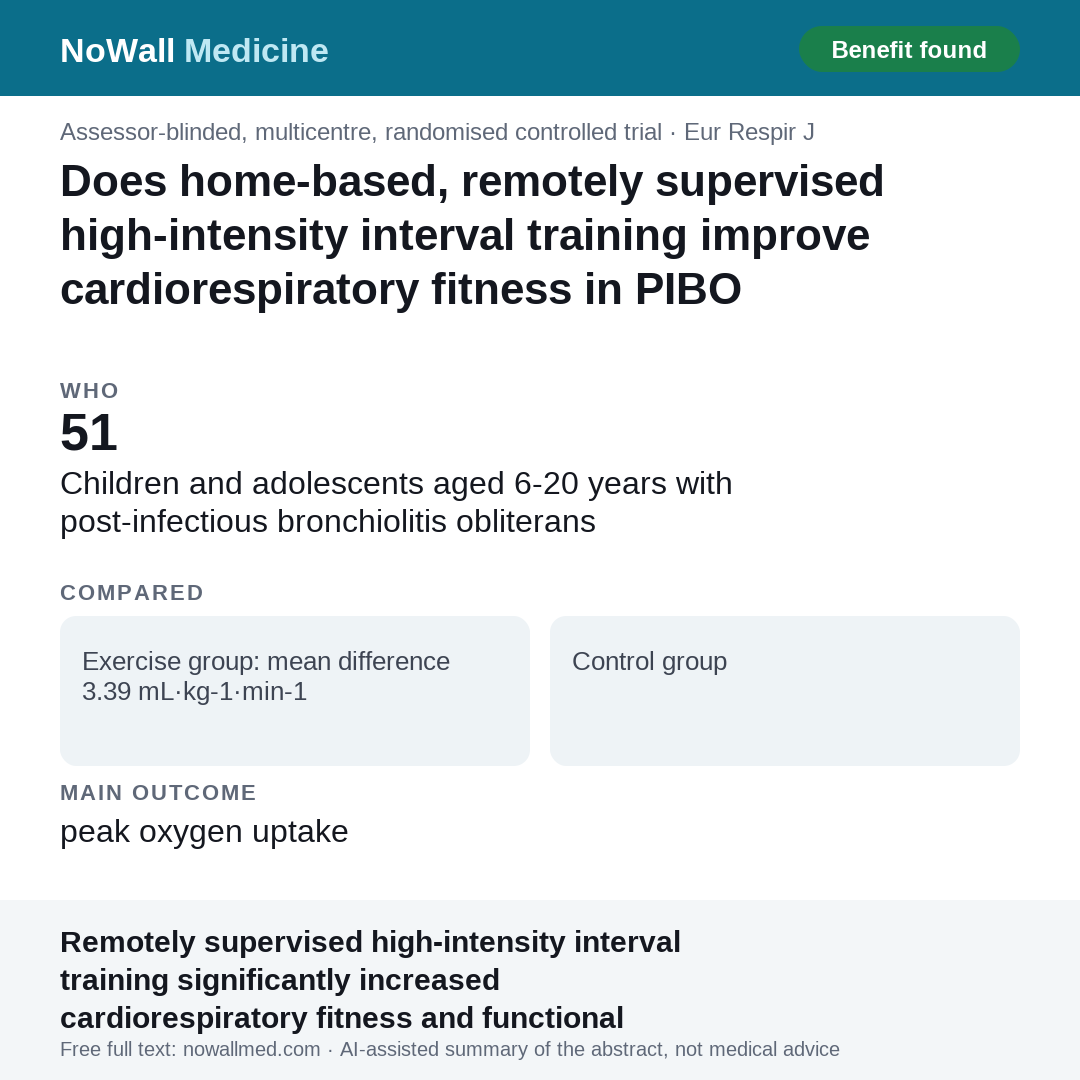
Home-based, remotely supervised, high-intensity interval training and cardiorespiratory fitness in children and adolescents with post-infectious bronchiolitis obliterans: a randomised controlled trial
Assessor-blinded, multicentre, randomised controlled trialBenefit found
Does home-based, remotely supervised high-intensity interval training improve cardiorespiratory fitness in PIBO patients?
Who
51
Children and adolescents aged 6-20 years with post-infectious bronchiolitis obliterans
Compared
Exercise group: mean difference 3.39 mL·kg-1·min-1
Control group
Main outcome
peak oxygen uptake
Result: mean difference 3.39 mL·kg-1·min-1; p=0.04
Bottom line: Remotely supervised high-intensity interval training significantly increased cardiorespiratory fitness and functional capacity in children with post-infectious bronchiolitis obliterans.
Eur Respir J · 2026-10-09Download image