Visual abstracts
New randomized trials and meta-analyses from leading journals at a glance: who was studied, what was compared, and what was found. Every paper is free to read in full.
All specialtiesCardiology 842Oncology 763Gastroenterology & Hepatology 307Infectious Disease 626Neurology 350Psychiatry & Mental Health 430Pulmonology 366Critical Care 245Endocrinology & Diabetes 480Pediatrics 536Surgery 324Orthopedics & Sports Medicine 162Neurosurgery 93Cardiothoracic & Vascular Surgery 87Plastic & Reconstructive Surgery 124Nephrology 197Rheumatology 108Hematology 182Dermatology 80Ophthalmology 97Obstetrics & Gynecology 261Public & Global Health 167Radiology & Imaging 98Anesthesiology 114Urology 162ENT (Otolaryngology) 91Emergency Medicine 73Allergy & Immunology 58Geriatrics 160Family Medicine & Primary Care 111Medical Genetics & Genomics 91Pathology & Laboratory Medicine 24Physical Medicine & Rehabilitation 148Palliative Care 81Nutrition 223Digital Health & AI 460General Medicine 101
Identifying subtypes of Long COVID: a systematic review
Systematic review and meta-analysisMixed results
What are the existing clustering and classification approaches for Long COVID subtypes and symptoms?
Who
2
Long COVID patients · 20 countries
Compared
Respiratory symptom cluster: 47% [95% CI: 29%-65%]
Neurological symptom cluster: 31% [95% CI: 3%-60%]
Gastrointestinal symptom cluster: 28% [95% CI: 0%-57%]}
Main outcome
Percentage of organ system-based symptom clusters
Bottom line: Long COVID can be categorized by symptom co-occurrence or organ systems, with respiratory, neurological, and gastrointestinal clusters identified.
Funded by: K. C. Wong Education Foundation and several Chinese medical funds
eClinicalMedicine · 2025-12-18Download image

Meta-analysis and external validation of a risk model for gastrointestinal bleeding after percutaneous coronary intervention
Meta-analysis and external validationBenefit found
What risk factors predict gastrointestinal bleeding after percutaneous coronary intervention?
Who
7211114
Patients undergoing percutaneous coronary intervention · Two tertiary hospitals for external validation
Compared
Model I: AUC 0.842
CRUSADE score: AUC 0.770
PRECISE-DAPT score: AUC 0.772
Main outcome
Predictive performance for gastrointestinal bleeding
Bottom line: Model I outperformed CRUSADE and PRECISE-DAPT scores in predicting gastrointestinal bleeding after percutaneous coronary intervention.
BMC Med · 2025-12-18Download image

Postpartum management of the hypertensive disorders of pregnancy: a systematic review and meta-analysis
Systematic review and meta-analysisMixed results
What are the effective and safe management strategies for postpartum hypertension?
Who
Participants with postpartum hypertension
Compared
Diuretics plus antihypertensive: better blood pressure control
Placebo or no therapy
Self-monitoring/management or lifestyle change: lower blood pressure 8 months postpartum
Usual care
Main outcome
maternal blood pressure and laboratory parameters
Bottom line: Diuretics may aid blood pressure control with antihypertensives, and self-monitoring or lifestyle changes lower long-term blood pressure.
Limitation: Certainty of evidence was low or very low.
AJOG · 2025-12-18Download image

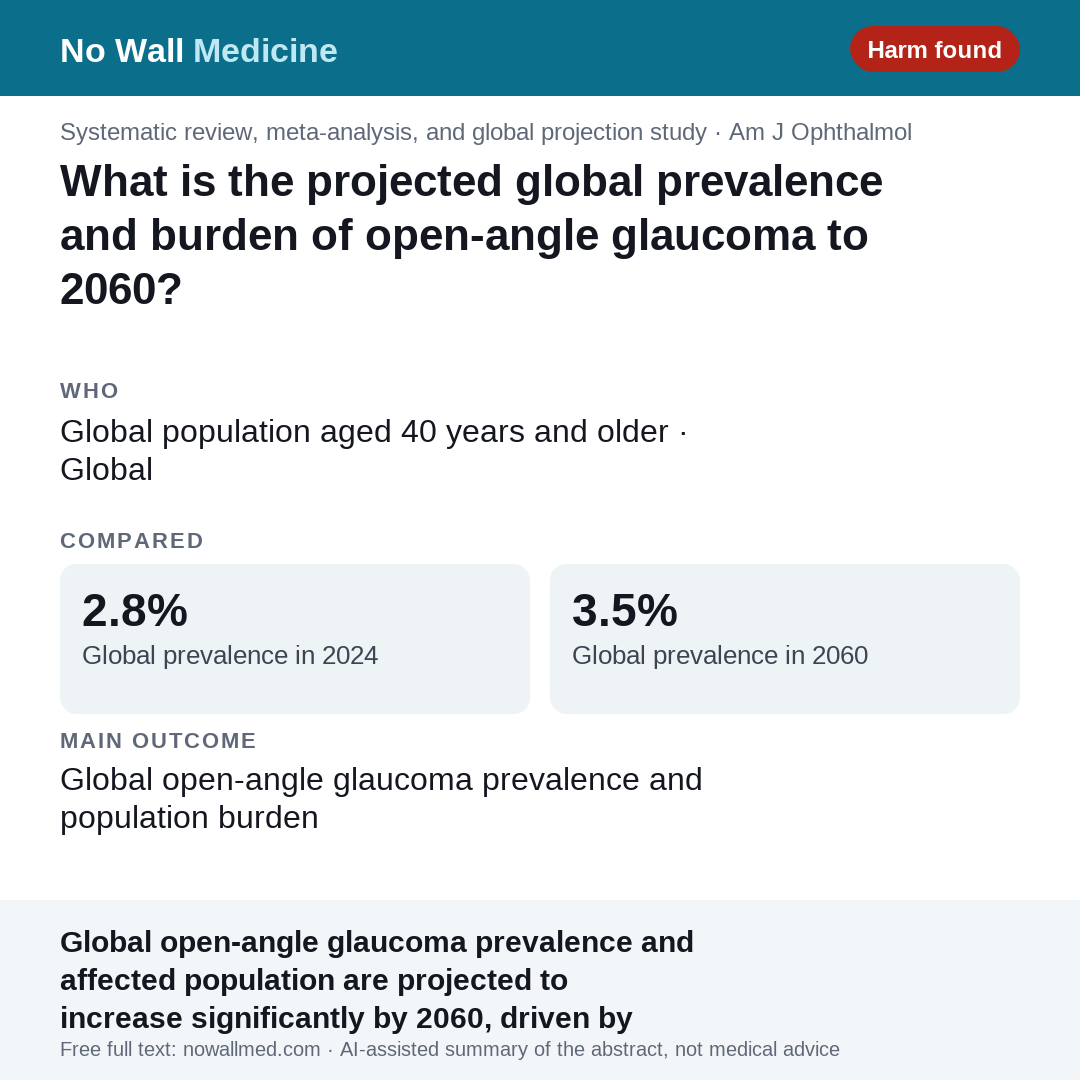
Global Glaucoma Prevalence: Burden and Projection to 2060
Systematic review, meta-analysis, and global projection studyHarm found
What is the projected global prevalence and burden of open-angle glaucoma to 2060?
Who
Global population aged 40 years and older · Global
Compared
2.8%Global prevalence in 2024 (95% CI, 2.6%-3.0%)
3.5%Global prevalence in 2060 (95% CI, 3.2%-3.8%)
Main outcome
Global open-angle glaucoma prevalence and population burden
Bottom line: Global open-angle glaucoma prevalence and affected population are projected to increase significantly by 2060, driven by aging and myopia.
Am J Ophthalmol · 2025-12-18Download image
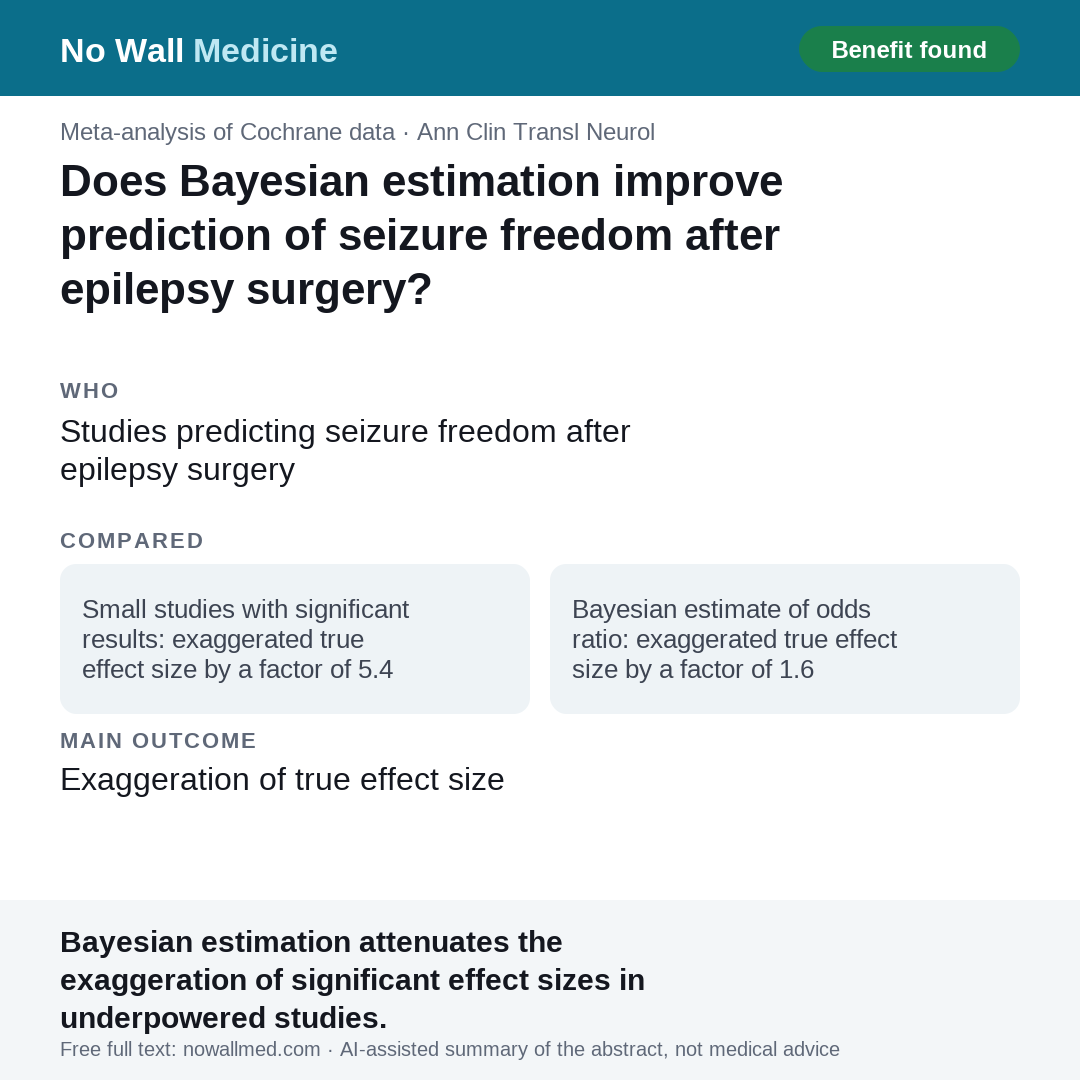
Bayesian Estimation Improves Prediction of Outcomes After Epilepsy Surgery
Meta-analysis of Cochrane dataBenefit found
Does Bayesian estimation improve prediction of seizure freedom after epilepsy surgery?
Who
Studies predicting seizure freedom after epilepsy surgery
Compared
Small studies with significant results: exaggerated true effect size by a factor of 5.4
Bayesian estimate of odds ratio: exaggerated true effect size by a factor of 1.6
Main outcome
Exaggeration of true effect size
Bottom line: Bayesian estimation attenuates the exaggeration of significant effect sizes in underpowered studies.
Ann Clin Transl Neurol · 2025-12-18Download image
The inverse palliative care law in advanced lung disease: a mixed-methods systematic review and meta-analysis
Mixed-methods systematic review and meta-analysisHarm found
Are there socioeconomic inequalities in palliative care access for advanced lung disease?
Who
4
People with advanced lung disease
Compared
Lowest socioeconomic position group: 18% less likely to receive palliative care
Highest socioeconomic position group
Main outcome
Receipt of palliative care
Result: odds ratio 0.82 (95% CI 0.75-0.90)
Bottom line: People from lower socioeconomic groups are significantly less likely to access palliative care despite having greater need.
Limitation: Few studies considered multiple demographic characteristics.
Funded by: National Institute for Health and Care Research
eClinicalMedicine · 2025-12-17Download image

Patient and clinician perspectives on the management of obesity in kidney failure prior to kidney transplantation: a mixed-methods systematic review
Mixed-methods systematic reviewUnclear result
Obesity management in kidney failure
Who
738
Patients and clinicians with kidney failure
Compared
Patients
Clinicians
Main outcome
Obesity management experiences
Bottom line: Barriers to obesity management exist
Limitation: Low quality of included studies
Funded by: National Institute for Health and Care Research
eClinicalMedicine · 2025-12-17Download image

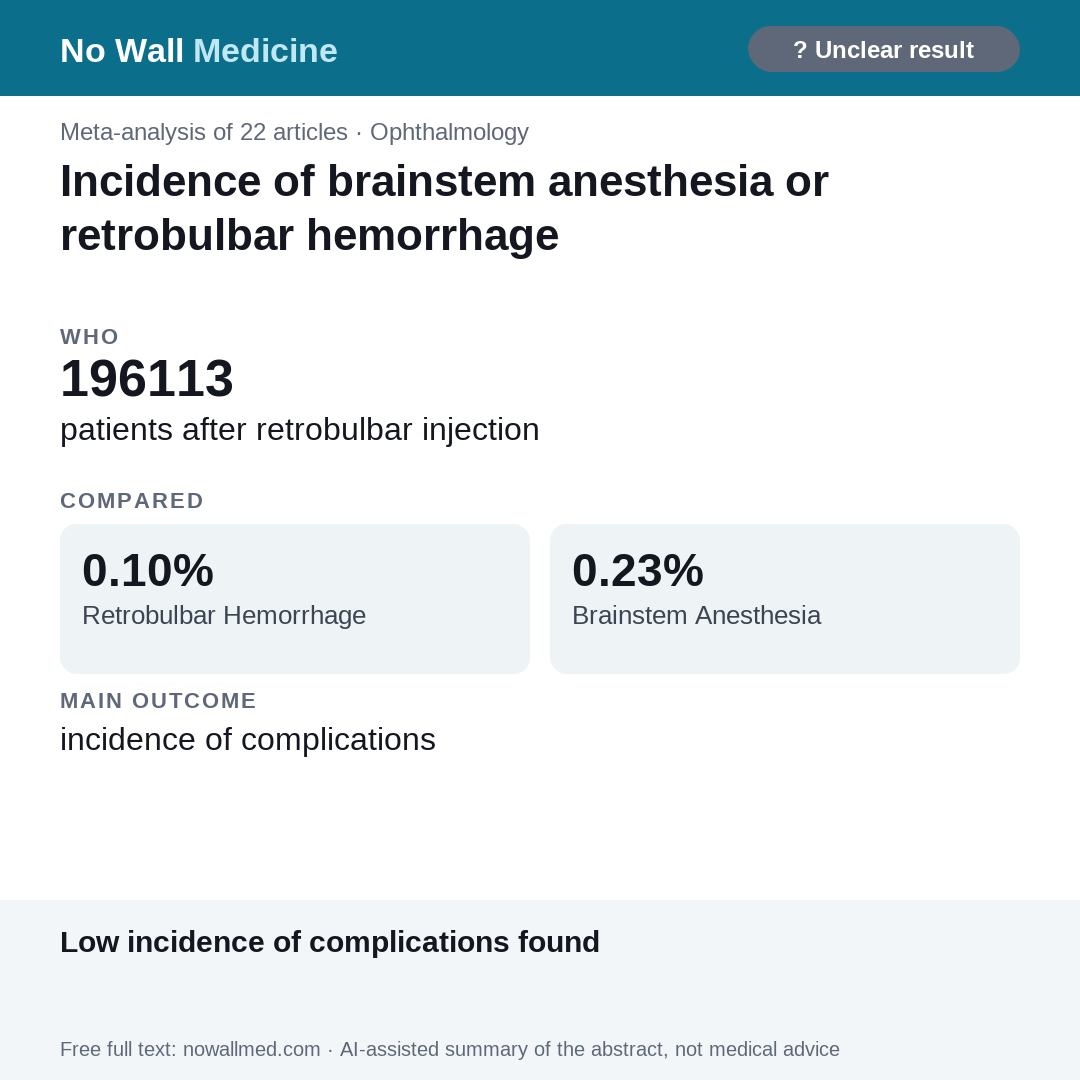
Incidence of Brainstem Anesthesia or Retrobulbar Hemorrhage after Retrobulbar Injection: A Systematic Review and Meta-Analysis
Meta-analysis of 22 articlesUnclear result
Incidence of brainstem anesthesia or retrobulbar hemorrhage
Who
196113
patients after retrobulbar injection
Compared
0.10%Retrobulbar Hemorrhage (95% CI: 0.03%-0.42%)
0.23%Brainstem Anesthesia (95% CI: 0.16%-0.34%)
Main outcome
incidence of complications
Bottom line: Low incidence of complications found
Limitation: low-certainty evidence due to imprecision
Ophthalmology · 2025-12-17Download image
Systematic review of antimicrobial pharmacokinetic/pharmacodynamic indices in murine thigh and hollow fibre dose fractionation studies analysed with a standard method
Systematic literature reviewMixed results
What is the optimal method for determining antimicrobial pharmacokinetic/pharmacodynamic indices in preclinical models?
Who
Murine thigh infection model and hollow fibre infection model studies · Database search of PubMed, MEDLINE, BIOSIS, SCOPUS and EMBASE
Compared
Murine thigh infection model: 50 studies of 1138
Hollow fibre infection model: 3 studies of 316
Main outcome
Pharmacokinetic/pharmacodynamic indices determination
Bottom line: A standardized modeling approach using Akaike information criterion is recommended to avoid over fitting in preclinical studies.
Limitation: Too few hollow fibre infection model studies were found to allow comparison with murine thigh infection models.
J Antimicrob Chemother · 2025-12-17Download image

Alterations in resting-state brain activity patterns following antidepressant treatment: insights from a coordinate-based meta-analysis
Coordinate-based meta-analysisMixed results
What are the neural differences between medicated and unmedicated major depressive disorder patients?
Who
Patients with major depressive disorder
Compared
Medicated major depressive disorder: increased activation in the left striatum
Unmedicated major depressive disorder: reduced activation in the left middle occipital gyrus
Main outcome
resting-state functional magnetic resonance imaging brain activation patterns
Bottom line: Antidepressant treatment is associated with increased left striatum activation, while left middle occipital gyrus activation is reduced in both groups.
Psychol Med · 2025-12-17Download image

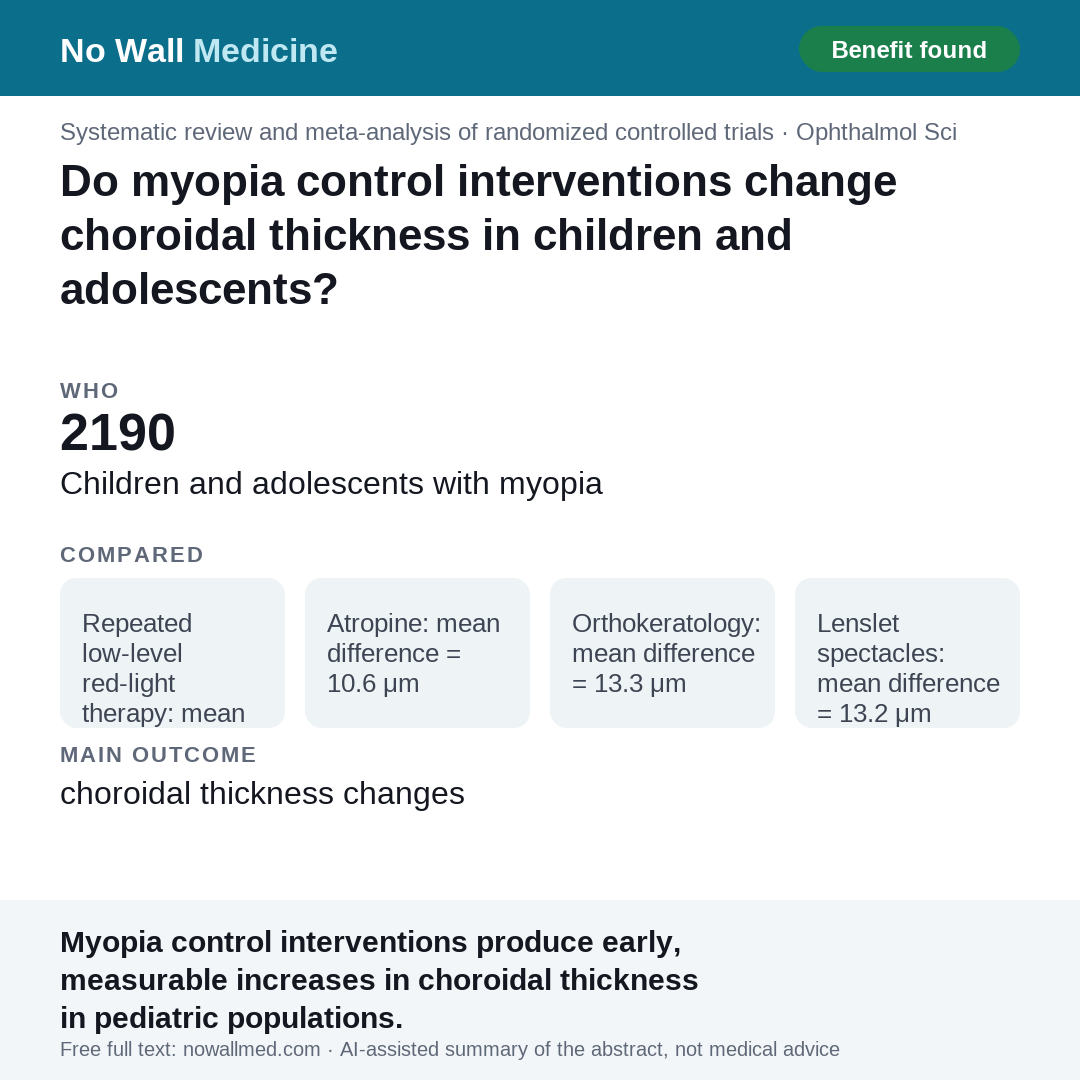
Impact of Myopia Control Interventions on Choroidal Thickness in Children: A Systematic Review and Meta-Analysis of Randomized Controlled Trials
Systematic review and meta-analysis of randomized controlled trialsBenefit found
Do myopia control interventions change choroidal thickness in children and adolescents?
Who
2190
Children and adolescents with myopia
Compared
Repeated low-level red-light therapy: mean difference = 24.1 μm
Atropine: mean difference = 10.6 μm
Orthokeratology: mean difference = 13.3 μm
Lenslet spectacles: mean difference = 13.2 μm
Main outcome
choroidal thickness changes
Bottom line: Myopia control interventions produce early, measurable increases in choroidal thickness in pediatric populations.
Limitation: clinical relevance remains uncertain
Ophthalmol Sci · 2025-12-17Download image
Orolabial and Genital Herpes Clinical Trials: A Meta-analysis of Endpoints
Meta-analysis of 22 randomized placebo-controlled trialsUnclear result
What are the endpoints used in clinical trials for orolabial and genital herpes?
Who
Immunocompetent, nonpregnant adults with established herpes simplex virus infection
Compared
Episodic treatment
Daily suppressive therapy
Main outcome
Various endpoints including healing time and recurrence rates
Bottom line: Clinical trials for herpes simplex virus use various endpoints with nonstandardized definitions.
Open Forum Infect Dis · 2025-12-17Download image

Health promotion through reading in the first thousand days: a systematic review and meta-analysis
Systematic review and meta-analysisMixed results
Does shared group reading intervention improve outcomes in the first thousand days?
Who
Children up to 24 months and their caregivers · Community settings
Compared
Shared group reading intervention
Control
Main outcome
Language skills, cognitive development, prosocial behaviour, and parent-child relationship
Bottom line: Evidence suggests potential improvements in language comprehension, but results for other developmental outcomes remain limited and inconsistent.
Limitation: Evidence was limited and inconsistent.
BMJ Paediatr Open · 2025-12-17Download image

Meta-analysis of randomized controlled trials of electronic health interventions to reduce medication errors
Meta-analysis of randomized controlled trialsBenefit found
Do electronic health interventions reduce medication errors compared to usual care?
Who
Patients receiving healthcare services
Compared
Electronic interventions
Usual care
Main outcome
Risk of medication errors
Result: relative risk 0.85 (95% CI 0.77 to 0.94)
Bottom line: Electronic interventions are associated with a 15% reduction in the risk of medication errors.
NPJ Digit Med · 2025-12-17Download image

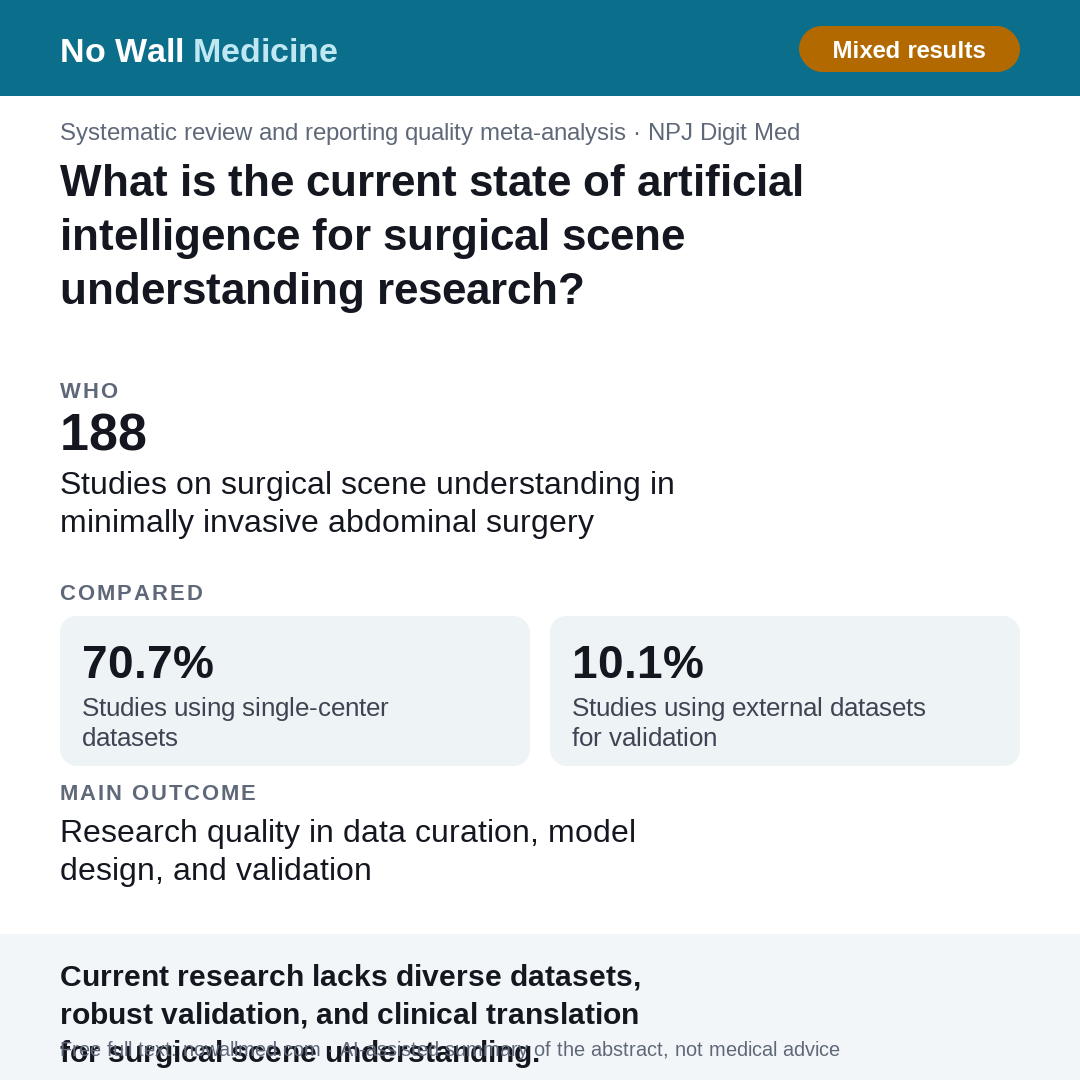
Artificial intelligence for surgical scene understanding: a systematic review and reporting quality meta-analysis
Systematic review and reporting quality meta-analysisMixed results
What is the current state of artificial intelligence for surgical scene understanding research?
Who
188
Studies on surgical scene understanding in minimally invasive abdominal surgery
Compared
70.7%Studies using single-center datasets
10.1%Studies using external datasets for validation
Main outcome
Research quality in data curation, model design, and validation
Bottom line: Current research lacks diverse datasets, robust validation, and clinical translation for surgical scene understanding.
Limitation: Most studies relied on small, single-center datasets and weak validation practices.
NPJ Digit Med · 2025-12-17Download image
Artificial Intelligence Platform Architecture for Hospital Systems: Systematic Review
Systematic reviewMixed results
What is the maturity of a 5-layer hospital artificial intelligence platform architecture?
Who
29
Peer-reviewed empirical studies of hospital-based artificial intelligence implementations · 11 countries
Compared
Application layer: mean 3.17, SD 0.85
Data layer: mean 3.00, SD 0.76
Algorithm layer: mean 2.79, SD 0.77
Infrastructure layer: mean 2.79, SD 1.70
Main outcome
Maturity of five architecture layers on a 0 to 5 point scale
Bottom line: Clinical layers show higher maturity, but sustainable implementation requires stronger investment in infrastructure, data governance, and compliance.
Limitation: Exclusion of non-English and gray literature and potential simplification by ordinal maturity scoring.
J Med Internet Res · 2025-12-17Download image

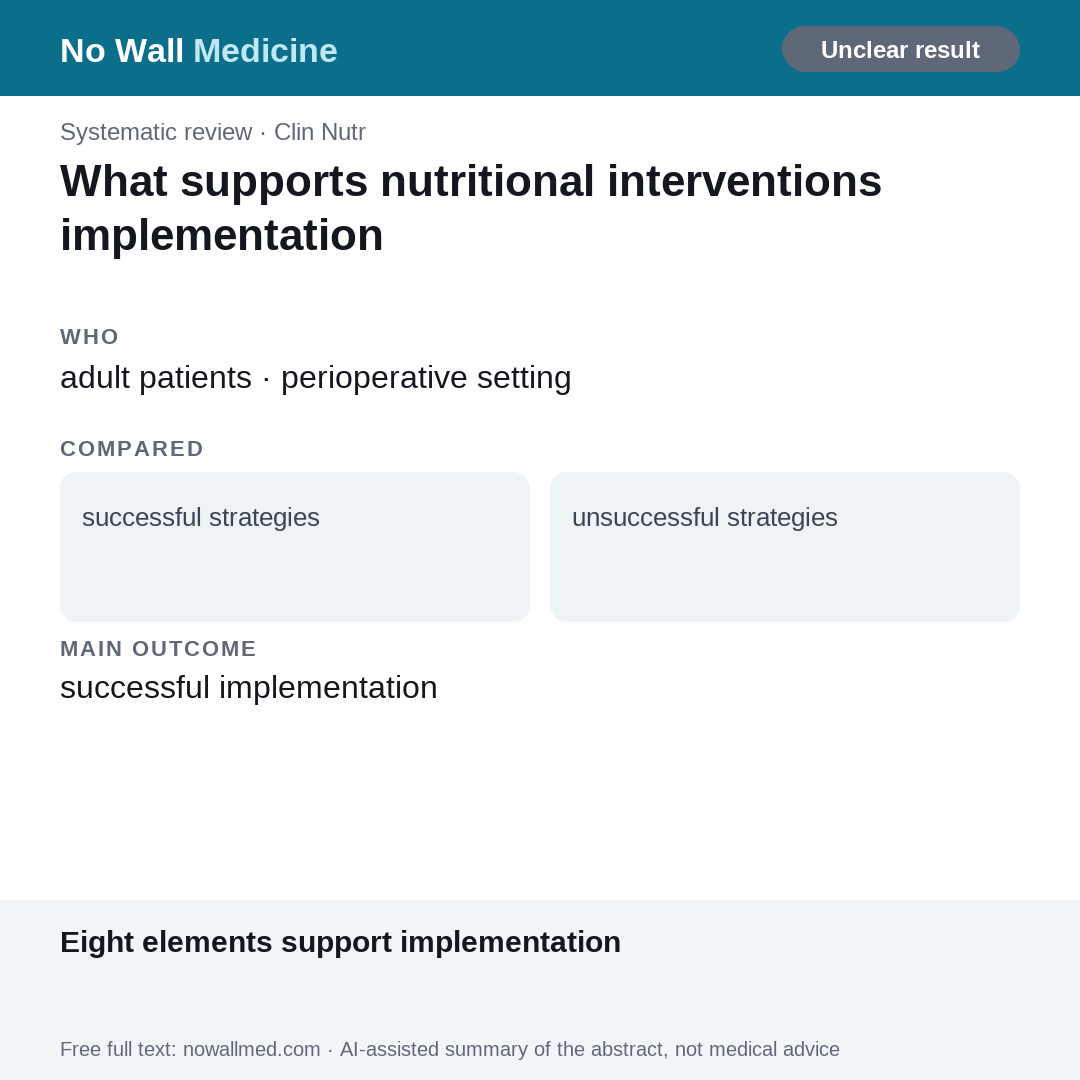
Eight strategic elements that support successful implementation of beneficial nutritional interventions in the perioperative setting: A systematic review
Systematic reviewUnclear result
What supports nutritional interventions implementation
Who
adult patients · perioperative setting
Compared
successful strategies
unsuccessful strategies
Main outcome
successful implementation
Bottom line: Eight elements support implementation
Limitation: methodological weaknesses
Clin Nutr · 2025-12-16Download image
A Systematic Review and Meta-Analysis on the Induction of Confirmed Eosinophilic Esophagitis as a Side Effect of Allergen Immunotherapy: An EAACI Task Force Report
Systematic review and meta-analysisMixed results
Does allergen immunotherapy induce confirmed eosinophilic esophagitis as a side effect?
Who
Patients receiving food desensitization or sublingual immunotherapy with aeroallergens
Compared
2.31%food desensitization (95% CI 1.45, 3.36)
sublingual immunotherapy with aeroallergens: not reporting cases of eosinophilic esophagitis
Main outcome
incidence of confirmed eosinophilic esophagitis
Result: 2.31% (95% CI 1.45, 3.36)
Bottom line: Eosinophilic esophagitis is a common adverse effect of food oral immunotherapy but uncommon during sublingual aeroallergen immunotherapy.
Allergy · 2025-12-16Download image

Anti-Müllerian Hormone Levels Across Phenotypes in Polycystic Ovary Syndrome: A Systematic Review and Meta-analysis
Systematic review and meta-analysisBenefit found
How do anti-Müllerian hormone levels compare across the four polycystic ovary syndrome phenotypes?
Who
15 535
Women with polycystic ovary syndrome diagnosed by Rotterdam criteria
Compared
Phenotype A: 11.49 ng/mL
Phenotype D: 8.97 ng/mL
Phenotype C: 7.98 ng/mL
Phenotype B: 6.25 ng/mL
Main outcome
Anti-Müllerian hormone concentrations
Bottom line: Anti-Müllerian hormone levels differ markedly across polycystic ovary syndrome phenotypes, following a hierarchy of A greater than D approximately equal to C greater than B.
Limitation: High heterogeneity and geographic region as a significant contributor to heterogeneity.
J Endocr Soc · 2025-12-16Download image

Generative AI Mental Health Chatbots as Therapeutic Tools: Systematic Review and Meta-Analysis of Their Role in Reducing Mental Health Issues
Systematic review and meta-analysis of randomized controlled trialsBenefit found
Are generative artificial intelligence mental health chatbots effective in reducing negative mental health issues?
Who
6314
Participants in studies measuring negative mental health issues
Compared
Generative artificial intelligence chatbots
Comparison group without chatbot features
Main outcome
Negative mental health issues, such as depression and anxiety
Result: effect size 0.30 (95% CI 0.004, 0.59)
Bottom line: Generative artificial intelligence chatbots are, on average, effective in reducing negative mental health issues like depression and anxiety.
Limitation: The meta-analysis included a small number of studies (n=14).
J Med Internet Res · 2025-12-16Download image