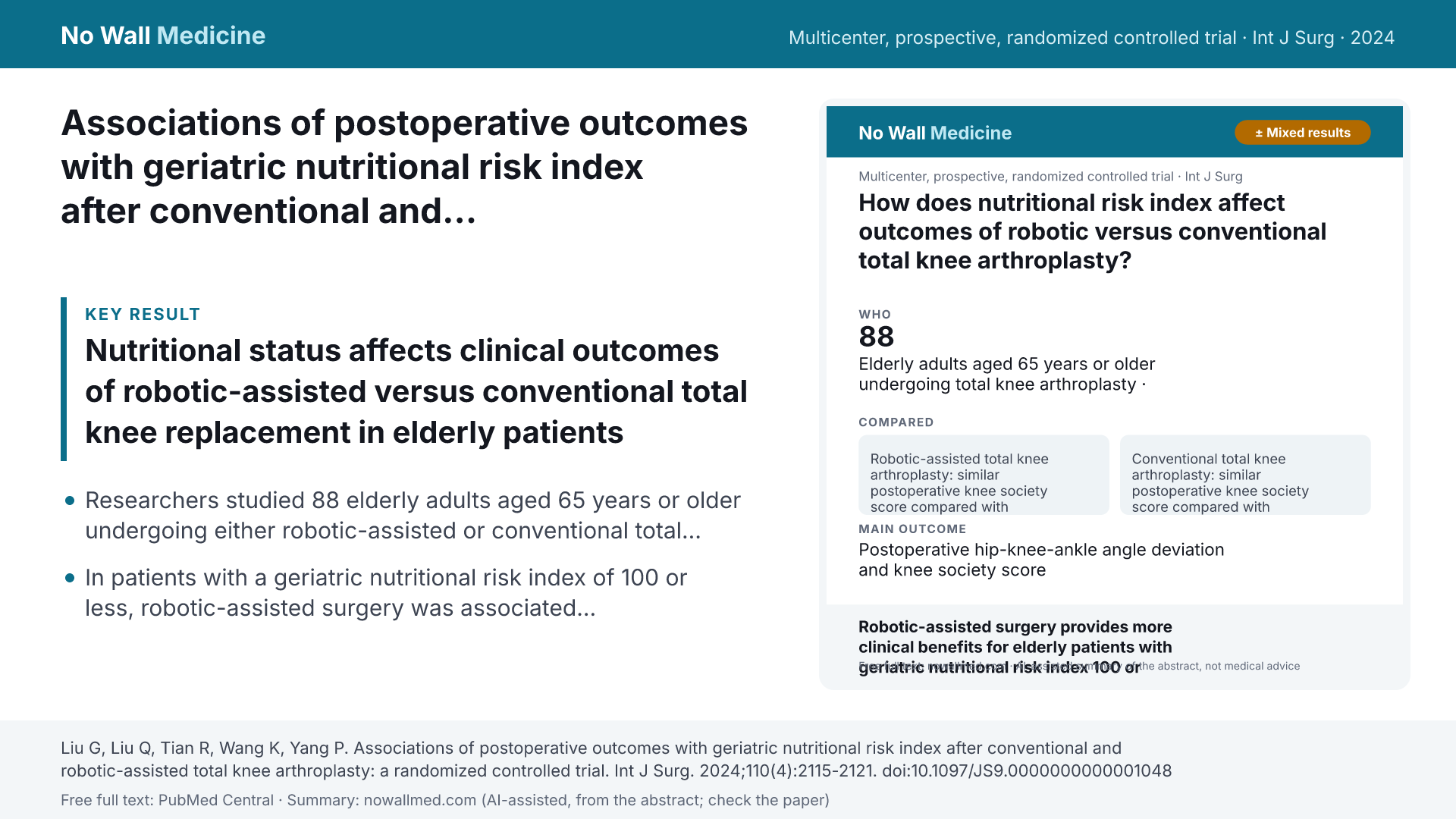
Nutritional status affects clinical outcomes of robotic-assisted versus conventional total knee replacement in elderly patients
Associations of postoperative outcomes with geriatric nutritional risk index after conventional and robotic-assisted total knee arthroplasty: a randomized controlled trial
Multicenter, prospective, randomized controlled trialMixed results
How does nutritional risk index affect outcomes of robotic versus conventional total knee arthroplasty?
Who
88
Elderly adults aged 65 years or older undergoing total knee arthroplasty · Multicenter
Compared
Robotic-assisted total knee arthroplasty: similar postoperative knee society score compared with conventional
Conventional total knee arthroplasty: similar postoperative knee society score compared with robotic-assisted
Main outcome
Postoperative hip-knee-ankle angle deviation and knee society score
Bottom line: Robotic-assisted surgery provides more clinical benefits for elderly patients with geriatric nutritional risk index 100 or less.
Int J Surg · 2024-04-01Download image
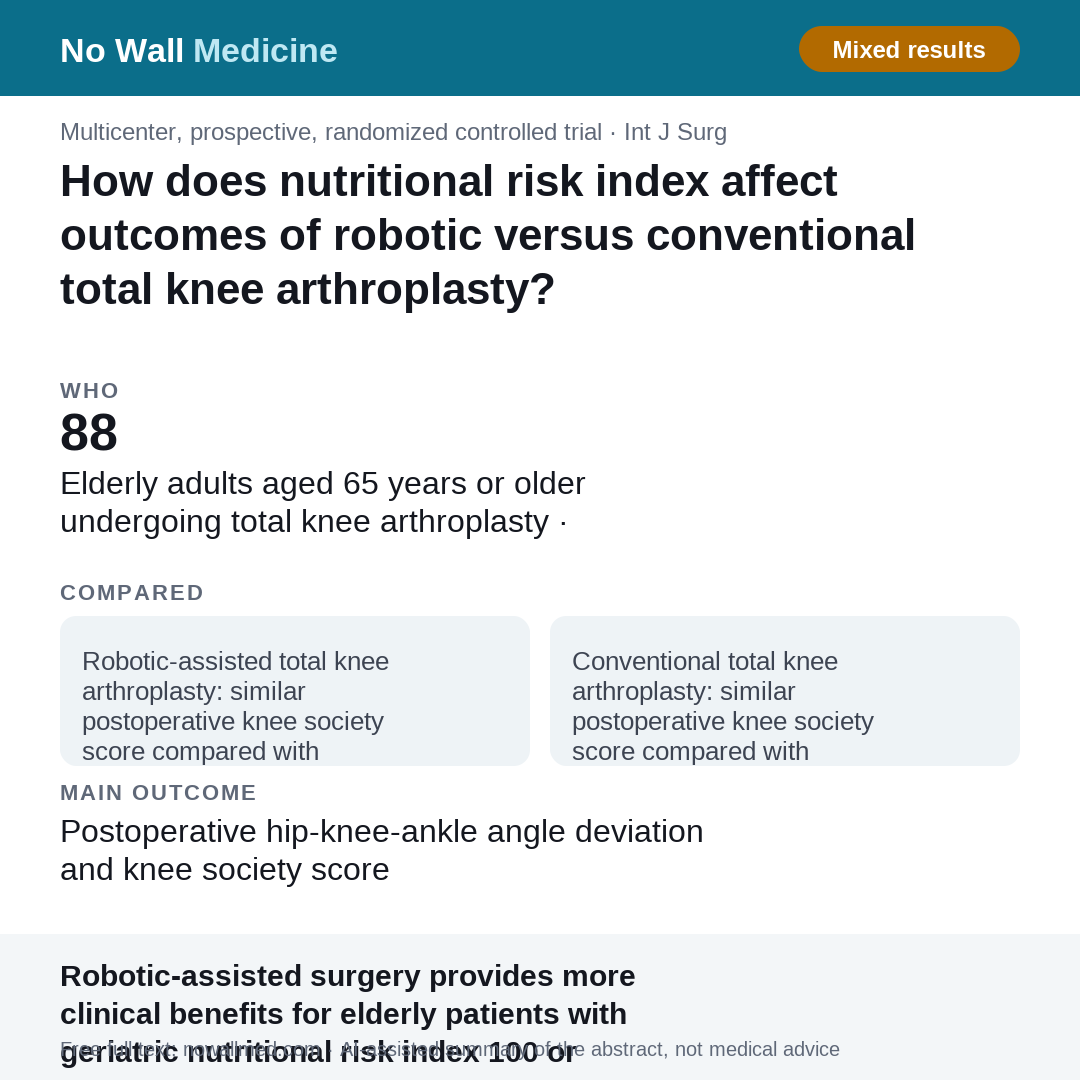
Clinical question: How does nutritional risk index affect outcomes of robotic versus conventional total knee arthroplasty?
Why it matters: The association between nutritional status and postoperative outcomes for robotic-assisted versus conventional total knee replacement in elderly adults was unclear.
Key points
- Researchers studied 88 elderly adults aged 65 years or older undergoing either robotic-assisted or conventional total knee replacement.
- In patients with a geriatric nutritional risk index of 100 or less, robotic-assisted surgery was associated with significantly higher knee society scores.
- Among patients with a geriatric nutritional risk index greater than 100, robotic-assisted surgery achieved more accurate alignment but did not result in higher knee society scores.
Headline and key points written with AI from the paper’s abstract, with every number checked against it. Read the paper before relying on them.
Was this summary helpful?
Subject terms
Cite this article
Liu G, Liu Q, Tian R, Wang K, Yang P. Associations of postoperative outcomes with geriatric nutritional risk index after conventional and robotic-assisted total knee arthroplasty: a randomized controlled trial. Int J Surg. 2024. doi:10.1097/JS9.0000000000001048
Spotted a mistake? Suggest a correction