Visual abstracts
New randomized trials and meta-analyses from leading journals at a glance: who was studied, what was compared, and what was found. Every paper is free to read in full.
All specialtiesCardiology 2802Oncology 2380Gastroenterology & Hepatology 1085Infectious Disease 1786Neurology 1128Psychiatry & Mental Health 1292Pulmonology 1170Critical Care 774Endocrinology & Diabetes 1442Pediatrics 1658Surgery 1451Orthopedics & Sports Medicine 509Neurosurgery 341Cardiothoracic & Vascular Surgery 313Plastic & Reconstructive Surgery 407Nephrology 585Rheumatology 424Hematology 607Dermatology 331Ophthalmology 320Obstetrics & Gynecology 924Public & Global Health 520Radiology & Imaging 391Anesthesiology 565Urology 465ENT (Otolaryngology) 323Emergency Medicine 310Allergy & Immunology 175Geriatrics 597Family Medicine & Primary Care 320Medical Genetics & Genomics 323Pathology & Laboratory Medicine 92Physical Medicine & Rehabilitation 450Palliative Care 243Nutrition 760Digital Health & AI 1333General Medicine 201
Long-Term Outcomes of Transcatheter Aortic Valve Replacement in Low-Flow Low-Gradient Aortic Stenosis: A Reconstructed Time-to-Event and Multivariate Meta-Analysis
Reconstructed time-to-event and multivariate meta-analysisHarm found
What are the long-term outcomes of TAVR for different types of severe aortic stenosis?
Who
20493
Patients with high-gradient, classical low-flow low-gradient, or paradoxical low-flow low-gradient aortic stenosis
Compared
High-gradient aortic stenosis
Classical low-flow low-gradient aortic stenosis: hazard ratio 1.92 (95% CI 1.62-2.27)
Paradoxical low-flow low-gradient aortic stenosis: hazard ratio 1.20 (95% CI 1.07-1.34)
Main outcome
5-year all-cause mortality
Result: hazard ratio 1.92 (95% CI 1.62-2.27) for classical and 1.20 (95% CI 1.07-1.34) for paradoxical
Bottom line: Classical and paradoxical low-flow low-gradient aortic stenosis are associated with higher mortality following transcatheter aortic valve replacement.
J Am Heart Assoc · 2026-04-27Download image

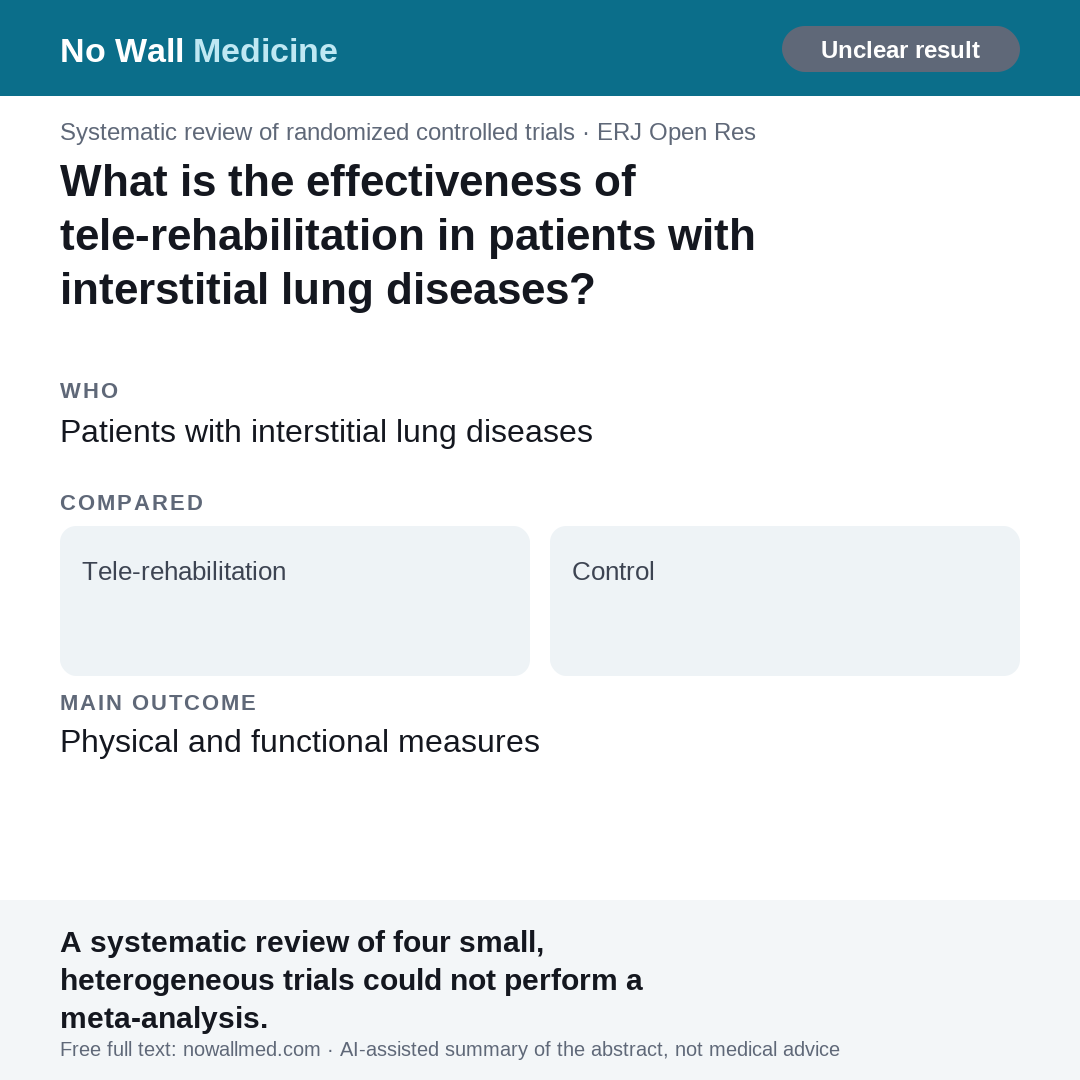
Home-based rehabilitation in interstitial lung disease: picturing the present and drawing the future through a systematic review of the literature
Systematic review of randomized controlled trialsUnclear result
What is the effectiveness of tele-rehabilitation in patients with interstitial lung diseases?
Who
Patients with interstitial lung diseases
Compared
Tele-rehabilitation
Control
Main outcome
Physical and functional measures
Bottom line: A systematic review of four small, heterogeneous trials could not perform a meta-analysis.
ERJ Open Res · 2026-04-27Download image
The past, present and future of control architectures in lower-limb cable-driven robots for gait rehabilitation
Systematic reviewMixed results
What are the control strategies for lower-limb cable-driven rehabilitation robots?
Who
70
Lower-limb cable-driven rehabilitation robots
Compared
Traditional classical control
Personalized adaptive and learning-based methods
Main outcome
Control strategies and their evolution
Bottom line: Control strategies are evolving from traditional classical methods toward personalized, adaptive, and intention-driven frameworks.
J Neuroeng Rehabil · 2026-04-27Download image

Palliative care symptoms of people living with rapidly progressive prion diseases: a systematic review
Systematic reviewMixed results
What are the palliative care symptoms of people living with Creutzfeldt-Jakob disease?
Who
4,434
People living with sporadic, iatrogenic, and acquired Creutzfeldt-Jakob disease
Compared
17.6%Motor impairments
17.6%Coordination, balance and vestibular issues
23.5%Behavioural, psychiatric and emotional symptoms
10.1%Speech and language disorders
Main outcome
Identification and categorization of palliative care symptoms
Bottom line: Creutzfeldt-Jakob disease involves a complex symptom burden, most frequently involving behavioural, psychiatric, motor, and coordination impairments.
Limitation: Limited evidence regarding social or spiritual symptoms, quality of life, or symptom progression.
BMC Palliat Care · 2026-04-27Download image

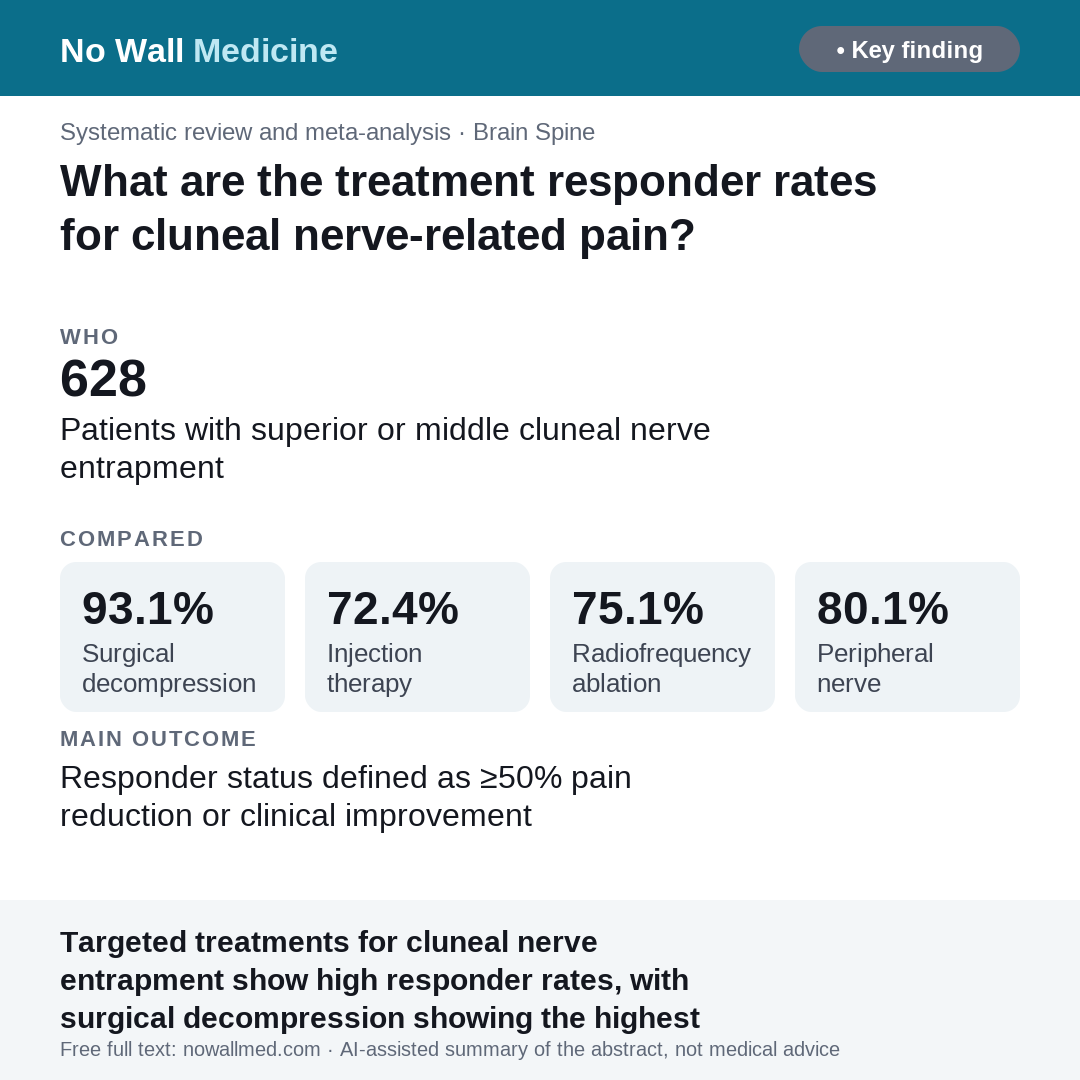
Treatment outcomes for cluneal neuropathy: a systematic review and meta-analysis
Systematic review and meta-analysisBenefit found
What are the treatment responder rates for cluneal nerve-related pain?
Who
628
Patients with superior or middle cluneal nerve entrapment
Compared
93.1%Surgical decompression (95% CI 84.9-97.0)
72.4%Injection therapy (95% CI 65.9-78.1)
75.1%Radiofrequency ablation (95% CI 62.1-84.7)
80.1%Peripheral nerve stimulation (95% CI 58.5-92.0)
Main outcome
Responder status defined as ≥50% pain reduction or clinical improvement
Result: 78.3% (95% CI 72.9-82.9) at ≥3 months
Bottom line: Targeted treatments for cluneal nerve entrapment show high responder rates, with surgical decompression showing the highest proportion.
Limitation: Predominantly observational, non-comparative evidence with heterogeneity in diagnostic criteria and potential confounding by indication.
Brain Spine · 2026-04-27Download image
The use of supplemental oxygen during cardiopulmonary resuscitation - a systematic review of the literature
Systematic review of observational studiesUnclear result
Does supplemental oxygen during cardiopulmonary resuscitation improve outcomes after cardiac arrest?
Who
Patients with out-of-hospital or in-hospital cardiac arrest
Compared
Hyperoxaemia: ROSC 50-100%, survival 10-56%, favorable outcome 5-23%
Hypoxaemia: ROSC 21-58%, survival 1-16%, favorable outcome 0.5-3%
Main outcome
Return of spontaneous circulation, survival, and favorable neurological outcome
Bottom line: Very low-certainty indirect evidence suggests higher arterial oxygen levels during cardiopulmonary resuscitation are associated with improved outcomes.
Limitation: All included studies were observational and judged to be at critical risk of bias.
Resusc Plus · 2026-04-27Download image

Global complications among patients with mpox: a systematic review and meta-analysis
Systematic review and meta-analysisMixed results
What is the incidence of complications among patients with mpox?
Who
127,564
Patients with laboratory-confirmed mpox of all ages · Global
Compared
Non-severe mpox: hospitalization occurred in 4.4%
Severe mpox: All-cause mortality, abscess, sepsis, tonsillitis, keratitis, and mechanical ventilation occurred in 2.5%-5.5%
Main outcome
Incidence of complications among patients with mpox
Bottom line: Non-severe mpox has low complication rates, while severe disease carries substantial risks of life-threatening complications and death.
Limitation: low certainty evidence for hospitalization rates
Funded by: World Health Organization
eClinicalMedicine · 2026-04-25Download image

The effects of metformin and exercise training on cardiorespiratory, blood pressure, and metabolic adaptations across the spectrum of glucose dysregulation: a systematic review and meta-analysis
Systematic review and meta-analysisHarm found
Does adding metformin to exercise affect cardiorespiratory, blood pressure, and metabolic adaptations?
Who
827
Adults with conditions across the spectrum of glucose dysregulation
Compared
Exercise plus metformin
Exercise alone
Main outcome
Peak oxygen uptake, body composition, blood pressure, glycaemic markers, and lipids
Result: mean difference -1.19 (95% CI -2.33 to -0.04) for VO2peak
Bottom line: Adding metformin to exercise may modestly attenuate improvements in cardiorespiratory fitness and blood pressure.
Limitation: Certainty of evidence was low to very low for most glycaemic and lipid markers.
eClinicalMedicine · 2026-04-25Download image

Multi-Factorial and Multi-Component Fall Prevention Interventions Initiated From the Emergency Department: A Systemic Review and Meta-Analysis
Systematic review and meta-analysisNo clear difference
Are emergency department based fall prevention interventions effective for older patients?
Who
Older patients aged 60 years or older · Emergency department and outpatient settings
Compared
Interventions
Control
Main outcome
Risk of falls and recurrent healthcare use
Result: risk difference 0.05 95% CI [0.00; 0.09] at 3 months
Bottom line: Emergency department based fall prevention interventions did not decrease falls or recurrent healthcare use in older adults.
Limitation: Comparisons are limited by heterogeneity in intervention types, compliance, and timing of outcomes.
Acad Emerg Med · 2026-04-25Download image

Passive digital health technologies for Alzheimer's disease screening and diagnosis: a systematic review
Systematic reviewBenefit found
Can passive digital health technologies screen and diagnose Alzheimer's disease and related dementias?
Who
Individuals for Alzheimer's disease and related dementias screening or diagnosis · Six major databases
Compared
Passive digital health technologies: median accuracy, sensitivity, specificity, and precision between 80-90%
F1-score and AUC: medians approaching 78%
Main outcome
Accuracy, sensitivity, specificity, precision, F1-score, and area under the curve
Bottom line: Passive digital health technologies show promise as low-burden triage tools for population-level Alzheimer's disease and related dementias screening.
NPJ Digit Med · 2026-04-25Download image

Comparative efficacy of motor imagery augmented with central non-invasive brain stimulation versus peripheral electrical stimulation for upper extremity rehabilitation post-stroke: a systematic review and network meta-analysis
Systematic review and network meta-analysisBenefit found
Which motor imagery combined stimulation is most effective for upper extremity stroke recovery?
Who
846
Adult stroke patients with upper limb dysfunction
Compared
Motor imagery with low-frequency repetitive transcranial magnetic stimulation: Standardized Mean Difference 1.755
Conventional rehabilitation alone
Main outcome
Change in upper limb motor function measured by Fugl-Meyer Assessment
Result: Standardized Mean Difference 1.755 (95% CI 0.631 to 2.879)
Bottom line: Motor imagery combined with low-frequency repetitive transcranial magnetic stimulation significantly improves upper limb motor function compared to conventional rehabilitation.
Limitation: Heterogeneity was influenced by brain-computer interface use, publication year, and patient mean age.
J Neuroeng Rehabil · 2026-04-25Download image

Editor's Choice - Global Temporal Trends in the Incidence of Major Lower Limb Amputations: A Systematic Review and Meta-analysis
Systematic review and meta-analysisMixed results
What are the global temporal trends in the incidence of major lower limb amputations?
Who
General population and people with diabetes · Global
Compared
All cause major amputations: average annual percentage change -3.44%
Diabetes related major amputations: average annual percentage change -7.13
Main outcome
Incidence of major lower limb amputations
Result: average annual percentage change -3.44% (95% CI -5.17 to -1.67) and -7.13 (95% CI -8.60 to -5.64)
Bottom line: Major amputation incidence is falling globally but rising in low and middle income countries.
Eur J Vasc Endovasc Surg · 2026-04-24Download image

The effectiveness of hormonal treatment to improve reproductive outcomes in normogonadotropic men with abnormal semen parameters: results of 2 linked systematic reviews
Two linked systematic reviewsMixed results
Does hormonal treatment improve reproductive outcomes in normogonadotropic men with abnormal semen parameters?
Who
735
Normogonadotropic men with abnormal semen parameters
Compared
Follicle-stimulating hormone: sperm count mean difference 11.0 (95% CI, 7.2-14.8)
Placebo or no treatment
Main outcome
Semen quality and pregnancy
Result: mean difference 11.0 (95% CI, 7.2-14.8)
Bottom line: Follicle-stimulating hormone may modestly improve sperm count, concentration, and motility, but pregnancy benefits remain uncertain.
Limitation: Expected benefits are modest and short-term, with uncertain translation to pregnancy or live birth.
J Clin Endocrinol Metab · 2026-04-24Download image

Prevalence and clinical impact of hepatic steatosis on autoimmune liver disease: A systematic review and meta-analysis
Systematic review and meta-analysisMixed results
What is the prevalence and clinical impact of hepatic steatosis in autoimmune liver disease?
Who
19898
Patients with autoimmune hepatitis, primary biliary cholangitis, and primary sclerosing cholangitis
Compared
Autoimmune hepatitis with hepatic steatosis: higher risk of hepatic decompensation (OR: 1.6, 95% CI: 1.3-2.1) and hepatocellular carcinoma (OR: 1.8, 95% CI: 1.3-2.6)
Primary biliary cholangitis with hepatic steatosis: did not influence the clinical outcomes
Main outcome
Prevalence and clinical impact of hepatic steatosis
Bottom line: Hepatic steatosis increases risks in autoimmune hepatitis but does not influence outcomes in primary biliary cholangitis.
Hepatol Commun · 2026-04-24Download image

Breast Sensation After Abdominal Free Flap Reconstruction With or Without Neurotization: A Systematic Review and Meta-analysis
Systematic review and meta-analysisBenefit found
Does neurotization improve breast sensation after abdominal free flap reconstruction?
Who
563
Patients undergoing abdominal free flap reconstruction
Compared
Neurotized reconstruction: significantly lower pressure threshold for fine sensation
Nonneurotized reconstruction
Main outcome
total breast skin sensation
Result: standardized mean difference -0.87 (95% confidence interval -1.33 to -0.41)
Bottom line: Neurotization significantly improves total breast, flap, and native breast skin sensation after abdominal free flap reconstruction.
Plast Reconstr Surg Glob Open · 2026-04-24Download image

Inflammation as a mediating pathway between social defeat and mental health in humans: A systematic review
Systematic reviewUnclear result
Does inflammation mediate the relationship between social defeat and mental health in humans?
Who
Humans experiencing social isolation, peer victimisation, discrimination, and childhood adversity
Compared
Social defeat and mental health
Inflammation and mental health
Main outcome
Associations between social defeat, inflammation, and mental health
Bottom line: Social defeat may alter immunological profiles and mental health, but inflammation's mediating role remains inconclusive.
Limitation: Results were limited by moderate-to-high quality and low-to-high risk of bias across studies.
Transl Psychiatry · 2026-04-24Download image

Effectiveness of Digital Serious Games on Knowledge and Attitudes in Public Health Education: Systematic Review and Bayesian Network Meta-Analysis of Randomized Controlled Trials
Systematic review and Bayesian network meta-analysisBenefit found
Do digital serious games improve public health knowledge and attitudes compared to traditional education?
Who
8764
Nonprofessional participants · 19 countries
Compared
Digital serious games
Traditional or noninteractive education
Main outcome
Public health knowledge and attitudes
Result: knowledge standardized mean difference 0.66 (95% CI 0.32-0.99); attitudes standardized mean difference 0.50 (95% CI 0.27-0.76)
Bottom line: Digital serious games significantly improve public health knowledge and attitudes compared to traditional or noninteractive education methods.
Limitation: Future research requires adequately powered trials, longer follow-up, and standardized frameworks.
J Med Internet Res · 2026-04-24Download image

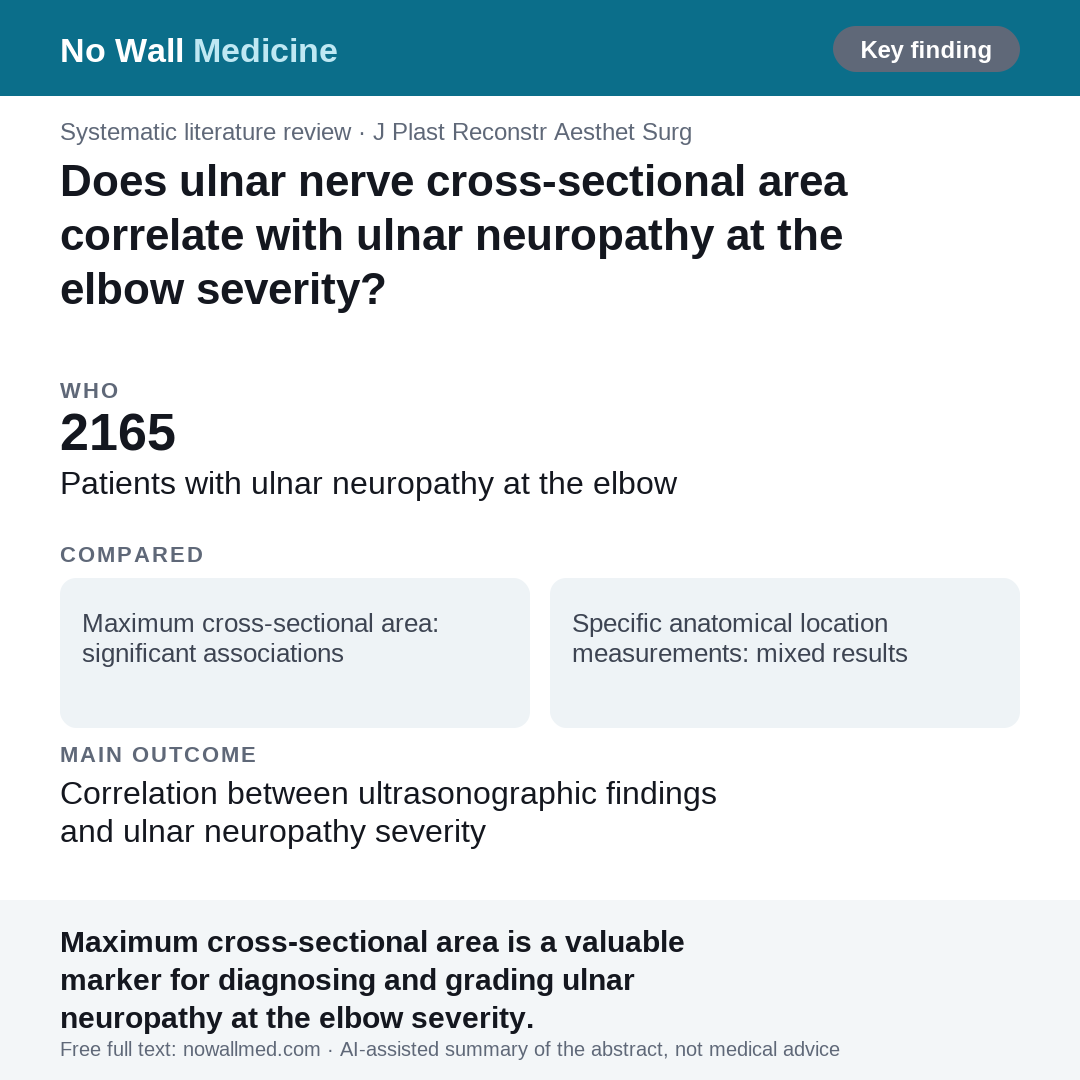
The relationship between the cross-sectional area of the ulnar nerve and severity of ulnar neuropathy at the elbow: A systematic review
Systematic literature reviewBenefit found
Does ulnar nerve cross-sectional area correlate with ulnar neuropathy at the elbow severity?
Who
2165
Patients with ulnar neuropathy at the elbow
Compared
Maximum cross-sectional area: significant associations
Specific anatomical location measurements: mixed results
Main outcome
Correlation between ultrasonographic findings and ulnar neuropathy severity
Bottom line: Maximum cross-sectional area is a valuable marker for diagnosing and grading ulnar neuropathy at the elbow severity.
Limitation: Due to study variability, qualitative data synthesis was performed.
J Plast Reconstr Aesthet Surg · 2026-04-23Download image
Iatrogenic ureteric injuries after abdominal surgery: a systematic review and meta-regression from the European Association of Urology Endourology Section
Systematic review and meta-regressionBenefit found
What are the outcomes of management strategies for iatrogenic ureteric injuries?
Who
1517
Patients treated for iatrogenic ureteric injury
Compared
91%Reconstructive procedures (95% CI 84-95%)
66%Endoscopic techniques (95% CI 58-73%)
Main outcome
Clinical success rate
Result: odds ratio 0.14 (95% CI 0.05-0.40) for endoscopic success
Bottom line: Reconstructive-dominant management had higher clinical success than endoscopic-dominant approaches for iatrogenic ureteric injuries.
Limitation: Serious risk of bias and substantial heterogeneity in definitions and follow-up practices.
BJU Int · 2026-04-23Download image

Health-related quality of life in people with autosomal dominant polycystic kidney disease: a systematic review
Systematic reviewHarm found
How does autosomal dominant polycystic kidney disease impact health-related quality of life?
Who
People with autosomal dominant polycystic kidney disease · Five databases and Google Scholar
Compared
Early chronic kidney disease stages
Later chronic kidney disease stages: lower values relative to matched population norms
Main outcome
Health-related quality of life
Bottom line: Health-related quality of life, especially physical health, declines as chronic kidney disease progresses in patients with autosomal dominant polycystic kidney disease.
Limitation: Generic patient-reported outcome measures may underestimate the impact of the disease compared to disease-specific tools.
Clin Kidney J · 2026-04-23Download image