Visual abstracts
New randomized trials and meta-analyses from leading journals at a glance: who was studied, what was compared, and what was found. Every paper is free to read in full.
All specialtiesCardiology 4763Oncology 4043Gastroenterology & Hepatology 1903Infectious Disease 3756Neurology 1872Psychiatry & Mental Health 2216Pulmonology 2044Critical Care 1319Endocrinology & Diabetes 2544Pediatrics 2889Surgery 2480Orthopedics & Sports Medicine 917Neurosurgery 525Cardiothoracic & Vascular Surgery 656Plastic & Reconstructive Surgery 574Nephrology 1107Rheumatology 810Hematology 1090Dermatology 611Ophthalmology 532Obstetrics & Gynecology 1645Public & Global Health 1037Radiology & Imaging 619Anesthesiology 958Urology 745ENT (Otolaryngology) 494Emergency Medicine 481Allergy & Immunology 309Geriatrics 972Family Medicine & Primary Care 534Medical Genetics & Genomics 659Pathology & Laboratory Medicine 156Physical Medicine & Rehabilitation 734Palliative Care 421Nutrition 1560Digital Health & AI 2137General Medicine 318
Effects of workplace interventions on sedentary behaviour and physical activity: an umbrella review with meta-analyses and narrative synthesis
Umbrella review with meta-analyses and narrative synthesisMixed results
What are the effects of workplace interventions on sedentary behaviour and physical activity?
Who
Working adults aged 18 years and older
Compared
Sit-to-stand workstations alone: decreasing it by up to 75 min per day (95% CI -109 to -41)
Self-monitoring with psychosocial strategies: average gains of 1056 steps per day (371 to 1740)
Main outcome
sedentary behaviour and physical activity
Bottom line: Workplace interventions can reduce sedentary time and increase step counts, but none consistently improve moderate-to-vigorous physical activity.
Limitation: High heterogeneity (I2=84·80%) and potential publication bias in environmental-level interventions.
Lancet Public Health · 2025-04-03 · Save PNG

Circulating tumor DNA clearance as a predictive biomarker of pathologic complete response in patients with solid tumors treated with neoadjuvant immune checkpoint inhibitors: a systematic review and meta-analysis
Systematic review and meta-analysisMixed results
Does circulating tumor DNA clearance predict pathologic complete response in patients receiving neoadjuvant immune checkpoint inhibitors?
Who
380
Patients with solid tumors and detectable circulating tumor DNA
Compared
ctDNA clearance
No ctDNA clearance
Main outcome
Pathologic complete response
Result: sensitivity 0.98 (95% CI 0.86-1.00), specificity 0.53 (95% CI 0.37-0.69)
Bottom line: Circulating tumor DNA clearance identifies patients unlikely to achieve pathologic complete response but has low specificity for confirmation.
Limitation: Significant heterogeneity and variability in the diagnostic performance of assays.
Ann Oncol · 2025-04-03 · Save PNG

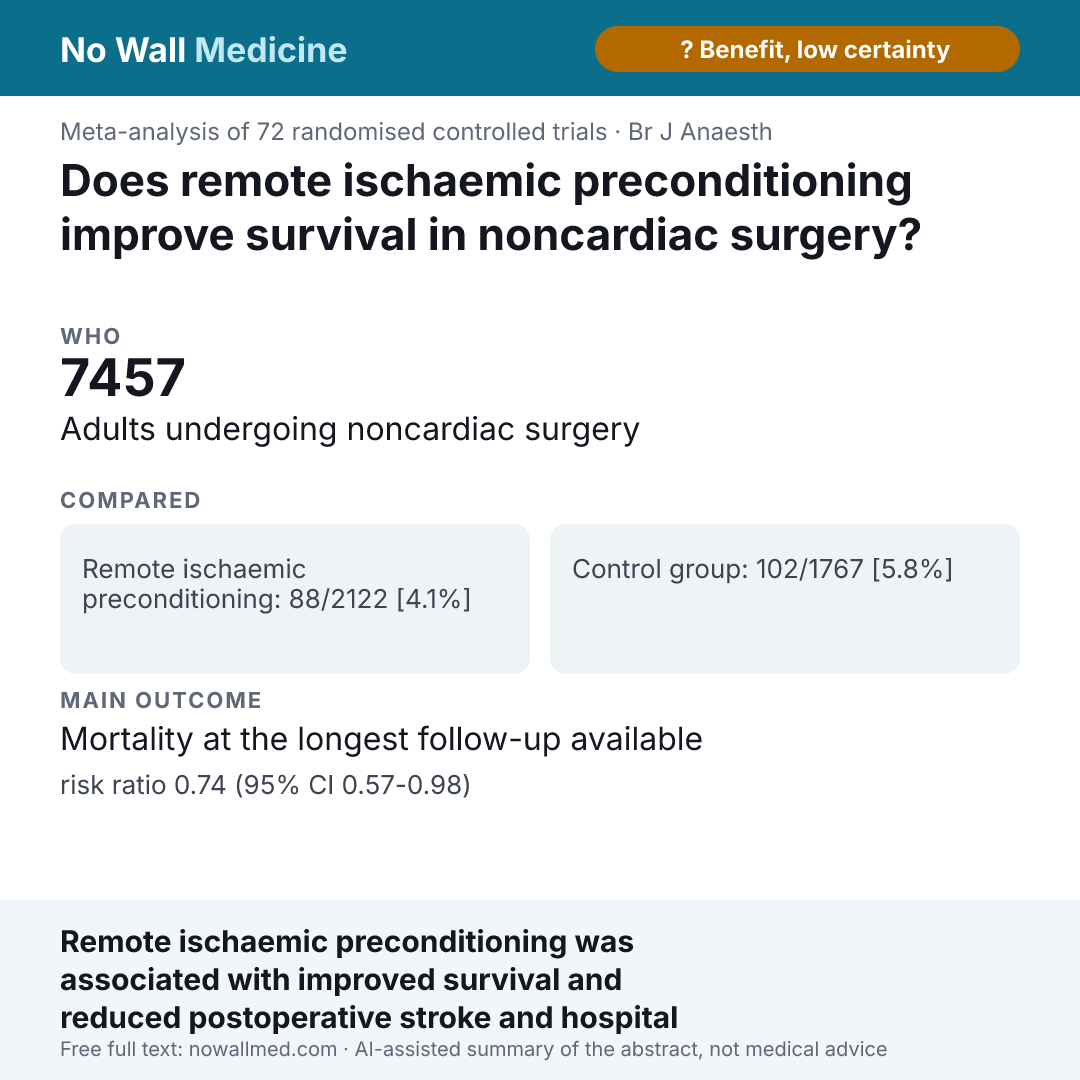
Remote ischaemic preconditioning and survival in noncardiac surgery: a meta-analysis of randomised trials
Meta-analysis of 72 randomised controlled trialsBenefit, low certainty
Does remote ischaemic preconditioning improve survival in noncardiac surgery?
Who
7457
Adults undergoing noncardiac surgery
Compared
Remote ischaemic preconditioning: 88/2122 [4.1%]
Control group: 102/1767 [5.8%]
Main outcome
Mortality at the longest follow-up available
Result: risk ratio 0.74 (95% CI 0.57-0.98)
Bottom line: Remote ischaemic preconditioning was associated with improved survival and reduced postoperative stroke and hospital stay in noncardiac surgery.
Br J Anaesth · 2025-04-03 · Save PNG
Return to Work After Ischemic Stroke in Young Adults: A Multicenter Cohort Study, Systematic Review, and Meta-Analysis
Systematic review and meta-analysisMixed results
What are the proportions and factors associated with return to work after young adult ischemic stroke?
Who
1914
Young adults aged 18 to 50 years with ischemic stroke · Multicenter cohort study in Singapore
Compared
63.2%Pooled return to work proportion (984/1574 [95% CI, 56.0-69.9])
84.7%Pooled functional recovery proportion (719/846 [95% CI, 81.1-87.8])
Main outcome
Return to work and functional recovery
Bottom line: Large-artery atherosclerosis, diabetes, and higher stroke severity scores are associated with lower odds of returning to work.
J Am Heart Assoc · 2025-04-03 · Save PNG

Neighborhood Safety and Hypertension Risk: A Systematic Review
Systematic reviewKey finding
Does neighborhood safety impact blood pressure and hypertension risk?
Who
General population in various residential environments · Not specified
Compared
Safe neighborhood: lower blood pressure outcomes
Unsafe neighborhood: increase blood pressure and hypertension risk
Main outcome
blood pressure and hypertension risk
Bottom line: Living in safe neighborhoods is associated with lower blood pressure, particularly in longitudinal studies.
J Am Heart Assoc · 2025-04-03 · Save PNG

Outcome Measures in Dystrophic Calcinosis Cutis: A Systematic Review
Systematic reviewUnclear result
What are the clinically relevant outcome measures used to assess dystrophic calcinosis cutis?
Who
Patients with dystrophic calcinosis cutis
Compared
73.1%Clinician-reported measures
50.0%Imaging
42.3%Patient-reported outcomes
Main outcome
Clinically relevant outcome measures used in studies
Bottom line: No consistent outcome measures were identified, and there is a lack of standardized measures for dystrophic calcinosis cutis.
Limitation: The majority of included studies were retrospective observational studies.
JID Innov · 2025-04-03 · Save PNG

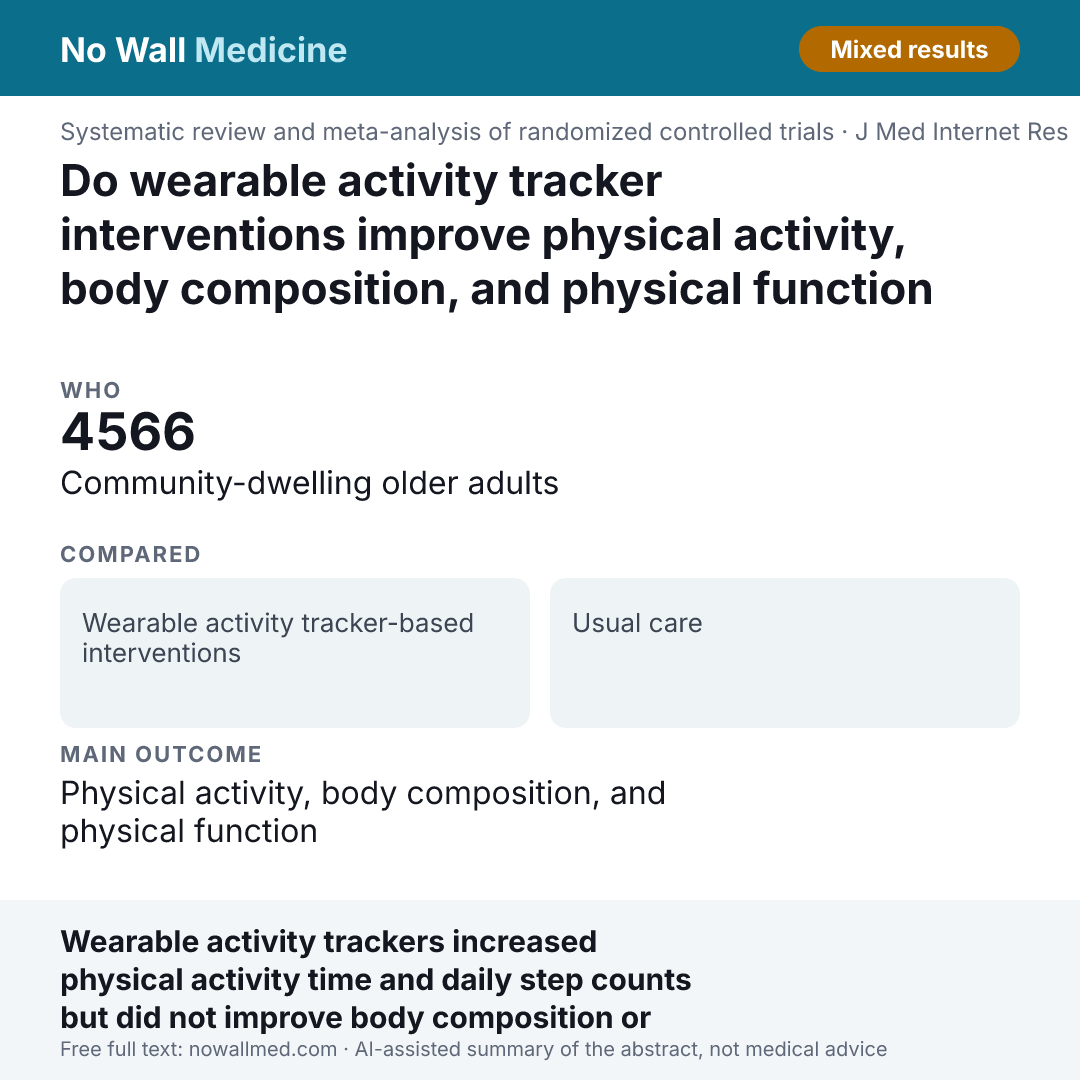
Wearable Activity Tracker-Based Interventions for Physical Activity, Body Composition, and Physical Function Among Community-Dwelling Older Adults: Systematic Review and Meta-Analysis of Randomized Controlled Trials
Systematic review and meta-analysis of randomized controlled trialsMixed results
Do wearable activity tracker interventions improve physical activity, body composition, and physical function in older adults?
Who
4566
Community-dwelling older adults
Compared
Wearable activity tracker-based interventions
Usual care
Main outcome
Physical activity, body composition, and physical function
Result: standardized mean difference 0.28 (95% CI 0.10 to 0.47) for physical activity time
Bottom line: Wearable activity trackers increased physical activity time and daily step counts but did not improve body composition or physical function.
Limitation: low- to moderate-certainty evidence
J Med Internet Res · 2025-04-03 · Save PNG
Can motion capture improve task-based fMRI studies of motor function post-stroke? A systematic review
Systematic literature reviewBenefit found
Can motion capture improve task-based functional magnetic resonance imaging studies of motor function post-stroke?
Who
23
Post-stroke individuals
Compared
Studies using kinematic information
Studies without kinematic coupling
Main outcome
Understanding of motor function and cortico-kinematic relationships
Bottom line: Coupling functional magnetic resonance imaging and kinematics may provide valuable insight into cortico-kinematic relationships post-stroke.
J Neuroeng Rehabil · 2025-04-03 · Save PNG

Body Composition and Survival in Patients With Heart Failure: A Systematic Review and Meta-Analysis
Systematic review and meta-analysisMixed results
How do body composition parameters impact survival in patients with heart failure?
Who
36,176
Patients with heart failure
Compared
Low muscle mass: HR: 1.73 (95% CI: 1.32-2.26)
Elevated fat mass: pooled adjusted HR: 0.75 (95% CI: 0.26-2.12)
Main outcome
All-cause mortality
Result: hazard ratio 1.73 (95% CI 1.32-2.26) for low muscle mass
Bottom line: Low muscle mass is associated with increased mortality, but elevated fat mass shows no significant association.
JACC Heart Fail · 2025-04-02 · Save PNG

Efficacy and safety of iGlarLixi versus IDegAsp in people with type 2 diabetes inadequately controlled with basal insulin: A systematic literature review and network meta-analysis of non-Asian studies
Network meta-analysis of four randomized controlled trialsBenefit found
Is iGlarLixi more effective than IDegAsp in people with type 2 diabetes?
Who
2535
People with type 2 diabetes inadequately controlled with basal insulin · non-Asian studies
Compared
iGlarLixi: mean difference -0.39 %-units
IDegAsp
Main outcome
HbA1c reduction
Result: mean difference -0.39 (95% credible interval -0.58, -0.21) %-units
Bottom line: iGlarLixi provided superior blood glucose control and body weight benefit compared with IDegAsp in non-Asian populations.
Diabetes Obes Metab · 2025-04-02 · Save PNG

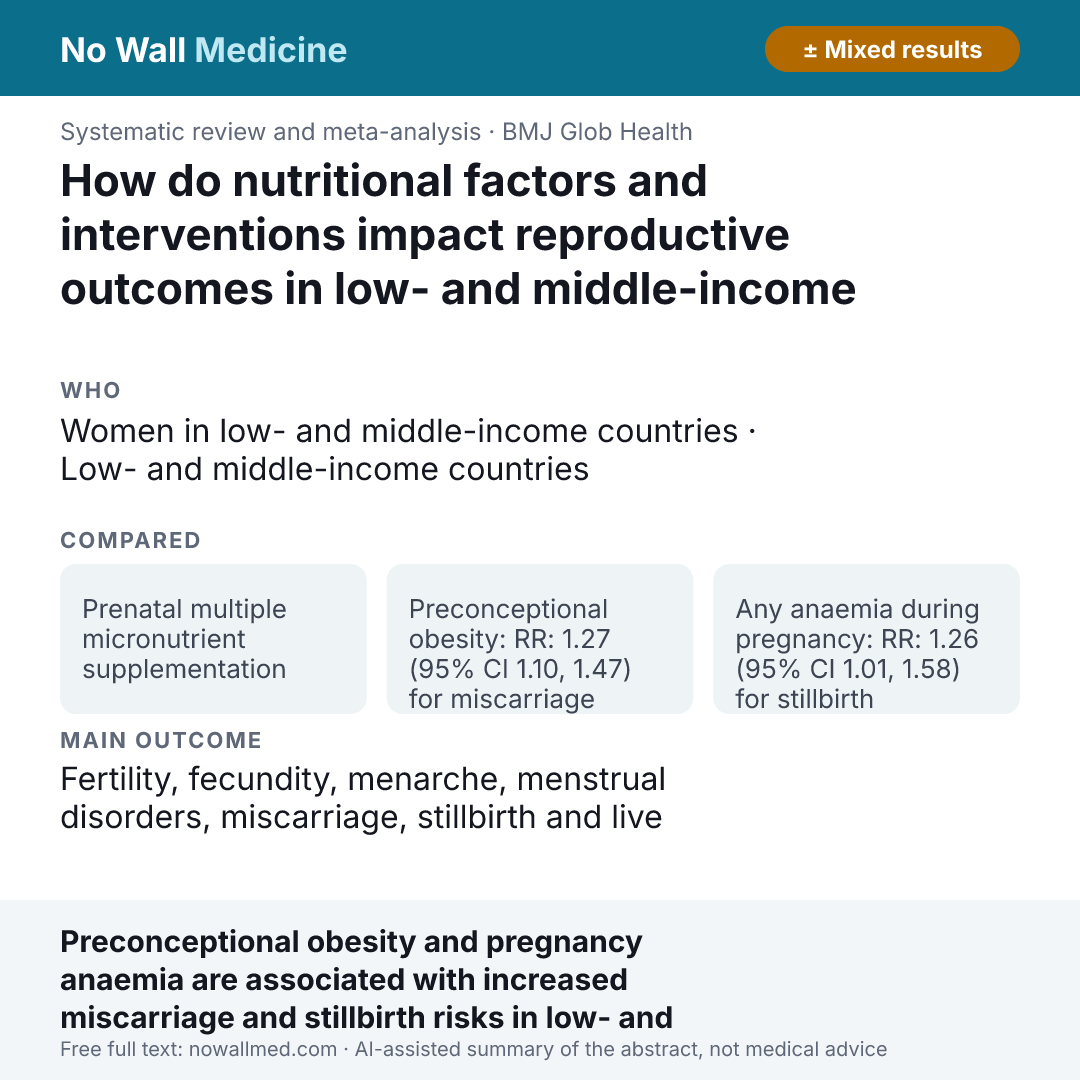
Nutrition and reproductive potential of women in low- and middle-income countries: a systematic review and meta-analysis
Systematic review and meta-analysisMixed results
How do nutritional factors and interventions impact reproductive outcomes in low- and middle-income countries?
Who
Women in low- and middle-income countries · Low- and middle-income countries
Compared
Prenatal multiple micronutrient supplementation
Preconceptional obesity: RR: 1.27 (95% CI 1.10, 1.47) for miscarriage
Any anaemia during pregnancy: RR: 1.26 (95% CI 1.01, 1.58) for stillbirth
Main outcome
Fertility, fecundity, menarche, menstrual disorders, miscarriage, stillbirth and live birth
Bottom line: Preconceptional obesity and pregnancy anaemia are associated with increased miscarriage and stillbirth risks in low- and middle-income countries.
Limitation: The review calls for more randomised controlled trials to evaluate preconceptional and prenatal interventions.
BMJ Glob Health · 2025-04-02 · Save PNG
Cumulative Burden of Digital Health Technologies for Patients With Multimorbidity: A Systematic Review
Systematic reviewHarm found
How many digital health technologies are needed to benefit a patient with five conditions?
Who
Hypothetical woman with five chronic conditions · United States and United Kingdom
Compared
148Total digital health technologies identified
5Technologies intended for 2 or more conditions (3.4%)
Main outcome
Number of technologies required to receive important health benefits
Bottom line: Patients with multiple chronic conditions may need up to 13 apps and 7 devices to receive important digital health benefits.
JAMA Netw Open · 2025-04-01 · Save PNG

An Evidence Map of the Women Veterans' Health Literature, 2016 to 2023: A Systematic Review
Systematic reviewMixed results
What is the scope and breadth of women veterans' health literature from 2016 to 2023?
Who
932
Articles reporting on United States women veterans' health outcomes or care experiences · United States
Compared
Chronic medical conditions: 137 articles [15%]
General mental health: 203 articles [22%]
Interpersonal violence: 121 articles [13%]
Main outcome
Scope and breadth of published women veterans' health literature
Bottom line: Literature volume doubled between 2016 and 2023, but several important research gaps remain in women veterans' health.
Limitation: Several important research gaps remain within this field of study.
JAMA Netw Open · 2025-04-01 · Save PNG

Engagement in Hypertension and Diabetes Clinical Trials at Federally Qualified Health Centers: A Systematic Review
Systematic review and ordinal regression analysisMixed results
What are the levels of Federally Qualified Health Center engagement in hypertension and diabetes clinical trials?
Who
Federally Qualified Health Centers in the United States · United States
Compared
Higher physician to patient ratio: 54% (odds ratio 1.54; 95% CI, 1.06-2.23) higher odds
Higher education specialist to patient ratio: 41% (odds ratio 1.41; 95% CI, 1.03-1.94) higher odds
Main outcome
Levels of Federally Qualified Health Center engagement
Bottom line: Federally Qualified Health Centers show lower levels of engagement in hypertension and type 2 diabetes clinical trials.
JAMA Netw Open · 2025-04-01 · Save PNG

Reporting of Noninferiority Margins on ClinicalTrials.gov: A Systematic Review
Systematic reviewHarm found
How is the noninferiority margin reported on ClinicalTrials.gov and in publications?
Who
Noninferiority trials registered on ClinicalTrials.gov · ClinicalTrials.gov
Compared
Trials completed 2010 to 2015: 3.0% reported margin at registration
Trials with results posted on ClinicalTrials.gov: 59.8% reported the noninferiority margin
Trials with corresponding publication: 94.2% reported the noninferiority margin
Trials posted 2022 to 2023: 9.2% reported margin at registration
Main outcome
Reporting of the noninferiority margin
Bottom line: Reporting of the noninferiority margin on ClinicalTrials.gov was low, suggesting a need for mandatory reporting at registration.
JAMA Netw Open · 2025-04-01 · Save PNG

Systematic review of the efficacy of pharmacological and non-pharmacological interventions for improving quality of life of people with dementia
Systematic review and meta-analysisBenefit found
Do pharmacological or non-pharmacological interventions improve quality of life for people with dementia?
Who
People with dementia
Compared
Group cognitive stimulation therapy: standardised mean difference 0.25
Other non-pharmacological interventions
Pharmacological interventions: limited
Main outcome
Quality of life
Result: standardised mean difference 0.25; P = 0.003
Bottom line: Non-pharmacological interventions, especially group cognitive stimulation therapy, improve quality of life for people with dementia.
Limitation: Current evidence supporting the use of any pharmacological intervention is limited.
Br J Psychiatry · 2025-04-01 · Save PNG

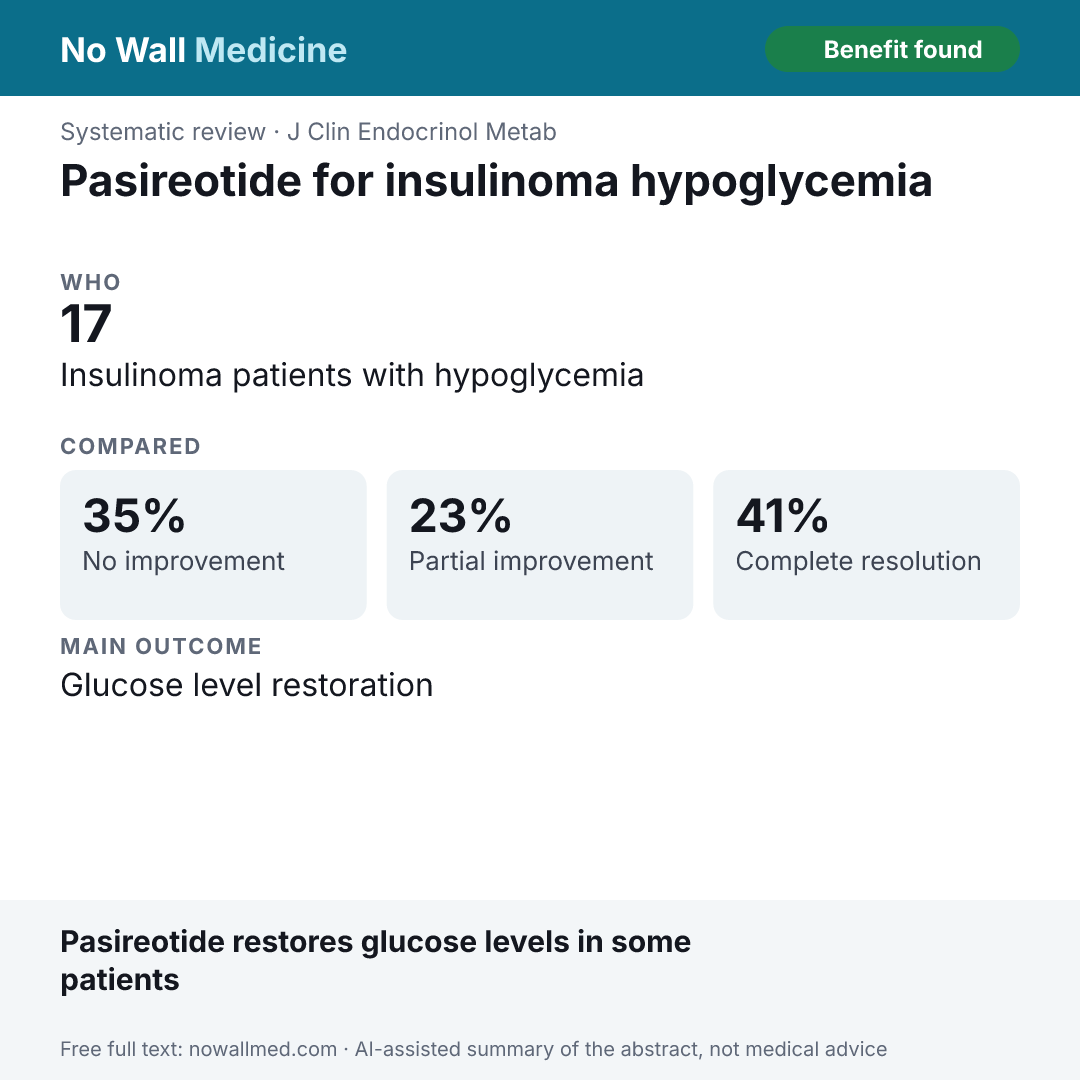
Efficacy and Safety of Pasireotide in Insulinoma-Associated Hypoglycemia
Systematic reviewBenefit found
Pasireotide for insulinoma hypoglycemia
Who
17
Insulinoma patients with hypoglycemia
Compared
35%No improvement
23%Partial improvement
41%Complete resolution
Main outcome
Glucose level restoration
Bottom line: Pasireotide restores glucose levels in some patients
Limitation: Small number of cases
J Clin Endocrinol Metab · 2025-04-01 · Save PNG
Maximizing oral intake tolerance in malignant gastric outlet obstruction - a Markov decision tree analysis comparing duodenal stenting, endoscopic ultrasound-guided gastroenterostomy and surgical gastrojejunostomy based on a meta-analysis of randomized controlled trials
Markov decision model based on meta-analysisMixed results
Which management strategy maximizes oral intake tolerance in malignant gastric outlet obstruction?
Who
patients with malignant gastric outlet obstruction
Compared
duodenal stenting: 81.2% at 1-month and 21.3% at 6-month
endoscopic ultrasound-guided gastroenterostomy: 80.4% at 1-month and 23.8% at 6-month
surgical gastrojejunostomy: 75.5% at 1-month and 25.2% at 6-month
Main outcome
successful oral intake tolerance at 1-6 months post-intervention
Bottom line: Duodenal stenting is best at 1-month, but EUS-GE or surgery is preferred for 6-month oral intake tolerance.
Limitation: scarcity of randomized controlled trials for endoscopic ultrasound-guided gastroenterostomy
Int J Surg · 2025-04-01 · Save PNG

Risk factors of failure to achieve textbook outcome in patients after pancreatoduodenectomy: a systematic review and meta-analysis
Systematic review and meta-analysisMixed results
What are the risk factors for failure to achieve textbook outcome after pancreatoduodenectomy?
Who
5238
Patients undergoing pancreatoduodenectomy
Compared
Preoperative biliary drainage: OR = 2.09 (95%CI 1.30-3.36)
Smaller tumor size: OR = 1.36 (95%CI 1.02-1.81)
Soft pancreatic texture: OR = 2.25 (95%CI 1.01-5.02)
Small pancreatic duct diameter: OR = 2.30 (95%CI 1.62-3.28)
Main outcome
Failure to achieve textbook outcome after pancreatoduodenectomy
Bottom line: Biliary drainage, tumor size, pancreatic texture, duct diameter, and blood loss are risk factors for non-textbook outcome.
Int J Surg · 2025-04-01 · Save PNG

Rectal cancer approach strategies after neoadjuvant treatment - a systematic review and network meta-analysis
Systematic review and network meta-analysisMixed results
What are the long-term outcomes of different rectal cancer approach strategies after neoadjuvant treatment?
Who
2778
Patients with rectal cancer after neoadjuvant chemoradiotherapy
Compared
Total mesorectal excision surgery
Watch-and-wait: OR, 0.20; 95% CI, 0.12-0.35
Local excision: 3.00; 1.60-5.80
Main outcome
2-year local regrowth rate and overall survival
Result: OR, 0.37; 95% CI, 0.09-0.95
Bottom line: Total mesorectal excision reduces 2-year local regrowth, but watch-and-wait and local excision show noninferiority in long-term survival.
Limitation: Low-certainty evidence for 2-year local regrowth rate
Int J Surg · 2025-04-01 · Save PNG