Visual abstracts
New randomized trials and meta-analyses from leading journals at a glance: who was studied, what was compared, and what was found. Every paper is free to read in full.
All specialtiesCardiology 4832Oncology 4114Gastroenterology & Hepatology 1934Infectious Disease 3824Neurology 1899Psychiatry & Mental Health 2256Pulmonology 2082Critical Care 1345Endocrinology & Diabetes 2572Pediatrics 2940Surgery 2525Orthopedics & Sports Medicine 926Neurosurgery 534Cardiothoracic & Vascular Surgery 671Plastic & Reconstructive Surgery 591Nephrology 1124Rheumatology 823Hematology 1104Dermatology 620Ophthalmology 543Obstetrics & Gynecology 1684Public & Global Health 1056Radiology & Imaging 641Anesthesiology 962Urology 754ENT (Otolaryngology) 503Emergency Medicine 489Allergy & Immunology 313Geriatrics 981Family Medicine & Primary Care 541Medical Genetics & Genomics 675Pathology & Laboratory Medicine 157Physical Medicine & Rehabilitation 751Palliative Care 424Nutrition 1580Digital Health & AI 2195General Medicine 321
Do proprioceptive training strategies with dual-task exercises positively influence gait parameters in chronic stroke? A systematic review
Systematic reviewBenefit found
Do proprioceptive training with dual-task exercises improve gait in chronic stroke?
Who
393
People with chronic stroke
Compared
dual-task in proprioceptive training
other stroke rehabilitation
Main outcome
gait parameters
Bottom line: Proprioceptive training strategies with dual-task exercises improved walking abilities in people with chronic stroke.
J Rehabil Med · 2024-08-15Download image

Blood Pressure, Antihypertensive Use, and Late-Life Alzheimer and Non-Alzheimer Dementia Risk: An Individual Participant Data Meta-Analysis
Individual participant data meta-analysisMixed results
Does hypertension or antihypertensive use modify Alzheimer and non-Alzheimer dementia risk?
Who
31250
Community-based longitudinal studies of aging · 14 nations
Compared
36%Untreated hypertension (hazard ratio 1.36, 95% CI 1.01-1.83)
42%Treated hypertension (hazard ratio 1.42, 95% CI 1.08-1.87)
Healthy controls
Main outcome
Risk of developing Alzheimer dementia and non-Alzheimer dementia
Bottom line: Hypertension increases dementia risk, and antihypertensive use is associated with decreased Alzheimer dementia risk but not non-Alzheimer dementia risk.
Neurology · 2024-08-14Download image

Hyperalgesia in Patients With a History of Opioid Use Disorder: A Systematic Review and Meta-Analysis
Systematic review and meta-analysisUnclear result
Is hyperalgesia in patients with opioid use disorder related to opioid use?
Who
Patients with opioid use disorder history and healthy controls
Compared
Patients with opioid use disorder: 2- to 3-seconds lower pain threshold and 29-seconds lower pain tolerance
Healthy controls
Main outcome
Cold pressor test pain threshold, tolerance, and intensity
Bottom line: Patients receiving opioid agonist treatment are hypersensitive to cold pain, but the link to opioid use is unclear.
Limitation: Differences may be overestimated; concerns of bias due to inadequate sample matching and participant dropout.
JAMA Psychiatry · 2024-08-14Download image

Assessing palliative care practices in intensive care units and interpreting them using the lens of appropriate care concepts. An umbrella review
Umbrella reviewUnclear result
Palliative care in intensive care units
Who
Critically ill patients and families
Compared
Palliative care
End-of-life care
Main outcome
Patient and family outcomes
Bottom line: Palliative care improves patient outcomes
Intensive Care Med · 2024-08-14Download image

Exploring the Germline Genetics of In Situ and Invasive Cutaneous Melanoma: A Genome-Wide Association Study Meta-Analysis
Three genome-wide association study meta-analysesMixed results
Do germline genetic factors influence in situ and invasive melanoma risk differently?
Who
Participants from four population-based genetic cohorts · UK Biobank, FinnGen, QSkin, and Q-MEGA cohorts
Compared
6.7%In situ melanoma (95% CI, 4.1-9.3)
4.9%Invasive melanoma (95% CI, 2.8-7.2)
Main outcome
Single-nucleotide variant-based heritability and genetic correlation
Result: genetic r = 0.96; 95% CI, 0.76-1.15
Bottom line: While melanoma subtypes share high genetic correlation, polygenic risk scores suggest genetics may influence progression from in situ to invasive.
JAMA Dermatol · 2024-08-14Download image

Clinical evidence for high-risk CE-marked medical devices for glucose management: A systematic review and meta-analysis
Systematic review and meta-analysisBenefit found
How effective and safe are CE-marked high-risk glucose management devices?
Who
Patients using glucose management devices
Compared
Automated insulin delivery systems: glycated haemoglobin lowered by 0.5 percentage points
Other treatments
Main outcome
glycated haemoglobin and time in target range
Result: absolute mean difference -0.5 for glycated haemoglobin; MD 13.4 for time in target range
Bottom line: Automated insulin delivery systems improve glucose control safely, though evidence on long-term end-organ damage is lacking.
Diabetes Obes Metab · 2024-08-14Download image

Preimplantation genetic testing for aneuploidy in unexplained recurrent pregnancy loss: a systematic review and meta-analysis
Systematic review and meta-analysisBenefit found
Does preimplantation genetic testing for aneuploidy improve outcomes in unexplained recurrent pregnancy loss?
Who
Patients with two or more unexplained recurrent pregnancy losses
Compared
Preimplantation genetic testing for aneuploidy: OR, 2.17 (95% CI, 1.77-2.65) live birth rate per transfer
Without preimplantation genetic testing for aneuploidy
Main outcome
Live birth rate
Result: OR, 2.17 (95% CI, 1.77-2.65)
Bottom line: Preimplantation genetic testing for aneuploidy enhances live birth rates per transfer and per patient in unexplained recurrent pregnancy loss.
Fertil Steril · 2024-08-14Download image

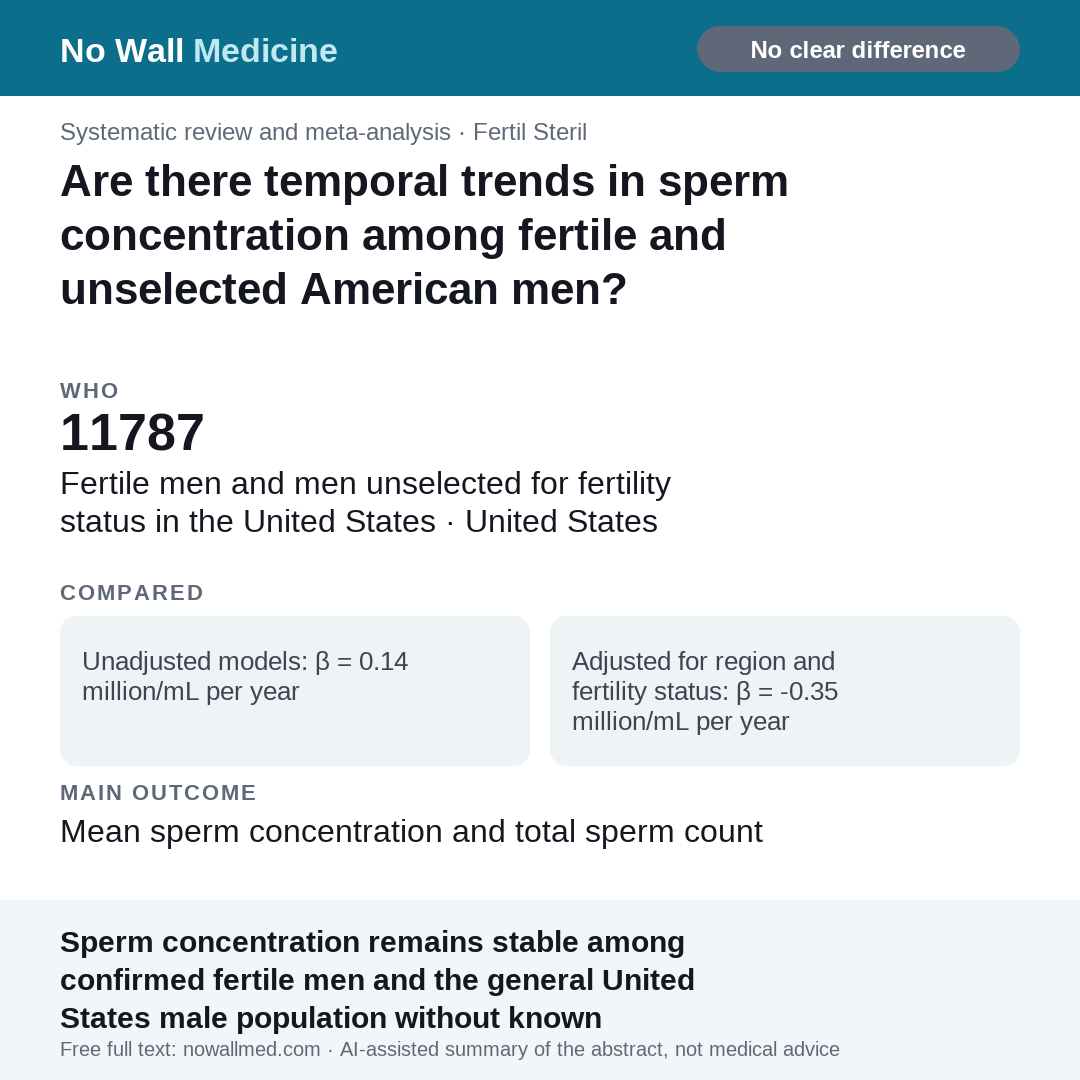
Sperm concentration remains stable among fertile American men: a systematic review and meta-analysis
Systematic review and meta-analysisNo clear difference
Are there temporal trends in sperm concentration among fertile and unselected American men?
Who
11787
Fertile men and men unselected for fertility status in the United States · United States
Compared
Unadjusted models: β = 0.14 million/mL per year
Adjusted for region and fertility status: β = -0.35 million/mL per year
Main outcome
Mean sperm concentration and total sperm count
Bottom line: Sperm concentration remains stable among confirmed fertile men and the general United States male population without known infertility.
Limitation: Further studies are necessary to better understand this important topic.
Fertil Steril · 2024-08-14Download image
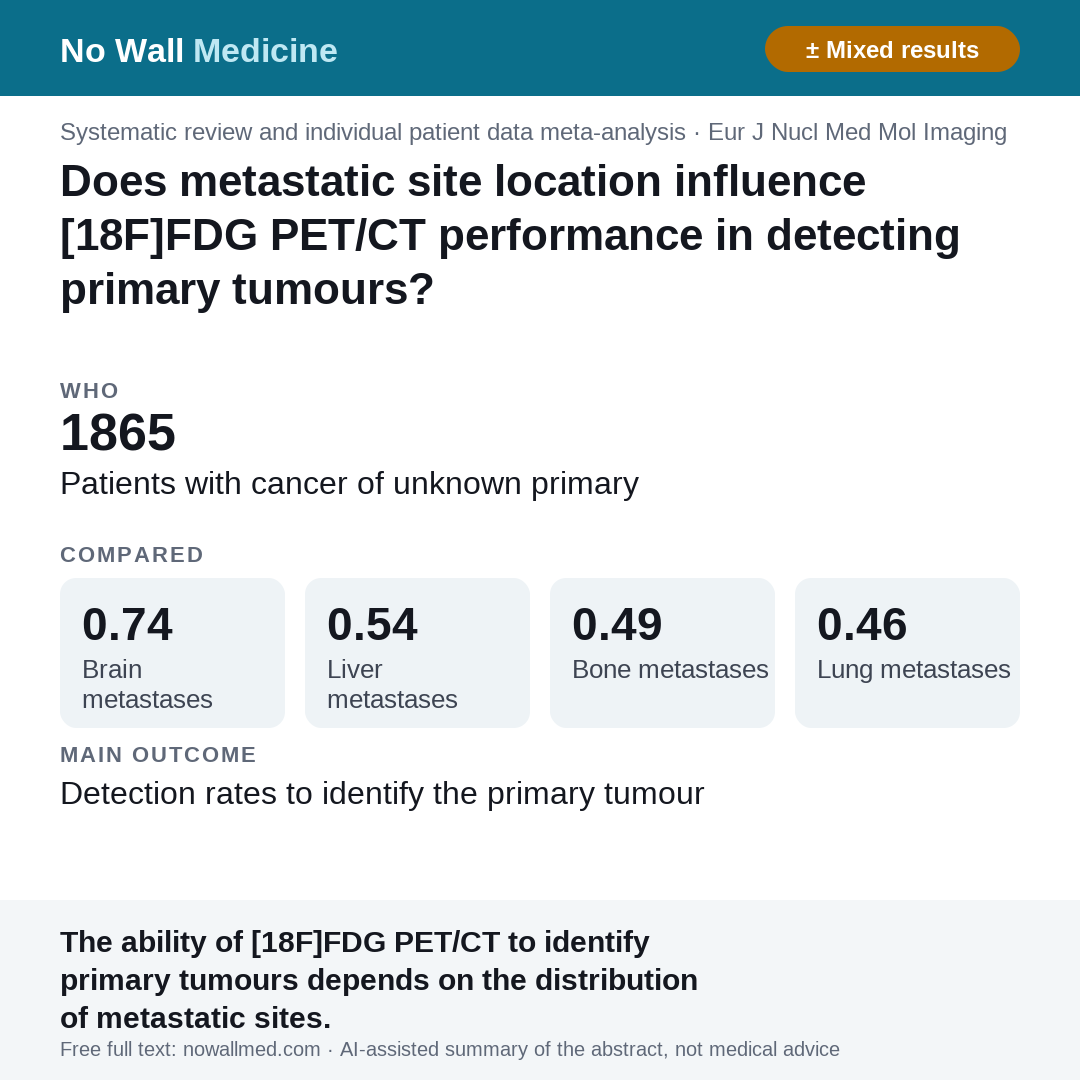
Identifying the primary tumour in patients with cancer of unknown primary (CUP) using [18F]FDG PET/CT: a systematic review and individual patient data meta-analysis
Systematic review and individual patient data meta-analysisMixed results
Does metastatic site location influence [18F]FDG PET/CT performance in detecting primary tumours?
Who
1865
Patients with cancer of unknown primary
Compared
0.74Brain metastases
0.54Liver metastases
0.49Bone metastases
0.46Lung metastases
Main outcome
Detection rates to identify the primary tumour
Bottom line: The ability of [18F]FDG PET/CT to identify primary tumours depends on the distribution of metastatic sites.
Eur J Nucl Med Mol Imaging · 2024-08-14Download image
Impact of Tranexamic Acid on Bleeding Outcomes and Complication Rates in Facelift: A Systematic Review and Meta-analysis
Systematic review and meta-analysisBenefit found
Does tranexamic acid reduce bleeding and complications in facelift surgery?
Who
388
Patients undergoing facelift surgery
Compared
Tranexamic acid recipients: minor hematoma OR 0.18 (95% CI 0.05-0.62)
Controls
Main outcome
hematoma, drain output, and complications
Result: minor hematoma OR 0.18 (95% CI 0.05-0.62); drain output mean difference -25.59 (95% CI -30.4 to -20.77)
Bottom line: Tranexamic acid significantly reduces minor hematomas and postoperative drain output in facelift surgery without increasing major complications.
Limitation: further studies are required to explore efficacy with different dosages and administration routes
Aesthet Surg J · 2024-08-14Download image

Endovascular therapy in acute ischemic stroke with poor reperfusion is associated with worse outcomes compared with best medical management: a HERMES substudy
Patient-level meta-analysis of seven randomized trialsHarm found
Are outcomes worse for endovascular therapy with poor reperfusion compared to medical management?
Who
1764
Patients with acute ischemic stroke and large vessel occlusion
Compared
Endovascular therapy with poor reperfusion: median 4 (IQR 3-6)
Control arm: median 4 (IQR 2-5)
Main outcome
modified Rankin Scale score at 90 days
Result: adjusted common OR 0.59 (95% CI 0.38 to 0.91)
Bottom line: Poor reperfusion after endovascular therapy was associated with worse functional outcomes than best medical management.
J Neurointerv Surg · 2024-08-14Download image

Development and validation of a prognostic model to predict birth weight: individual participant data meta-analysis
Individual participant data meta-analysisBenefit found
Can birth weight be predicted
Who
237228
pregnant women in four cohorts · US, UK, Norway, Australia
Compared
IPPIC model
observed birth weight
Main outcome
birth weight
Result: calibration slope 0.99 (95% CI 0.88 to 1.10)
Bottom line: Model predicts birth weight well
BMJ Med · 2024-08-14Download image

Ultrasound elastography of back muscle biomechanical properties: a systematic review and meta-analysis of current methods
Systematic review and meta-analysisBenefit found
How reliable, valid, and responsive are ultrasound elastography methods for back muscle biomechanics?
Who
3178
Patients with musculoskeletal disorders and controls
Compared
Strain imaging: pICC > 0.70
Shear wave imaging: pICC > 0.70
Vibration sonoelastography
Main outcome
Reliability, validity, and responsiveness of elastography methods
Bottom line: Ultrasound elastography reliably quantifies back muscle biomechanics and moderately discriminates musculoskeletal disorders from control conditions.
Insights Imaging · 2024-08-14Download image

Characterizing Dysphonia After Pediatric Open Airway Reconstruction: Systematic Review and Meta-Analysis
Systematic review and meta-analysisHarm found
What are the voice outcomes in pediatric patients after open airway reconstruction?
Who
497
Pediatric patients who underwent open airway reconstruction
Compared
55.6Consensus Auditory-Perceptual Evaluation of Voice (95% CI: 47.9-63.3)
35.6pediatric Voice Handicap Index (95% CI: 21.4-49.7)
83.7Pediatric Voice-Related Quality of Life Survey (95% CI: 74.1-93.2)
Main outcome
acoustic parameters, perceptual voice quality, and voice-related quality of life
Bottom line: Pediatric patients after open airway reconstruction exhibited moderately decreased voice quality and reduced voice-related quality of life.
Limitation: There was inconsistency in study protocols and outcome measures used.
J Otolaryngol Head Neck Surg · 2024-08-14Download image

Facedown Positioning in Macular Hole Surgery: A Systematic Review and Individual Participant Data Meta-Analysis
Systematic review and individual participant data meta-analysisMixed results
Does facedown positioning improve macular hole closure and visual acuity?
Who
379
Adults with idiopathic full-thickness macular holes undergoing vitrectomy
Compared
Facedown positioning: adjusted odds ratio 2.41 (95% CI 0.98-5.93)
No facedown positioning
Main outcome
primary macular hole closure and postoperative visual acuity
Result: adjusted odds ratio 2.41 (95% CI 0.98-5.93)
Bottom line: Facedown positioning modestly improves anatomic and visual outcomes, especially for macular holes exceeding 400 micrometers.
Ophthalmology · 2024-08-13Download image

Effectiveness of nonpharmacological conservative therapies for chronic pelvic pain in women: a systematic review and meta-analysis
Systematic review and meta-analysis of 38 randomized controlled trialsBenefit found
Are nonpharmacological conservative therapies effective for women with chronic pelvic pain?
Who
2168
Women with chronic pelvic pain
Compared
Multimodal physical therapy: lower pain intensity
Inert or nonconservative treatments
Predominantly psychological approaches: no difference in pain intensity
Main outcome
pain intensity, sexual function, and other clinical measures
Result: standardized mean difference -1.69 (95% CI -2.54, -0.85) for multimodal physical therapy
Bottom line: Multimodal physical therapy is effective for reducing pain intensity in women with chronic pelvic pain.
Limitation: A limited number of trials investigated individual tissue-based monotherapies.
AJOG · 2024-08-13Download image

Virulence and resistance factors of Nakaseomyces glabratus (formerly known as Candida glabrata) in Europe: A systematic review
Systematic reviewMixed results
What is the distribution and drug resistance of Nakaseomyces glabratus in Europe?
Who
15,400
Nakaseomyces glabratus isolates in Europe · Europe
Compared
Azole resistance: voriconazole (n=2225, 14.45%), fluconazole (n=1612, 10.47%), itraconazole (n=337, 2.19%) and clotrimazole (n=89, 0.58%)
Echinocandin resistance: anidulafungin (n=138, 0.89%)
Amphotericin B sensitivity: high sensitivity
Main outcome
Antifungal susceptibility and resistance of Nakaseomyces glabratus isolates
Bottom line: Triazole-resistant Nakaseomyces glabratus cases are increasing in Europe, making echinocandins and amphotericin B potential empirical treatments.
J Eur Acad Dermatol Venereol · 2024-08-13Download image

Evaluation of glucose-lowering medications in older people: a comprehensive systematic review and network meta-analysis of randomized controlled trials
Network meta-analysis of randomized controlled trialsBenefit found
What are the advantages and drawbacks of different glucose-lowering medications in older adults?
Who
41654
Adults aged 65 years or older with type 2 diabetes mellitus
Compared
Glucagon-like peptide-1 receptor agonists: major adverse cardiovascular events risk ratio 0.83 (95% CI 0.71 to 0.97)
Sulfonylureas: any hypoglycaemia risk ratio 4.19 (95% CI 3.52 to 4.99)
Main outcome
Patient-centered outcomes including cardiovascular events, weight, and hypoglycemia
Result: GLP-1RAs major adverse cardiovascular events risk ratio 0.83 (95% CI 0.71 to 0.97)
Bottom line: Novel glucose-lowering medications like GLP-1 receptor agonists and SGLT2 inhibitors provide significant benefits for older patients with diabetes.
Age Ageing · 2024-08-13Download image

Social inequity in ageing in place among older adults in Organisation for Economic Cooperation and Development countries: a mixed studies systematic review
Mixed studies systematic reviewMixed results
What are the social inequities in ageing in place among older adults?
Who
Adults aged 65 and older in Organisation for Economic Co-operation and Development countries · Organisation for Economic Co-operation and Development countries
Compared
Rural residents, minorities, immigrants, high socioeconomic position: more likely to age in place
Women and those with higher educational attainment: less likely to age in place
Main outcome
Social inequity in ageing in place
Bottom line: Social dimensions and intersectional effects influence the ability of older adults to age in place.
Age Ageing · 2024-08-13Download image

Effectiveness of music therapy, aromatherapy, and massage therapy on patients in palliative care with end-of-life needs: A systematic review
Systematic reviewBenefit found
Are music, aromatherapy, and massage therapy effective for palliative care patients?
Who
Patients in palliative and hospice care
Compared
Music therapy
Aromatherapy
Massage therapy
Main outcome
Pain, anxiety, well-being and quality of life
Bottom line: Music and massage therapy showed potential short-term benefits for pain and quality of life.
Limitation: Future studies may require more qualitative or mixed methods for comprehensive evaluation.
J Pain Symptom Manage · 2024-08-13Download image