Visual abstracts
New randomized trials and meta-analyses from leading journals at a glance: who was studied, what was compared, and what was found. Every paper is free to read in full.
All specialtiesCardiology 417Oncology 339Gastroenterology & Hepatology 171Infectious Disease 336Neurology 192Psychiatry & Mental Health 289Pulmonology 191Critical Care 134Endocrinology & Diabetes 261Pediatrics 202Surgery 147Orthopedics & Sports Medicine 90Neurosurgery 27Cardiothoracic & Vascular Surgery 50Plastic & Reconstructive Surgery 82Nephrology 82Rheumatology 85Hematology 103Dermatology 43Ophthalmology 72Obstetrics & Gynecology 131Public & Global Health 133Radiology & Imaging 41Anesthesiology 77Urology 99ENT (Otolaryngology) 53Emergency Medicine 43Allergy & Immunology 50Geriatrics 124Family Medicine & Primary Care 75Medical Genetics & Genomics 41Pathology & Laboratory Medicine 6Physical Medicine & Rehabilitation 112Palliative Care 63Nutrition 146Digital Health & AI 369General Medicine 51
The Impact of Digitalization on European General Practice From the Perspective of General Practitioners: Systematic Review
Systematic reviewMixed results
How do European general practitioners perceive the adoption and implementation of digital health technologies?
Who
24,994
General practitioners in European primary care · 14 European countries
Compared
Perceived usefulness: 86.2% positive
Perceived ease of use: 0% positive
96.9%Actual use
Main outcome
General practitioners' perspectives on digital health technology adoption and implementation
Bottom line: General practitioners extensively use digital tools despite high perceived usefulness, poor usability, and significant implementation barriers.
J Med Internet Res · 2026-08-18Download image

Mixed Delivery Mode Reminder Strategy to Tackle Low Participation in an e-Cohort: Randomized Controlled Trial Nested Within the Le French Gut e-Cohort
4-arm parallel randomized controlled trialBenefit found
Which reminder strategy best increases the response rate in a population-based e-cohort?
Who
20487
healthy adults enrolled online but not yet active participants · online SKEZIA platform
Compared
7.4%standard emails only
8.4%text messages only
8.3%institutional emails only
9.4%standard email, text message, and institutional email
Main outcome
30-day completion rate of the personal information questionnaire
Bottom line: A mixed delivery mode strategy of email and text messages effectively increases response rates in large e-cohorts.
J Med Internet Res · 2026-08-18Download image

Suture Tape Augmentation in Anterior Cruciate Ligament Reconstruction: A Meta-Analysis of Prospective and Matched Retrospective Studies
Meta-analysis of prospective and matched retrospective studiesNo clear difference
Does suture tape augmentation provide clinical benefits in anterior cruciate ligament reconstruction?
Who
Patients undergoing anterior cruciate ligament reconstruction
Compared
Suture tape augmentation
Control group
Main outcome
Arthrofibrosis, graft failure, return to sports, and functional outcomes
Bottom line: Suture tape augmentation did not provide additional clinical benefits in patients undergoing anterior cruciate ligament reconstruction.
JBJS Open Access · 2026-08-18Download image

A Locally Executed Agentic Artificial Intelligence Framework for Deduplication, Screening, and Structured Data Extraction in Spine Surgery Systematic Reviews: A PRISMA-Transparent Reporting of Artificial Intelligence in Comprehensive Evidence Synthesis-Compliant Evaluation
Validation study with human-in-the-loop validationBenefit found
Can a locally executed agentic artificial intelligence framework automate systematic review tasks?
Who
6214
6,214 records across 3 spine surgery systematic reviews
Compared
Agentic artificial intelligence framework: 91.1% (90.8%-91.4%) time reduction
Human reviewers
Main outcome
Accuracy, inter-rater agreement, time savings, and clinically critical error rates
Bottom line: The artificial intelligence framework significantly reduces reviewer time by 91.1% with high accuracy and minimal critical errors.
JBJS Open Access · 2026-08-18Download image

Effectiveness of a scalable, remotely delivered stepped-care intervention for psychological distress among Polish migrant workers in the Netherlands: The RESPOND randomised controlled trial
Parallel-group, two-arm, superiority randomised controlled trialBenefit found
Is a remotely delivered stepped-care intervention effective for psychological distress among Polish migrant workers?
Who
218
Polish-speaking migrant workers aged 18 years or older with elevated psychological distress · The Netherlands
Compared
14.8Stepped-care intervention
21.3Care-as-usual
Main outcome
Composite measure of anxiety and depression
Result: -6.52 (95% CI [-8.73, -4.31])
Bottom line: A remotely delivered stepped-care intervention significantly reduced anxiety and depression symptoms among Polish migrant workers in the Netherlands.
Limitation: Limited generalisability due to participant demographics and short follow-up period.
PLOS Med · 2026-08-17Download image

Vegetable-First Meal Sequence Suppresses Postprandial Glycaemic Excursions and Variability in Young Women With High-Risk Phenotype for Early-Onset Type 2 Diabetes: A 4-Arm Randomized Crossover Trial With Continuous Glucose Monitoring
Randomized crossover trialBenefit found
Does a vegetable-first meal sequence suppress postprandial glycaemic excursions in young women?
Who
33
Healthy Korean women with high-risk phenotype for early-onset type 2 diabetes
Compared
vegetables-protein-carbohydrates meal sequence: reduced glucose incremental area under the curve and mean glucose
carbohydrates-protein-vegetables meal sequence
all together without sequence
no meal intake time limit
Main outcome
postprandial glycaemic profiles and variability
Bottom line: A vegetable-first meal sequence improves postprandial glycaemic control and reduces glycaemic variability in young women.
Diabetes Obes Metab · 2026-08-17Download image

Body Composition Remodelling During GLP-1-Based Therapy: A Systematic Review and Meta-Analysis Using a Hierarchical Physiological Framework
Systematic review and meta-analysisUnclear result
How does glucagon-like peptide-1 based therapy affect body composition remodelling?
Who
Adults receiving glucagon-like peptide-1 receptor agonists or dual incretin therapies
Compared
Glucagon-like peptide-1 based therapy
Control
Main outcome
Adiposity, muscle quantity, muscle quality, and body weight
Bottom line: Limited evidence suggests possible greater adiposity reduction, but definitive conclusions regarding fat loss or muscle preservation cannot be made.
Limitation: Limited number of comparative studies, substantial heterogeneity, and low certainty of evidence.
Diabetes Obes Metab · 2026-08-17Download image

Retatrutide-Associated Improvements in Cardiovascular Risk Biomarkers in Adults With Obesity With or Without Type 2 Diabetes
Two randomized, double-blind, placebo-controlled phase 2 trialsBenefit found
How does retatrutide affect cardiometabolic, lipoprotein, and inflammatory biomarkers in adults with obesity?
Who
Adults with obesity or overweight with or without type 2 diabetes
Compared
Retatrutide: non-high-density lipoprotein cholesterol reduction up to -26.9%
Placebo
Main outcome
Cardiometabolic, lipoprotein, and inflammatory biomarkers
Bottom line: Retatrutide treatment was associated with reductions in atherogenic lipoproteins and inflammatory biomarkers linked to cardiovascular disease risk.
Diabetes Obes Metab · 2026-08-17Download image

Oleanolic Acid-Enriched Olive Oil Attenuates Kidney Function Decline in Patients With Type 2 Diabetes: Results From the OLTRAD Randomised Controlled Trial
Randomised controlled trialBenefit found
Does oleanolic acid-enriched olive oil attenuate kidney function decline in type 2 diabetes?
Who
97
Patients with type 2 diabetes mellitus
Compared
Oleanolic acid-enriched olive oil: attenuated estimated glomerular filtration rate decline
Control olive oil: rise in urinary albumin-to-creatinine ratio
Main outcome
estimated glomerular filtration rate and urinary albumin-to-creatinine ratio
Bottom line: Oleanolic acid-enriched olive oil attenuated kidney function decline in patients with mildly impaired baseline kidney function.
Limitation: The trial was powered for glycemic control rather than renal outcomes.
Diabetes Obes Metab · 2026-08-17Download image

Bimekizumab efficacy in male and female patients with axial spondyloarthritis: 52-week results from the phase 3 BE MOBILE trials
Post hoc analysis of two phase 3 trialsMixed results
Are there sex-based differences in response to bimekizumab in axial spondyloarthritis patients?
Who
Patients with non-radiographic and radiographic axial spondyloarthritis
Compared
Male patients: earlier clinical responses
Female patients: longer-term improvements
Main outcome
Disease activity, function, pain, fatigue, quality of life, and inflammation
Bottom line: Male patients had earlier clinical responses, while female patients demonstrated longer-term improvements in composite and patient-reported outcomes.
Rheumatology · 2026-08-17Download image

Genome-Wide Association Study of Corneal Dystrophy Uncovers Novel Risk Loci and Enables Improved Polygenic Prediction of Fuchs Endothelial Corneal Dystrophy
Meta-analysis and genome-wide association studyBenefit found
What are the risk loci for corneal dystrophy and improved polygenic prediction for Fuchs endothelial corneal dystrophy?
Who
Europeans with corneal dystrophy and African ancestry participants · UK Biobank, All of Us, FinnGen, and Million Veteran Program
Compared
Optimized polygenic risk score: AUC = 0.83 (95% confidence interval, 0.82-0.84)
Short tandem repeat expansion: AUC = 0.89 (odds ratio = 54)
Main outcome
Identification of risk loci and polygenic prediction performance
Result: odds ratio = 54
Bottom line: Integrating short tandem repeat expansion with polygenic risk scores improves prediction of Fuchs endothelial corneal dystrophy risk.
Invest Ophthalmol Vis Sci · 2026-08-17Download image

Impact of propofol-based vs. volatile-based anaesthesia on survival and recurrence after cancer surgery: a systematic review and meta-analysis of randomised trials
Systematic review and meta-analysis of randomised trialsNo clear difference
Does propofol-based versus volatile-based anaesthesia affect survival and recurrence after cancer surgery?
Who
Adult patients undergoing curative cancer surgery
Compared
Propofol-based anaesthesia
Volatile-based anaesthesia
Main outcome
Overall survival, recurrence-free survival, mortality, and recurrence
Result: hazard ratio 1.05 (95%CI 0.94-1.17)
Bottom line: Propofol-based and volatile-based anaesthesia yield similar long-term oncological outcomes regarding survival and recurrence.
Anaesthesia · 2026-08-17Download image

Sigh ventilation versus conventional protective ventilation in cardiac surgery: a proof-of-concept randomized controlled trial
Randomized, assessor-blinded, phase 2 trialBenefit found
Does adding sigh breaths to protective ventilation improve postoperative oxygenation in cardiac surgery?
Who
192
Patients undergoing elective on-pump cardiac surgery
Compared
Sigh ventilation: 380 ± 86
Conventional ventilation: 338 ³93
Main outcome
Time-weighted average SpO2/FiO2 ratio during the first postextubation hour
Result: mean difference 42.1, 95% CI [16.7 to 67.5]
Bottom line: Adding sigh breaths to protective ventilation improved postoperative oxygenation and reduced respiratory failure severity in cardiac surgery patients.
Crit Care · 2026-08-17Download image

Neuroprotection in the early window: a randomized controlled trial of butylphthalide initiation within 3 hours in acute ischemic stroke
Randomized, open-label trial with blinded endpoint assessmentNo clear difference
Does initiating butylphthalide within 3 hours versus 3-6 hours improve outcomes in acute ischemic stroke?
Who
204
Acute ischemic stroke patients with NIHSS score 4-25 · 19 stroke centers in China
Compared
67.3%Early butylphthalide (< 3 h)
58.0%Late butylphthalide (3-6 h)
Main outcome
Favorable functional outcomes at 90 days
Result: risk ratio 1.16 (95% CI 0.94-1.44)
Bottom line: Initiating butylphthalide within 3 hours did not significantly improve favorable functional outcomes compared to 3-6 hours.
Limitation: This finding warrants further verification through larger-scale clinical trials.
BMC Med · 2026-08-15Download image

First-line immune checkpoint inhibitors versus chemotherapy in delaying quality of life deterioration in advanced NSCLC: a systematic review and meta-analysis
Systematic review and meta-analysis of 15 randomized trialsBenefit found
Do immune checkpoint inhibitors delay quality of life deterioration versus chemotherapy in advanced non-small-cell lung cancer?
Who
7127
Patients with advanced non-small-cell lung cancer
Compared
Immune checkpoint inhibitor-based therapies
Chemotherapy
Main outcome
Time to deterioration of global quality of life
Result: hazard ratio 0.75 (95% CI 0.69-0.81)
Bottom line: Immune checkpoint inhibitor-based therapies, especially immunochemotherapy, delay health-related quality of life deterioration compared to chemotherapy.
BMC Med · 2026-08-14Download image

Effect of a 6-month low-carbohydrate diet on the circulating fatty acid composition in patients with type 2 diabetes: a secondary analysis of an open-label randomized controlled trial
Open-label, randomized, controlled trialBenefit found
Does a 6-month low-carbohydrate diet improve circulating fatty acid composition in type 2 diabetes?
Who
71
Adults with type 2 diabetes
Compared
Low-carbohydrate diet: reduced total saturated fatty acids [-0.6 (CI: -0.9, -0.2)]
Control diet
Main outcome
Change in serum phospholipid fatty acids in weight percentage
Bottom line: A 6-month low-carbohydrate diet modified fatty acid composition toward a potentially favorable cardioprotective profile in type 2 diabetes.
Am J Clin Nutr · 2026-08-14Download image

Effect of a PROtein-enriched MEDiterranean diet and EXercise (PROMED-EX) on nutritional status and cognitive performance in older adults at risk of undernutrition and cognitive decline: the PROMED-EX randomized controlled trial
Randomized controlled trialBenefit found
Does a protein-enriched Mediterranean diet with or without exercise improve nutritional status and cognition?
Who
105
Community-dwelling older adults at risk of undernutrition and cognitive decline
Compared
PROMED-EX (diet plus exercise): mean difference in MNA 2.9 (95% CI: 1.5, 4.3)
PROMED (diet only): mean difference in MNA 2.7 [95% confidence interval (CI): 1.3, 4.2]
CON (healthy eating leaflet)
Main outcome
change in nutritional status measured by Mini Nutritional Assessment
Bottom line: A protein-enriched Mediterranean diet improved nutritional status and cognitive function in older adults at risk.
Limitation: low adherence to exercise
Am J Clin Nutr · 2026-08-14Download image

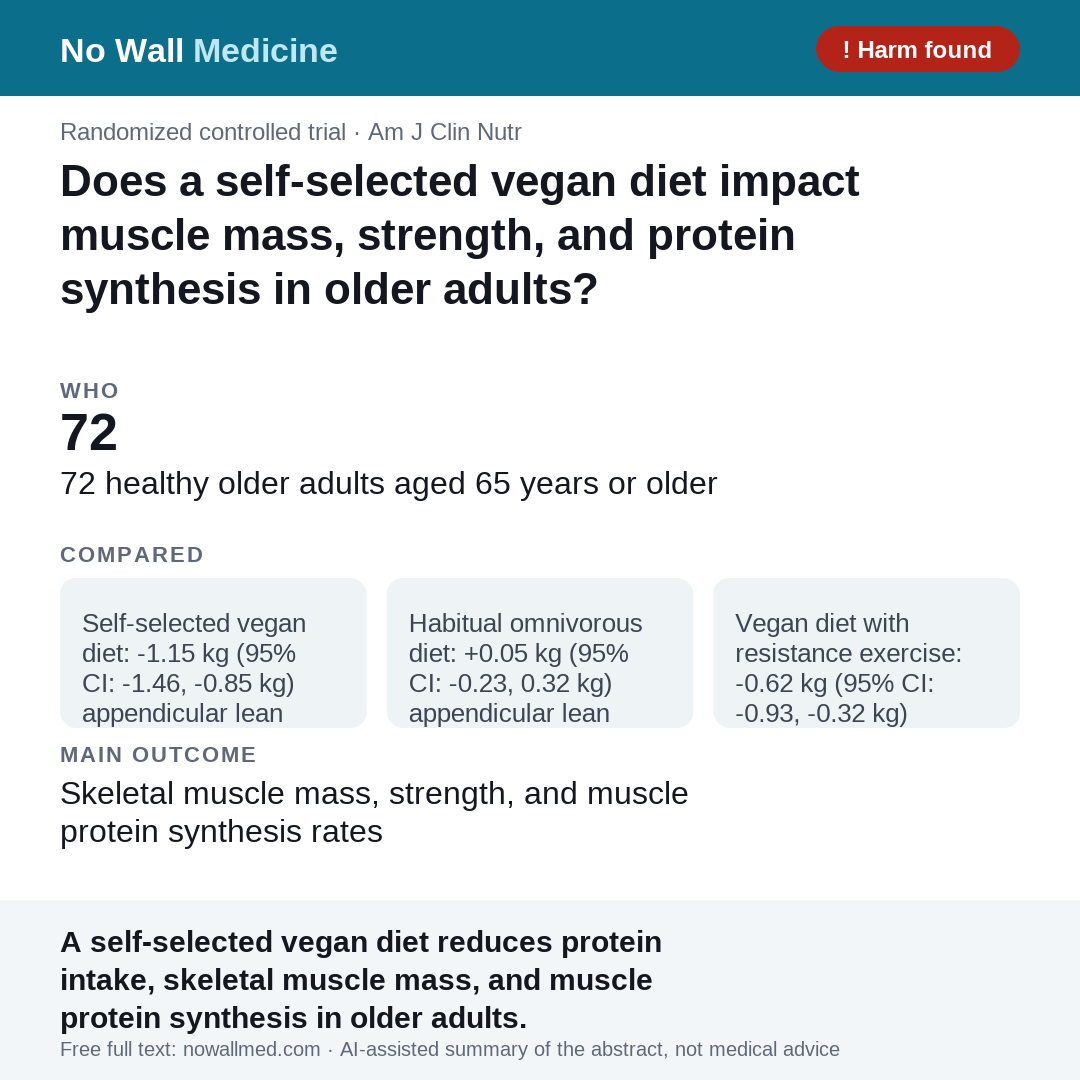
A self-selected vegan diet reduces skeletal muscle mass in healthy older adults: a randomized controlled trial
Randomized controlled trialHarm found
Does a self-selected vegan diet impact muscle mass, strength, and protein synthesis in older adults?
Who
72
72 healthy older adults aged 65 years or older
Compared
Self-selected vegan diet: -1.15 kg (95% CI: -1.46, -0.85 kg) appendicular lean mass
Habitual omnivorous diet: +0.05 kg (95% CI: -0.23, 0.32 kg) appendicular lean mass
Vegan diet with resistance exercise: -0.62 kg (95% CI: -0.93, -0.32 kg) appendicular lean mass
Main outcome
Skeletal muscle mass, strength, and muscle protein synthesis rates
Bottom line: A self-selected vegan diet reduces protein intake, skeletal muscle mass, and muscle protein synthesis in older adults.
Am J Clin Nutr · 2026-08-14Download image
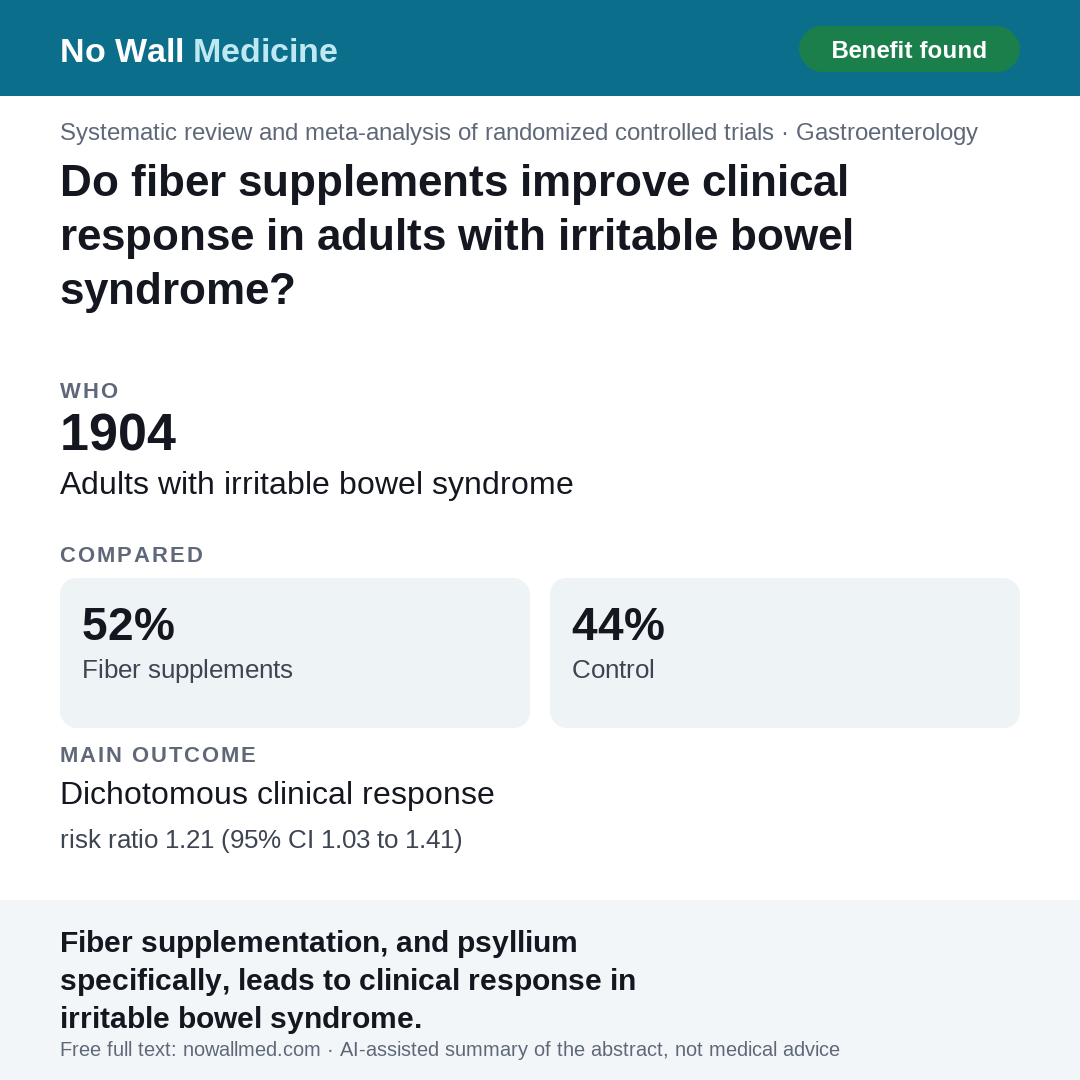
Fiber Supplementation in Irritable Bowel Syndrome: A Systematic Review and Meta-Analysis of Randomized Controlled Trials
Systematic review and meta-analysis of randomized controlled trialsBenefit found
Do fiber supplements improve clinical response in adults with irritable bowel syndrome?
Who
1904
Adults with irritable bowel syndrome
Compared
52%Fiber supplements
44%Control
Main outcome
Dichotomous clinical response
Result: risk ratio 1.21 (95% CI 1.03 to 1.41)
Bottom line: Fiber supplementation, and psyllium specifically, leads to clinical response in irritable bowel syndrome.
Limitation: Subgroup analysis for irritable bowel syndrome subtype was not possible for most outcomes.
Gastroenterology · 2026-08-14Download image
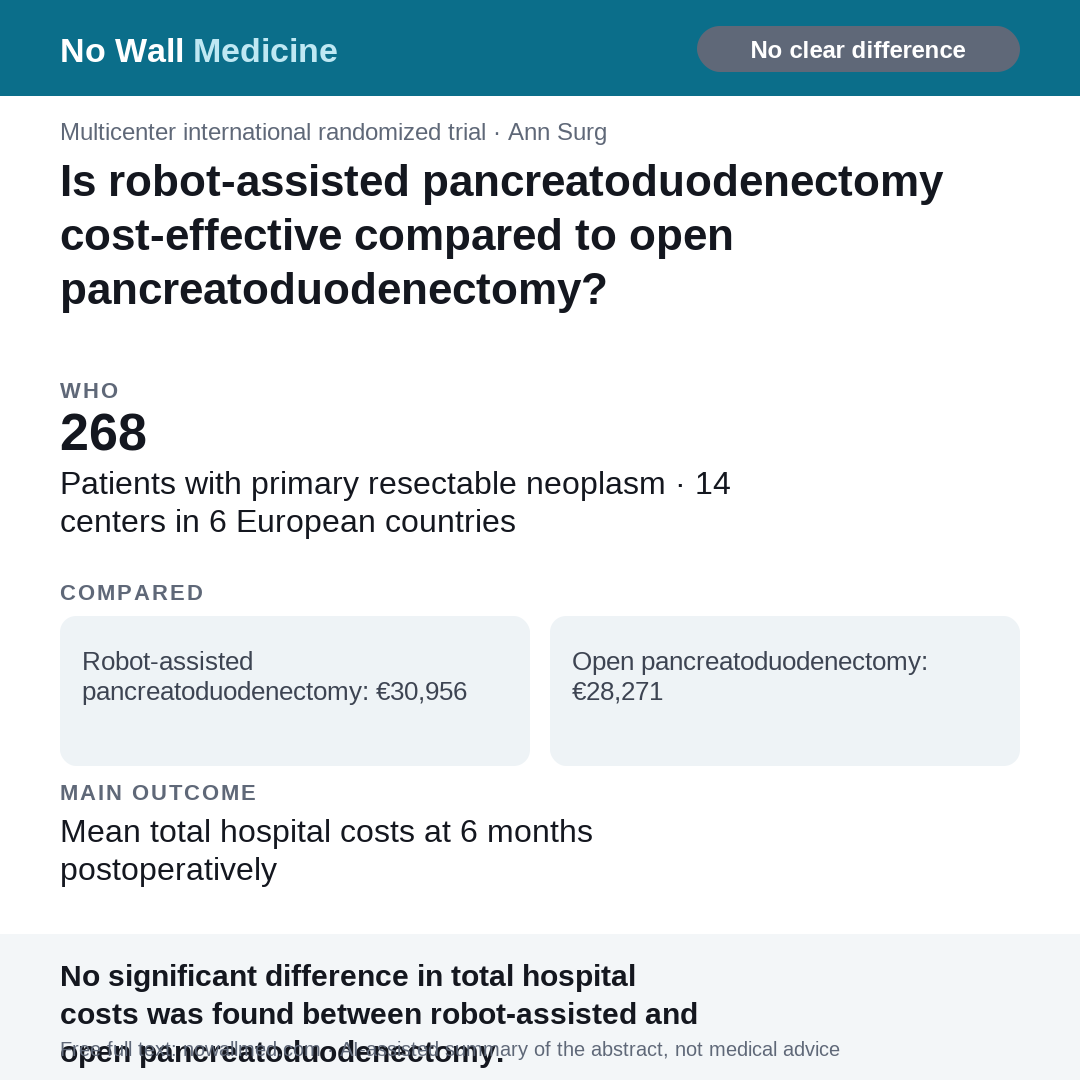
Cost-effectiveness Analysis of Robotic Versus Open Pancreatoduodenectomy (DIPLOMA-2): A Multicenter International Randomized Trial
Multicenter international randomized trialNo clear difference
Is robot-assisted pancreatoduodenectomy cost-effective compared to open pancreatoduodenectomy?
Who
268
Patients with primary resectable neoplasm · 14 centers in 6 European countries
Compared
Robot-assisted pancreatoduodenectomy: €30,956
Open pancreatoduodenectomy: €28,271
Main outcome
Mean total hospital costs and cost-effectiveness
Result: less than 30% probability of being cost-effective
Bottom line: No significant difference in total hospital costs was found between robot-assisted and open pancreatoduodenectomy up to 6 months.
Ann Surg · 2026-08-14Download image