Visual abstracts
New randomized trials and meta-analyses from leading journals at a glance: who was studied, what was compared, and what was found. Every paper is free to read in full.
All specialtiesCardiology 4763Oncology 4042Gastroenterology & Hepatology 1902Infectious Disease 3756Neurology 1872Psychiatry & Mental Health 2214Pulmonology 2042Critical Care 1319Endocrinology & Diabetes 2544Pediatrics 2889Surgery 2479Orthopedics & Sports Medicine 917Neurosurgery 525Cardiothoracic & Vascular Surgery 656Plastic & Reconstructive Surgery 574Nephrology 1107Rheumatology 810Hematology 1090Dermatology 611Ophthalmology 532Obstetrics & Gynecology 1645Public & Global Health 1037Radiology & Imaging 617Anesthesiology 957Urology 745ENT (Otolaryngology) 494Emergency Medicine 481Allergy & Immunology 309Geriatrics 972Family Medicine & Primary Care 533Medical Genetics & Genomics 659Pathology & Laboratory Medicine 156Physical Medicine & Rehabilitation 734Palliative Care 421Nutrition 1560Digital Health & AI 2133General Medicine 318
Facilitators and Barriers to Implementing AI in Routine Medical Imaging: Systematic Review and Qualitative Analysis
Systematic reviewUnclear result
What facilitates AI in medical imaging
Who
medical imaging studies
Compared
Facilitators
Barriers
Main outcome
AI implementation success
Bottom line: AI implementation has various facilitators and barriers
Limitation: most studies lacked comprehensive reporting
J Med Internet Res · 2025-07-21Download image

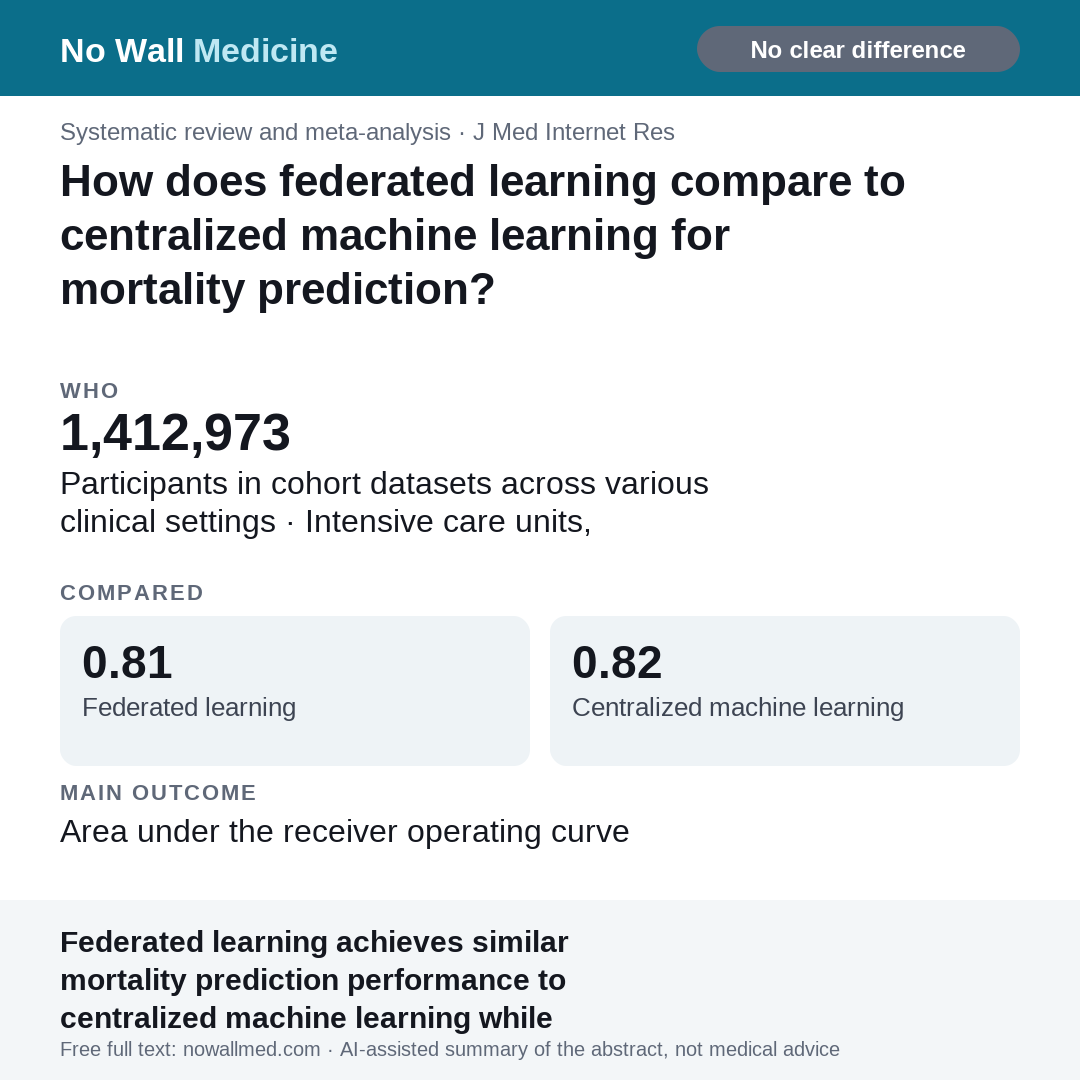
Federated Learning-Based Model for Predicting Mortality: Systematic Review and Meta-Analysis
Systematic review and meta-analysisNo clear difference
How does federated learning compare to centralized machine learning for mortality prediction?
Who
1,412,973
Participants in cohort datasets across various clinical settings · Intensive care units, emergency departments, and trauma centers
Compared
0.81Federated learning (95% CI 0.76-0.85)
0.82Centralized machine learning (95% CI 0.77-0.86)
Main outcome
Area under the receiver operating curve
Result: no difference
Bottom line: Federated learning achieves similar mortality prediction performance to centralized machine learning while addressing privacy risks.
Limitation: Small number of studies and moderate proportion of high risk of bias.
J Med Internet Res · 2025-07-21Download image
Pathogenesis of peritoneal high-grade serous carcinoma after risk-reducing surgery: a systematic review
Systematic reviewMixed results
What are the pathogenic pathways of peritoneal high-grade serous carcinoma after risk-reducing surgery?
Who
Germline BRCA1/2 pathogenic variant carriers
Compared
Tubal origin
Endometrial origin
Ovarian origin
Main outcome
Pathophysiological mechanisms of peritoneal high-grade serous carcinoma
Bottom line: Evidence suggests peritoneal high-grade serous carcinoma may originate from fallopian tube precursor cells or the endometrium.
J Pathol Clin Res · 2025-07-20Download image

Comparative safety and efficacy of oncolytic virotherapy for the treatment of individuals with malignancies: a systematic review, meta-analysis, and Bayesian network meta-analysis
Systematic review, meta-analysis, and Bayesian network meta-analysisBenefit found
What are the safety and efficacy of oncolytic virotherapy in cancer patients?
Who
6979
Individuals with malignancies
Compared
Oncolytic virus monotherapy: DCR 2.45 (95% CI 1.60-3.76)
Oncolytic virus plus chemotherapy: DCR 8.53 (95% CI 1.97-37.03)
Oncolytic virus plus immunotherapy: DCR 0.08 (95% CrI 0.02-0.33)
Main outcome
Adverse events and disease control rate
Result: DCR 0.08 (95% CrI 0.02-0.33) for oncolytic virus plus immunotherapy vs oncolytic virus plus chemotherapy
Bottom line: Oncolytic virotherapy shows potential efficacy, with combination with immunotherapy offering a more favorable safety and efficacy profile.
eClinicalMedicine · 2025-07-19Download image

Novel Therapeutic Strategies for Metastatic Prostate Cancer Care
Narrative and qualitative synthesisUnclear result
What are the novel therapeutic strategies for metastatic prostate cancer care?
Who
Patients with metastatic prostate cancer
Compared
Targeted therapies
Immune checkpoint inhibitors
177Lu-PSMA-617
Main outcome
Disease outcomes and therapeutic strategies
Bottom line: Targeted therapies, immune checkpoint inhibitors, and radiopharmaceuticals are emerging for specific molecular subtypes of metastatic prostate cancer.
Limitation: This is a narrative and qualitative synthesis based on a systematic search.
Eur Urol · 2025-07-19Download image

Establishing the Adequate Levothyroxine Dose After Total Thyroidectomy: A Systematic Review With Meta-analysis
Systematic review and meta-analysisNo clear difference
What is the most effective levothyroxine dosing strategy to achieve early euthyroidism?
Who
2577
Patients after total thyroidectomy
Compared
29%Weight-based dosing
40%Fixed or algorithm-based dosing
Main outcome
Proportion of patients achieving euthyroidism at first follow-up
Result: 33.9%
Bottom line: Only about one-third of patients achieve euthyroidism at first follow-up regardless of the levothyroxine dosing strategy used.
J Clin Endocrinol Metab · 2025-07-19Download image

Meta-analysis identifies the major impact of patient classification on the ACPA association with rheumatoid arthritis-associated interstitial lung disease (RA-ILD)
Meta-analysis and meta-regressionBenefit found
What factors account for the variability of anti-citrullinated protein antibodies association with rheumatoid arthritis-associated interstitial lung disease?
Who
31
Patients with rheumatoid arthritis and interstitial lung disease
Compared
Studies using chest computed tomography: OR 3.05 [95%CI: 2.12-4.38]
Studies employing multifactorial criteria: 1.55 [95%CI: 1.18-2.03]
Main outcome
Association of anti-citrullinated protein antibodies with rheumatoid arthritis-associated interstitial lung disease
Result: OR 3.05 [95%CI: 2.12-4.38] vs 1.55 [95%CI: 1.18-2.03]
Bottom line: Chest computed tomography classification shows a stronger association between anti-citrullinated protein antibodies and rheumatoid arthritis-associated interstitial lung disease.
Limitation: One outlier study recruited cases and controls in different place and time contexts.
Arthritis Res Ther · 2025-07-19Download image

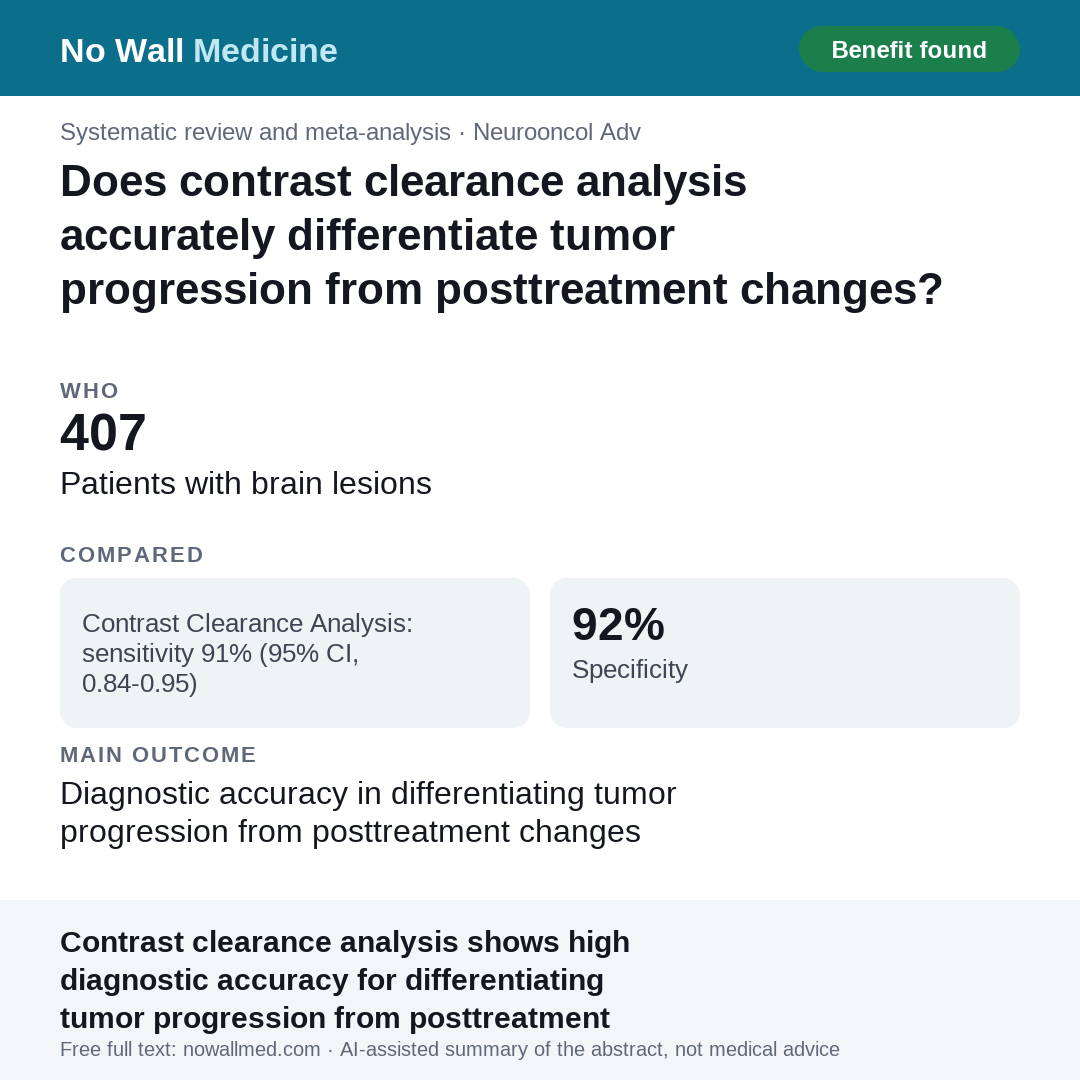
Contrast clearance analysis in neuro-oncology: A systematic review and meta-analysis on differentiating posttreatment changes from tumor progression
Systematic review and meta-analysisKey finding
Does contrast clearance analysis accurately differentiate tumor progression from posttreatment changes?
Who
407
Patients with brain lesions
Compared
Contrast Clearance Analysis: sensitivity 91% (95% CI, 0.84-0.95)
92%Specificity (95% CI, 0.87-0.95)
Main outcome
Diagnostic accuracy in differentiating tumor progression from posttreatment changes
Result: AUC 88%
Bottom line: Contrast clearance analysis shows high diagnostic accuracy for differentiating tumor progression from posttreatment changes.
Limitation: Considerable risk of bias in the reference test domain and variability in reference standards.
Neurooncol Adv · 2025-07-19Download image
Artificial intelligence in microsurgery and supermicrosurgery training within plastic surgery: A systematic review
Systematic reviewBenefit found
What are the applications and future of artificial intelligence in microsurgery and supermicrosurgery training?
Who
Microsurgery and supermicrosurgery plastic surgery training
Compared
Automated skill classification: above 95 % accuracy
Eye tracking parameters
Instrument and hand tracking
Main outcome
Applications of artificial intelligence in microsurgery and supermicrosurgery training
Bottom line: Artificial intelligence models tracking motion and eye parameters enable objective, real-time monitoring of microsurgical proficiency and workload.
Limitation: All studies reported moderate risk of bias.
JPRAS Open · 2025-07-19Download image

A meta-analysis of changes in gut microbiota structure following bariatric surgery
Systematic review and meta-analysisBenefit found
How does bariatric surgery change gut microbiota composition?
Who
Patients undergoing bariatric surgery
Compared
Pre-surgery
Post-surgery: alpha diversity significantly increased
Main outcome
gut microbiota alpha diversity
Result: Chao index: SMD 0.50 (95% CI 0.01-0.99); Shannon index: SMD 0.37 (95% CI 0.04-0.70)
Bottom line: Bariatric surgery significantly increases gut microbiota alpha diversity, though taxonomic findings show high heterogeneity.
Limitation: high heterogeneity in taxonomic findings
Int J Surg · 2025-07-18Download image

Biomarkers of in vivo platelet activation in coronary artery disease: a systematic review and meta-analysis: communication from the SSC of the ISTH
Systematic review and meta-analysisBenefit found
Are soluble platelet-activation markers associated with coronary artery disease?
Who
Patients with coronary artery disease and healthy subjects
Compared
Coronary artery disease
Healthy subjects
Main outcome
Levels of 14 soluble platelet-activation markers
Bottom line: Most studied platelet-activation markers were significantly elevated in patients with coronary artery disease compared to healthy subjects.
Limitation: Heterogeneity in the assessed studies and identified publication bias for certain markers.
J Thromb Haemost · 2025-07-18Download image

Effectiveness of Exercise-Based Interventions on Depressive Symptoms in Older Adults: A Systematic Review and Network Meta-Analysis
Systematic review and network meta-analysisBenefit found
How effective are exercise-based interventions for improving depressive symptoms in older adults?
Who
5536
Older adults
Compared
Exercises: SMD -0.69 (95% CI 0.90 to -0.48)
Waitlist controls
Active controls: SMD -0.42 (95% CI 0.48 to -0.36)
Main outcome
depressive symptoms
Result: SMD -0.69 (95% CI 0.90 to -0.48)
Bottom line: Exercise-based interventions effectively improve depressive symptoms in older adults, with neuromotor exercise showing the highest likelihood of effectiveness.
Limitation: Higher attrition rates, limited number of studies, and loop inconsistency.
J Am Med Dir Assoc · 2025-07-18Download image

Incidence of Human Metapneumovirus Among Older Adults in 10 High-Income Countries: A Systematic Literature Review, Meta-analysis, and Modeling Study
Meta-analysis and modeling studyBenefit found
What is the incidence of human metapneumovirus lower respiratory infection among older adults?
Who
Adults aged 60 years or older · 10 high-income countries
Compared
7.0%Meta-analyzed percentage of lower respiratory infection cases (95% CI, 5.4%-9.1%)
185.7Italy incidence rate per 100 000 (95% uncertainty interval, 134.7-251.1)
462.1United States incidence rate per 100 000 (333.1-628.2)
Main outcome
Incidence of lower respiratory infection associated with human metapneumovirus
Bottom line: Human metapneumovirus causes a significant burden of lower respiratory infection in older adults across high-income countries.
Open Forum Infect Dis · 2025-07-18Download image

Comparing the Performance of Machine Learning Models and Conventional Risk Scores for Predicting Major Adverse Cardiovascular Cerebrovascular Events After Percutaneous Coronary Intervention in Patients With Acute Myocardial Infarction: Systematic Review and Meta-Analysis
Systematic review and meta-analysisKey finding
Do machine learning models outperform conventional risk scores for predicting major adverse cardiovascular cerebrovascular events?
Who
89,702
Patients with acute myocardial infarction who underwent percutaneous coronary intervention
Compared
Machine learning models: area under the receiver operating characteristic curve: 0.88 (95% CI 0.86-0.90)
Conventional risk scores: area under the receiver operating characteristic curve: 0.79 (95% CI 0.75-0.84)
Main outcome
major adverse cardiovascular and cerebrovascular events
Result: area under the receiver operating characteristic curve: 0.88 (95% CI 0.86-0.90) vs 0.79 (95% CI 0.75-0.84)
Bottom line: Machine learning models showed superior discriminatory performance compared to conventional risk scores for predicting events after percutaneous coronary intervention.
Limitation: High heterogeneity across studies and need for multicenter prospective studies with external validation.
J Med Internet Res · 2025-07-18Download image

Performance of Machine Learning in Diagnosing KRAS (Kirsten Rat Sarcoma) Mutations in Colorectal Cancer: Systematic Review and Meta-Analysis
Systematic review and meta-analysisKey finding
What is the performance of machine learning in diagnosing KRAS mutations in colorectal cancer?
Who
10888
Patients with colorectal cancer
Compared
CT radiomic features: c-index 0.87 (95% CI 0.84-0.90)
MRI radiomic features: c-index 0.77 (95% CI 0.71-0.83)
PET/CT radiomic features: c-index 0.84 (95% CI 0.77-0.90)
Pathological image deep learning: c-index 0.96 (95% CI 0.94-0.98)
Main outcome
Concordance index, sensitivity, and specificity for KRAS mutation diagnosis
Bottom line: Machine learning is highly accurate for KRAS mutation diagnosis, especially deep learning models using pathological images and magnetic resonance imaging.
Limitation: Clinical application of deep learning models remains relatively limited at present.
J Med Internet Res · 2025-07-18Download image

Timing of intravenous iron for treatment of anaemia in surgical patients: a systematic review and network meta-analysis
Systematic review and network meta-analysisMixed results
Is preoperative or postoperative intravenous iron better for anaemia in surgical patients?
Who
3026
Surgical patients with anaemia
Compared
Postoperative intravenous iron: RR 0.80 (95% CI 0.68-0.94) for transfusion rates
Preoperative intravenous iron: RR 0.91 (95% CI 0.72-1.15) for transfusion rates
Main outcome
Blood transfusion rates and haemoglobin levels
Result: RR 0.80 (95% CI 0.68-0.94) for postoperative transfusion reduction
Bottom line: Postoperative intravenous iron reduces transfusion rates, while preoperative supplementation improves haemoglobin recovery at postoperative day 30.
Limitation: Heterogeneity among studies, limited subgroup analyses, and no direct comparisons between approaches.
Funded by: National Key Research and Development Program of China and others
eClinicalMedicine · 2025-07-17Download image

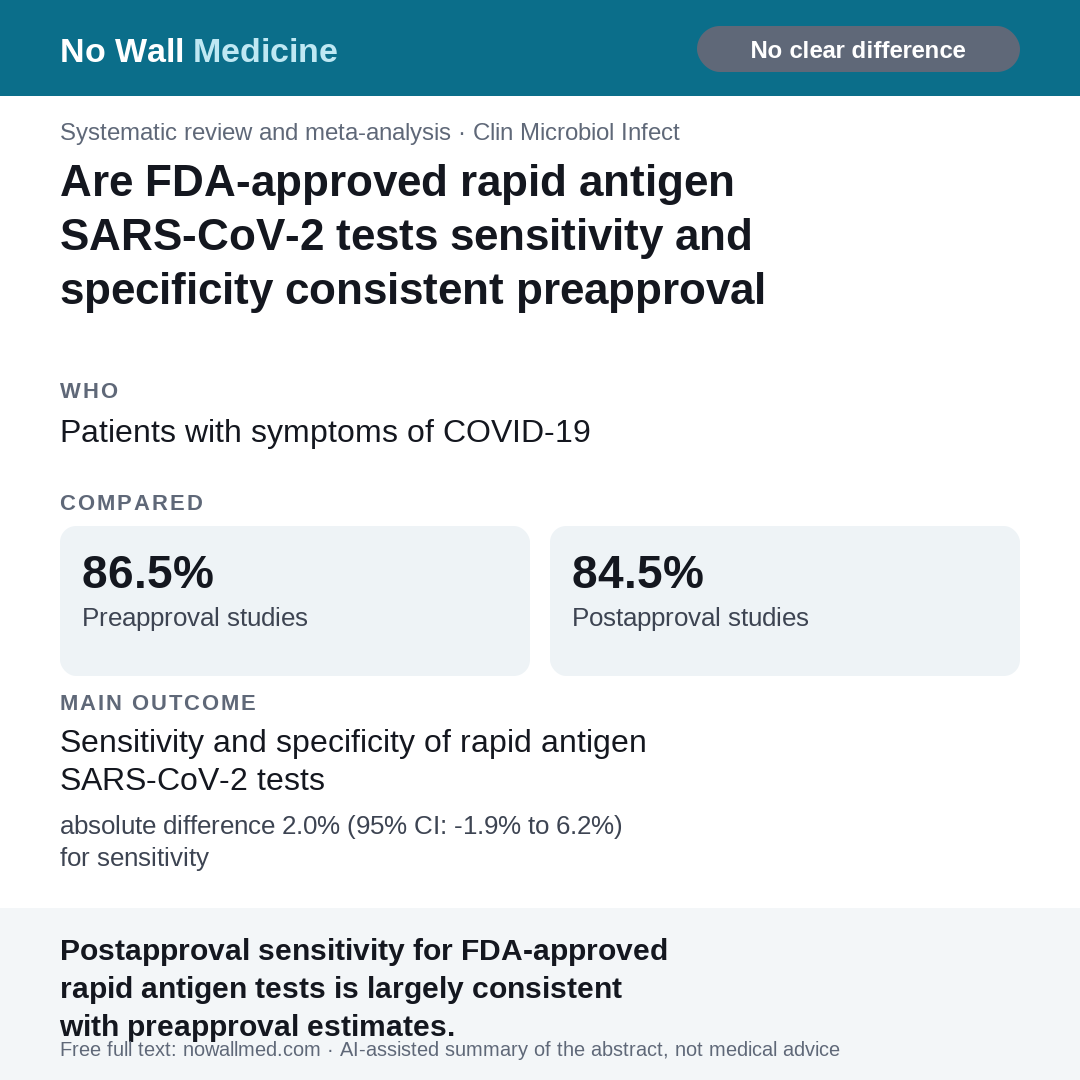
Preapproval and postapproval diagnostic test accuracy of food and drug administration-authorized rapid antigen SARS-CoV-2 tests used according to instruction: a systematic review and meta-analysis
Systematic review and meta-analysisNo clear difference
Are FDA-approved rapid antigen SARS-CoV-2 tests sensitivity and specificity consistent preapproval versus postapproval?
Who
Patients with symptoms of COVID-19
Compared
86.5%Preapproval studies (95% CI: 83.3-89.1%)
84.5%Postapproval studies (95% CI: 81.2-87.3%)
Main outcome
Sensitivity and specificity of rapid antigen SARS-CoV-2 tests
Result: absolute difference 2.0% (95% CI: -1.9% to 6.2%) for sensitivity
Bottom line: Postapproval sensitivity for FDA-approved rapid antigen tests is largely consistent with preapproval estimates.
Limitation: 79% of FDA-approved rapid antigen tests lacked postapproval studies.
Clin Microbiol Infect · 2025-07-17Download image
Gene expression signatures of response to fluoxetine treatment: systematic review and meta-analyses
Systematic review and meta-analysesMixed results
What are the gene expression signatures of response to fluoxetine treatment?
Who
Humans and rodent models with depression or anxiety · Gene Expression Omnibus
Compared
Responders vs non-responders: 18 pathways identified as consistently different
Fluoxetine treatment vs control: Signal transduction pathways consistently affected
Main outcome
Gene expression signatures and biological pathways
Bottom line: Fluoxetine affects signal transduction pathways, and eighteen pathways consistently distinguish responders from non-responders.
Limitation: Most studies involved rodent models and patient studies had small cohorts.
Mol Psychiatry · 2025-07-17Download image

ctDNA to Predict Treatment Response in Head and Neck Squamous Cell Carcinoma: A Systematic Review
Systematic reviewKey finding
Can plasma circulating tumor DNA predict treatment response in head and neck squamous cell carcinoma?
Who
Patients with HPV-positive and HPV-negative head and neck squamous cell carcinoma
Compared
ctDNA monitoring: 91.7% negative predictive value for residual and recurrent disease
Persistently positive ctDNA: corresponded with poorer outcomes overall
Main outcome
prediction of residual and recurrent disease
Bottom line: Circulating tumor DNA monitoring shows high negative predictive value for residual and recurrent disease in head and neck cancer.
Limitation: Suboptimal study quality, short follow-up, and modest cohort sizes.
Laryngoscope · 2025-07-17Download image

Biostimulants in Aesthetic Medicine: A Systematic Review and Meta-analysis of Efficacy, Safety, and Patient Satisfaction
Meta-analysis of 25 studiesKey finding
Do biostimulants work in aesthetic medicine
Who
patients in aesthetic medicine
Compared
91%biostimulants (95% CI, 67%-98%)
control
Main outcome
satisfaction rate
Result: pooled satisfaction rate 91% (95% CI, 67%-98%)
Bottom line: Biostimulants show clinical promise and favorable tolerability
Limitation: common occurrence of minor adverse events
Aesthet Surg J · 2025-07-17Download image