Visual abstracts
New randomized trials and meta-analyses from leading journals at a glance: who was studied, what was compared, and what was found. Every paper is free to read in full.
All specialtiesCardiology 4877Oncology 4136Gastroenterology & Hepatology 1942Infectious Disease 3836Neurology 1904Psychiatry & Mental Health 2273Pulmonology 2143Critical Care 1364Endocrinology & Diabetes 2580Pediatrics 2980Surgery 2556Orthopedics & Sports Medicine 931Neurosurgery 537Cardiothoracic & Vascular Surgery 674Plastic & Reconstructive Surgery 591Nephrology 1133Rheumatology 823Hematology 1109Dermatology 621Ophthalmology 543Obstetrics & Gynecology 1686Public & Global Health 1058Radiology & Imaging 648Anesthesiology 986Urology 764ENT (Otolaryngology) 503Emergency Medicine 511Allergy & Immunology 313Geriatrics 979Family Medicine & Primary Care 562Medical Genetics & Genomics 676Pathology & Laboratory Medicine 159Physical Medicine & Rehabilitation 757Palliative Care 444Nutrition 1588Digital Health & AI 2197General Medicine 320
Phase 1/2 AAV5-hRKp.RPGR (Botaretigene Sparoparvovec) Gene Therapy: Safety and Efficacy in RPGR-Associated X-Linked Retinitis Pigmentosa
Open-label, phase 1/2 dose escalation/expansion studyBenefit found
Is AAV5-hRKp.RPGR gene therapy safe and effective for X-linked retinitis pigmentosa?
Who
52
Males aged 5 years or older with RPGR-associated X-linked retinitis pigmentosa
Compared
Immediate treatment
Deferred treatment
Main outcome
Safety and efficacy including retinal sensitivity and functional vision
Bottom line: AAV5-hRKp.RPGR gene therapy was safe and improved retinal sensitivity and functional vision.
Am J Ophthalmol · 2024-06-12Download image

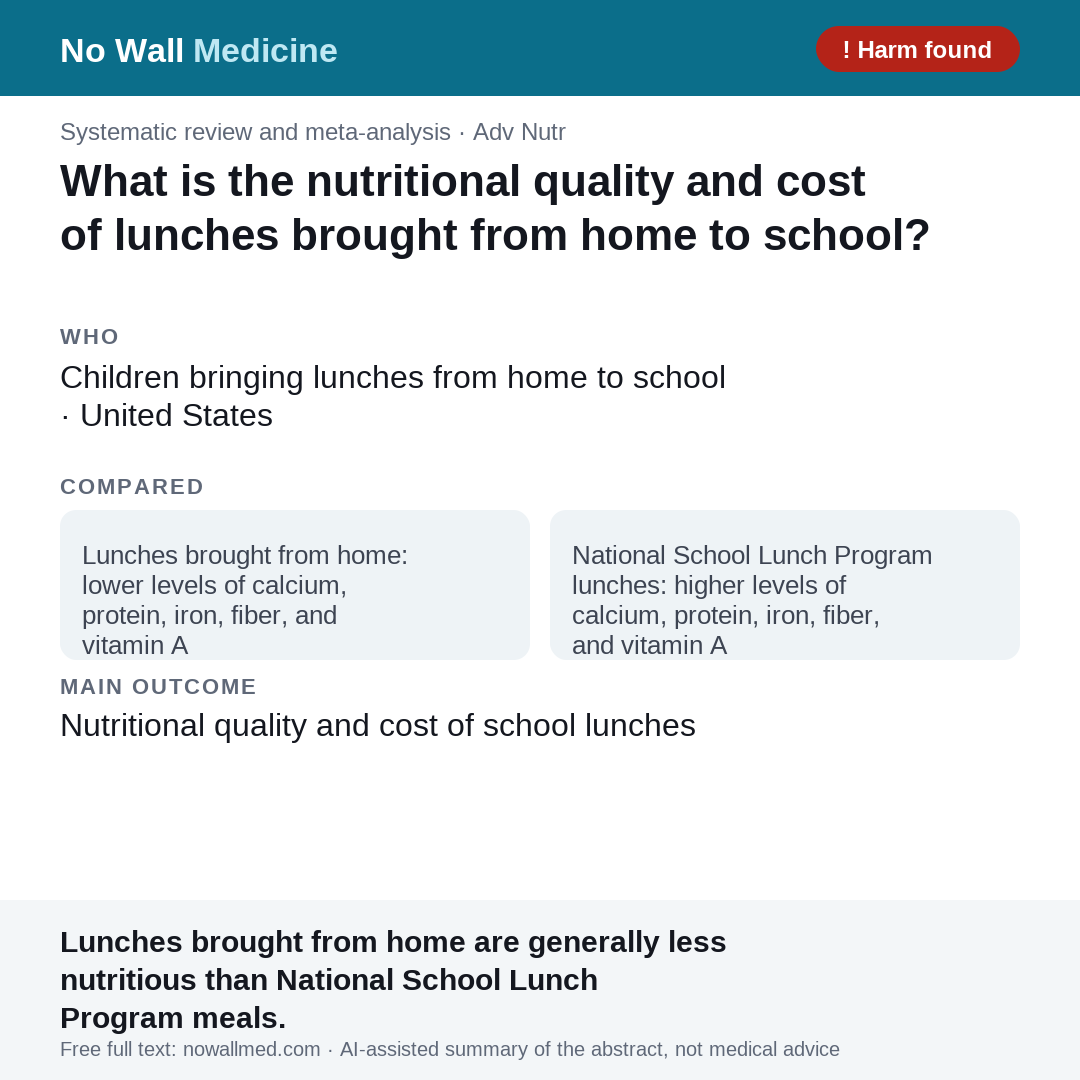
The Quality of Lunches Brought from Home to School: A Systematic Review and Meta-Analysis
Systematic review and meta-analysisHarm found
What is the nutritional quality and cost of lunches brought from home to school?
Who
Children bringing lunches from home to school · United States
Compared
Lunches brought from home: lower levels of calcium, protein, iron, fiber, and vitamin A
National School Lunch Program lunches: higher levels of calcium, protein, iron, fiber, and vitamin A
Main outcome
Nutritional quality and cost of school lunches
Bottom line: Lunches brought from home are generally less nutritious than National School Lunch Program meals.
Adv Nutr · 2024-06-12Download image
Link between gut microbiota dysbiosis and childhood asthma: Insights from a systematic review
Systematic reviewMixed results
Is there an association between gut microbiota composition and childhood asthma development?
Who
Infants and children
Compared
Higher alpha diversity (Bifidobacterium, Faecalibacterium, Roseburia): protective effects
Lower relative abundances (Bacteroides and Malassezia): associated with asthma
Main outcome
Development of atopic wheeze and asthma
Bottom line: Gut microbiota composition during infancy and childhood is associated with the subsequent development of asthma.
JACI Glob · 2024-06-12Download image

Newborn heart rate monitoring methods at birth and clinical outcomes: A systematic review
Systematic reviewUnclear result
Do different heart rate assessment methods at birth affect newborn clinical outcomes?
Who
Newborns in the delivery room
Compared
Electrocardiogram
Auscultation plus pulse oximetry
Main outcome
Newborn clinical outcomes
Bottom line: There is insufficient evidence to determine if electrocardiogram versus pulse oximetry plus auscultation benefits newborns.
Limitation: Only two randomized controlled trials and one nonrandomized study were included.
Resusc Plus · 2024-06-12Download image

Genetics of child aggression, a systematic review
Systematic reviewUnclear result
Genetics of child aggression
Who
children with aggression
Compared
candidate genes
genome-wide association
Main outcome
aggression
Bottom line: Genetic underpinnings of aggression unclear
Transl Psychiatry · 2024-06-11Download image

Immunogenicity, reactogenicity, and IgE-mediated immune responses of a mixed whole-cell and acellular pertussis vaccine schedule in Australian infants: A randomised, double-blind, noninferiority trial
Bayesian, 2-stage, double-blind, randomised trialBenefit found
Is a mixed whole-cell and acellular pertussis vaccine schedule noninferior to acellular-only?
Who
150
Infants in Australia · Australia
Compared
Mixed whole-cell and acellular schedule: GMR = 0·98
Acellular-only schedule
Main outcome
Pertussis toxin IgG responses
Result: GMR = 0·98, 95% credible interval (0·77 to 1·26)
Bottom line: A mixed pertussis vaccine schedule is noninferior to acellular-only schedules for pertussis toxin IgG responses.
PLOS Med · 2024-06-10Download image

Expanding community case management of malaria to all ages can improve universal access to malaria diagnosis and treatment: results from a cluster randomized trial in Madagascar
Cluster randomized trialBenefit found
Does expanding malaria community case management to all ages improve access to diagnosis and treatment?
Who
Households in Farafangana District, Madagascar · Rural Madagascar
Compared
mCCM for all ages
mCCM for children under 5 years only
Main outcome
Access to malaria diagnosis and treatment
Result: rate ratio for rapid diagnostic tests in 6-13-year-olds 1.65 (95% CIs 1.45-1.87)
Bottom line: Expanding malaria community case management to all ages improves access to diagnosis and treatment, especially for those living further from health centers.
BMC Med · 2024-06-10Download image

Acetaminophen and Ibuprofen in Pediatric Central Nervous System Malaria: A Randomized Clinical Trial
Randomized clinical trialBenefit found
Does aggressive antipyretic therapy compare to usual care in pediatric central nervous system malaria?
Who
256
Children aged 2 to 11 years with central nervous system malaria · Hospitals in Zambia and Malawi
Compared
Aggressive antipyretic therapy: 38.6 °C
Usual care: 39.2 °C
Main outcome
Maximum temperature over 72 hours
Result: difference, -0.62 °C (95% CI, -0.82 to -0.42)
Bottom line: Aggressive antipyretic therapy reduced maximum temperature and improved acute seizure outcomes in children with central nervous system malaria.
JAMA Neurol · 2024-06-10Download image

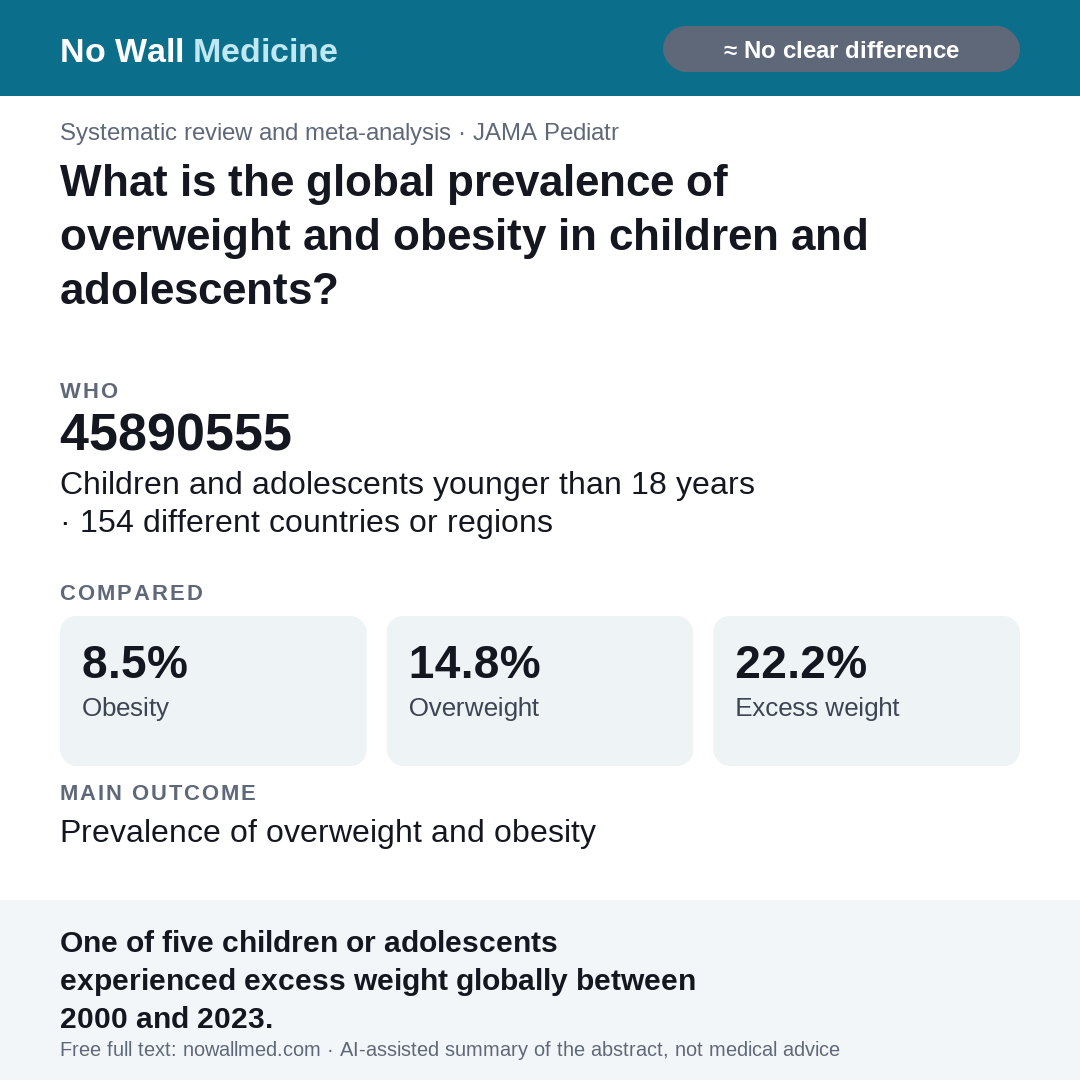
Global Prevalence of Overweight and Obesity in Children and Adolescents: A Systematic Review and Meta-Analysis
Systematic review and meta-analysisNo clear difference
What is the global prevalence of overweight and obesity in children and adolescents?
Who
45890555
Children and adolescents younger than 18 years · 154 different countries or regions
Compared
8.5%Obesity (95% CI 8.2-8.8)
14.8%Overweight (95% CI 14.5-15.1)
22.2%Excess weight (95% CI 21.6-22.8)
Main outcome
Prevalence of overweight and obesity
Bottom line: One of five children or adolescents experienced excess weight globally between 2000 and 2023.
JAMA Pediatr · 2024-06-10Download image
Association of EEG characteristics with outcomes following pediatric ICU cardiac arrest: A secondary analysis of the ICU-RESUScitation trial
Secondary analysis of a multicenter randomized interventional trialBenefit found
Do EEG characteristics predict neurologic outcomes after pediatric in-hospital cardiac arrest?
Who
151
Patients with in-hospital cardiac arrest achieving return of circulation · 18 pediatric and pediatric cardiac intensive care units in the United States
Compared
Model with EEG Background Category: AUROC 0.84 (CI 0.77-0.92)
Model without EEG Background Category: AUROC 0.76 (CI 0.67-0.85)
Main outcome
Survival to hospital discharge with favorable neurologic outcome
Result: AUROC 0.84 (CI 0.77-0.92) vs AUROC 0.76 (CI 0.67-0.85)
Bottom line: Adding EEG background category to clinical models improves prediction of favorable neurologic outcomes after pediatric cardiac arrest.
Limitation: This is a secondary analysis of a cohort with evaluable EEG monitoring.
Resuscitation · 2024-06-10Download image

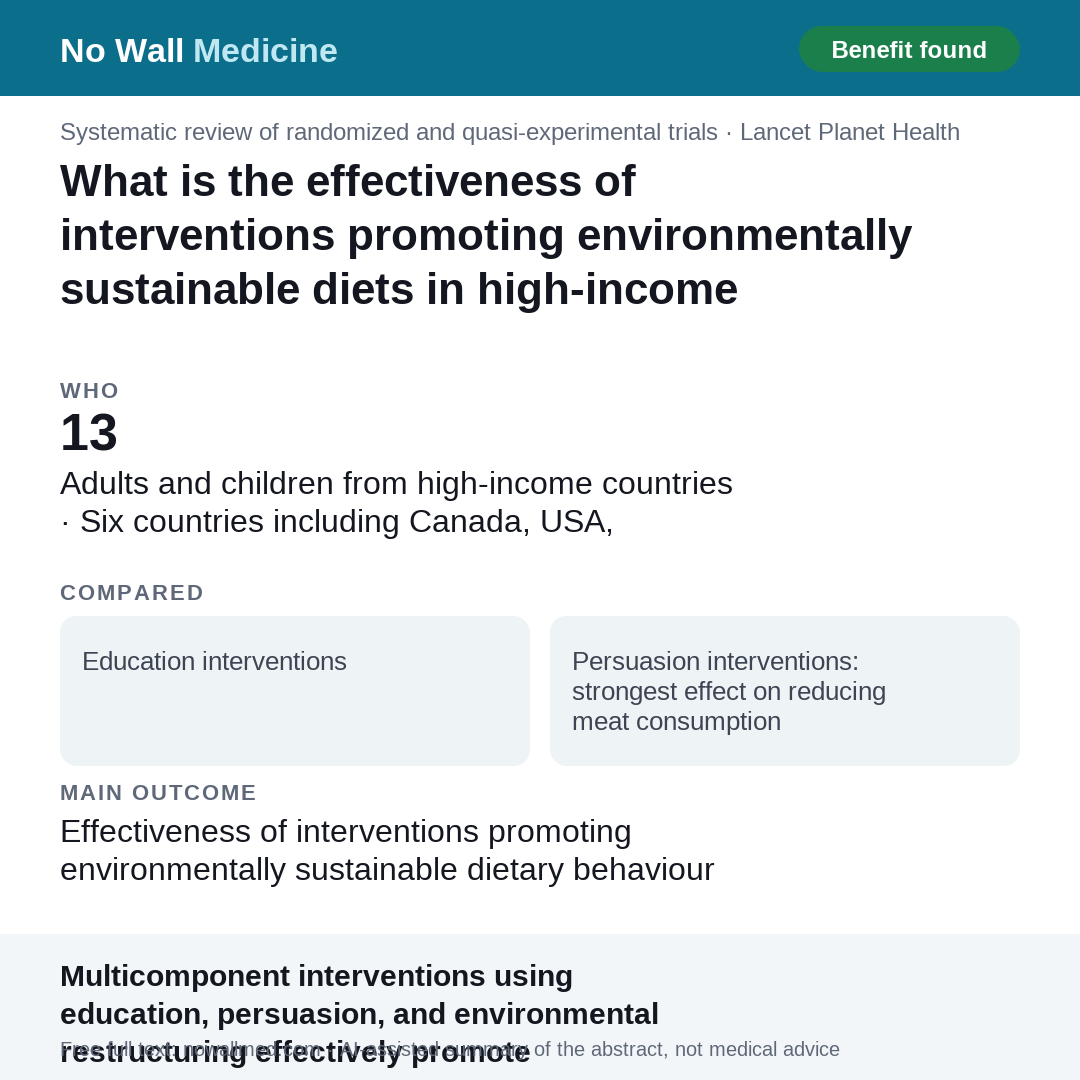
Investigating intervention components and their effectiveness in promoting environmentally sustainable diets: a systematic review
Systematic review of randomized and quasi-experimental trialsBenefit found
What is the effectiveness of interventions promoting environmentally sustainable diets in high-income countries?
Who
13
Adults and children from high-income countries · Six countries including Canada, USA, Germany, UK, Netherlands, Italy
Compared
Education interventions
Persuasion interventions: strongest effect on reducing meat consumption
Main outcome
Effectiveness of interventions promoting environmentally sustainable dietary behaviour
Bottom line: Multicomponent interventions using education, persuasion, and environmental restructuring effectively promote environmentally sustainable diets.
Limitation: Little high-quality research was available, with several studies having high risk of bias.
Lancet Planet Health · 2024-06-08Download image
Comparative effectiveness of alternative spontaneous breathing trial techniques: a systematic review and network meta-analysis of randomized trials
Network meta-analysis of 40 randomized trialsMixed results
Which spontaneous breathing trial technique best balances successful extubation and reintubation risk?
Who
6716
Critically ill adults and children
Compared
Pressure augmentation (PS, ATC, PS/ATC): increased initial successful SBT and successful extubation rates
Without pressure augmentation (T-piece, CPAP)
Main outcome
initial spontaneous breathing trial success, successful extubation, and reintubation
Bottom line: Pressure augmentation increases successful extubation but may increase reintubation rates compared to high flow nasal cannulae.
Crit Care · 2024-06-08Download image

Leukotriene receptor antagonists as add-on therapy to antihistamines for urticaria: Systematic review and meta-analysis of randomized clinical trials
Systematic review and meta-analysis of randomized clinical trialsBenefit found
Does adding leukotriene receptor antagonists to antihistamines improve urticaria management?
Who
3324
Children and adults with acute or chronic urticaria
Compared
Antihistamines alone
Leukotriene receptor antagonist and antihistamines: mean difference, -5.04 (95% confidence interval, -6.36 to -3.71)
Main outcome
7-day urticaria activity score
Result: mean difference, -5.04 (95% confidence interval, -6.36 to -3.71)
Bottom line: Adding leukotriene receptor antagonists to antihistamines modestly improves urticaria activity with little to no increase in overall adverse events.
Limitation: No randomized controlled trial reported on neuropsychiatric adverse events.
JACI · 2024-06-07Download image

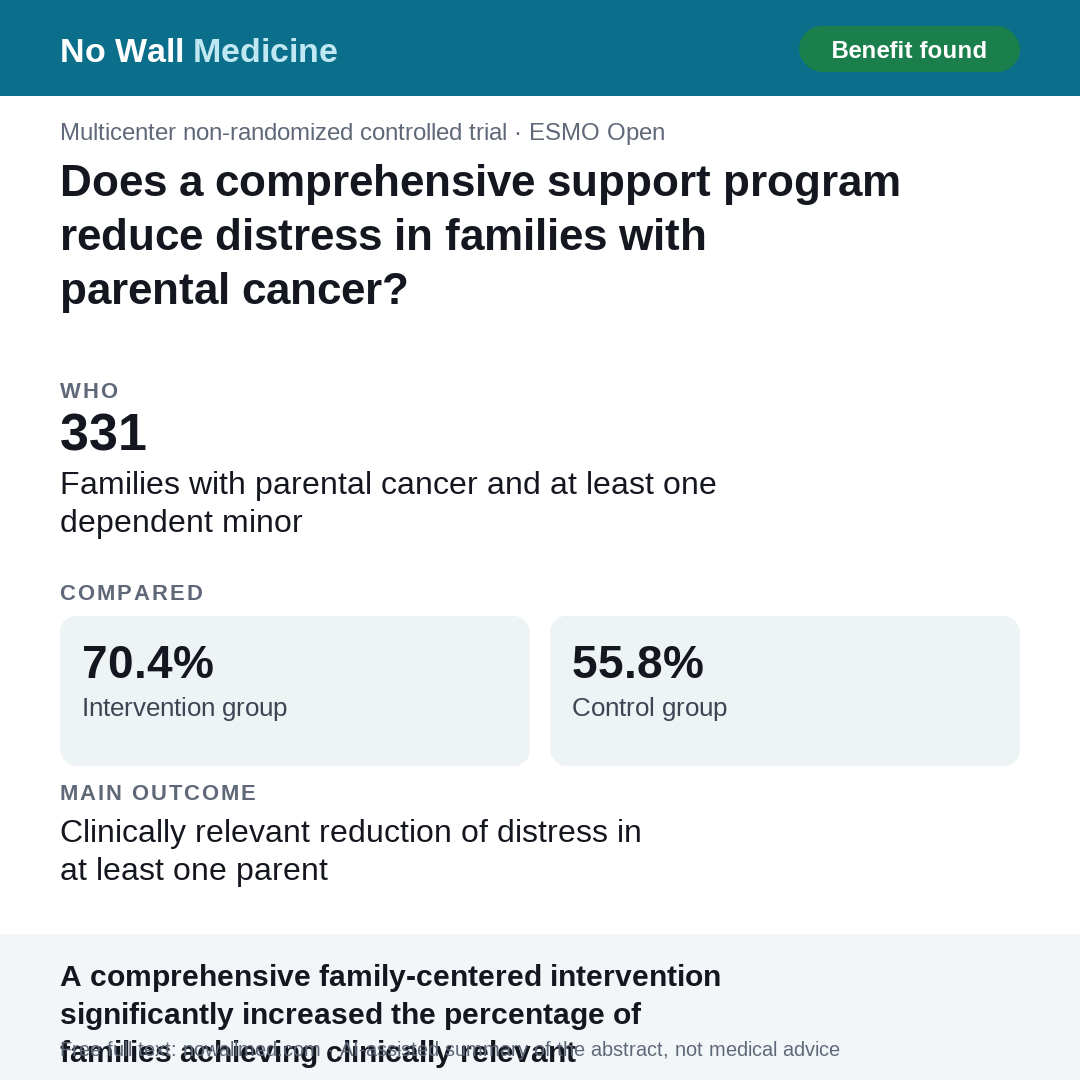
Effectiveness of a comprehensive support program for families with parental cancer (Family-SCOUT): results of a multicenter non-randomized controlled trial
Multicenter non-randomized controlled trialBenefit found
Does a comprehensive support program reduce distress in families with parental cancer?
Who
331
Families with parental cancer and at least one dependent minor
Compared
70.4%Intervention group
55.8%Control group
Main outcome
Clinically relevant reduction of distress in at least one parent
Result: P = 0.008
Bottom line: A comprehensive family-centered intervention significantly increased the percentage of families achieving clinically relevant distress reduction.
Limitation: Bias from other confounders cannot be excluded.
ESMO Open · 2024-06-07Download image
Repeated Low-Level Red Light Therapy for Myopia Control in High Myopia Children and Adolescents: A Randomized Clinical Trial
Multicenter, randomized, parallel-group, single-blind clinical trialBenefit found
Is repeated low-level red light therapy effective for myopia control in high myopia children?
Who
192
192 children aged 6 to 16 years with high myopia
Compared
repeated low-level red light plus single-vision spectacles: -0.06 mm (95% confidence interval, -0.10 to -0.02 mm)
single-vision spectacles: 0.34 mm (95% confidence interval, 0.30 to 0.39 mm)
Main outcome
changes in axial length and cycloplegic spherical equivalent refraction
Bottom line: Repeated low-level red light therapy effectively slows axial length progression in children and adolescents with high myopia.
Ophthalmology · 2024-06-06Download image

Clinical presentation, diagnosis and management of multisystem inflammatory syndrome in children (MIS-C): a systematic review
Systematic review of observational studiesMixed results
What are the clinical features, management, and outcomes of multisystem inflammatory syndrome in children?
Who
20881
Patients with multisystem inflammatory syndrome in children · Not specified
Compared
High-income countries
Middle-income countries
Main outcome
pooled mean mortality among patients with multisystem inflammatory syndrome in children
Result: 3.9% (95% CI 2.7% to 5.6%)
Bottom line: Multisystem inflammatory syndrome in children is severe, with higher mortality rates in middle-income countries compared to high-income countries.
Limitation: The review includes observational studies which may have inherent biases.
BMJ Paediatr Open · 2024-06-06Download image

Instruments for Measuring Psychological Dimensions in Human-Robot Interaction: Systematic Review of Psychometric Properties
Systematic reviewMixed results
What are the psychometric properties of instruments measuring psychological dimensions in human-robot interaction?
Who
34
Instruments assessing psychological dimensions in social and domestic robot interaction
Compared
Structural validity studies: 24/27 (89%)
Internal consistency studies: 26/27 (96%)
Main outcome
Psychometric properties of instruments for human-robot interaction
Bottom line: Most instruments focus on structural validity and internal consistency, but lack evaluation of measurement error and responsiveness.
Limitation: Included instruments for both social and domestic robots while excluding other specific robot types.
J Med Internet Res · 2024-06-05Download image

Fast and accurate newborn heart rate monitoring at birth: A systematic review
Systematic reviewMixed results
How fast and accurate are various newborn heart rate measurement methods at birth?
Who
Newborns
Compared
Electrocardiogram
Pulse oximetry: slower and less precise than electrocardiogram
Auscultation and palpation: imprecise
Main outcome
Speed and accuracy of newborn heart rate measurement
Bottom line: Electrocardiogram is best for fast and accurate heart rate assessment, though pulse oximetry and auscultation are alternatives.
Limitation: Certainty of evidence was low or very low for most comparisons.
Resusc Plus · 2024-06-05Download image

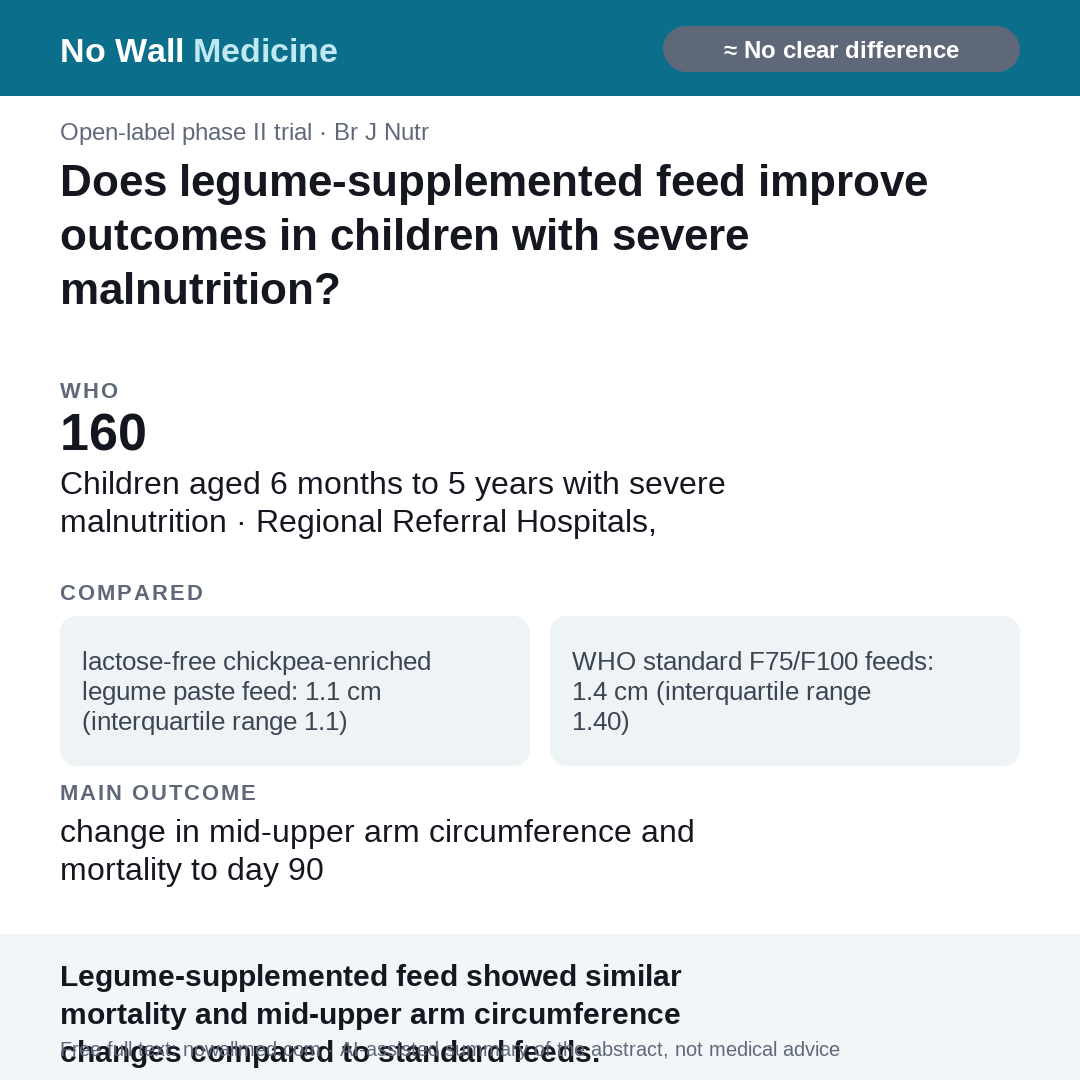
Legume-supplemented feed for children hospitalised with severe malnutrition: a phase II trial
Open-label phase II trialNo clear difference
Does legume-supplemented feed improve outcomes in children with severe malnutrition?
Who
160
Children aged 6 months to 5 years with severe malnutrition · Regional Referral Hospitals, Uganda
Compared
lactose-free chickpea-enriched legume paste feed: 1.1 cm (interquartile range 1.1)
WHO standard F75/F100 feeds: 1.4 cm (interquartile range 1.40)
Main outcome
change in mid-upper arm circumference and mortality to day 90
Result: OR 0.91 (95 % CI 0.40, 2.07)
Bottom line: Legume-supplemented feed showed similar mortality and mid-upper arm circumference changes compared to standard feeds.
Br J Nutr · 2024-06-04Download image
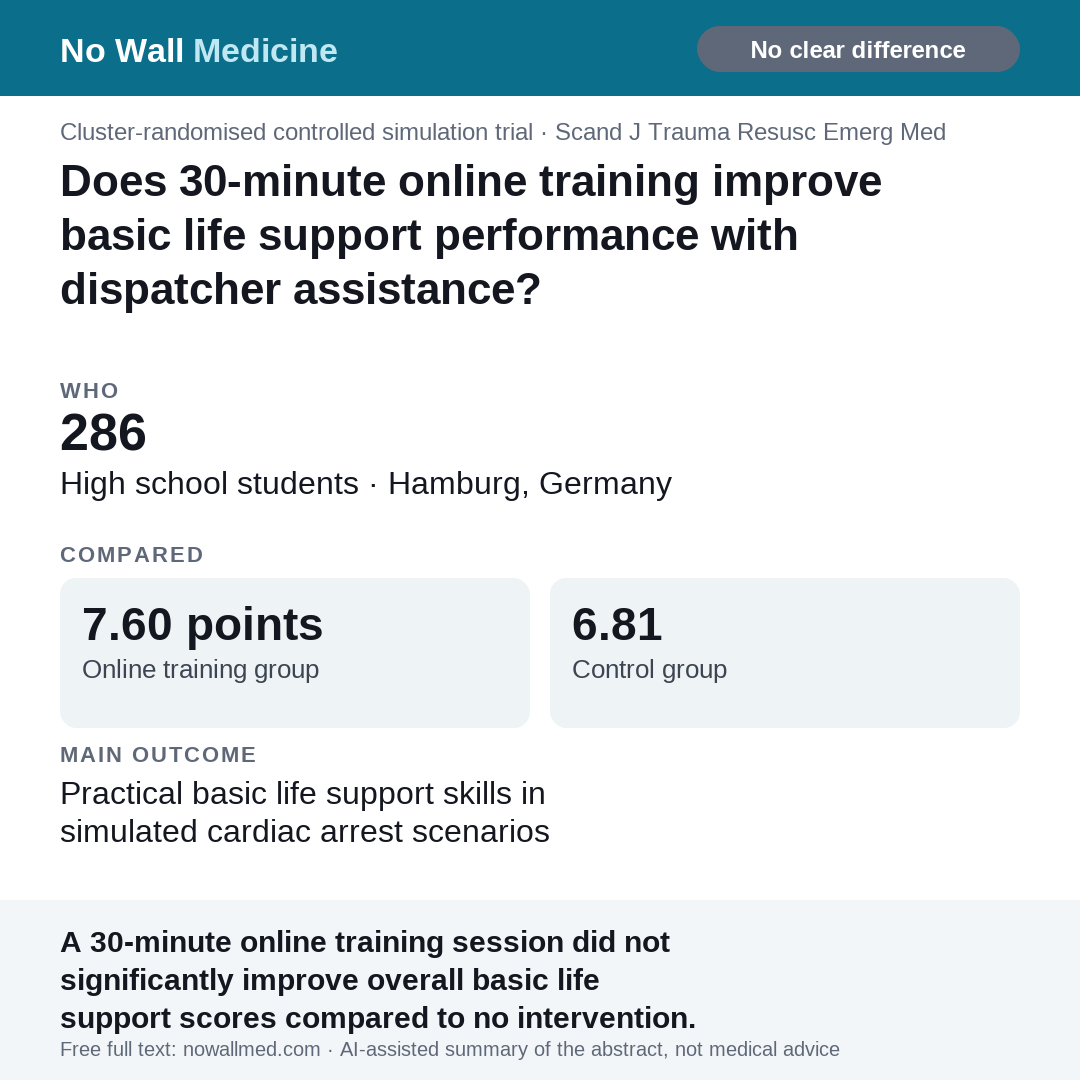
Online training to improve BLS performance with dispatcher assistance? Results of a cluster-randomised controlled simulation trial
Cluster-randomised controlled simulation trialNo clear difference
Does 30-minute online training improve basic life support performance with dispatcher assistance?
Who
286
High school students · Hamburg, Germany
Compared
7.60 pointsOnline training group (95% CI: 6.76 to 8.44)
6.81Control group (95% CI: 5.97 to 7.65)
Main outcome
Practical basic life support skills in simulated cardiac arrest scenarios
Result: mean difference 0.79 (95% CI: -0.40 to 1.97)
Bottom line: A 30-minute online training session did not significantly improve overall basic life support scores compared to no intervention.
Scand J Trauma Resusc Emerg Med · 2024-06-04Download image