Visual abstracts
New randomized trials and meta-analyses from leading journals at a glance: who was studied, what was compared, and what was found. Every paper is free to read in full.
All specialtiesCardiology 4763Oncology 4042Gastroenterology & Hepatology 1902Infectious Disease 3756Neurology 1872Psychiatry & Mental Health 2214Pulmonology 2042Critical Care 1319Endocrinology & Diabetes 2544Pediatrics 2889Surgery 2479Orthopedics & Sports Medicine 917Neurosurgery 525Cardiothoracic & Vascular Surgery 656Plastic & Reconstructive Surgery 574Nephrology 1107Rheumatology 810Hematology 1090Dermatology 611Ophthalmology 532Obstetrics & Gynecology 1645Public & Global Health 1037Radiology & Imaging 617Anesthesiology 957Urology 745ENT (Otolaryngology) 494Emergency Medicine 481Allergy & Immunology 309Geriatrics 972Family Medicine & Primary Care 533Medical Genetics & Genomics 659Pathology & Laboratory Medicine 156Physical Medicine & Rehabilitation 734Palliative Care 421Nutrition 1560Digital Health & AI 2133General Medicine 318
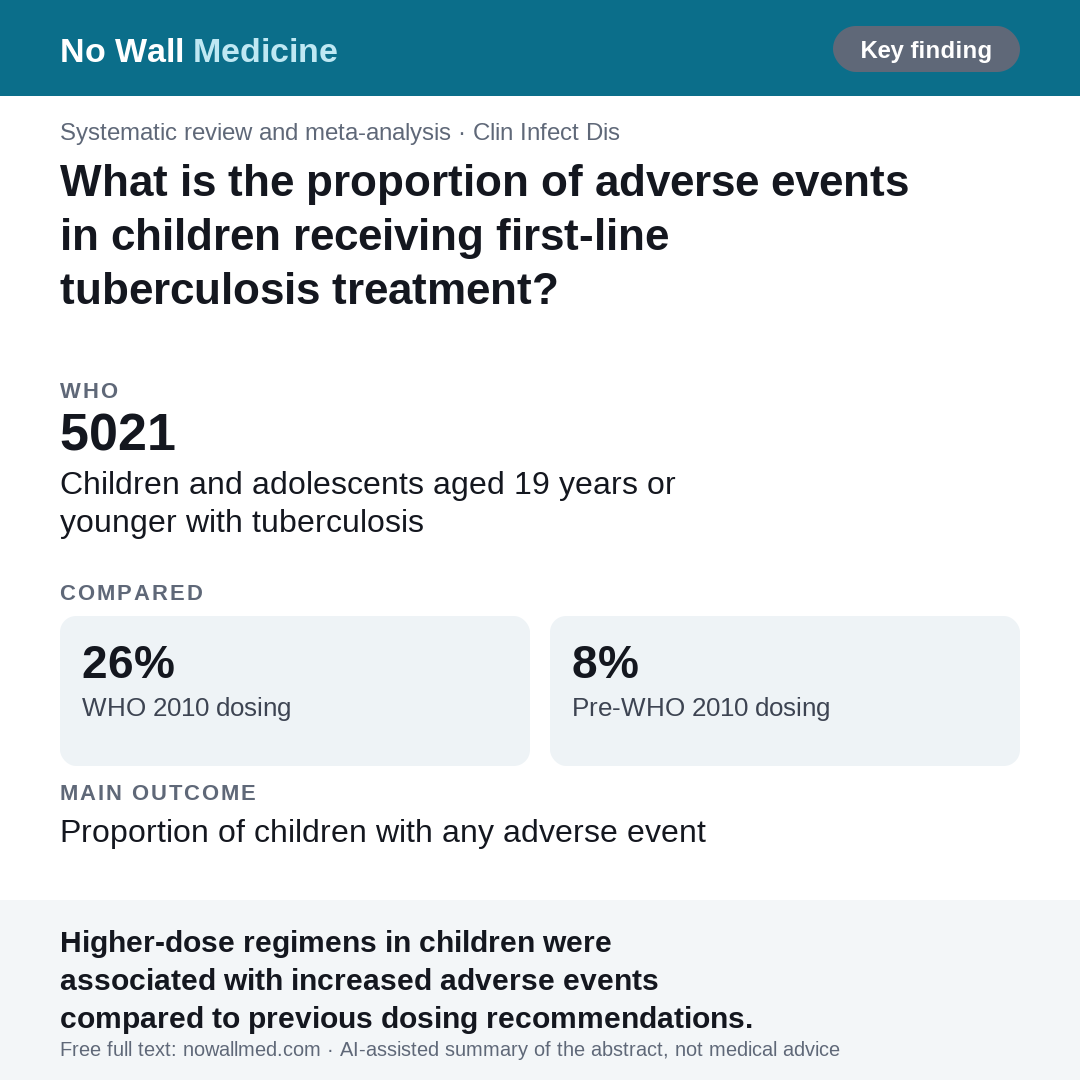
Adverse Events of First-Line Therapy for Pediatric Tuberculosis: A Systematic Review and Meta-Analysis
Systematic review and meta-analysisKey finding
What is the proportion of adverse events in children receiving first-line tuberculosis treatment?
Who
5021
Children and adolescents aged 19 years or younger with tuberculosis
Compared
26%WHO 2010 dosing (95% CI, 18%-34%)
8%Pre-WHO 2010 dosing (95% CI, 4%-15%)
Main outcome
Proportion of children with any adverse event
Bottom line: Higher-dose regimens in children were associated with increased adverse events compared to previous dosing recommendations.
Limitation: Findings are limited by publication bias in observational trials.
Clin Infect Dis · 2025-03-24Download image
The Use of Computed Tomography Densitometry for the Assessment of Emphysema in Clinical Trials: A Position Paper from the Fleischner Society
Systematic literature reviewKey finding
Can computed tomography densitometry serve as diagnostic, prognostic, and progression monitoring biomarkers?
Who
Patients with emphysema or chronic obstructive pulmonary disease
Compared
Diagnostic and prognostic metrics: 0.99 scan-rescan intraclass correlation coefficient
Disease monitoring metric: 0.99 scan-rescan intraclass correlation coefficient
Main outcome
Computed tomography densitometry as a biomarker for emphysema
Bottom line: Computed tomography densitometry is a validated, highly reproducible biomarker for emphysema diagnosis, prognosis, and monitoring.
AJRCCM · 2025-03-24Download image

Evolving patterns of macrolide and fluoroquinolone resistance in Mycoplasma genitalium: an updated systematic review and meta-analysis
Systematic review and meta-analysisMixed results
What are the contemporary prevalence estimates of macrolide and fluoroquinolone resistance in Mycoplasma genitalium?
Who
Mycoplasma genitalium samples · 41 countries
Compared
33·3%Macrolide resistance (2018-21) (95% CI 27·2-39·7)
13·3%Fluoroquinolone resistance (2018-21) (10·0-17·0)
6·5%Dual-class resistance (2018-21) (4·0-9·4)
Main outcome
Prevalence of antibiotic resistance
Bottom line: In 2018-21, macrolide, fluoroquinolone, and dual-class resistance rates were 33.3%, 13.3%, and 6.5% respectively.
Funded by: Australian Research Council
Lancet Microbe · 2025-03-24Download image

Incidence and prevalence of functional neurological disorder: a systematic review
Systematic reviewUnclear result
What are the incidence and prevalence rates of functional neurological disorder?
Who
General population
Compared
Incidence of functional neurological disorder: 10-22/100 000
Prevalence of functional neurological disorder: 80-140/100 000
Main outcome
Incidence and prevalence rates of functional neurological disorder
Bottom line: Functional neurological disorder shows wide variation in incidence and prevalence estimates across studies with significant heterogeneity.
Limitation: Methodological differences and significant heterogeneity among studies, with likely underestimates.
J Neurol Neurosurg Psychiatry · 2025-03-24Download image

Association between cardiovascular risk factors and the occurrence of giant cell arteritis: a systematic review and meta-analysis
Systematic review and meta-analysisMixed results
What is the association between cardiovascular risk factors and giant cell arteritis onset?
Who
Individuals with cardiovascular risk factors
Compared
Type 2 diabetes: odds ratio 0.75 (95% CI 0.61-0.93)
History of cardiovascular disease: odds ratio 1.28 (95% CI 1.18-1.38)
Overweight: odds ratio 0.64 (95% CI 0.41-1.00)
Main outcome
Risk of giant cell arteritis occurrence
Bottom line: Type 2 diabetes is inversely associated with giant cell arteritis, while cardiovascular disease history is positively associated.
Rheumatology · 2025-03-24Download image

The use of iron after surgery: a systematic review and meta-analysis
Meta-analysis of trialsBenefit found
Does iron therapy increase haemoglobin levels
Who
1865
Adults undergoing elective surgery with anaemia
Compared
Intravenous iron
Oral iron
Main outcome
Haemoglobin level
Result: mean difference 4.51 g.l-1 (95% CI 2.63 to 6.38) for intravenous iron
Bottom line: Intravenous iron increases haemoglobin levels after surgery
Anaesthesia · 2025-03-24Download image

Unconventional exercises for motor function in Parkinson's disease: an umbrella review of meta-analyses
Umbrella review of meta-analysesBenefit found
Do unconventional exercises improve motor function in people with Parkinson's disease?
Who
People with Parkinson's disease
Compared
Unconventional exercises
Conventional or passive interventions
Main outcome
Motor function including impairment, balance, walking and endurance
Bottom line: Unconventional exercises like dancing and robotic-assisted gait training show advantages for motor function in Parkinson's disease.
Limitation: Variations across studies and differing certainty levels require cautious interpretation.
Age Ageing · 2025-03-24Download image

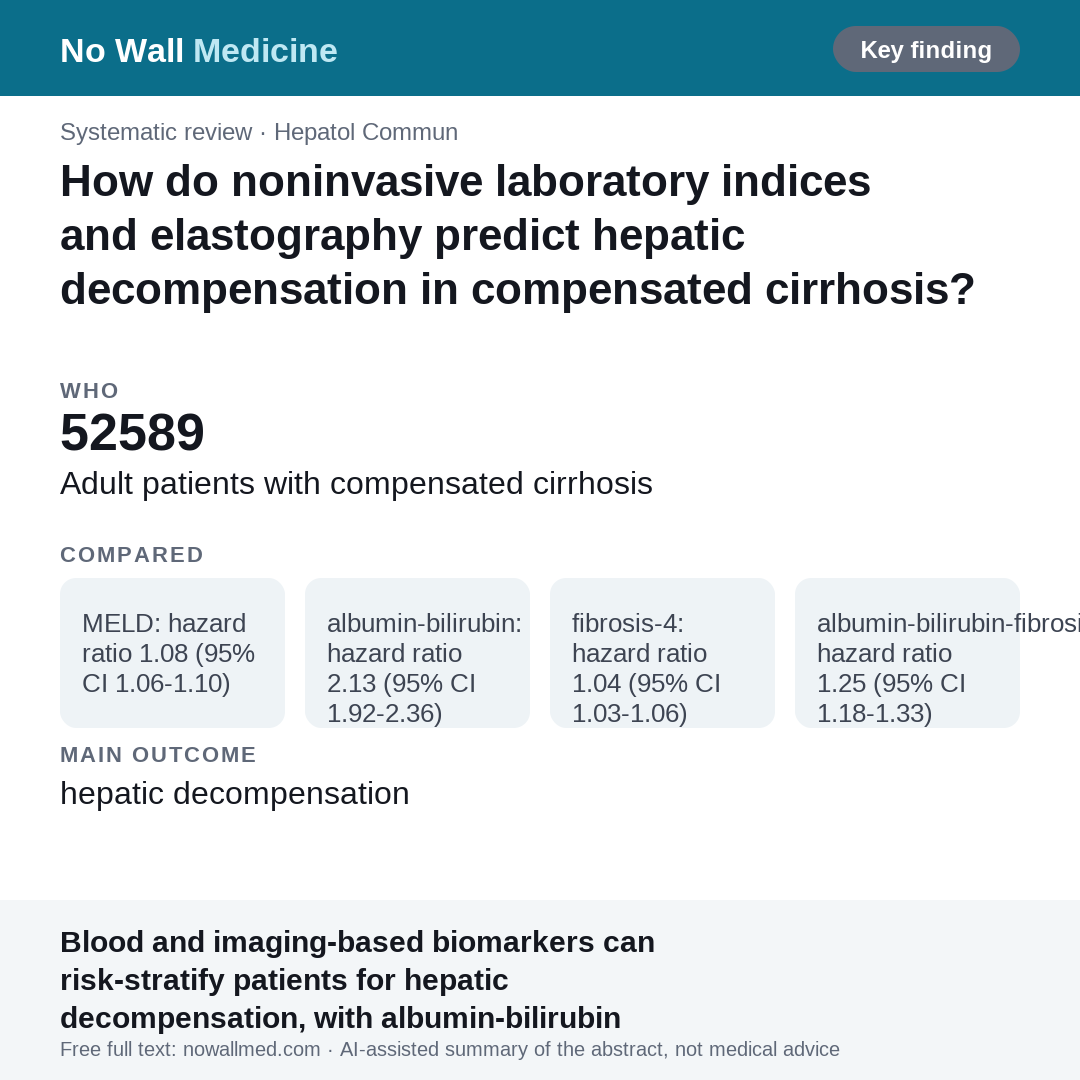
A systematic review of noninvasive laboratory indices and elastography to predict hepatic decompensation
Systematic reviewKey finding
How do noninvasive laboratory indices and elastography predict hepatic decompensation in compensated cirrhosis?
Who
52589
Adult patients with compensated cirrhosis
Compared
MELD: hazard ratio 1.08 (95% CI 1.06-1.10)
albumin-bilirubin: hazard ratio 2.13 (95% CI 1.92-2.36)
fibrosis-4: hazard ratio 1.04 (95% CI 1.03-1.06)
albumin-bilirubin-fibrosis-4: hazard ratio 1.25 (95% CI 1.18-1.33)
Main outcome
hepatic decompensation
Bottom line: Blood and imaging-based biomarkers can risk-stratify patients for hepatic decompensation, with albumin-bilirubin showing the highest discrimination.
Hepatol Commun · 2025-03-24Download image
Effectiveness of anti-IL-5/5Rα biologics in severe asthma in real-world studies: a systematic review and meta-analysis
Meta-analysis of observational and nonrandomised studiesKey finding
Effectiveness of anti-IL-5/5Rα biologics in severe asthma in real-world studies
Who
9546
Real-life patients with severe eosinophilic asthma
Compared
Anti-IL-5/5Rα biologics: 62% reduction in severe exacerbations
Pre-treatment
Main outcome
Severe exacerbations at 12 months
Result: risk ratio 0.38, 95% CI 0.29-0.50
Bottom line: Biologics use was associated with a 62% reduction in severe exacerbations at 12 months.
ERJ Open Res · 2025-03-24Download image

Efficacy and safety of behavioural activation on depression in people with co-occurring non-communicable diseases: systematic review and meta-analysis
Systematic review and meta-analysis of 12 randomized controlled trialsUnclear result
Is behavioural activation effective and safe for depression in people with non-communicable diseases?
Who
2144
People with non-communicable diseases and comorbid depression
Compared
Behavioural activation
Comparators
Main outcome
Depression symptom improvement
Result: Hedges' g = -0.24 (95% CI, -0.62 to 0.15)
Bottom line: Evidence is insufficient to draw clear conclusions about behavioural activation efficacy for depression in people with non-communicable diseases.
Limitation: High heterogeneity (I2 = 91.91%) and insufficient high-quality, well-designed randomized controlled trials.
BJPsych Open · 2025-03-24Download image

Neoadjuvant treatment versus upfront surgery in borderline resectable and resectable pancreatic ductal adenocarcinoma: meta-analysis
Meta-analysis of nine randomized trialsMixed results
Does neoadjuvant treatment improve outcomes versus upfront surgery in pancreatic cancer?
Who
1194
Patients with borderline-resectable or resectable pancreatic ductal adenocarcinoma
Compared
Neoadjuvant treatment
Upfront surgery
Main outcome
Overall survival
Result: hazard ratio 0.73 (95% c.i. 0.55 to 0.98)
Bottom line: Neoadjuvant treatment improves survival for borderline-resectable pancreatic cancer but not for resectable pancreatic cancer.
BJS Open · 2025-03-24Download image

Clonal relatedness as a prognostic marker in Richter transformation of chronic lymphocytic leukemia: a systematic review
Systematic reviewMixed results
Is clonal relatedness a prognostic marker in Richter transformation of chronic lymphocytic leukemia?
Who
336
Patients with Richter transformation of chronic lymphocytic leukemia
Compared
Clonally related Richter transformation: significantly poorer prognosis
Clonally unrelated Richter transformation
Main outcome
Survival outcomes
Bottom line: Clonal relatedness may confer poorer survival, but it is not independent of other known clinical and genomic variables.
Blood Adv · 2025-03-24Download image

AI-Derived Blood Biomarkers for Ovarian Cancer Diagnosis: Systematic Review and Meta-Analysis
Meta-analysis of 40 studiesBenefit found
AI for ovarian cancer diagnosis
Who
patients with ovarian cancer
Compared
85%Machine learning (sensitivity)
77%Deep learning (sensitivity)
Main outcome
diagnostic accuracy
Result: pooled sensitivity 85% (95% CI 83%-87%)
Bottom line: AI algorithms show satisfactory performance
Limitation: need for external validation
J Med Internet Res · 2025-03-24Download image

Short-term effect of prism adaptation treatment on severity of unilateral spatial neglect following right hemispheric stroke: a systematic review and meta-analysis
Systematic review and meta-analysis of randomized controlled trialsBenefit found
Does prism adaptation affect unilateral spatial neglect severity following right hemispheric stroke?
Who
227
Patients with unilateral spatial neglect following right hemispheric stroke
Compared
Prism adaptation
Placebo therapy
Main outcome
Unilateral spatial neglect outcomes
Result: standardized mean difference 0.49 (95% CI 0.07 to 0.92)
Bottom line: Prism adaptation shows significant short-term effects on neglect outcomes, especially with angles exceeding 10 degrees.
J Rehabil Med · 2025-03-24Download image

Factors influencing accessibility of palliative care: a systematic review and meta-analysis
Systematic review and meta-analysisMixed results
What factors influence the accessibility of palliative care?
Who
Patients with life-threatening illnesses
Compared
Facilitators: female gender (OR 1.18), higher income (OR 1.11), larger hospital bed capacity (OR 1.22)
Barriers: residing in rural areas (OR 0.80), being of African descent (OR 0.78)
Main outcome
accessibility of palliative care
Result: OR 1.18 (95% CI 1.14-1.23), OR 1.11 (95% CI 1.08-1.14), OR 1.22 (95% CI 1.14-1.32), OR 0.80 (95% CI 0.67-0.95), OR 0.78 (95% CI 0.68-0.90)
Bottom line: Sociodemographic, healthcare service, and disease-related factors significantly influence palliative care accessibility.
Limitation: Limited number of studies focusing on specific dimensions like availability, affordability, accessibility, and accommodation.
BMC Palliat Care · 2025-03-24Download image

Synthetic extracellular volume fraction as an imaging biomarker of the myocardial interstitium without blood sampling: a systematic review and meta-analysis
Systematic review and meta-analysisBenefit found
How well does synthetic extracellular volume fraction correlate with laboratory extracellular volume fraction?
Who
4492
Patients undergoing cardiac magnetic resonance imaging
Compared
1.5 Tesla magnetic resonance: correlation 0.95 (95% confidence interval: 0.92 to 0.97)
3.0 Tesla magnetic resonance: correlation 0.91 (95% confidence interval: 0.86 to 0.94)
Main outcome
Correlation and agreement between synthetic and laboratory extracellular volume fraction
Result: mean difference 0.61% (95% CI 0.23 to 0.98%) at 1.5T
Bottom line: Synthetic extracellular volume fraction correlates excellently with laboratory measurements, allowing noninvasive quantification without blood sampling.
J Cardiovasc Magn Reson · 2025-03-24Download image

Manikin physical realism for resuscitation education: A systematic review
Systematic review and meta-analysisMixed results
Does higher manikin physical realism improve resuscitation education outcomes?
Who
Participants in life support education studies
Compared
Higher physical realism manikins
Lower realism manikins
Main outcome
Simulation skill performance and knowledge at course conclusion
Result: standardized mean difference 0.66 (95% CI 0.08 - 1.25)
Bottom line: Higher manikin realism improves simulated clinical performance but does not affect knowledge at course conclusion.
Limitation: Significant risk of bias and a high degree of heterogeneity were found.
Resusc Plus · 2025-03-24Download image

AGA Living Clinical Practice Guideline on Computer-Aided Detection-Assisted Colonoscopy
AGA clinical practice guidelineUnclear result
Should computer-aided detection systems be used during colonoscopy for colorectal polyp detection?
Who
Patients undergoing colonoscopy
Compared
Computer-aided detection assisted colonoscopy: 8% (95% CI, 6%-10%) increase in adenoma detection rate
Standard colonoscopy
Main outcome
Colorectal cancer, cancer deaths, and adenoma detection rates
Bottom line: No recommendation can be made due to very low certainty of evidence regarding benefits and harms.
Limitation: Very low certainty of evidence for critical outcomes and close tradeoff between effects.
Gastroenterology · 2025-03-23Download image

Optimizing the strategies to perform prostate biopsy in MRI-positive patients: a systematic review and network meta-analysis
Systematic review and network meta-analysisMixed results
Which biopsy schemes are most effective for detecting prostate cancer in MRI-positive patients?
Who
74113
MRI-positive patients with PIRADS or Likert score 2-5
Compared
Systematic biopsy and targeted biopsy
Targeted biopsy alone: RR 0.86 (95% CrI 0.84, 0.88)
Systematic biopsy alone: RR 0.75 (95% CrI 0.73, 0.77)
Main outcome
Detection rate of clinically significant prostate cancer
Bottom line: Combining systematic and targeted biopsy is superior to using either method alone for detecting clinically significant prostate cancer.
Funded by: National Natural Science Foundation of China and Sichuan Province
eClinicalMedicine · 2025-03-22Download image

Effectiveness of tuberculosis preventive treatment in patients with rheumatic diseases: a global systematic review and meta-analysis
Systematic review and meta-analysisBenefit found
Is tuberculosis preventive treatment effective in patients with rheumatic diseases?
Who
116,015
Patients with rheumatic disease · Global
Compared
Tuberculosis preventive treatment
No tuberculosis preventive treatment
Main outcome
Incidence of tuberculosis disease
Result: risk ratio 0.76 (95% CI 0.63-0.91)
Bottom line: Tuberculosis preventive treatment decreased the risk of tuberculosis disease in patients with rheumatic diseases.
Funded by: National Natural Science Foundation of China and others
eClinicalMedicine · 2025-03-22Download image