Visual abstracts
New randomized trials and meta-analyses from leading journals at a glance: who was studied, what was compared, and what was found. Every paper is free to read in full.
All specialtiesCardiology 4012Oncology 3419Gastroenterology & Hepatology 1590Infectious Disease 2976Neurology 1583Psychiatry & Mental Health 1885Pulmonology 1731Critical Care 1126Endocrinology & Diabetes 2069Pediatrics 2404Surgery 2120Orthopedics & Sports Medicine 756Neurosurgery 460Cardiothoracic & Vascular Surgery 503Plastic & Reconstructive Surgery 534Nephrology 889Rheumatology 666Hematology 896Dermatology 510Ophthalmology 435Obstetrics & Gynecology 1398Public & Global Health 794Radiology & Imaging 543Anesthesiology 802Urology 644ENT (Otolaryngology) 432Emergency Medicine 428Allergy & Immunology 252Geriatrics 833Family Medicine & Primary Care 475Medical Genetics & Genomics 549Pathology & Laboratory Medicine 138Physical Medicine & Rehabilitation 614Palliative Care 358Nutrition 1219Digital Health & AI 1853General Medicine 278
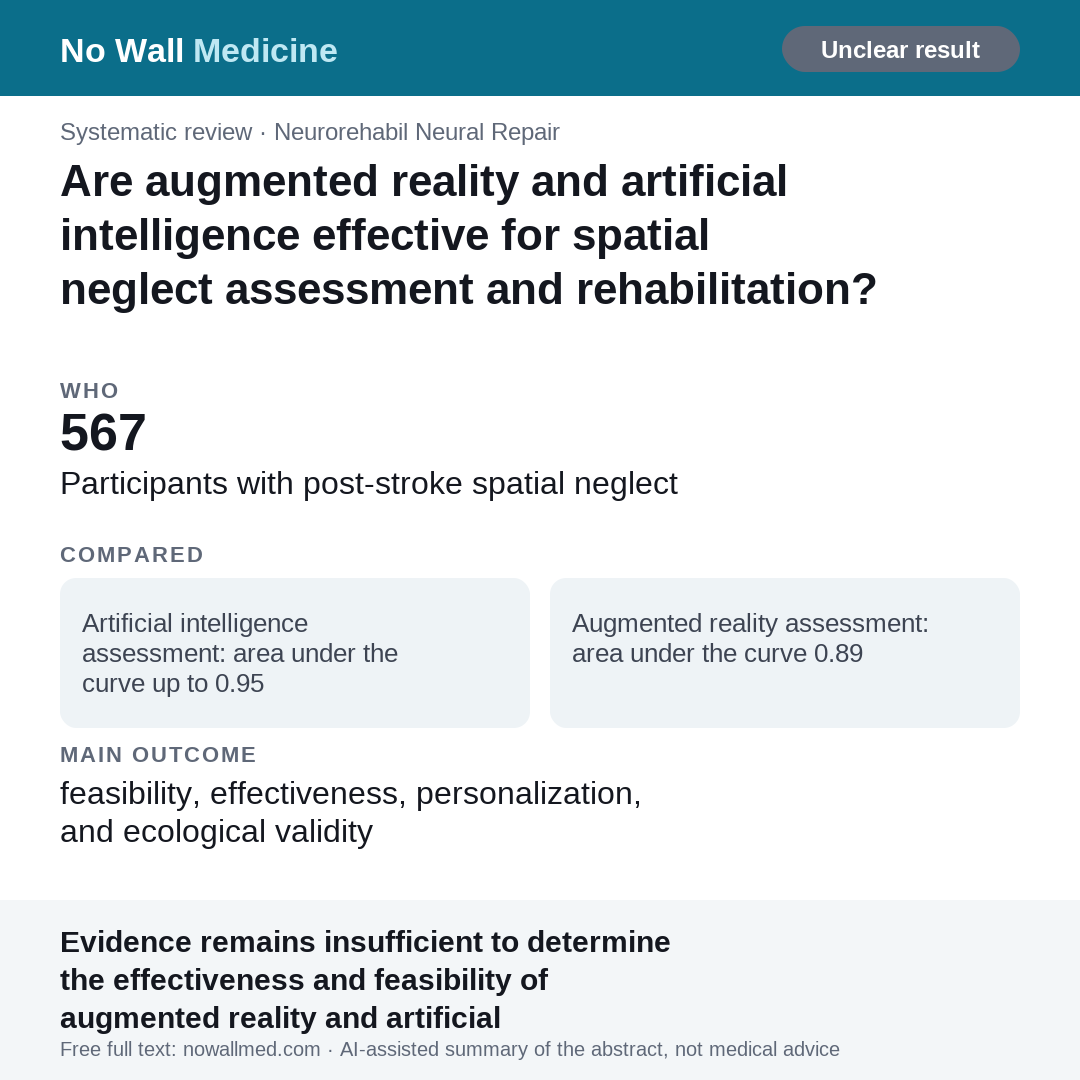
Augmented Reality and Artificial Intelligence for the Assessment and Rehabilitation of Spatial Neglect: A Systematic Review
Systematic reviewUnclear result
Are augmented reality and artificial intelligence effective for spatial neglect assessment and rehabilitation?
Who
567
Participants with post-stroke spatial neglect
Compared
Artificial intelligence assessment: area under the curve up to 0.95
Augmented reality assessment: area under the curve 0.89
Main outcome
feasibility, effectiveness, personalization, and ecological validity
Bottom line: Evidence remains insufficient to determine the effectiveness and feasibility of augmented reality and artificial intelligence for spatial neglect.
Limitation: Small sample sizes, methodological heterogeneity, and limited number of randomized controlled trials.
Neurorehabil Neural Repair · 2026-05-04Download image
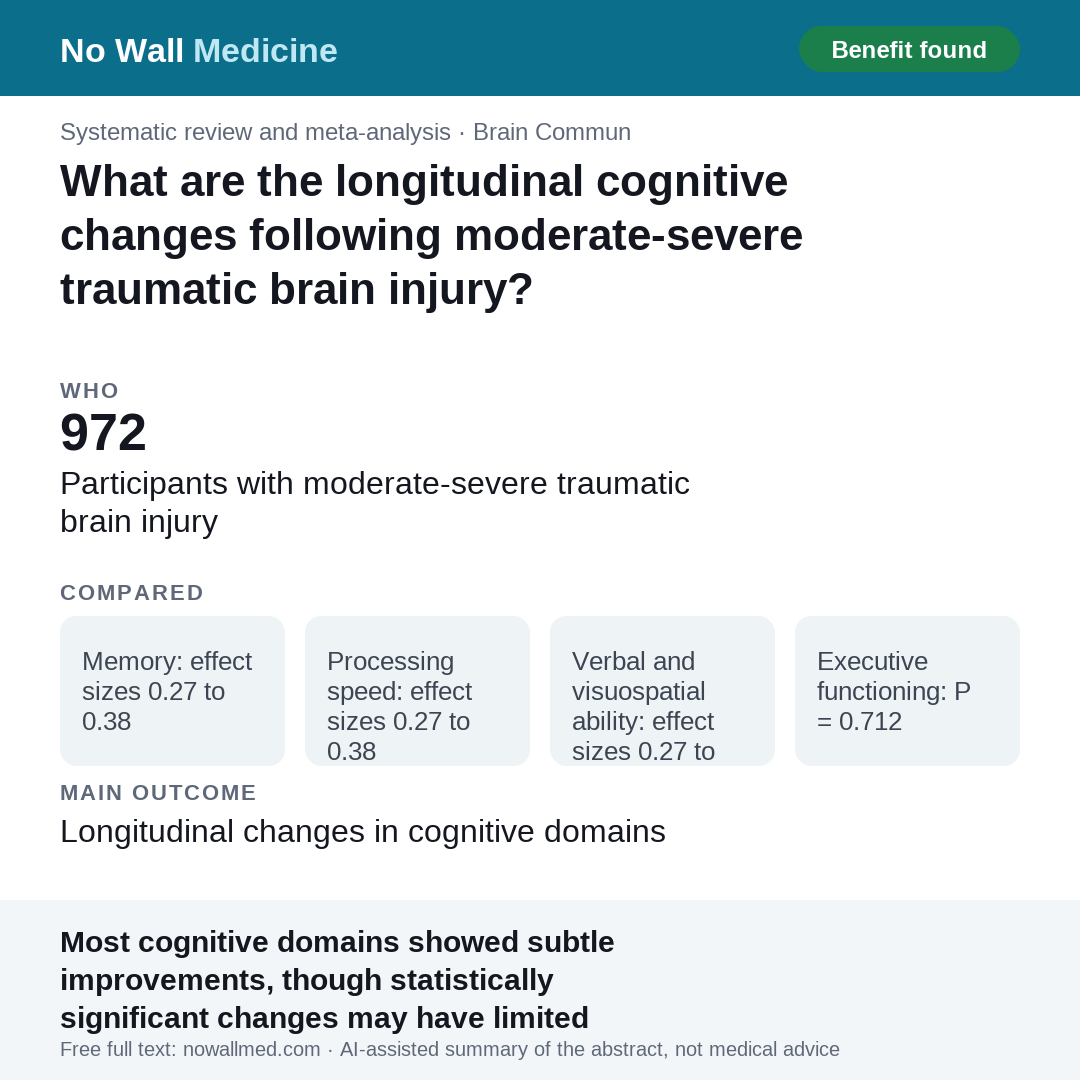
Longitudinal changes in cognitive ability following traumatic brain injury: a systematic review and meta-analysis
Systematic review and meta-analysisBenefit found
What are the longitudinal cognitive changes following moderate-severe traumatic brain injury?
Who
972
Participants with moderate-severe traumatic brain injury
Compared
Memory: effect sizes 0.27 to 0.38
Processing speed: effect sizes 0.27 to 0.38
Verbal and visuospatial ability: effect sizes 0.27 to 0.38
Executive functioning: P = 0.712
Main outcome
Longitudinal changes in cognitive domains
Bottom line: Most cognitive domains showed subtle improvements, though statistically significant changes may have limited clinical significance.
Limitation: Statistically significant improvements have limited clinical significance.
Brain Commun · 2026-05-04Download image
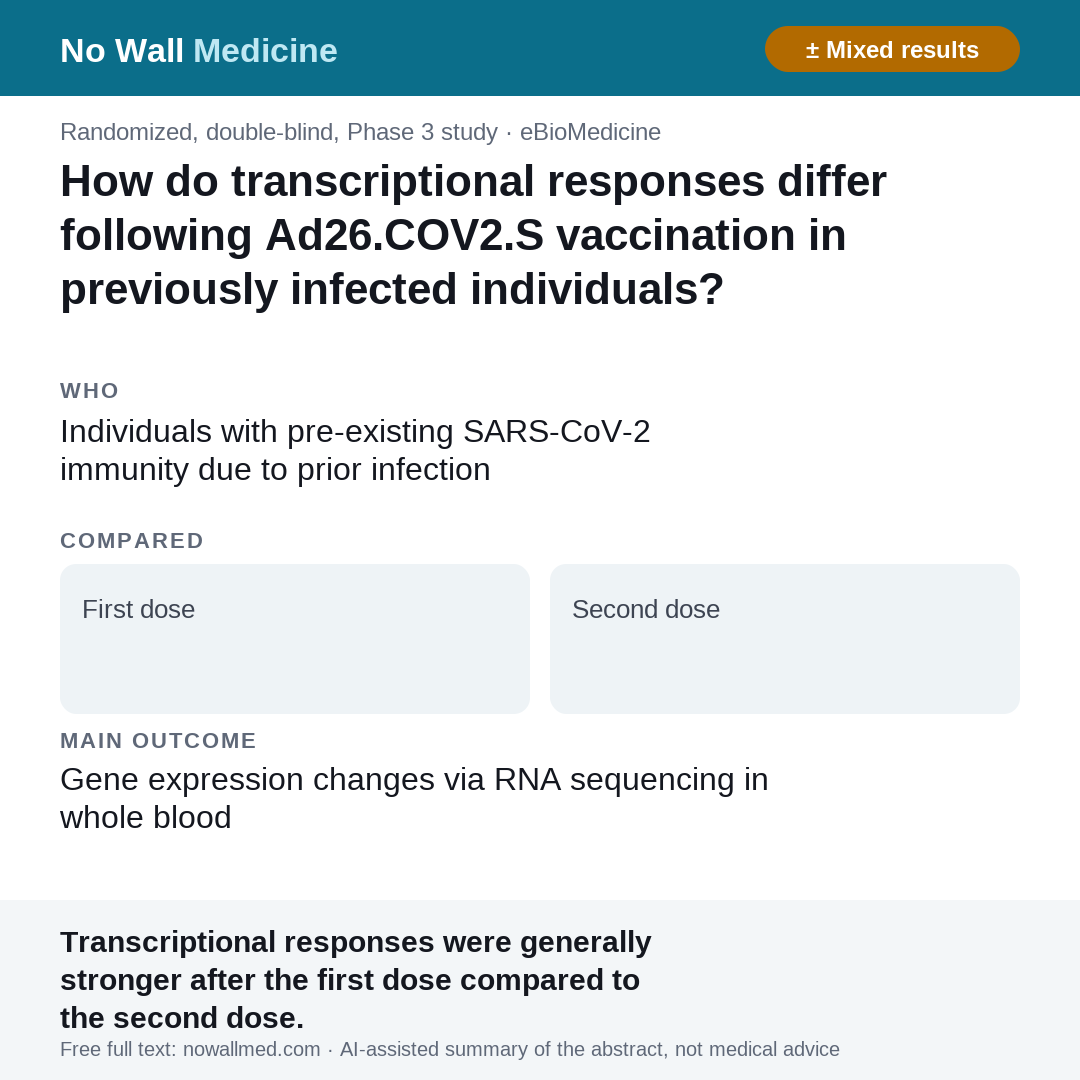
Early transcriptional responses following Ad26.COV2.S vaccination in individuals with prior SARS-CoV-2 infection
Randomized, double-blind, Phase 3 studyMixed results
How do transcriptional responses differ following Ad26.COV2.S vaccination in previously infected individuals?
Who
Individuals with pre-existing SARS-CoV-2 immunity due to prior infection
Compared
First dose
Second dose
Main outcome
Gene expression changes via RNA sequencing in whole blood
Bottom line: Transcriptional responses were generally stronger after the first dose compared to the second dose.
Funded by: Johnson & Johnson Innovative Medicine
eBioMedicine · 2026-05-04Download image
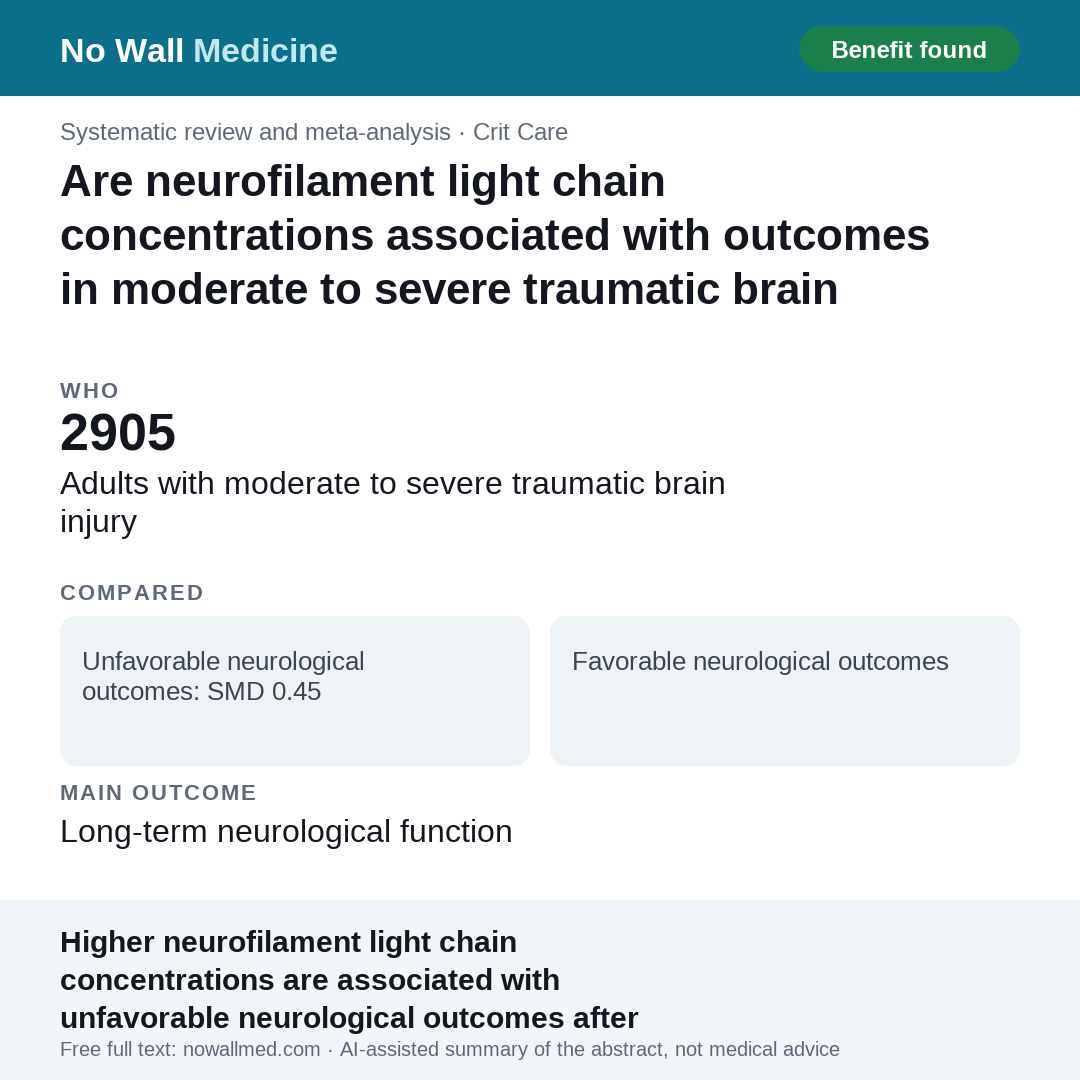
Association between neurofilament light chain concentrations and outcomes in patients with moderate to severe traumatic brain injury: a systematic review and meta-analysis
Systematic review and meta-analysisBenefit found
Are neurofilament light chain concentrations associated with outcomes in moderate to severe traumatic brain injury?
Who
2905
Adults with moderate to severe traumatic brain injury
Compared
Unfavorable neurological outcomes: SMD 0.45
Favorable neurological outcomes
Main outcome
Long-term neurological function
Result: SMD 0.45 (95% CI 0.33-0.56)
Bottom line: Higher neurofilament light chain concentrations are associated with unfavorable neurological outcomes after moderate-to-severe traumatic brain injury.
Limitation: Certainty of evidence was very low due to risk of bias, inconsistency, and imprecision.
Crit Care · 2026-05-04Download image
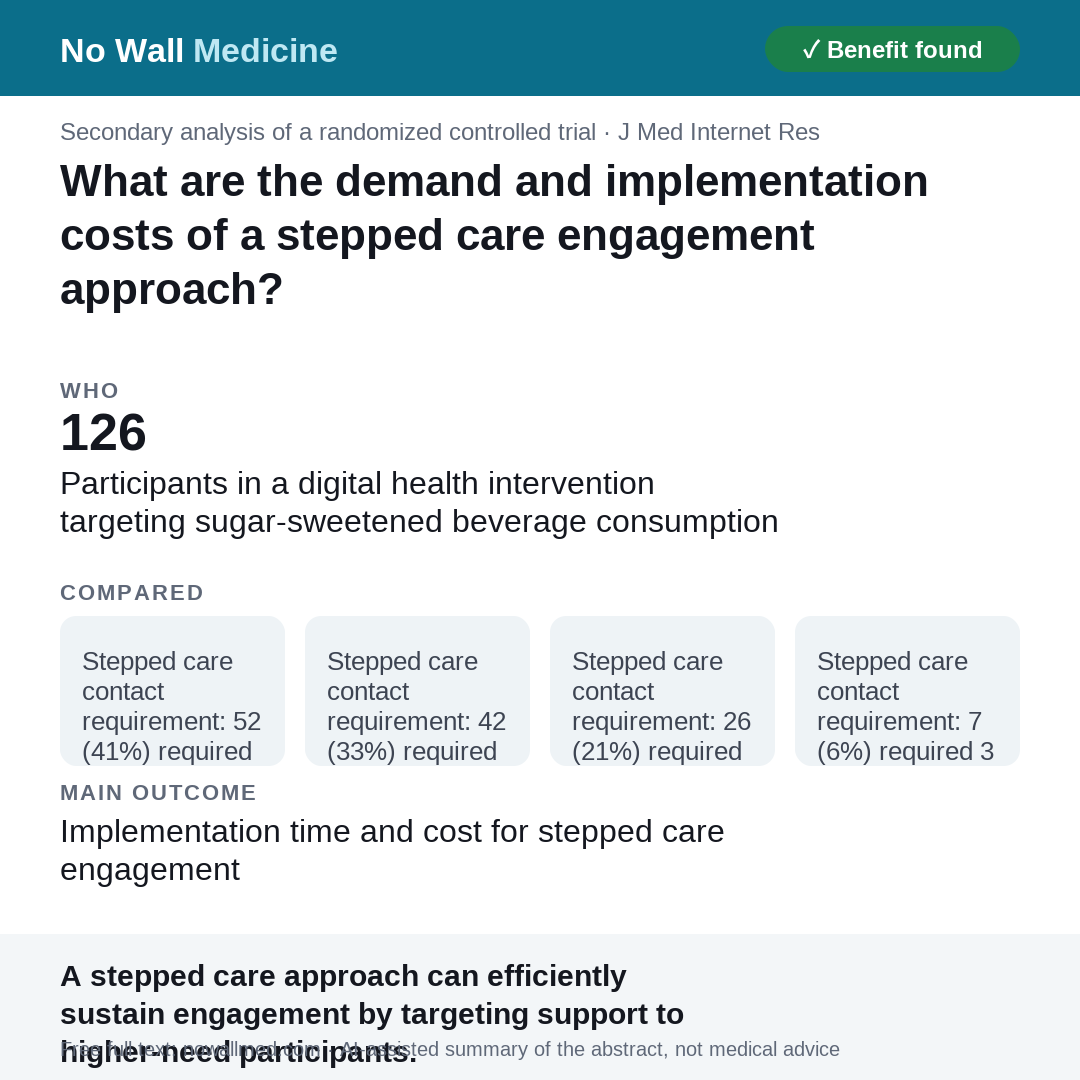
A Stepped Care Approach to Promoting Engagement in a Digital Health Intervention: Secondary Analysis of a Randomized Controlled Trial
Secondary analysis of a randomized controlled trialBenefit found
What are the demand and implementation costs of a stepped care engagement approach?
Who
126
Participants in a digital health intervention targeting sugar-sweetened beverage consumption · Rural Appalachia
Compared
Stepped care contact requirement: 52 (41%) required none
Stepped care contact requirement: 42 (33%) required 1 Core contact
Stepped care contact requirement: 26 (21%) required 2
Stepped care contact requirement: 7 (6%) required 3
Main outcome
Implementation time and cost for stepped care engagement
Bottom line: A stepped care approach can efficiently sustain engagement by targeting support to higher-need participants.
J Med Internet Res · 2026-05-04Download image
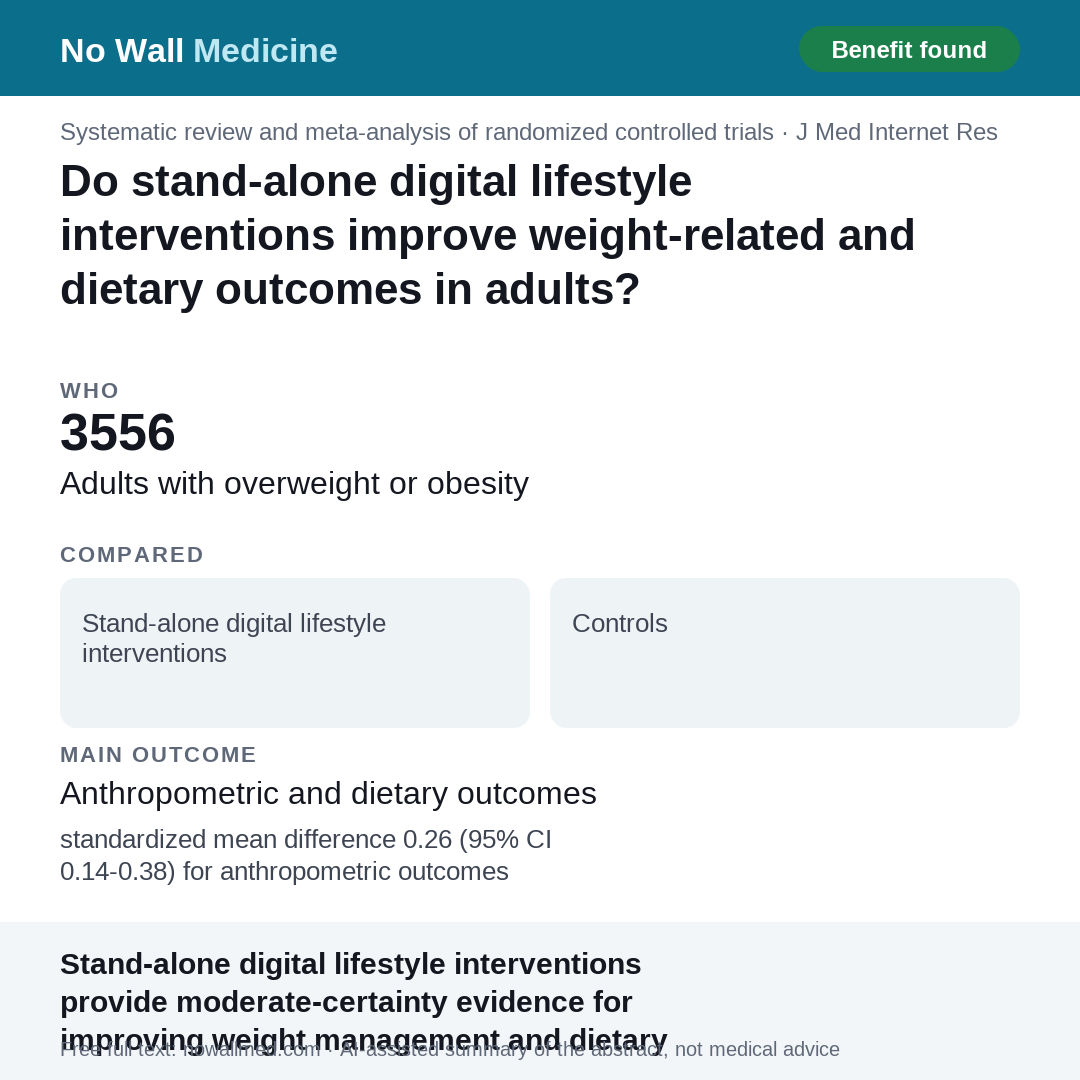
Effects of Stand-Alone Digital Lifestyle Interventions on Weight-Related Outcomes in Adults With Overweight or Obesity: Systematic Review and Meta-Analysis of Randomized Controlled Trials
Systematic review and meta-analysis of randomized controlled trialsBenefit found
Do stand-alone digital lifestyle interventions improve weight-related and dietary outcomes in adults?
Who
3556
Adults with overweight or obesity
Compared
Stand-alone digital lifestyle interventions
Controls
Main outcome
Anthropometric and dietary outcomes
Result: standardized mean difference 0.26 (95% CI 0.14-0.38) for anthropometric outcomes
Bottom line: Stand-alone digital lifestyle interventions provide moderate-certainty evidence for improving weight management and dietary outcomes without human intervention.
Limitation: Substantial statistical heterogeneity was observed and prediction intervals included zero.
J Med Internet Res · 2026-05-04Download image
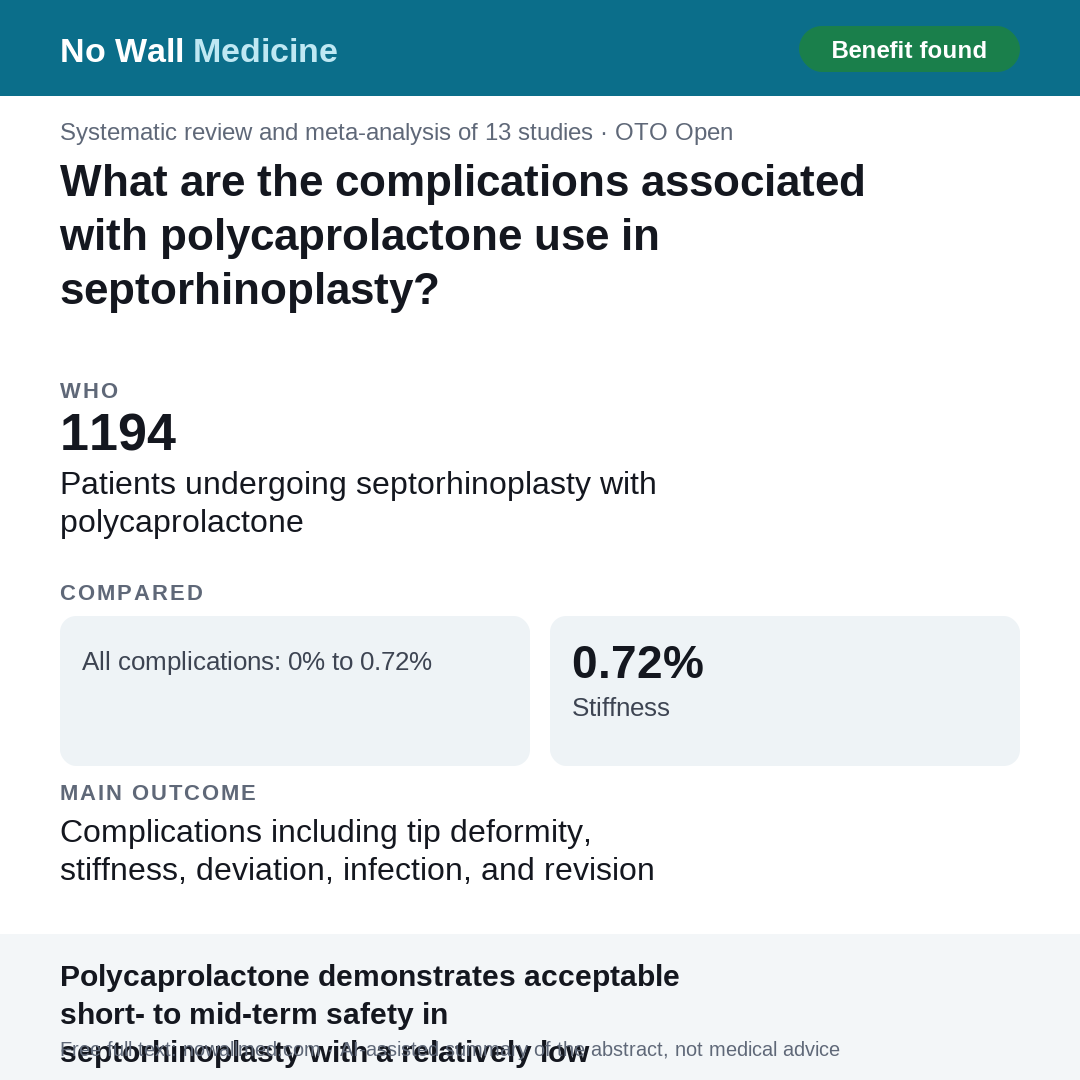
Complications Associated With Polycaprolactone (PCL) Use in Septorhinoplasty: A Systematic Review and Meta-Analysis
Systematic review and meta-analysis of 13 studiesBenefit found
What are the complications associated with polycaprolactone use in septorhinoplasty?
Who
1194
Patients undergoing septorhinoplasty with polycaprolactone
Compared
All complications: 0% to 0.72%
0.72%Stiffness (95% CI 0.59-0.85)
Main outcome
Complications including tip deformity, stiffness, deviation, infection, and revision
Bottom line: Polycaprolactone demonstrates acceptable short- to mid-term safety in septorhinoplasty with a relatively low proportion of complications.
Limitation: Subgroup analysis by surgical approach, procedure type, and material type could not be performed.
OTO Open · 2026-05-04Download image
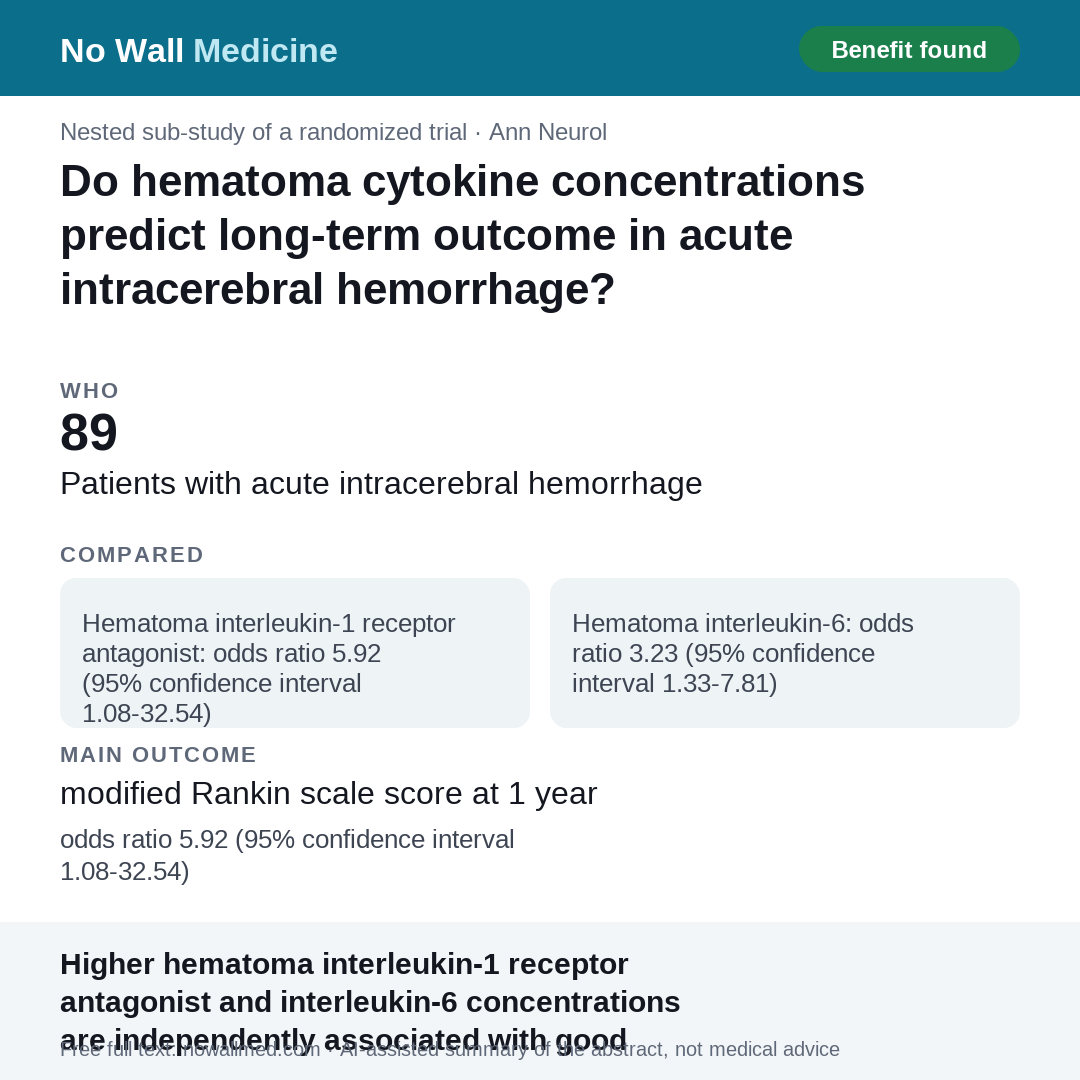
Hematoma Interleukin-1 Receptor Antagonist Concentrations Predict Long-Term Outcome in Acute Human Intracerebral Hemorrhage
Nested sub-study of a randomized trialBenefit found
Do hematoma cytokine concentrations predict long-term outcome in acute intracerebral hemorrhage?
Who
89
Patients with acute intracerebral hemorrhage
Compared
Hematoma interleukin-1 receptor antagonist: odds ratio 5.92 (95% confidence interval 1.08-32.54)
Hematoma interleukin-6: odds ratio 3.23 (95% confidence interval 1.33-7.81)
Main outcome
modified Rankin scale score at 1 year
Result: odds ratio 5.92 (95% confidence interval 1.08-32.54)
Bottom line: Higher hematoma interleukin-1 receptor antagonist and interleukin-6 concentrations are independently associated with good outcomes at 1 year.
Ann Neurol · 2026-05-03Download image
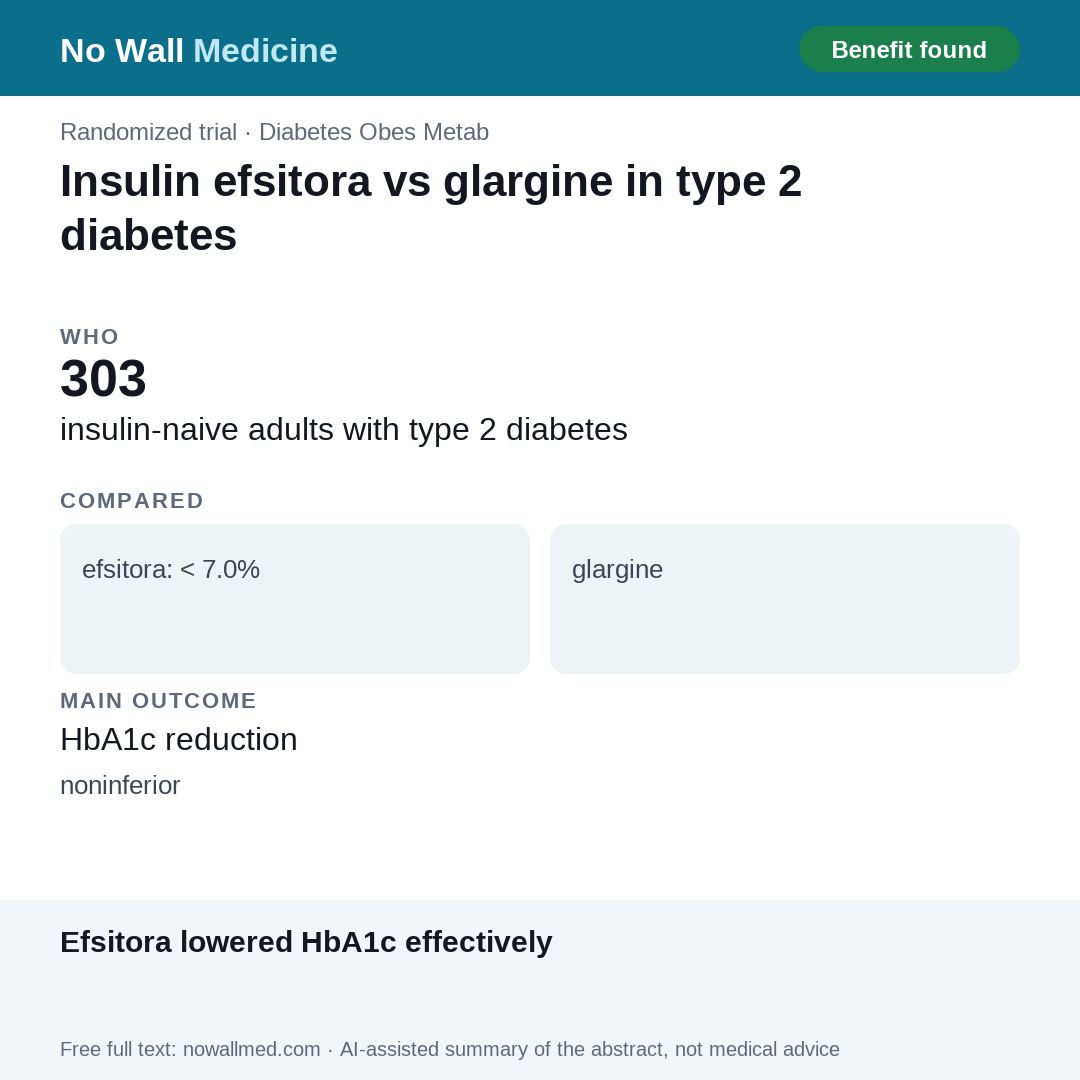
Glycaemic Control According to the Final Insulin Dose Using an Innovative Fixed-Dose Titration of Weekly Insulin Efsitora in Insulin-Naïve Type 2 Diabetes
Randomized trialBenefit found
Insulin efsitora vs glargine in type 2 diabetes
Who
303
insulin-naive adults with type 2 diabetes
Compared
efsitora: < 7.0%
glargine
Main outcome
HbA1c reduction
Result: noninferior
Bottom line: Efsitora lowered HbA1c effectively
Diabetes Obes Metab · 2026-05-03Download image
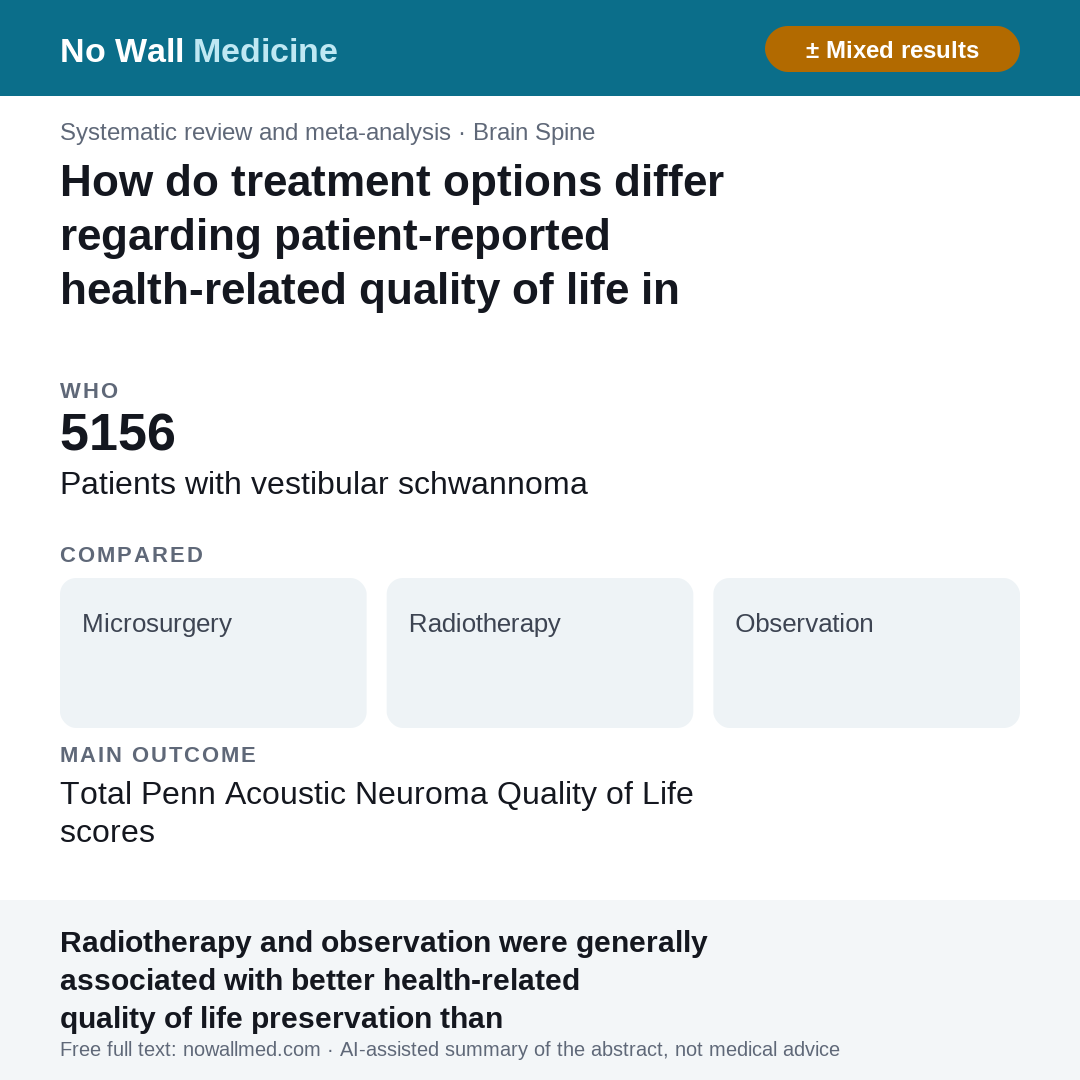
Health-related quality of life disparities among vestibular schwannoma patients under different treatment regimens: A systematic review and meta-analysis
Systematic review and meta-analysisMixed results
How do treatment options differ regarding patient-reported health-related quality of life in vestibular schwannoma?
Who
5156
Patients with vestibular schwannoma
Compared
Microsurgery
Radiotherapy
Observation
Main outcome
Total Penn Acoustic Neuroma Quality of Life scores
Result: microsurgery vs radiotherapy g = -0.43, microsurgery vs observation g = -1.58, radiotherapy vs observation g = -0.34
Bottom line: Radiotherapy and observation were generally associated with better health-related quality of life preservation than microsurgery.
Limitation: Heterogeneity across analyses was substantial (I2 = 0.90-0.98).
Brain Spine · 2026-05-03Download image
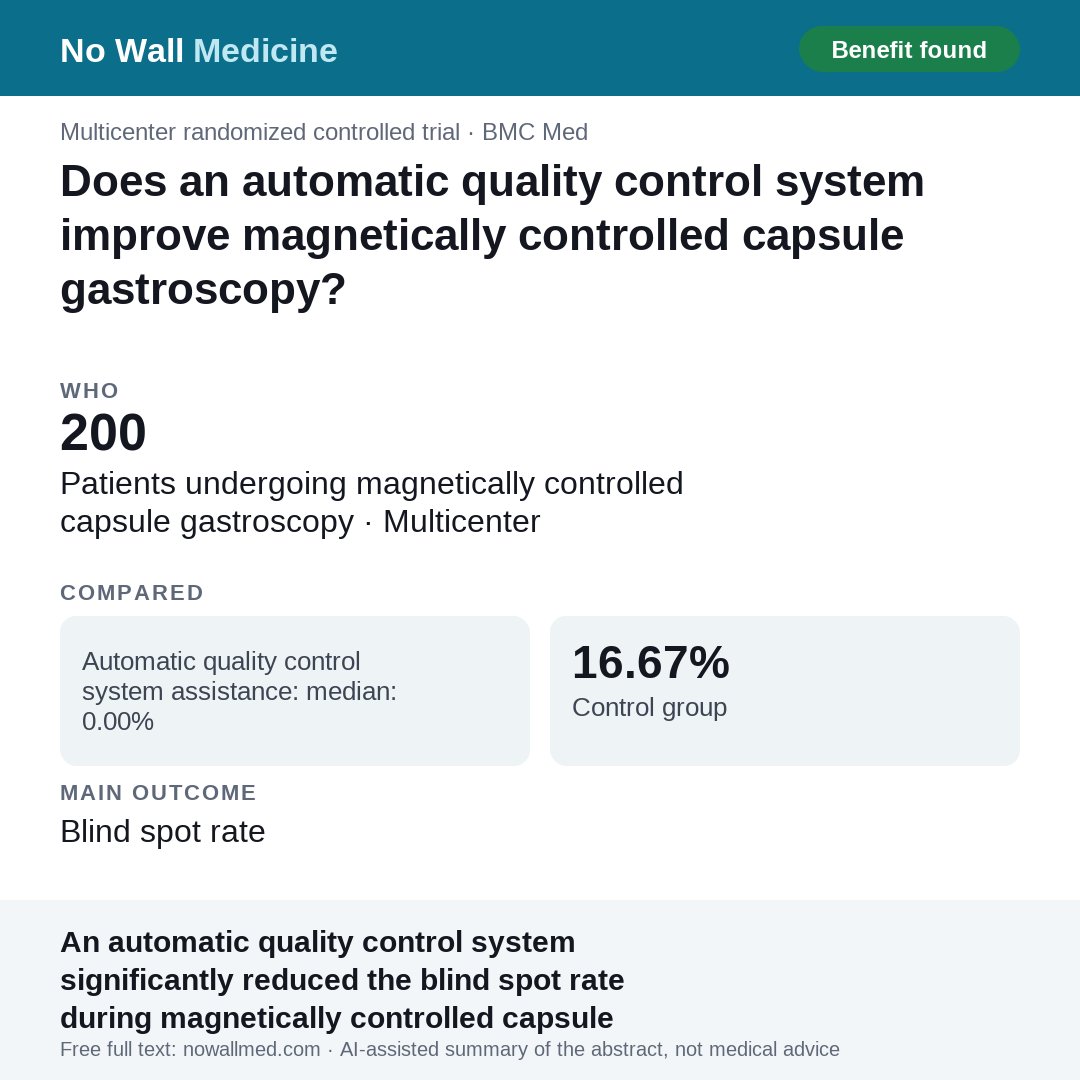
Impact of a real-time automatic quality control system for magnetically controlled capsule gastroscopy: a multicenter randomized controlled trial
Multicenter randomized controlled trialBenefit found
Does an automatic quality control system improve magnetically controlled capsule gastroscopy?
Who
200
Patients undergoing magnetically controlled capsule gastroscopy · Multicenter
Compared
Automatic quality control system assistance: median: 0.00%
16.67%Control group
Main outcome
Blind spot rate
Bottom line: An automatic quality control system significantly reduced the blind spot rate during magnetically controlled capsule gastroscopy procedures.
BMC Med · 2026-05-02Download image
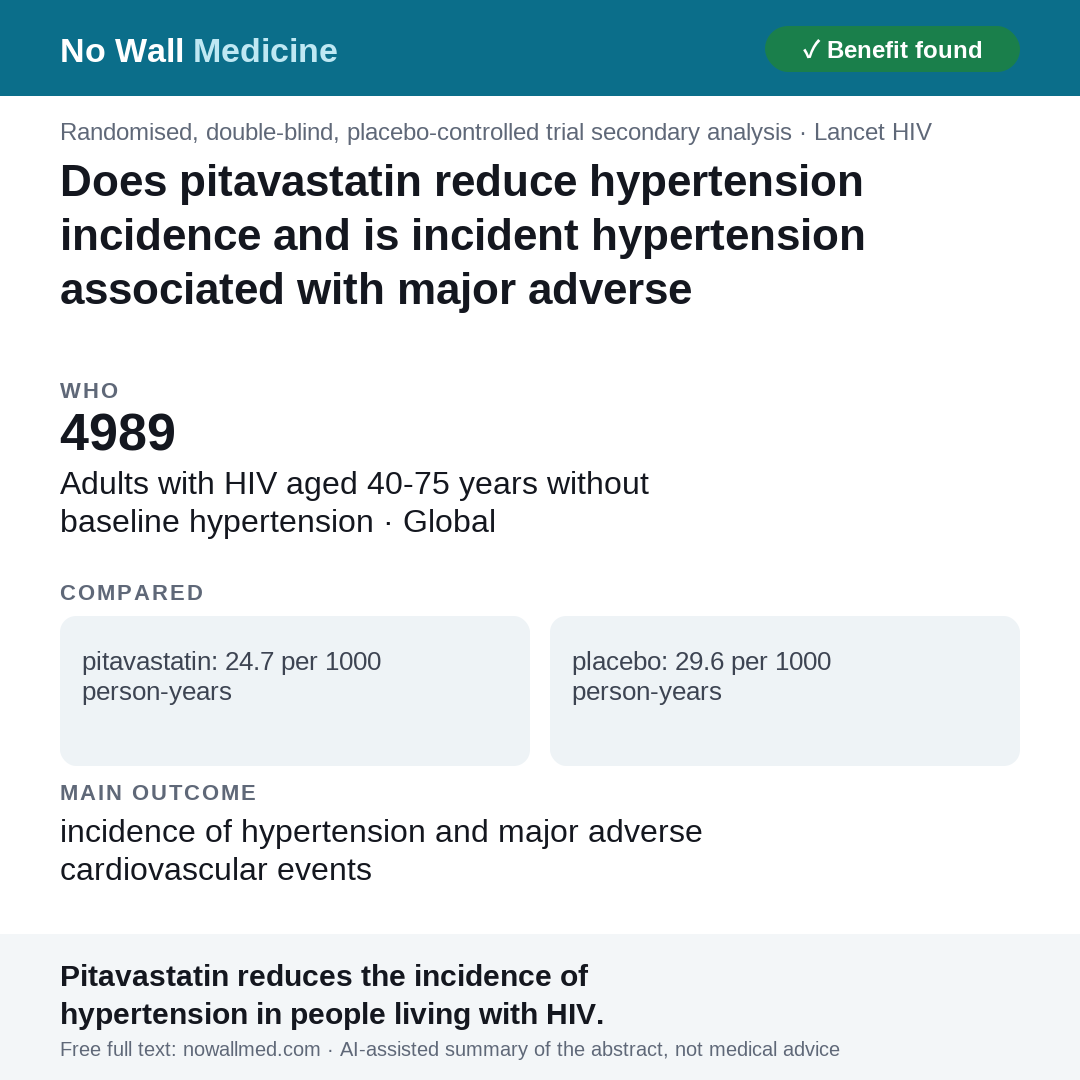
Incidence, risk factors, and cardiovascular impact of hypertension in people with HIV: a secondary analysis of the REPRIEVE trial
Randomised, double-blind, placebo-controlled trial secondary analysisBenefit found
Does pitavastatin reduce hypertension incidence and is incident hypertension associated with major adverse cardiovascular events?
Who
4989
Adults with HIV aged 40-75 years without baseline hypertension · Global
Compared
pitavastatin: 24.7 per 1000 person-years
placebo: 29.6 per 1000 person-years
Main outcome
incidence of hypertension and major adverse cardiovascular events
Result: cause-specific hazard ratio 0.83 (95% CI 0.71-0.97)
Bottom line: Pitavastatin reduces the incidence of hypertension in people living with HIV.
Lancet HIV · 2026-05-02Download image
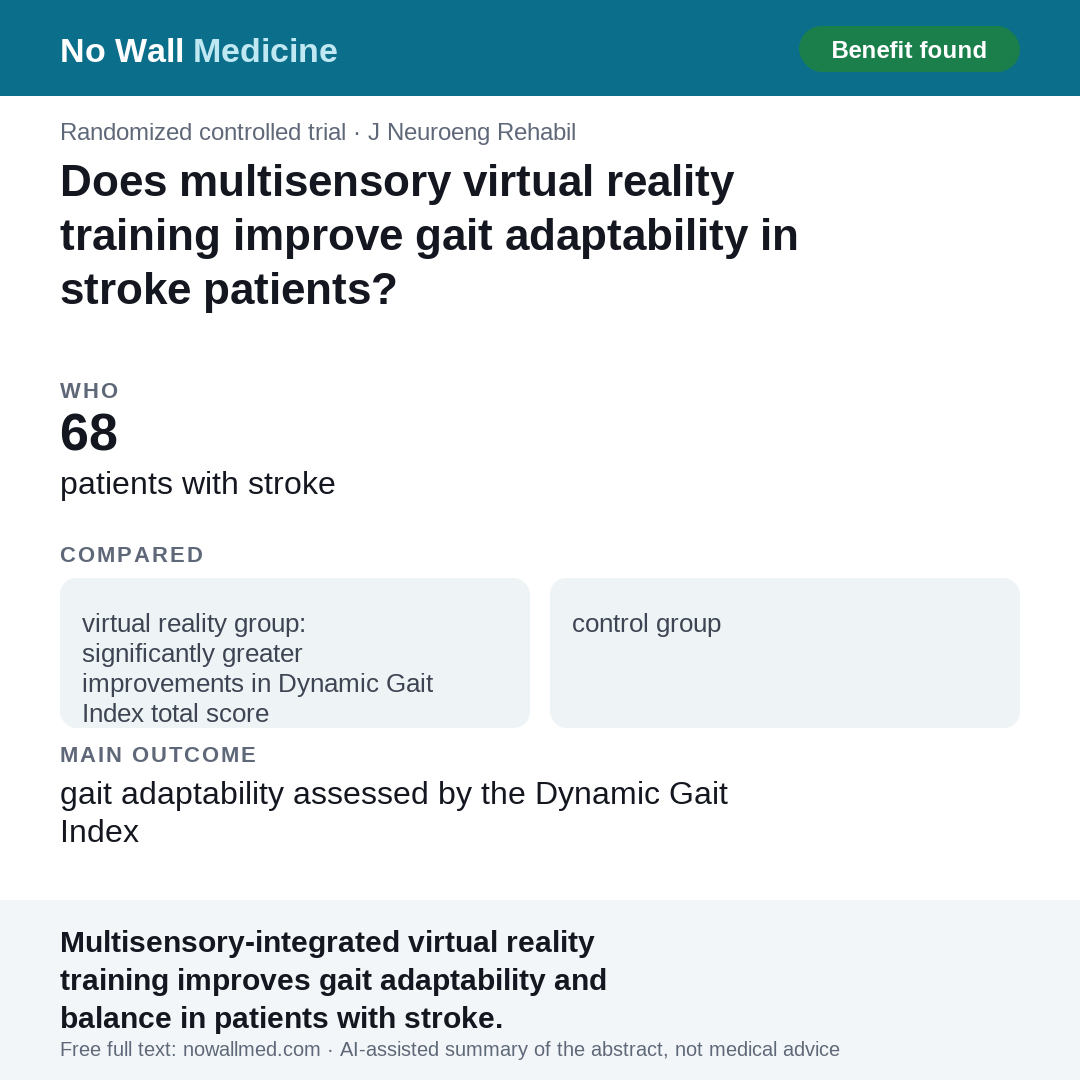
Effects of multi-sensory virtual reality training on gait adaptability and somatomotor network remodeling in patients with stroke: a randomized controlled trial
Randomized controlled trialBenefit found
Does multisensory virtual reality training improve gait adaptability in stroke patients?
Who
68
patients with stroke
Compared
virtual reality group: significantly greater improvements in Dynamic Gait Index total score
control group
Main outcome
gait adaptability assessed by the Dynamic Gait Index
Bottom line: Multisensory-integrated virtual reality training improves gait adaptability and balance in patients with stroke.
Limitation: Improvements were not sustained under the most conservative assumptions about missing data.
J Neuroeng Rehabil · 2026-05-02Download image
Group-Based Suicide Safety Planning and Skills Training for Veterans With High Suicide Risk: A Randomized Clinical Trial
Multisite randomized clinical trialMixed results
Does Project Life Force plus treatment as usual delay or decrease suicidal behavior?
Who
207
Veterans at high risk for suicide · 4 Veterans Health Administration outpatient care teams
Compared
Project Life Force plus treatment as usual
Treatment as usual alone
Main outcome
time in days to first suicidal behavior
Result: hazard ratio 0.49 (95% CI 0.26-0.92)
Bottom line: Project Life Force plus treatment as usual did not change time to suicidal behavior but decreased hazard of actual suicide attempts.
JAMA Netw Open · 2026-05-01Download image

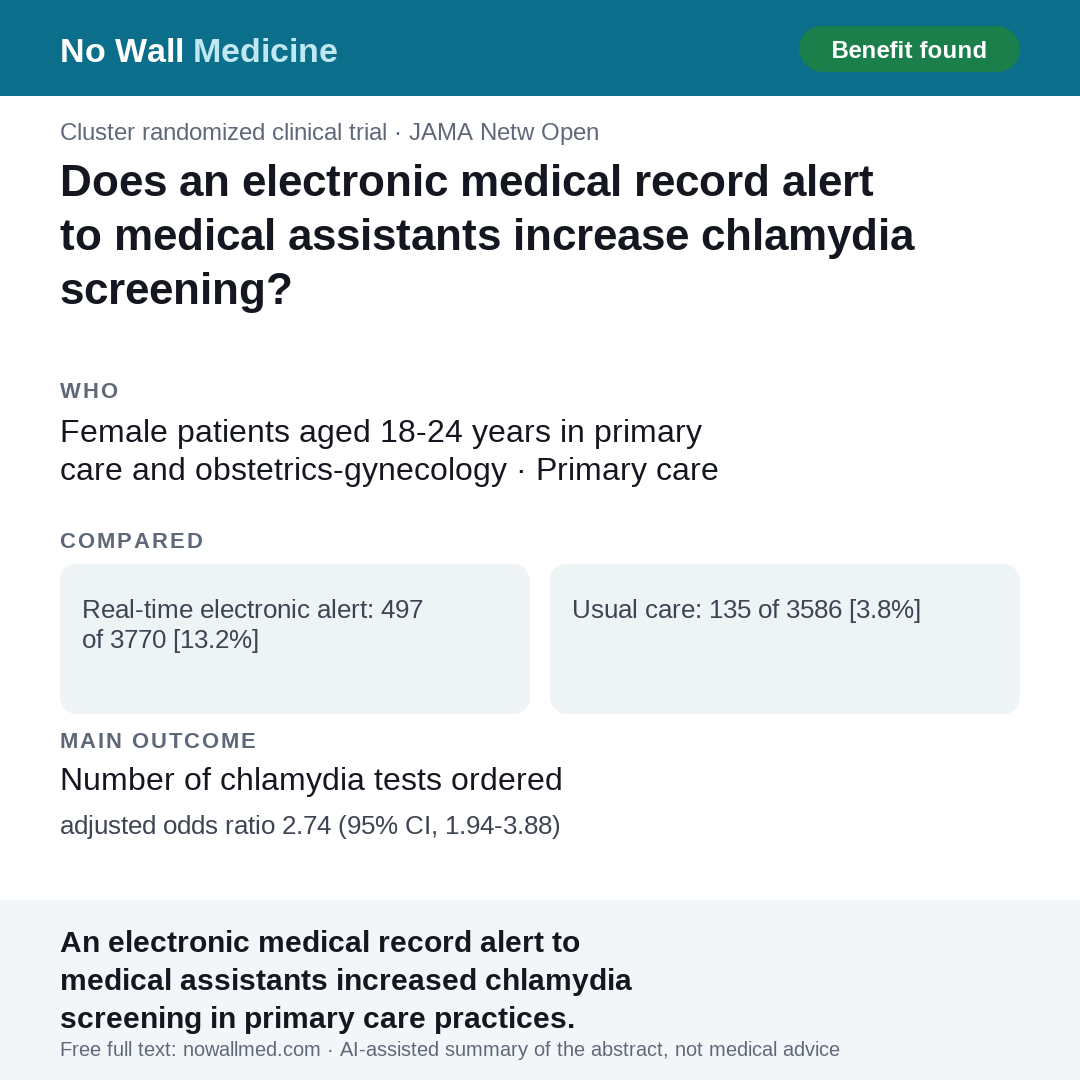
A Staff-Directed Electronic Medical Record Alert to Increase Chlamydia Screening: A Randomized Clinical Trial
Cluster randomized clinical trialBenefit found
Does an electronic medical record alert to medical assistants increase chlamydia screening?
Who
Female patients aged 18-24 years in primary care and obstetrics-gynecology · Primary care and obstetrics-gynecology offices in western Pennsylvania
Compared
Real-time electronic alert: 497 of 3770 [13.2%]
Usual care: 135 of 3586 [3.8%]
Main outcome
Number of chlamydia tests ordered
Result: adjusted odds ratio 2.74 (95% CI, 1.94-3.88)
Bottom line: An electronic medical record alert to medical assistants increased chlamydia screening in primary care practices.
Limitation: The alert did not affect screening in obstetrics-gynecology practices.
JAMA Netw Open · 2026-05-01Download image
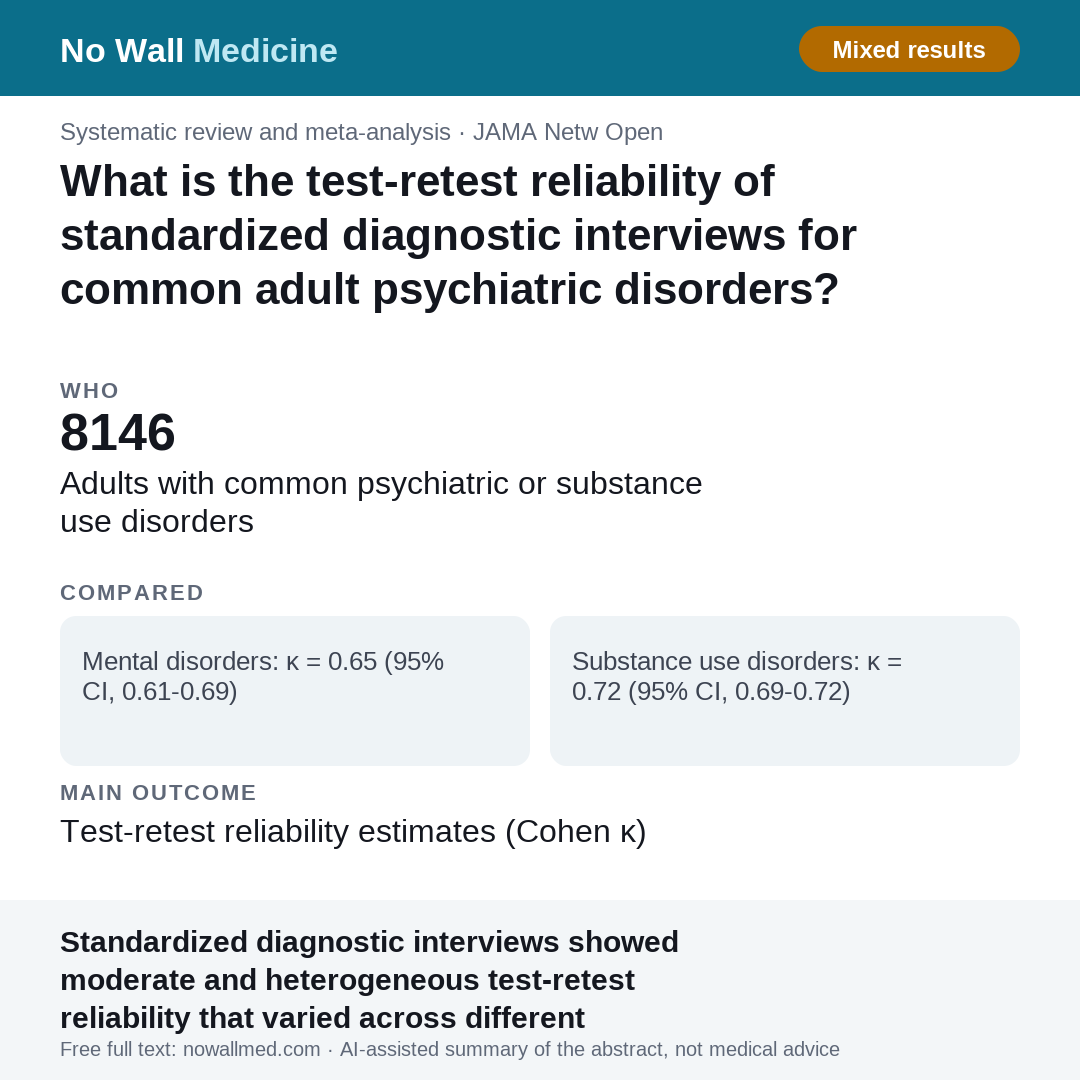
Test-Retest Reliability of Standardized Diagnostic Interviews for Common Adult Psychiatric Disorders: A Systematic Review and Meta-Analysis
Systematic review and meta-analysisMixed results
What is the test-retest reliability of standardized diagnostic interviews for common adult psychiatric disorders?
Who
8146
Adults with common psychiatric or substance use disorders
Compared
Mental disorders: κ = 0.65 (95% CI, 0.61-0.69)
Substance use disorders: κ = 0.72 (95% CI, 0.69-0.72)
Main outcome
Test-retest reliability estimates (Cohen κ)
Result: κ = 0.69 (95% CI, 0.66-0.72)
Bottom line: Standardized diagnostic interviews showed moderate and heterogeneous test-retest reliability that varied across different psychiatric disorders.
Limitation: Substantial between-study heterogeneity was observed.
JAMA Netw Open · 2026-05-01Download image
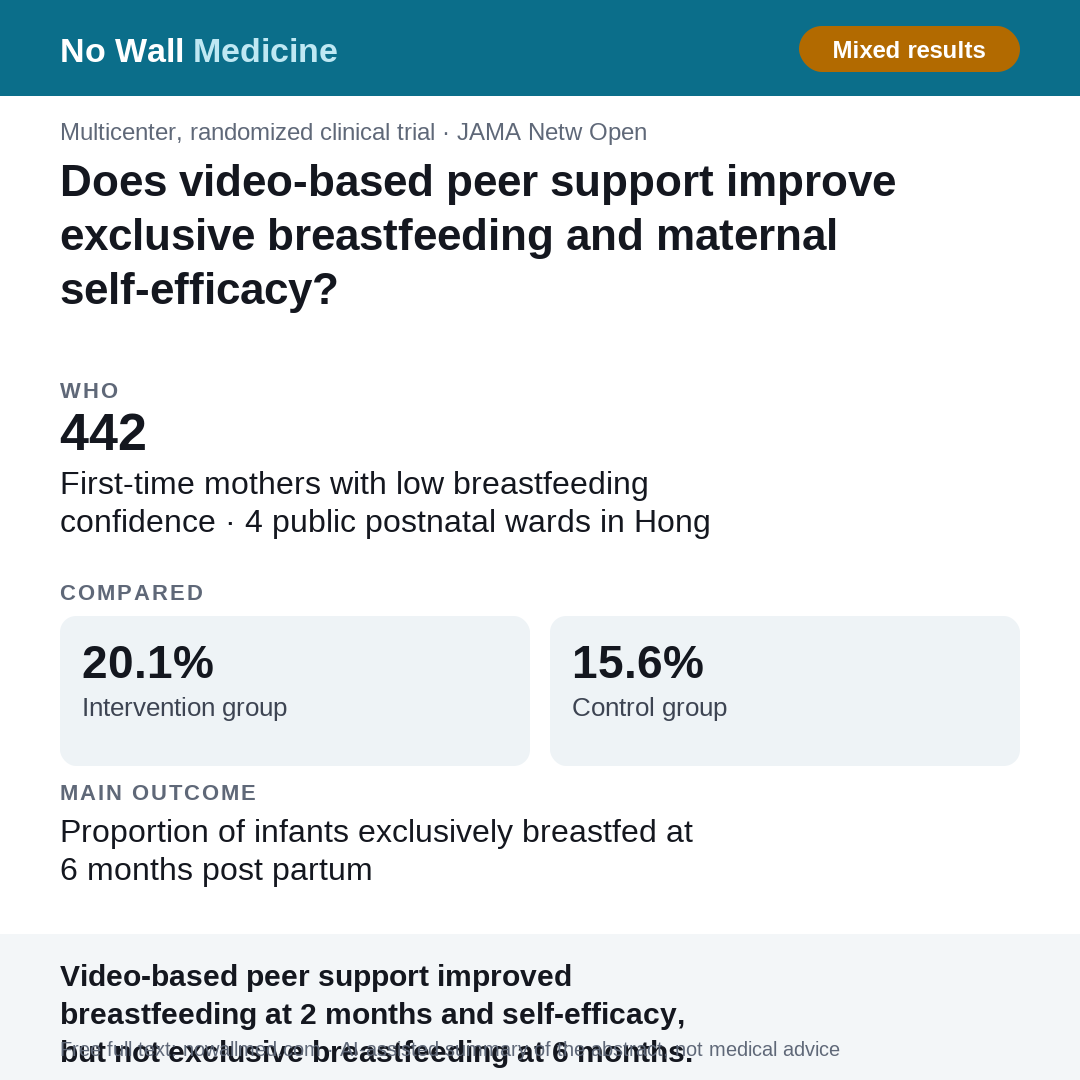
Video-Based Peer Support and Exclusive Breastfeeding and Maternal Self-Efficacy: A Randomized Clinical Trial
Multicenter, randomized clinical trialMixed results
Does video-based peer support improve exclusive breastfeeding and maternal self-efficacy?
Who
442
First-time mothers with low breastfeeding confidence · 4 public postnatal wards in Hong Kong
Compared
20.1%Intervention group
15.6%Control group
Main outcome
Proportion of infants exclusively breastfed at 6 months post partum
Result: adjusted odds ratio 1.57 (95% CI 0.85-2.89)
Bottom line: Video-based peer support improved breastfeeding at 2 months and self-efficacy, but not exclusive breastfeeding at 6 months.
JAMA Netw Open · 2026-05-01Download image
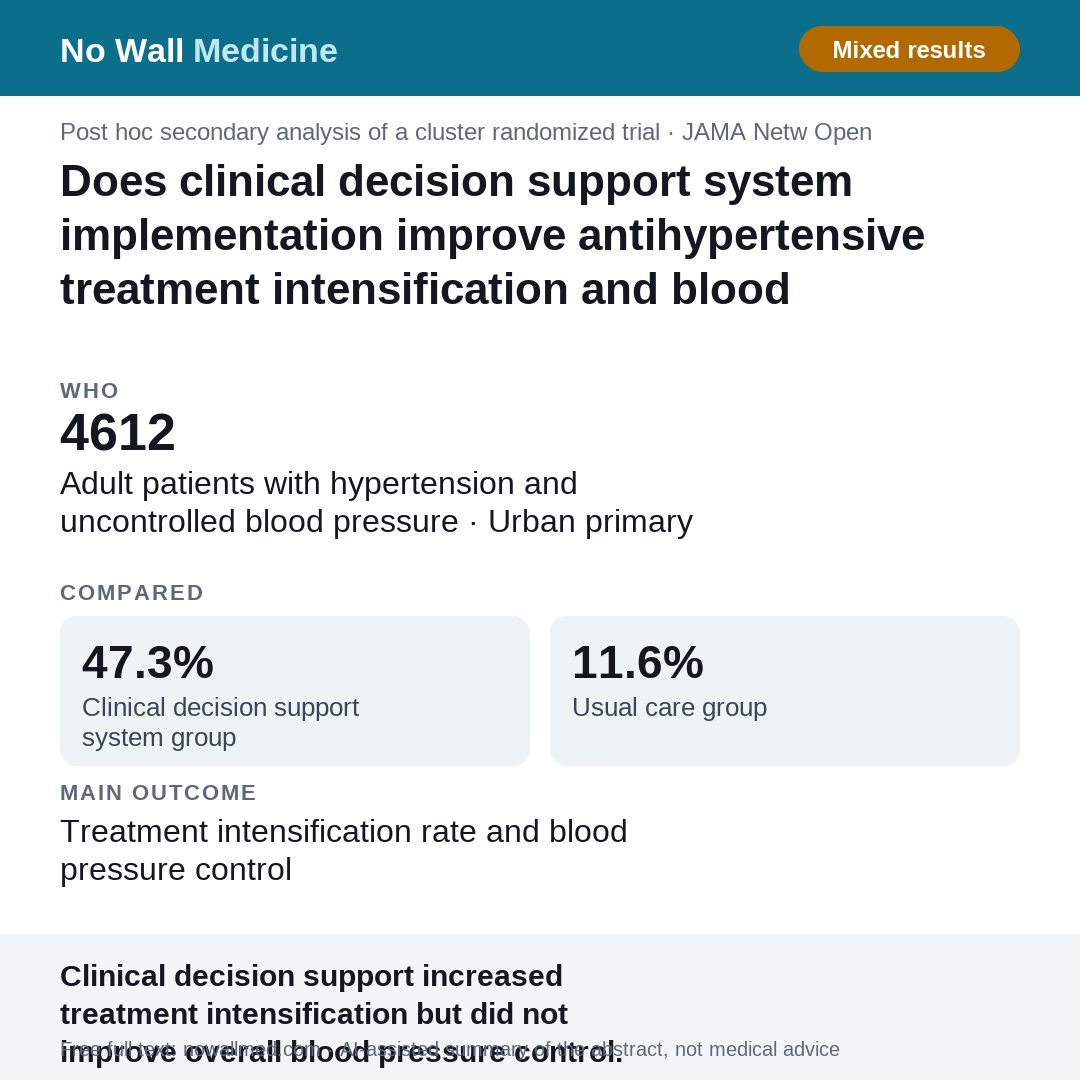
Clinical Decision Support System, Antihypertensive Treatment Intensification, and Blood Pressure Control: A Post Hoc Secondary Analysis of a Cluster Randomized Trial
Post hoc secondary analysis of a cluster randomized clinical trialMixed results
Does clinical decision support system implementation improve antihypertensive treatment intensification and blood pressure control?
Who
4612
Adult patients with hypertension and uncontrolled blood pressure · Urban primary care practices in China
Compared
47.3%Clinical decision support system group (95% CI, 40.1%-54.6%)
11.6%Usual care group (95% CI, 8.9%-14.9%)
Main outcome
Treatment intensification rate and blood pressure control
Result: adjusted odds ratio 6.87 (95% CI, 4.90-9.64)
Bottom line: Clinical decision support increased antihypertensive treatment intensification but did not improve overall blood pressure control.
Limitation: This was a post hoc secondary analysis of a cluster randomized clinical trial.
JAMA Netw Open · 2026-05-01Download image
Once-Weekly Semaglutide in Adults With Daily Cigarette Use: A Randomized Clinical Trial
Phase 2a randomized clinical trialMixed results
Does semaglutide versus placebo affect smoking, craving, and weight in smokers?
Who
24
Non-treatment-seeking adults consuming at least 5 cigarettes per day · Academic medical center
Compared
Semaglutide: reduced nicotine craving (β = -0.11 [95% CI, -0.20 to -0.03]) and body weight (β = -0.04 [95% CI, -0.05 to -0.03])
Placebo
Main outcome
Smoking resistance, reinstatement, self-administration, cigarette use, craving, and weight
Result: smoking resistance β = 0.16 (95% CI, -0.07 to 0.40)
Bottom line: Semaglutide reduced nicotine craving and body weight but did not significantly increase smoking resistance or reduce cigarettes per day.
JAMA Netw Open · 2026-05-01Download image

Augmented Reality-Guided Decision Support in Simulated Pediatric Cardiac Arrest: A Randomized Clinical Trial
Randomized clinical trialNo clear difference
Does AR support improve resuscitation performance
Who
54
Pediatric nurses and physicians teams · Two pediatric emergency centers
Compared
AR support: 97.2 (38.5) seconds
Control: 113.8 (44.5) seconds
Main outcome
Time to first epinephrine
Result: mean difference, -16.6 seconds; 95% CI, -51.3 to 17.0 seconds
Bottom line: AR support did not improve time to first epinephrine
JAMA Netw Open · 2026-05-01Download image