Visual abstracts
New randomized trials and meta-analyses from leading journals at a glance: who was studied, what was compared, and what was found. Every paper is free to read in full.
All specialtiesCardiology 4877Oncology 4138Gastroenterology & Hepatology 1942Infectious Disease 3837Neurology 1905Psychiatry & Mental Health 2273Pulmonology 2143Critical Care 1365Endocrinology & Diabetes 2580Pediatrics 2980Surgery 2559Orthopedics & Sports Medicine 931Neurosurgery 537Cardiothoracic & Vascular Surgery 674Plastic & Reconstructive Surgery 591Nephrology 1133Rheumatology 823Hematology 1109Dermatology 621Ophthalmology 543Obstetrics & Gynecology 1686Public & Global Health 1058Radiology & Imaging 648Anesthesiology 986Urology 764ENT (Otolaryngology) 503Emergency Medicine 511Allergy & Immunology 313Geriatrics 981Family Medicine & Primary Care 562Medical Genetics & Genomics 676Pathology & Laboratory Medicine 159Physical Medicine & Rehabilitation 757Palliative Care 444Nutrition 1588Digital Health & AI 2201General Medicine 321
Breathing new life into pain management: a systematic review of nebulised ketamine for analgesia
Systematic reviewBenefit found
Is nebulised ketamine effective for reducing pain in adult emergency department patients?
Who
453
Adult emergency department patients · Emergency department
Compared
Nebulised ketamine: average reduction of 42.5% and 70.4%
Other treatments
Main outcome
Pain scores
Bottom line: Nebulised ketamine provides effective analgesia with a favourable safety profile for emergency department pain management.
Limitation: Further multicentre trials with larger populations are recommended to confirm findings.
Scand J Trauma Resusc Emerg Med · 2025-12-04Download image

The effects of ketogenic diet on polycystic ovary syndrome: A systematic review and meta-analysis
Systematic review and meta-analysisBenefit found
What are the effects of ketogenic diet on women with polycystic ovary syndrome?
Who
Women with polycystic ovary syndrome
Compared
Ketogenic diet
Other diets
Main outcome
Anthropometric, metabolic, and endocrinological outcomes
Result: MD: -1.65 (95% CI -2.76 to -0.55) for BMI
Bottom line: Ketogenic diet improves weight, insulin sensitivity, and reproductive hormone profiles in women with polycystic ovary syndrome.
Limitation: Considerable heterogeneity among included studies and variations in study quality.
Clin Nutr · 2025-12-03Download image

Specificity of environmental risk factors for schizophrenia, bipolar disorders, and depressive disorders - umbrella review
Meta-analysis of 70 meta-analysesMixed results
Risk factors for schizophrenia, bipolar, depressive disorders
Who
patients with schizophrenia, bipolar, depressive disorders
Compared
childhood maltreatment
pregnancy and birth complications
somatic conditions
Main outcome
risk of disorders
Bottom line: Childhood maltreatment is a transdiagnostic risk factor
Psychol Med · 2025-12-03Download image

Evaluating the use of virtual reality for weight management: A systematic review and meta-analysis
Systematic review and meta-analysisBenefit found
Does virtual reality enhance weight management compared to conventional treatments alone?
Who
Adults seeking weight loss
Compared
Virtual reality-enhanced treatment
Conventional treatments alone
Main outcome
Body weight and body mass index
Result: mean difference -5.16 kg (95% CI -8.46 to -1.85)
Bottom line: Virtual reality-enhanced treatment may be more effective for maintaining weight loss than conventional methods.
Limitation: Small number of studies with concerns regarding conduct, governance, and transparency.
Diabetes Obes Metab · 2025-12-03Download image

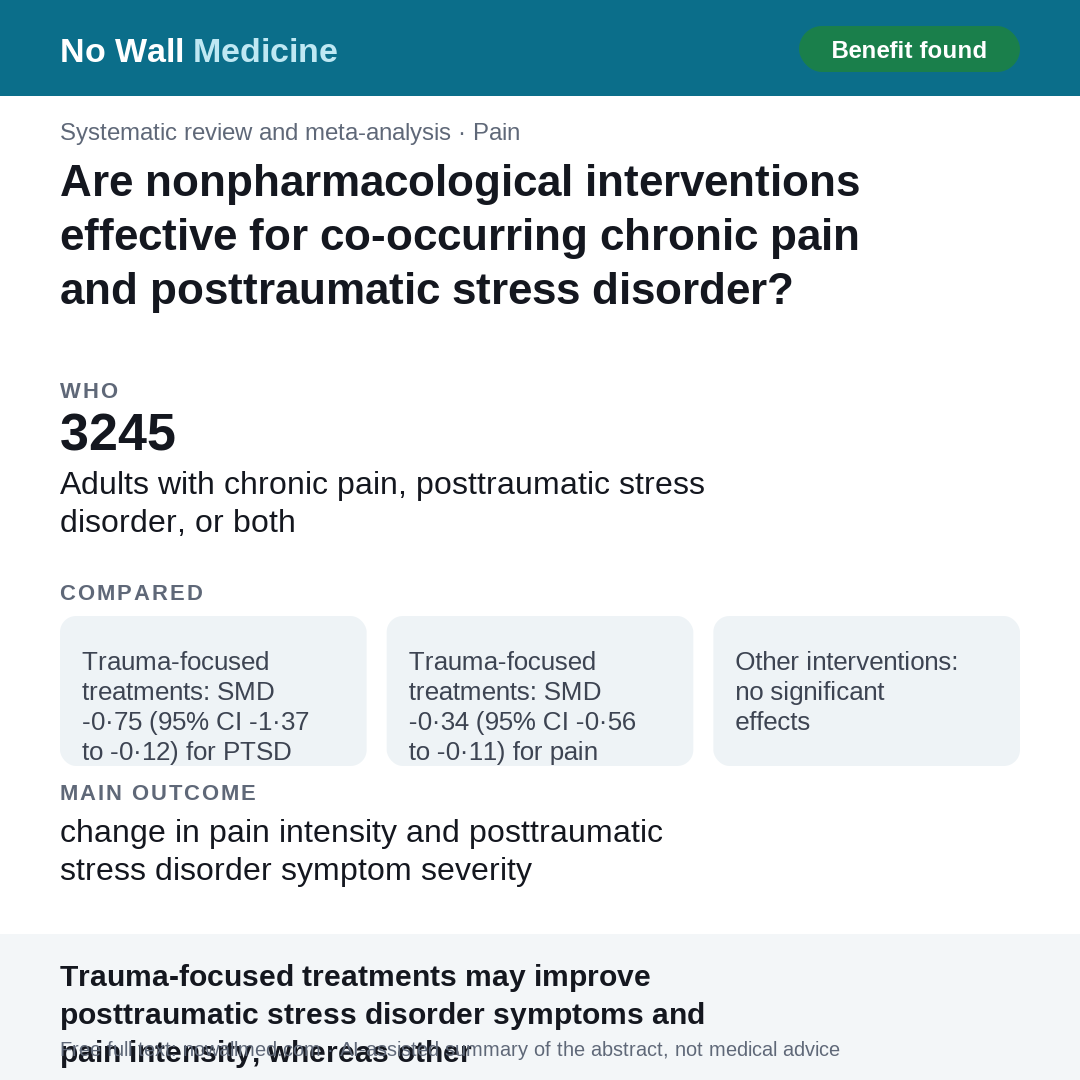
Systematic review and meta-analyses of nonpharmacological interventions for co-occurring chronic pain and posttraumatic stress disorder
Systematic review and meta-analysisBenefit found
Are nonpharmacological interventions effective for co-occurring chronic pain and posttraumatic stress disorder?
Who
3245
Adults with chronic pain, posttraumatic stress disorder, or both
Compared
Trauma-focused treatments: SMD -0·75 (95% CI -1·37 to -0·12) for PTSD
Trauma-focused treatments: SMD -0·34 (95% CI -0·56 to -0·11) for pain
Other interventions: no significant effects
Main outcome
change in pain intensity and posttraumatic stress disorder symptom severity
Result: SMD -0·75 (95% CI -1·37 to -0·12) for PTSD; SMD -0·34 (95% CI -0·56 to -0·11) for pain
Bottom line: Trauma-focused treatments may improve posttraumatic stress disorder symptoms and pain intensity, whereas other nonpharmacological therapies showed no significant effects.
Limitation: Most studies were methodologically weak and evidence quality was low.
Pain · 2025-12-03Download image
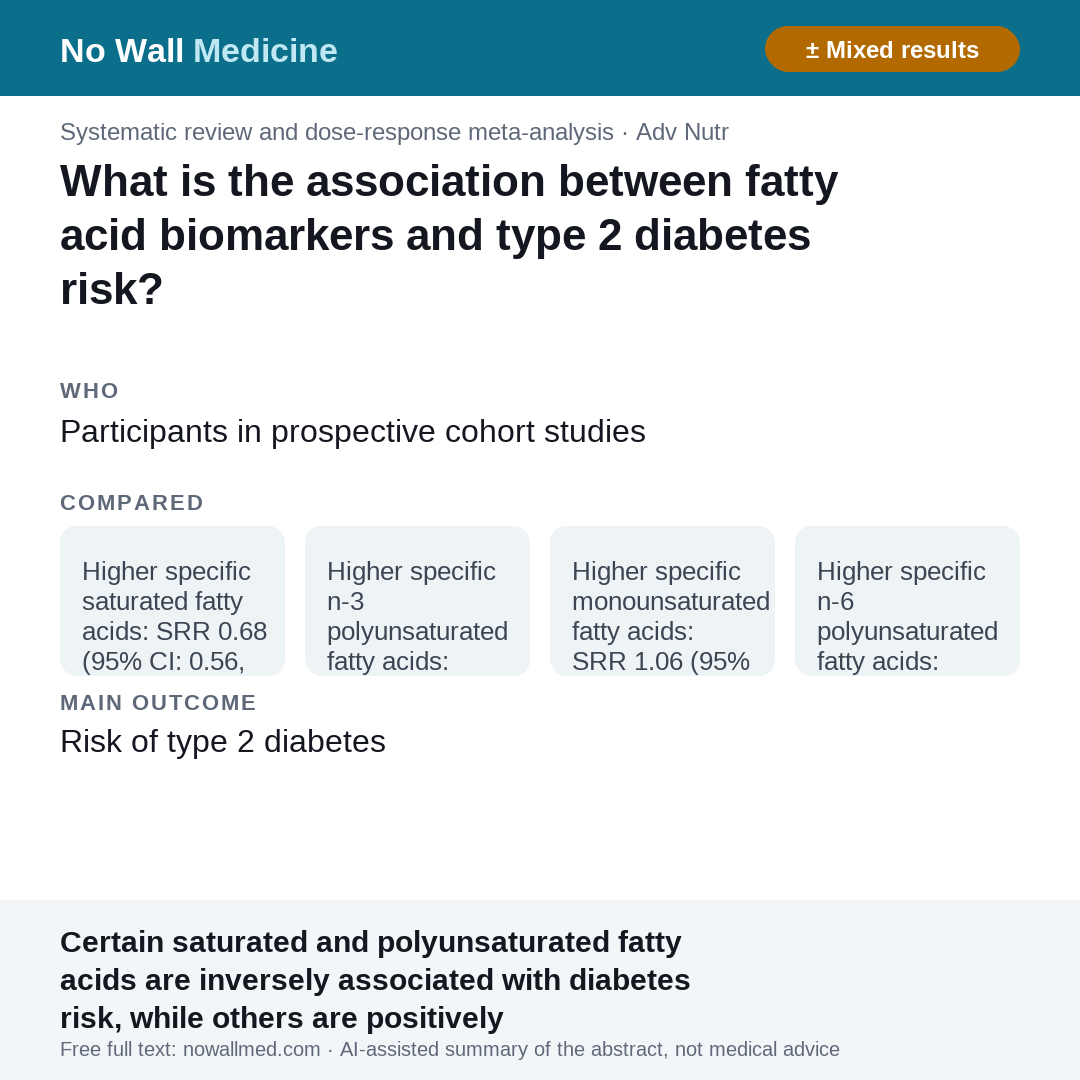
Fatty Acid Biomarkers and Incidence of Type 2 diabetes: A Systematic Review and Dose-Response Meta-analysis of Prospective Observational Studies
Systematic review and dose-response meta-analysisMixed results
What is the association between fatty acid biomarkers and type 2 diabetes risk?
Who
27
Participants in prospective cohort studies
Compared
Higher specific saturated fatty acids: SRR 0.68 (95% CI: 0.56, 0.81)
Higher specific n-3 polyunsaturated fatty acids: SRR 0.97 (95% CI: 0.95, 0.99)
Higher specific monounsaturated fatty acids: SRR 1.06 (95% CI: 1.03, 1.10)
Higher specific n-6 polyunsaturated fatty acids: SRR 1.07 (95% CI: 1.03, 1.11)
Main outcome
Risk of type 2 diabetes
Bottom line: Certain saturated and polyunsaturated fatty acids are inversely associated with diabetes risk, while others are positively associated.
Adv Nutr · 2025-12-03Download image
Prevention strategies and modifiable risk factors for upper extremity injury: a systematic review and meta-analysis for the Female, woman and/or girl Athlete Injury pRevention (FAIR) consensus
Systematic review and meta-analysisBenefit found
What are the injury prevention strategies and modifiable risk factors for female upper extremity injuries?
Who
33228
Female, woman and/or girl athletes
Compared
Shoulder exercise programmes: reduce shoulder injury rates by 51%
Control
Main outcome
shoulder injury rates
Result: 51% (95% CI 0.30 to 079)
Bottom line: Shoulder-specific strengthening and stability exercise programmes may reduce shoulder injury rates in female handball and volleyball players.
Limitation: Heterogeneity across injury outcomes, interventions, modifiable risk factors and limited female-specific data.
Br J Sports Med · 2025-12-03Download image

Prevention strategies and modifiable risk factors for concussion: a systematic review and meta-analysis for the Female, woman and girl/or Athlete Injury pRevention (FAIR) consensus
Systematic review and meta-analysisMixed results
What are the prevention strategies and modifiable risk factors for concussion in female athletes?
Who
Female, woman and/or girl athletes
Compared
Headgear use: 30% lower sport-related concussion rates
Eyewear use: not protective
Artificial turf versus grass: did not differ
Main outcome
sport-related concussion and head impact/head acceleration event outcomes
Result: headgear IRR=0.70 (95% CI 0.50 to 0.99); eyewear IRR=1.08 (95% CI 0.69 to 1.68); turf vs grass IRR=0.95 (95% CI 0.62 to 1.45)
Bottom line: Headgear may reduce concussion rates in adolescent female lacrosse and soccer, but evidence for other strategies remains limited.
Limitation: very-low certainty evidence
Br J Sports Med · 2025-12-03Download image

Epigenetic and blood markers associated with response to electroconvulsive therapy in patients with depressive disorders
Epigenome-wide association study and meta-analysisMixed results
What epigenetic and blood markers are associated with response to electroconvulsive therapy?
Who
99
Patients with depressive disorders · Norway and Germany
Compared
Norwegian cohort
German cohort
Main outcome
Percent clinical response and remission
Bottom line: DNA methylation and neutrophil to lymphocyte ratios are associated with electroconvulsive therapy response and remission.
Transl Psychiatry · 2025-12-03Download image

Systematic review and meta-analysis of effects of standalone digital mindfulness-based interventions on sleep in adults
Systematic review and meta-analysis of randomized controlled trialsBenefit found
Do standalone digital mindfulness-based interventions improve sleep and mental health in adults?
Who
4870
Adults
Compared
Standalone digital mindfulness-based interventions
Control
Main outcome
Sleep health and mental health
Result: Hedges' g = 0.38 for sleep and 0.33 for mental health
Bottom line: Standalone digital mindfulness-based interventions significantly improve sleep and mental health, though evidence certainty is very low.
Limitation: High heterogeneity and publication bias reduced the certainty of evidence to very low levels.
NPJ Digit Med · 2025-12-03Download image

Complications associated with anterior cervical spine surgery: A systematic review of literature
Systematic reviewMixed results
What are the frequency, etiology and outcomes of complications from anterior cervical spine surgery?
Who
Adult patients undergoing anterior cervical spine surgery
Compared
Dysphagia: 2.3 %-87.5 %
Adjacent segment disease: 0.4 % to 32 %
Recurrent laryngeal nerve palsy: 0.1 %-9 %
Infection: 0.39 %-8.5 %
Main outcome
Frequency and etiology of complications
Bottom line: Anterior cervical spine surgery is generally safe but carries risks ranging from common self-limiting to rare severe complications.
Brain Spine · 2025-12-03Download image

Location-specific outcomes and complications of endoscopic transorbital approaches: A systematic review with novel anatomical grouping
Systematic reviewMixed results
What are the location-specific outcomes and complications of endoscopic transorbital approaches?
Who
382
Patients undergoing endoscopic transorbital approach
Compared
Group I orbital: 70.6% visual acuity improvement
Group II cavernous sinus: 56.3% visual acuity improvement
Group III extradural: 11.8% cerebrospinal fluid leak
Group IV intradural: 63.3% visual acuity improvement
Main outcome
Location-specific surgical risks and outcomes
Bottom line: Outcomes and cerebrospinal fluid leak rates vary significantly depending on the anatomical location of the lesion.
Brain Spine · 2025-12-03Download image

Risk Factors for Failure in Minimally Invasive Bleb Surgery: A Systematic Review
Systematic reviewMixed results
What are the risk factors for failure in minimally invasive bleb surgery?
Who
9281
9281 subjects with 9580 eyes undergoing minimally invasive bleb surgery
Compared
Non-White ethnicity: higher risk of failure
Lower or no Mitomycin-C dosing: higher risk of failure
Main outcome
surgical failure following minimally invasive bleb surgery
Bottom line: Non-White ethnicity and reduced Mitomycin-C use are associated with higher failure risk, but evidence certainty is low.
Limitation: low certainty of evidence and low to moderate evidence quality
Am J Ophthalmol · 2025-12-02Download image

Economic evaluation of next-generation sequencing technologies in pediatric patient groups with confirmed or possible rare diseases: A systematic literature review
Systematic literature reviewBenefit found
Is next-generation sequencing cost-effective for diagnosing rare diseases in pediatric populations?
Who
25
Pediatric patients with confirmed or possible rare diseases · Organization for Economic Co-operation and Development or European Union countries
Compared
Next-generation sequencing
Standard diagnostic methods
Main outcome
Cost-effectiveness of next-generation sequencing technologies
Bottom line: Next-generation sequencing is generally cost-effective for diagnosing rare diseases in pediatrics, especially when used early.
Limitation: Significant variability in study methodology and limited evaluation of newborn screening.
Genet Med · 2025-12-02Download image

The user experience of ambulatory assessment and mood monitoring in depression: a systematic review & meta-synthesis
Systematic review and meta-synthesisMixed results
User experience of mood monitoring
Who
Individuals with depression
Compared
Mood monitoring
Ambulatory assessment
Main outcome
User experience
Bottom line: Mood monitoring has positive and negative effects
NPJ Digit Med · 2025-12-02Download image

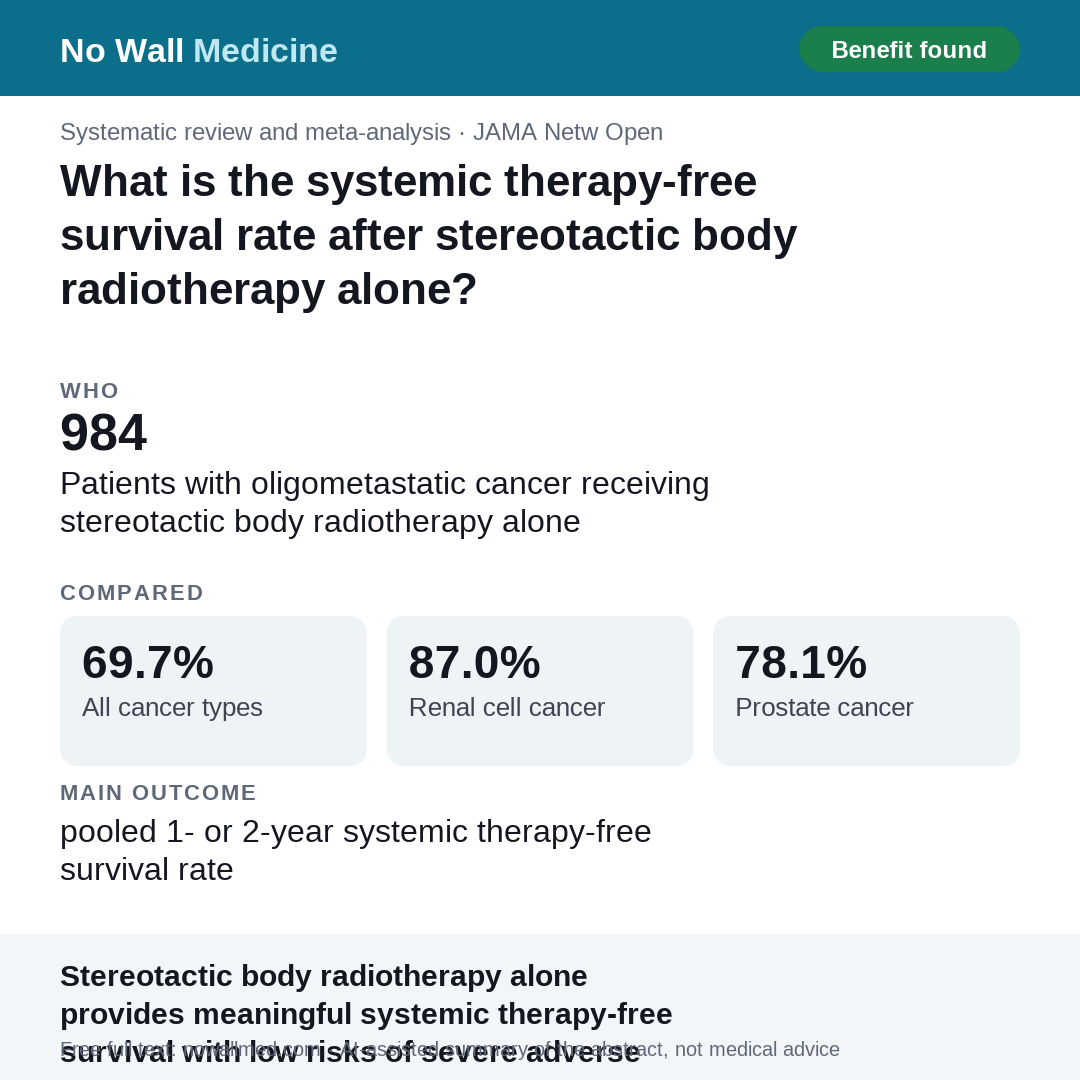
Stereotactic Body Radiotherapy Without Systemic Therapy for Oligometastatic Cancer: A Systematic Review and Meta-Analysis
Systematic review and meta-analysisBenefit found
What is the systemic therapy-free survival rate after stereotactic body radiotherapy alone?
Who
984
Patients with oligometastatic cancer receiving stereotactic body radiotherapy alone
Compared
69.7%All cancer types (95% CI, 57.4%-80.9%)
87.0%Renal cell cancer (95% CI, 76.2%-95.2%)
78.1%Prostate cancer (95% CI, 67.4%-87.3%)
Main outcome
pooled 1- or 2-year systemic therapy-free survival rate
Result: 69.7% (95% CI, 57.4%-80.9%)
Bottom line: Stereotactic body radiotherapy alone provides meaningful systemic therapy-free survival with low risks of severe adverse events.
JAMA Netw Open · 2025-12-01Download image
Diagnostic Accuracy of Severe Acute Respiratory Infection Definitions in Hospitalized Children: A Systematic Review and Meta-Analysis
Systematic review and meta-analysisHarm found
How accurate are severe acute respiratory infection definitions for detecting viral infections in hospitalized children?
Who
Hospitalized children with viral respiratory tract infections · 65 inpatient sites across 8 countries
Compared
WHO 2014 SARI definition for influenza: sensitivity 75.7% (95% CI, 65.0%-83.9%); specificity 30.6% (95% CI, 19.8%-44.0%)
WHO 2014 SARI definition for respiratory syncytial virus: sensitivity 70.6% (95% CI, 56.9%-81.9%); specificity 38.7% (95% CI, 25.7%-53.5%)
Main outcome
Sensitivity and specificity of case definitions
Bottom line: The WHO 2014 SARI definition may underestimate pediatric disease burden due to reduced sensitivity in younger cohorts.
JAMA Netw Open · 2025-12-01Download image

Cue-Elicited Brain Activity and Treatment Outcomes in Substance Use Disorders: A Meta-Analysis
Meta-analysisBenefit found
Is cue-elicited brain activity associated with substance use disorder treatment outcomes?
Who
1787
Adults undergoing substance use disorder treatment
Compared
Predictive biomarker regions: lower baseline cue reactivity associated with better treatment outcomes
Response biomarker regions: significant reductions in cue reactivity
Main outcome
functional magnetic resonance imaging-based cue reactivity
Bottom line: Specific brain regions like the insula may serve as predictive and response biomarkers for substance use disorder treatment.
JAMA Netw Open · 2025-12-01Download image

Flying blind? Recommendations for monitoring of 10 common chronic diseases in guidelines from Germany, England, and Europe - a modified systematic review
Modified systematic reviewMixed results
What is the detail and evidence level of monitoring recommendations in clinical practice guidelines?
Who
Guidelines for 10 common chronic diseases · Germany, England, and Europe
Compared
Monitoring frequency detail: low level of detail in 34.4% of cases
Monitoring parameters detail: low level of detail in 25.2% of cases
Monitoring consequences detail: low level of detail in 84.7% of cases
Main outcome
Level of detail and level of evidence in monitoring recommendations
Bottom line: Monitoring recommendations often lack detail and high-quality evidence, potentially causing medical underuse, overuse, and unnecessary diagnostic cascades.
Limitation: Overcoming systemic barriers is essential to enable the generation of high-quality evidence on monitoring.
BMC Med · 2025-12-01Download image

Enhancing Interpretability of Patient-Reported Outcomes Measurement Information System (PROMIS) and Related Measures in Rehabilitation Populations: A Systematic Review of Clinical and Research Applications
Systematic reviewMixed results
What are the interpretability metrics for PROMIS and related measures in rehabilitation populations?
Who
202
Rehabilitation populations using PROMIS, Neuro-QoL, TBI-QoL, or SCI-QoL · Electronic databases and clinical trial registries
Compared
PROMIS mental health domains: relatively consistent estimates
PROMIS physical function domains: more variable
Main outcome
Interpretability metrics including minimal important change, difference, and detectable change
Bottom line: Interpretability metrics varied widely across populations, with mental health domains being more consistent than physical function domains.
Limitation: Limited data were available for Spinal Cord Injury Quality of Life and Traumatic Brain Injury Quality of Life.
Arch Phys Med Rehabil · 2025-12-01Download image